
Why did God tell Israel to walk around Jericho for seven days instead of attacking it like an ordinary city? I want to understand that command in light of what happened before the march. Joshua records Israel renewing the covenant and meeting the Commander of the LORD’s army. Starting there helps us understand Jericho without turning it into a formula for overcoming any obstacle we decide to call a wall.
Covenant Preparation Before Jericho
Jericho was the first fortified city Israel confronted after crossing the Jordan into Canaan. Yet Joshua did not lead the people straight from the river into a siege. At Gilgal, the males born during the forty wilderness years were circumcised because that covenant sign had not been given to them during the journey. God said the reproach of Egypt had been rolled away.
Israel then kept Passover, remembering that the LORD had redeemed their people from Egypt before they possessed strength or land of their own. Afterward, they began eating Canaan’s produce, and the manna ceased. Before taking military action, this new generation worshiped God and remembered who they were as His people. They entered the campaign because He had already shown them grace and made a promise to Abraham. They were not an army inventing its own right to the land.
If I reduce Jericho to a lesson about personal breakthroughs, I miss why Israel was there in the first place. They were not trying out a seven-day technique. God was fulfilling a particular covenant promise while bringing a particular city under judgment, and the command must first be understood within those events.
Jericho stood in the Jordan Valley near the oasis associated with Tell es-Sultan, making it a gateway toward the central hill country. Its people feared Israel and had securely closed the city. Forty years earlier, Israel’s wilderness generation had feared Canaan’s fortified cities too. Recognizing the enemy’s strength was not their failure. They refused to believe the God who had promised them the land. Joshua’s generation now faced a real fortification, but God’s plan would leave them no reason to boast in ordinary siege methods.
Remembering the covenant did not make Jericho’s walls disappear. The older generation had died because they refused to trust God in the face of strong cities, and their children still had to face that danger. The difference was not a willingness to deny it. Joshua’s generation had remembered their Redeemer and renewed the covenant sign He gave them, preparing to face the city as His people.
Rahab Believes and Joshua Meets the Commander
And as soon as we heard these things, our hearts melted; neither did there remain any more courage in anyone because of you, for the LORD your God, He is God in heaven above and on earth beneath.
Rahab heard the same reports that frightened the rest of Jericho. They all knew what had happened at the Red Sea and had heard about Israel’s victories over Sihon and Og. But Rahab did more than fear the approaching people. She confessed that the LORD is God in heaven and on earth, then acted on that belief by protecting the spies and asking for mercy for her household.
I notice that Hebrews and James both describe what Rahab did because she believed. Fear alone did not rescue her. She received the messengers in peace and hid them before sending them away safely. Then she placed the agreed cord in her window and gathered her family inside. Her actions did not purchase grace; they showed that she trusted the promise and had given her allegiance to the God she confessed.
The cord identified Rahab’s house for Israel’s soldiers. Its scarlet color may remind us of Passover blood or later salvation imagery, but Joshua never identifies it as an atonement type. I don’t need to make that additional claim to appreciate what Rahab did. She believed the word given to her and displayed the identifying sign, staying in the house where protection had been promised.
Rahab’s rescue helps me understand the judgment on Jericho. She was a Canaanite inside the condemned city, yet she was spared and received into Israel. She even appears later in Messiah’s genealogy. Calling the conquest a cleansing of a genetic race cannot account for this Canaanite believer being welcomed among God’s covenant people. God judged mature wickedness and showed mercy to an outsider who turned to Him.
Nor does Joshua identify Jericho as a city of giants. Anakim lived elsewhere in Canaan, and Joshua later drove them from the hill country. The frightened spies made broad claims in the evil report recorded in Numbers 13, but those claims do not establish giant ancestry in every Canaanite city. The reason for judgment was moral, not a matter of unusual body size.
Genesis 15:16 explains why God delayed Abraham’s descendants from entering the land: Amorite iniquity was not yet complete. Generations passed before judgment came. Leviticus 18 describes the nations’ sexual corruption and idolatry, and condemns their child sacrifice. By the time Israel arrived, Jericho had heard what the LORD had done and shut its gates in resistance. Rahab responded to the same reports with faith. That contrast concerns how people responded to God, not which bloodline they belonged to.
Joshua 6 describes a city securely shut, with no one going out or coming in. Its people were guarding against an army they had already heard about, not being surprised by an unknown threat. Rahab had explained that the reports made their hearts melt. Behind those walls, the city had resolved to resist the God whose acts it knew.
Before receiving the instructions for the march, Joshua met a man standing with a drawn sword. He asked whether the man was for Israel or for its enemies and received this answer: “No, but as Commander of the army of the LORD I have now come.” Joshua’s question assumed a choice between the two sides. The answer required him to recognize who was in command and place himself under God.
Then the Commander of the LORD’s army said to Joshua, “Take your sandal off your foot, for the place where you stand is holy.” And Joshua did so.
Joshua fell on his face and worshiped, then was told to remove his sandal because the ground was holy. That command recalls Moses at the burning bush. Ordinary angels refuse worship, and their presence as created beings does not make the ground holy. Those details identify this Commander as a Christophany, an appearance of the preincarnate Son.
Joshua was the appointed human commander of Israel, but this encounter shows us that the eternal Son ruled the LORD’s army. I need to keep that authority in view as I read what happened to Jericho. The city fell under His command, not because Israel devised an ingenious way to capture it. God alone had the right to order that judgment; no human leader’s private will could authorize it.
Seven Days Around a Closed City
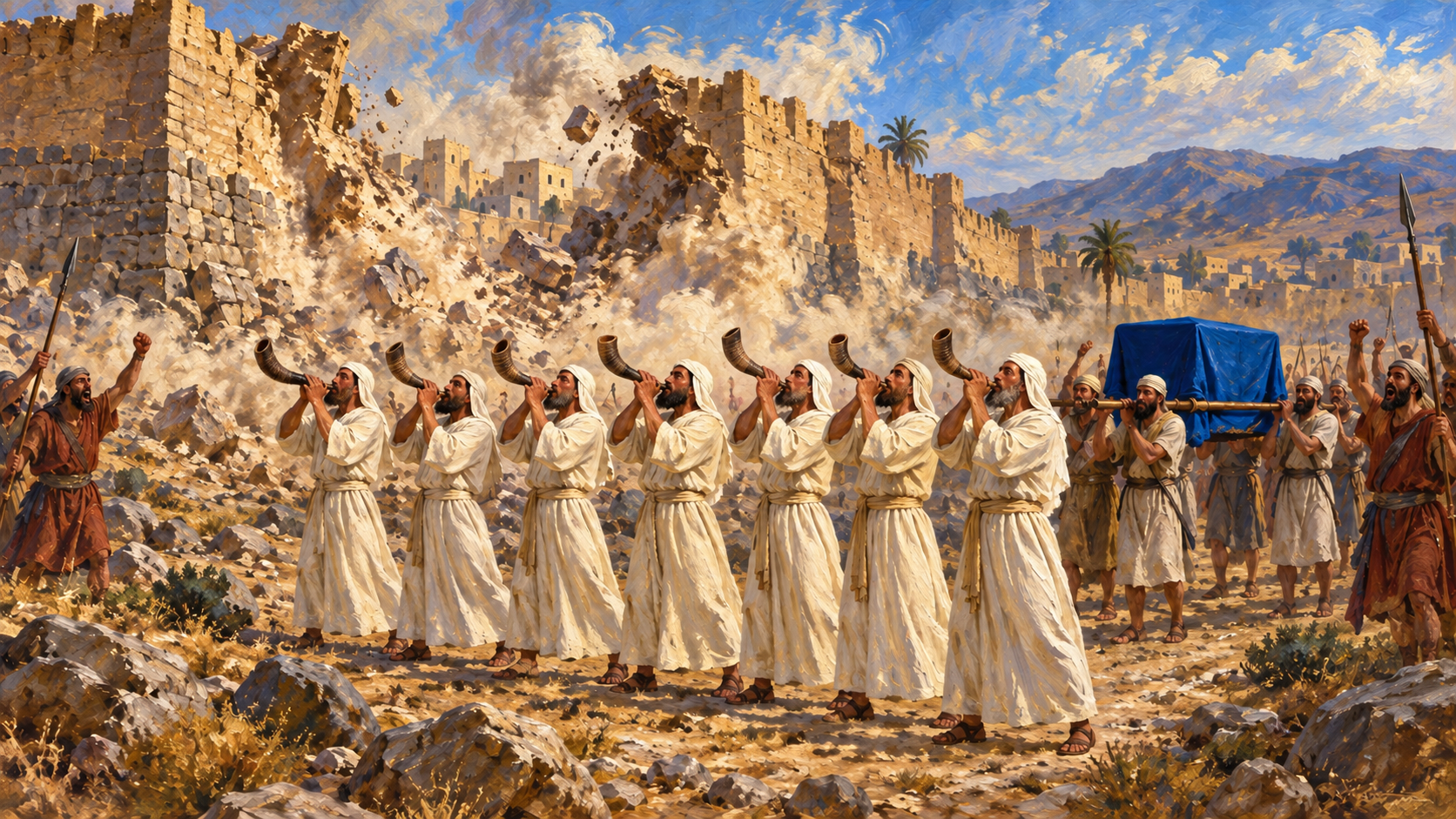
You shall march around the city, all you men of war; you shall go all around the city once. This you shall do six days. And seven priests shall bear seven trumpets of rams’ horns before the ark. But the seventh day you shall march around the city seven times, and the priests shall blow the trumpets.
God specified the order of the procession. Armed men led the way, with seven priests carrying seven ram’s-horn trumpets behind them. The ark followed the priests, and a rear guard came behind it. Israel circled the city once on each of the first six days. On the seventh day, they made seven circuits before the priests sounded the long blast and Joshua commanded the people to shout.
The repeated seven marks the completeness of what God ordered, without giving us an unlimited chart of numerical meanings. The people built no siege ramp and attacked no gate. Instead, they walked past the same closed wall day after day, seeing no change at the end of each of the first six days. I notice that God required a whole week of obedience before anything happened to the wall.
Before Israel made the first circuit, the LORD said, “See! I have given Jericho into your hand.” They could obey a command that looked foolish by ordinary military standards because God had already told them the outcome. His promise gave them a reason to obey, rather than a reason to think obedience no longer mattered.
The ark in the procession represented the covenant throne and the LORD’s presence among His people. It was not a weapon with magical power. Israel later treated it that way in 1 Samuel 4, but possessing the object did not rescue the disobedient nation. I would miss the point here if I gave the ark credit for what the LORD did.
While the priests sounded ram’s horns, the people kept silent. The Hebrew language associated those horns with proclamation and sacred assembly rather than a musical battle performance. Silence restrained panic and boasting, keeping the people from complaining their way into a different plan or improvising as they marched. Even the final shout had to wait for God’s stated moment. The wall did not fall because human sound waves could break masonry.
The Wall Falls and a Unique Judgment Follows
So the people shouted when the priests blew the trumpets. And it happened when the people heard the sound of the trumpet, and the people shouted with a great shout, that the wall fell down flat. Then the people went up into the city, every man straight before him, and they took the city.
Joshua connects the trumpet and obedient shout with the wall’s fall, after which the soldiers went straight up and captured the city. Hebrews 11:30 says the walls fell by faith after Israel had circled them for seven days. I understand their faith as reliance on the God who had promised and commanded, not an invisible force they used to push bricks.
We are not told how God caused the wall to fall. He could have acted without any secondary process or governed a natural event at precisely the appointed moment. An earthquake is a possibility, but Scripture neither identifies one as the cause nor rules out His using one. What it does reveal is His power and faithfulness.
The words “fell down flat” describe a collapse that allowed the soldiers to go straight before them into the city. They don’t require us to imagine every inch of every building disappearing into a perfectly level surface. Rahab’s house and those gathered there still had to be identifiable for rescue. I need to read the description alongside that part of the account too.
What followed troubles thoughtful readers, and I do not think we honor Scripture by softening it. Joshua records judgment on men and women, including the young and old. This was a unique judgment in earthly history, commanded directly by the Creator and Judge in fulfillment of a named covenant. It came after generations of divine patience. Modern armies have no permission to copy Israel’s action.
That does not mean every resident had committed the same acts or bore the same degree of personal guilt. God alone knows each heart and judges every person rightly. Because He gives human life, it belongs to Him, and He has authority to bring earthly life to an end. I cannot take His authority as permission for an individual or a church to imitate Joshua on private initiative.
The church’s calling is to proclaim the gospel and pray, not wage a holy war. We are to serve even when that brings suffering and continue loving our enemies. Jericho’s judgment was God’s to command. It does not authorize religious violence by those who claim His name.
We see God’s impartiality in the mercy Rahab received when she trusted Him and in the Gibeonites’ later survival. Israel itself eventually suffered exile and destruction after practicing the nations’ sins. Belonging to Israel did not protect rebellion any more than Canaanite birth prevented mercy. God’s patience is vast, but Jericho warns us against assuming He will never judge. Every person will answer to Him.
That warning calls me to repent before the Judge and trust the mercy He provides. It would lose its meaning if I turned it into a slogan about conquering personal inconveniences. Israel had not chosen a goal and then declared it God’s promise. Neither repeated phrases nor personal confidence brought down the wall. God judged Jericho in fulfillment of His own word.
Devoted Things, Mercy, and God’s Word Fulfilled
But all the silver and gold, and vessels of bronze and iron, are consecrated to the LORD; they shall come into the treasury of the LORD.”
The Hebrew term herem, written חֵרֶם, describes something placed under the ban or irrevocably devoted. The context shows us what happened to the devoted things: Jericho’s living inhabitants came under destruction, while durable metals entered the LORD’s treasury. Understanding the word in that setting helps explain why Israel could not take the first captured city’s possessions as private plunder.
Jericho’s wealth therefore functioned like firstfruits as Israel entered Canaan. The valuables belonged to God, who had given them the land and the victory. In Joshua 7, Achan took devoted items and hid them, bringing judgment within Israel through his secret theft. I see the same principle at work on both sides of the city’s walls: belonging to the covenant people did not shelter disobedience.
And Joshua spared Rahab the harlot, her father’s household, and all that she had. So she dwells in Israel to this day, because she hid the messengers whom Joshua sent to spy out Jericho.
The spies who had made the oath brought Rahab out with her relatives and possessions. Her family was initially placed outside Israel’s camp, which may have reflected the rules for purity. Rahab afterward lived within Israel. God’s mercy brought her into a new community instead of leaving her beside the ruins of the city.
Hebrews 11 places Rahab’s faith beside Israel’s faith at the walls, and James 2 points to her actions as evidence that her faith was alive. I don’t read either writer as saying she earned salvation by her deeds. Trusting God changed whom she protected and where she stood. Matthew later includes this Gentile woman from a condemned city in Jesus’ genealogy.
Ancient Jericho is commonly associated with Tell es-Sultan. A tell is a mound that forms when communities repeatedly occupy the same place. As buildings are destroyed and rebuilt, layers accumulate, and archaeologists call the study of their sequence stratigraphy. UNESCO’s documentation describes twenty-nine phases of occupation there, reaching back to very early settlement. Fortifications from several ancient periods confirm how old Jericho is and how important it was as a fortified center.
Excavators and later interpreters disagree about dates and the sequence of pottery. They also disagree about which events account for particular destruction layers. They work with incomplete remains from only part of a site and must fit those remains into a proposed chronology. I can learn from that evidence about the landscape and the city’s history without giving it authority to judge inspired Scripture.
I would be careful about both sensational proof and quick disbelief. A collapsed wall does not establish every detail of Joshua 6, just as a disputed dating system does not disprove an event God recorded. Jericho was destroyed and rebuilt many times, so we cannot identify every destruction layer with the biblical event. Faith can acknowledge the complexity of the evidence while receiving Joshua’s testimony as final authority.
Joshua later pronounced that anyone who defiantly rebuilt Jericho would lay its foundation with his firstborn and set up its gates with his youngest. In 1 Kings 16:34, Hiel the Bethelite rebuilt it during Ahab’s reign. Abiram died when the foundation was laid, and Segub died when the gates were set up. Centuries had passed, but the LORD’s word through Joshua was fulfilled exactly.
God’s word was fulfilled when Israel obeyed Joshua and Jericho was destroyed. Centuries later, the rebuilding brought the consequence Joshua had named. That long interval makes me consider how easily time can dull attention to a warning. A project does not become safe because generations have passed and a culture has forgotten what God said.
Hebrews says the walls fell by faith, and James says Rahab’s faith worked. Israel marched in response to God’s command, while Rahab protected the spies because she believed He had given Israel the land. In both cases, faith answered a word God had actually spoken. That is different from inventing a private promise and insisting that God remove whatever I call a wall. Some obstacles should remain, and some hardships require endurance rather than removal.
Jericho brings us to our own need for mercy before judgment. Our only Savior is Jesus, the eternal Son who is fully God and fully man. He was born of a virgin and lived without sin. Wicked men physically tortured and punished Him, putting Him to death. He willingly bore that real punishment for our sins in His innocent body and shed His blood for us. After His death and burial, He rose bodily. The Father did not punish or curse Jesus, nor did He abandon, strike, or bruise Him. He did not pour wrath on His Son.
Christ died for the whole world, making God’s offer genuine even though people can resist or reject it. Whoever repents and believes is forgiven and justified, receiving new life through the new birth. The Holy Spirit comes to dwell within and seal the believer, so everyone who genuinely believes is eternally secure. That security does not permit lawlessness, and a superficial profession does not prove that someone has been born again.
Three related studies develop parts of this history. Rahab and the Scarlet Cord follows Rahab’s confession, the covenant sign, her rescue, living faith, and place in Messiah’s line. The Land of Canaan examines the covenant promise, the peoples and boundaries of the land, judgment, and future restoration. Nephilim Tribes distinguishes the named giant peoples from unsupported bloodline claims about every Canaanite city.
My Final Thoughts
I do not believe Jericho gives us a technique for making every obstacle disappear. Israel first submitted to the divine Commander and then obeyed the particular word God had given, while His power brought the wall down. Rahab’s rescue shows why we cannot explain the judgment as a matter of genetics, while the city’s destruction rules out the comforting assumption that God will never judge evil. Mercy was available within that condemned city to the person who trusted the LORD. I need to hear the warning as well as the invitation: mercy is found in Christ, and faith obeys what God has actually spoken.