
The Old Testament names several peoples known for their extraordinary size, and it can be difficult to tell how they were related. Were the Nephilim, Anakim, Rephaim, and every unusually large warrior part of one family tree? Scripture gives us some connections, but I do not want to fill in the missing generations as though the Bible had named them.
The Names and Limits Scripture Gives
The Nephilim appear by name in only two passages. The first is Genesis 6, before the Flood:
There were giants on the earth in those days, and also afterward, when the sons of God came in to the daughters of men and they bore children to them.
Those were the mighty men who were of old, men of renown.
Genesis places the Nephilim in the setting where the sons of God took the daughters of men and produced mighty men of renown. I understand these sons of God to be rebellious heavenly beings. The Old Testament’s use of that phrase, together with the angelic rebellion described later in Jude and 2 Peter, leads me to that conclusion. Genesis does not explain how the event worked, however, and I cannot supply an explanation it never gives.
The words “and also afterward” prepare us to encounter giant language again without explaining how any post-Flood people were related to the earlier Nephilim. Scripture never says that a Nephilim survived the Flood or identifies anyone aboard the ark as carrying that lineage. It also does not describe a second angelic event after the Flood. When the name reappears in the spies’ report, Moses leaves the connection unexplained.
The Hebrew name Nephilim, written נְפִלִים, is rare, and its derivation is disputed. The NKJV translates it as “giants,” which fits both settings. Some connect it with “fallen ones,” but that possible relationship is not a settled dictionary definition. I need to understand the word through the passages where God used it before asking it to support a doctrine.
The other names give us more definite relationships. The Anakim descended from Anak, while Rephaim identifies an ancient people in the historical passages and may serve as a broader designation. The Moabites called the former inhabitants of their land Emim, and the Ammonites called theirs Zamzummim. Both groups were regarded as Rephaim, and Og was a Rephaite king. Goliath and other unusually large warriors appeared much later in Gath. These connections help us place the peoples without making every name interchangeable.
Leaving those gaps in the genealogy does not make the accounts less historical. Scripture locates these peoples in named cities and territories, identifies ancestors and kings, and follows them through actual battles. It even tells us where some remnants survived and describes Goliath’s weapons and armor. Israel faced real opponents of extraordinary stature. I can take that history seriously without relying on sensational measurements or secret-bloodline theories; the lesson rests on what God actually recorded.
We also need to read Rephaim, written רְפָאִים, in context. In Genesis and Deuteronomy, the name belongs to living peoples with their own territories and kings who fought actual battles. The same Hebrew consonants appear in poetry about the departed dead or shades. That shared spelling does not make the meanings identical. If I import the poetic meaning into Deuteronomy, I turn living nations into something the passage never describes.
Genesis 14 names the Rephaim among the peoples defeated by eastern kings at Ashteroth Karnaim. Deuteronomy then explains how the Moabites classified the Emim and the Ammonites classified the Zamzummim. The phrase “regarded as Rephaim” gives me a relationship to work with without tracing generations of ancestry. Rephaim can be the broader designation while Emim and Zamzummim are local names. We have enough to follow his geography, but not to draw a secret bloodline chart.
The Spies, the Anakim, and the Peoples East of Israel
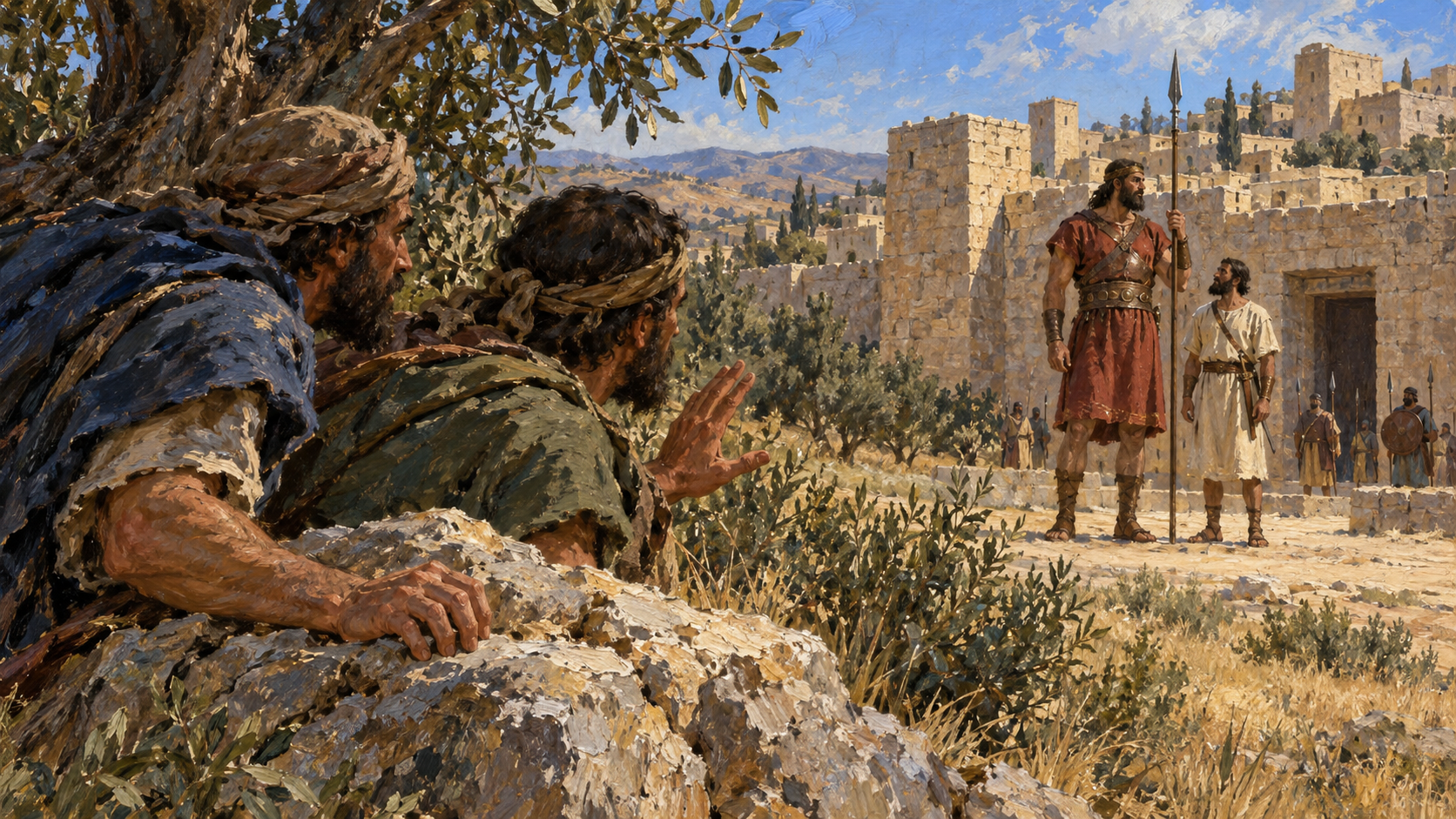
The second appearance of the Nephilim name comes when the spies return from Canaan. Numbers first calls their report bad and then records their words:
And they gave the children of Israel a bad report of the land which they had spied out, saying, “The land through which we have gone as spies is a land that devours its inhabitants,
and all the people whom we saw in it are men of great stature.
There we saw the giants (the descendants of Anak came from the giants);
and we were like grasshoppers in our own sight, and so we were in their sight.”
Scripture accurately preserves the spies’ words, including their claim that the descendants of Anak came from the Nephilim. I cannot simply dismiss that connection when it is recorded in the inspired text. But I also need to hear it in the setting Moses gives us: these men were using their report to frighten Israel.
Other passages confirm that the Anakim were unusually tall and formidable, so the spies had not invented the fortified cities or the people’s strength. Their grasshopper comparison, however, expressed fear rather than a measurement. They even claimed to know how their enemies saw them, although they could not read those men’s minds. Noticing the danger was not their sin. They magnified genuine evidence through fear and used it to insist that Israel could not obey the God who had already redeemed them from Egypt.
The spies may have used the ancient Nephilim name because the Anakim really were connected to them, or because their size and reputation recalled those ancient mighty men. Those possibilities may overlap. Since Moses does not explain the mechanism, I would be claiming more than he tells us if I treated either explanation as certain.
The Anakim themselves do have a named ancestry. They descended from Anak, whose father Arba is also called the greatest man among the Anakim. Kiriath Arba later became Hebron. Moses described the Anakim as a great and tall people and recorded the proverb, “Who can stand before the descendants of Anak?” Their reputation was real, but Israel’s failure at Kadesh Barnea came from treating their strength as more decisive than the LORD’s promise.
Joshua and Caleb did not have to deny what the spies had seen. Their answer was that if the LORD delighted in Israel, He would bring the nation into the land. The enemy’s strength was part of the test, but God had already spoken. That challenges the way I weigh intimidating evidence: pointing to a real obstacle cannot make unbelief wise when it contradicts His promise.
Anakim names a particular people, not every tall person in Canaan. Scripture places them especially in the hill country, where Caleb later drove Sheshai, Ahiman, and Talmai from Hebron. Joshua’s campaign left remnants in Gaza, Ashdod, and Gath. Gath helps me connect this earlier history with the later appearances of Goliath and other unusually large warriors there.
Deuteronomy also looks east of the land Israel was about to enter. It describes the people who had lived in Moab before the Moabites:
(The Emim had dwelt there in times past, a people as great and numerous and tall as the Anakim.
They were also regarded as giants, like the Anakim, but the Moabites call them Emim.
The Horites formerly dwelt in Seir, but the descendants of Esau dispossessed them and destroyed them from before them, and dwelt in their place, just as Israel did to the land of their possession which the LORD gave them.)
The Emim were a great and numerous people whose height was comparable to the Anakim. Moab regarded them as Rephaim, though that classification does not make the Emim and Anakim the same tribe. Their displacement was not part of Israel’s conquest. God had already allowed Moab to possess their territory.
The former inhabitants of Ammon’s land were called Zamzummim, and their history followed the same pattern. They were a great and numerous people, tall like the Anakim, whom the Ammonites regarded as Rephaim. The LORD destroyed them before the Ammonites settled there. Both this event and Moab’s earlier possession took place outside Israel’s conquest. These histories help me see why Moses did not reassure Israel by promising weak opponents. God had already displaced nations that appeared immovable.
Moses also recalled how Esau’s descendants dispossessed the Horites in Seir. As Israel approached Canaan, these histories showed that the LORD’s authority extended beyond Israel’s borders. A great people could not put its territory beyond His rule. Israel still had to obey the command given specifically to them, but the land ahead was not beyond the authority God had already displayed.
Some popular explanations connect Zamzummim with murmuring or buzzing, then use those proposed meanings to build claims about sinister rituals. Scripture gives no such doctrinal explanation. It describes imposing people in a known territory whom God allowed another nation to displace. I can learn from His authority in that history without inventing answers to every question the name raises.
Og, Goliath, and the Warriors from Gath
Og ruled Bashan and remained from the Rephaim. Israel defeated him at Edrei and took his fortified cities. Moses points to an iron bed kept in Rabbah of the Ammonites that measured nine cubits long and four cubits wide according to the common cubit. If we use an eighteen-inch estimate, that is near thirteen and one-half feet by six feet, though ancient cubit values varied.
A cubit was based roughly on the distance from the elbow to the tip of the middle finger, but ancient communities did not all use the same standard. That makes any modern conversion approximate. The more basic distinction is that the verse measures Og’s bed, not Og himself. Beds are longer than their occupants, and this object may have been a royal couch or memorial. I can recognize it as evidence of an extraordinary king without claiming that the verse gives him a standing height of twelve feet or more.
Og’s fearsome reputation and fortified cities help us understand the victory Moses describes. Neither his size nor his defenses could cancel God’s promise. Israel did not have to be naturally larger or stronger than the people of Bashan to be secure in what the LORD had said.
I do not want to dismiss the bed’s dimensions, but I also do not want them to eclipse the victory. A large object can help us understand scale without measuring its owner’s height. Moses pointed to something his readers could recognize, then brought their attention back to the God who delivered Bashan into Israel’s hand.
The word Amorite can name a broad Canaanite people or refer more generally to inhabitants of the land. Og ruled an Amorite kingdom, but that does not make every Amorite a Rephaite or a giant. Amos compared the Amorite before Israel to the height of cedars and the strength of oaks. I read that as a comparison magnifying the enemy God removed, not as a claim that men reached the tops of trees. It cannot supply a biological profile or a precise height.
Goliath gives us more direct measurements:
And a champion went out from the camp of the Philistines, named Goliath, from Gath, whose height was six cubits and a span.
He had a bronze helmet on his head, and he was armed with a coat of mail, and the weight of the coat was five thousand shekels of bronze.
And he had bronze armor on his legs and a bronze javelin between his shoulders. Now the staff of his spear was like a weaver’s beam, and his iron spearhead weighed six hundred shekels; and a shield-bearer went before him.
The Masoretic Text gives Goliath’s height as six cubits and a span, commonly estimated at more than nine feet. The exact conversion depends on the cubit used, while a span was roughly the distance across an outstretched hand. A shekel in this passage measures weight, not the value of a modern coin. The recorded weights of his armor and spearhead show equipment made for an extraordinary champion, but those ancient units cannot support extremely precise modern measurements.
Goliath came from Gath, one of the Philistine cities where Anakim remained after Joshua’s campaign. Scripture gives us that geographic connection, and it helps explain why later accounts again concentrate unusually large warriors there:
Yet again there was war at Gath, where there was a man of great stature, who had six fingers on each hand and six toes on each foot, twenty-four in number; and he also was born to the giant.
So when he defied Israel, Jonathan the son of Shimea, David’s brother, killed him.
These four were born to the giant in Gath, and fell by the hand of David and by the hand of his servants.
The man with six fingers on each hand and six toes on each foot had an unusual condition called polydactyly. Scripture records it without explaining its cause or saying it was common in a giant bloodline. The passage also says that four warriors were born to “the giant,” or Rapha, in Gath. That does not make all four sons of Goliath. In the received account, the warrior Elhanan killed is identified with Goliath’s brother, while the group as a whole belongs to the giant line of Gath.
David’s servants shared in these later victories; he did not kill every champion himself. That widens the lesson for me beyond his famous encounter in the valley of Elah. God repeatedly brought down proud intimidation through faithful men serving under the king.
We can believe the unusual details without filling every silence around them. Scripture says one warrior had twenty-four digits, and Joshua names Gath as a place where Anakim survived. Both observations belong in our understanding of these people. The unusual anatomy does not prove a trait shared by every giant, and the location does not give us a complete genealogy.
The Conquest Was Judgment, Not Genetic Cleansing
Joshua’s campaign removed the Anakim from Israel’s hill country:
And at that time Joshua came and cut off the Anakim from the mountains: from Hebron, from Debir, from Anab, from all the mountains of Judah, and from all the mountains of Israel; Joshua utterly destroyed them with their cities.
None of the Anakim were left in the land of the children of Israel; they remained only in Gaza, in Gath, and in Ashdod.
Joshua’s campaign fulfilled God’s covenant promise and carried out His judgment on Canaanite wickedness that had reached its full measure. Genesis had already shown His patience across centuries while the iniquity of the Amorites was not yet complete. Israel received this unique command by direct revelation. It gave them no continuing permission to attack neighboring nations whenever they wished, or to attack people simply because they were tall or came from an unusual family.
Rahab’s place in Israel helps me see why the conquest cannot be explained as racial or genetic cleansing. She responded in faith and was incorporated into the nation, while the Gibeonites sought terms and were spared. Later, Israel itself was removed from the land for practicing the same abominations God had judged in Canaan. Those outcomes point to moral rebellion under God’s covenant judgment, not a secret DNA test.
Decades after the unbelieving report, Caleb asked for the hill country where Anakim remained. He knew the cities were strong and did not imagine that their occupants had become harmless. He trusted the LORD to be with him and keep the promise already given. Caleb makes me consider whether I mistake an honest assessment of difficulty for a reason not to obey. Biblical courage can see the obstacle clearly and still trust God.
The same attention to what Scripture actually says leads me to reject several common claims. A disputed connection between Nephilim and “fallen ones” cannot carry a complete doctrine with certainty. Og’s bed cannot tell us his standing height, and Scripture does not give a single post-Flood genealogy for every large person. Recasting the conquest as an attempt to erase a hybrid race goes further still. It replaces the covenant judgment described in the text with a genetic theory the text never gives.
Faith Refuses to Make the Enemy Larger Than God
Ten spies judged the land by the size of its inhabitants until they saw themselves as grasshoppers. Joshua and Caleb faced the same enemies, yet understood that rebellion against the LORD posed the greater danger. Their answer to fear was His presence, not a genetic argument. Across these accounts, visible strength never displaced God’s promise as the reason to obey.
David heard Goliath defy the armies of the living God and remembered God’s past deliverance. He did not need to pretend that the champion was small or that his armor and spear were imaginary. David refused to let Goliath’s mockery define the conflict because he trusted God’s name and covenant faithfulness. Israel’s soldiers had training and weapons, yet fear controlled them. David’s confidence rested in God rather than himself, and his ordinary sling became an instrument in the hand of a faithful servant.
We should not describe every struggle as a “Nephilim spirit” or search for hidden giant ancestry. Spiritual warfare is real, but the New Testament directs us toward what God has revealed. God tells us how to stand through truth and the righteousness He provides. The gospel of peace makes us ready, while faith and the assurance of salvation guard us. His Word guides us, and prayer keeps us dependent on Him. I need to attend to that revealed instruction rather than let fascination with secret lineages take the place of faithful obedience.
Jesus Christ is Lord over every visible and invisible power. Wicked men physically tortured and punished Him before killing Him, and He willingly bore that real punishment for our sins in His innocent body. He shed His blood and died, was buried, and rose bodily from the grave. The Father did not punish or curse Jesus, nor did He abandon Him or pour wrath upon Him. He did not strike or bruise His Son. No ancient warrior or unseen power could prevent the victory His resurrection announces.
Christ died for the whole world, and His offer of salvation is genuine even though people can resist it. We need to respond to the risen Lord in repentance and faith, not become absorbed in bloodlines. Everyone who truly believes is forgiven and justified, receiving new life through the new birth. The Holy Spirit dwells within that believer and seals him, so his salvation is eternally secure. That security never excuses lawlessness, and a superficial profession is no proof that someone has truly been born again.
Three related studies take up questions beyond the narrow purpose of this article. Giants in the Bible examines Genesis 6, the sons of God, Canaan’s giants, and the response of faith across Scripture. A Biblical Examination of the Book of Enoch separates canonical revelation from later stories about Watchers, giant spirits, and hidden knowledge. A Complete Bible Study on Angels follows what Scripture teaches about holy angels, rebellion, service, and judgment.
My Final Thoughts
I can affirm the reality of these formidable peoples without pretending that God gave us a complete post-Flood family tree. Scripture tells us where they lived and identifies known relationships, while leaving the mechanism behind the later Nephilim name unexplained. What it does show is that no intimidating warrior stood outside the Lord’s authority or could cancel His promise. I want to take every revealed detail seriously and leave the hidden things in His hands where He has not spoken. That includes refusing to let an enemy become larger in my thinking than the Lord I trust.