
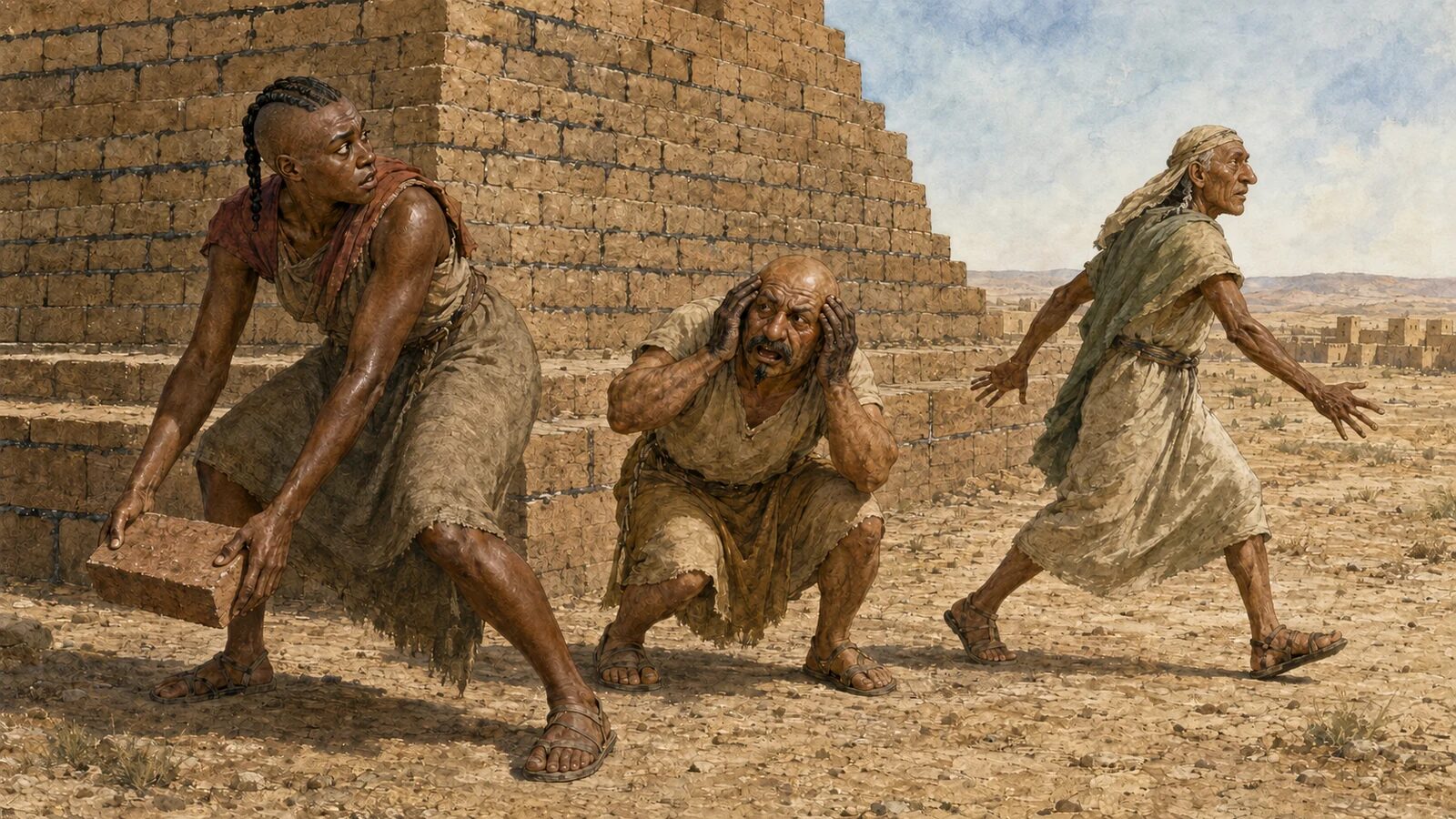
The builders at Babel tell us why they acted: they wanted a city centered on their own name, and they believed it would keep them from being scattered. Before deciding what the tower means, I want to follow Genesis 9-11 in order and keep every claim about Nimrod, the languages, and God’s judgment within what Scripture actually says. Their moral problem was not construction or cooperation by itself, but a shared refusal to obey the Creator, which keeps us from treating every large project as another Babel while still taking the builders’ pride seriously.
Genesis presents Babel as real history. The narrative identifies the region and tells us what materials the builders used. It also records their stated purpose before describing God’s response and the lasting result. At the same time, Scripture never gives the tower’s height or identifies its ruins. It does not describe the shape of the structure or tell us who supervised the work. A trustworthy study gives full weight to what Scripture says without turning a plausible reconstruction into inspired fact.
God Told Humanity to Fill the Earth
Genesis 11 comes after the worldwide Flood and the covenant God made with Noah. Noah’s family stepped into a renewed world, but the human heart had not been made sinless. God’s blessing included a clear direction: humanity was to multiply and fill the earth. The same Creator who told Adam and Eve to fill the earth repeated that purpose to the family through whom human life continued.
So God blessed Noah and his sons, and said to them: “Be fruitful and multiply, and fill the earth.
Filling the earth required families to spread beyond one protected center. Genesis 10 describes Noah’s descendants in relation to the lands where they eventually settled. It also distinguishes their languages and traces how their families became nations. The chapter is often called the Table of Nations because it follows the broad family lines that populated the post-Flood world. A reader may wonder why chapter 10 already mentions languages before chapter 11 says everyone had one language. Chapter 10 surveys the finished result; Genesis 11:1-9 then steps back to explain the event that produced that result.
This is a difference in focus, not a contradiction in chronology. Genesis often gives a broad record and then returns to explain one event in greater detail. Chapter 10 surveys the nations that resulted, and chapter 11 focuses on the turning point that divided their speech and scattered their settlements.
The narrative begins with one language and a shared vocabulary. As the people travel eastward, they find a plain in the land of Shinar and settle there. Shinar is the region associated with Babel. Erech and Accad are also located there, and the area later becomes identified with Babylon. The open plain gives the growing population room to establish an urban center.
Now the whole earth had one language and one speech. And it came to pass, as they journeyed from the east, that they found a plain in the land of Shinar, and they dwelt there. Then they said to one another, “Come, let us make bricks and bake them thoroughly.” They had brick for stone, and they had asphalt for mortar.
Genesis pays attention to the building materials. Where stone was less available, the people made bricks and fired them thoroughly. They used asphalt, which is also called bitumen, as mortar. These details fit construction in ancient Mesopotamia, but the passage does not present technical skill as evil. The people planned together and adapted their methods to the resources they found locally. Their cooperation produced durable construction. The moral problem lies in what they chose to build and why.
Some readers identify the tower as a ziggurat, a tall Mesopotamian religious structure built in receding levels. The comparison is possible because ziggurats belonged to the region and were built with mud brick cores and baked brick exteriors. Yet a comparison is not an identification. Genesis never uses that architectural term, gives no ground plan, and does not identify a surviving ruin. We can say that the tower fits the monumental building culture of Shinar without claiming that archaeology has located the biblical structure.
The builders explain their own motive. They want a city with a tower reaching into the heavens. Through it they hope to gain a celebrated name and protect themselves from being scattered. In plain terms, they want one center of power and identity under human control. They also resist God’s command to fill the earth. Their shared language helps them pursue the project quickly, but their deepest unity is moral: they agree about the future they want without submitting it to the Lord.
And they said, “Come, let us build ourselves a city, and a tower whose top is in the heavens; let us make a name for ourselves, lest we be scattered abroad over the face of the whole earth.”
Making a name can mean establishing a reputation that gives a people permanence and identity. The builders do not ask God to establish them. Instead, they use collective strength to manufacture significance for themselves. The city promises a sense of belonging, while the tower promises renown. Together the project promises control over a future in which they refuse to disperse.
Unity is not righteous merely because many people share it. Scripture values unity that is grounded in truth and expressed through love. It must also remain under obedience to God. Agreement can magnify evil when the shared purpose opposes Him. The people at Babel communicated well and cooperated effectively. They possessed technical ability and a compelling public vision. What they lacked was submission to the One who gave them life and land. Their intelligence and speech also came from Him.
The LORD Came Down and Scattered Them
The narrative turns with deliberate irony. Human beings announce a tower whose top reaches the heavens, yet the LORD must come down to see it. God is omniscient and does not need to travel for information. The language presents His judicial inspection in terms we can understand while showing how small the builders’ greatest work is before the Creator.
But the LORD came down to see the city and the tower which the sons of men had built. And the LORD said, “Indeed the people are one and they all have one language, and this is what they begin to do; now nothing that they propose to do will be withheld from them. Come, let Us go down and there confuse their language, that they may not understand one another’s speech.”
God does not confess fear that human beings might overpower Him. The statement about nothing being withheld describes the accelerating reach of unified rebellion. When a fallen society shares one language and a single purpose, centralized power can carry destructive plans much farther than scattered groups could. The Flood had already shown what the human heart becomes when evil spreads without restraint.
The plural “Let Us” agrees with the divine plurality already heard in Genesis 1:26. Scripture later reveals that the one God eternally exists as Father and Son together with the Holy Spirit. Genesis does not present a council of competing gods who combine their strength against humanity. The one LORD acts, and verse 8 uses a singular subject when He scatters the people.
The confusion of language directly stops the shared project. People who cannot understand one another can no longer coordinate the work or settle disputes. They also cannot govern one city as a single society. As communication breaks down, groups spread into different regions. God’s command to fill the earth is accomplished despite their resistance.
So the LORD scattered them abroad from there over the face of all the earth, and they ceased building the city. Therefore its name is called Babel, because there the LORD confused the language of all the earth; and from there the LORD scattered them abroad over the face of all the earth.
The Hebrew name is Bavel (בָּבֶל), the ordinary Old Testament name for Babel or Babylon. Genesis connects it with balal (בָּלַל), a verb meaning to mix or confuse. This is deliberate wordplay in the narrative. It is more accurate to say that Scripture explains Babel through the sound of a word connected with confusion than to say the place-name simply means confusion.
This judgment also restrains evil. God limits the scale of their immediate rebellion without destroying humanity in another flood. Different languages introduce real difficulty and often produce misunderstanding. They also separate people from one another. Yet this separation prevents one post-Flood regime from gathering everyone under the same defiant project. The scattering is severe mercy because it judges rebellion and limits its reach. Human life then continues under God’s covenant patience.
The city did not disappear from history. Babel became Babylon, a name later connected with empire and idolatry. Its rulers became known for conquest, and its wealth produced great luxury. Its history was also stained by persecution. The unfinished tower demonstrates that a project can appear permanent while already standing under God’s verdict. Human beings may build high, but they cannot secure their future against the Lord.
Ancient Mesopotamian writing could represent Babylon’s name with signs associated with a gate of the god or gods. That was Babylon’s own cultural language, not a meaning Genesis asks believers to accept. Genesis creates a deliberate contrast. The builders wanted a celebrated city reaching toward heaven, but the biblical account remembers the place through confused speech and forced scattering. Humanity advertised a gateway upward; the LORD came down to judge the project and expose its limits.
The tower’s top being “in the heavens” is ordinary monumental language for great height. Genesis does not say the builders believed masonry could physically enter God’s dwelling, though their project clearly expressed pride and a humanly controlled approach to security and fame.
What Scripture Actually Says About Nimrod
Genesis does not name an individual commissioner. The builders repeatedly speak as a group. They first decide to make bricks and then agree to build a city for themselves. Their stated purpose is to make their own name great. The account therefore places responsibility on the gathered society rather than on one ruler whose command excused everyone else.
Nimrod enters the discussion because Genesis 10 places Babel at the beginning of his kingdom. He was a son of Cush and therefore a descendant of Ham. Genesis also describes him as a mighty figure on the earth. The association between his kingdom and Babel makes it possible that he exercised authority there. It does not permit us to insert his name into Genesis 11. Scripture never identifies him as the architect or priest, nor does it call him the sole leader of the project.
Cush begot Nimrod; he began to be a mighty one on the earth. He was a mighty hunter before the LORD; therefore it is said, “Like Nimrod the mighty hunter before the LORD.” And the beginning of his kingdom was Babel, Erech, Accad, and Calneh, in the land of Shinar.
The phrase “before the LORD” can describe activity openly carried out in God’s sight. Some interpreters understand it as defiance, while others take it as a statement of exceptional ability known before God. The immediate wording does not add the phrase “against the LORD.” Nimrod’s kingdom later became associated with cities that opposed God, but careful teaching should not alter the verse to make an interpretation sound explicit.
Nimrod is the first person in Genesis whose kingdom is named in this way, so he represents the early concentration of political power. Even so, the sins named in Genesis 11 belong to the people who agreed together. A society can organize rebellion around a ruler, but it can also share guilt willingly. Genesis does not let the crowd disappear behind a famous name.
Scripture never calls Nimrod a Nephilim or a giant. It does not describe him as a hybrid or demonic offspring either. The argument usually begins with the Hebrew noun gibbor (גִּבּוֹר), translated “mighty one.” Genesis 6 uses the plural form for mighty men of old, while Genesis 10 uses the singular form for Nimrod. Shared vocabulary does not establish a shared bloodline.
The same word family describes ordinary human warriors and capable men throughout the Old Testament. It is used of Joshua’s mighty men and appears when Gideon is called a mighty man of valor. David’s warriors receive the same description, as do many other human figures. Depending on context, gibbor may describe recognized strength or military ability. It can also refer to prominence. The word is not a technical biological label for Nephilim.
Later traditions identify Nimrod with Gilgamesh or portray him as semi-divine. Some even speculate that a corrupted bloodline survived through a woman on the ark. Genesis provides no such genealogy. It directly names Cush as Nimrod’s father and gives no warning that his humanity was unusual. Gilgamesh belongs to a separate ancient literary tradition. Similarity in strength does not prove that two named figures were the same man. Neither do broad parallels in kingship or geography.
This is where I think we need to be restrained. Nimrod was a real and unusually powerful human ruler whose kingdom began with Babel. He may have led the tower project, but Genesis does not say so. He was not identified by Scripture as Nephilim, and readers should not turn later legend into biblical biography.
For that reason, repeating a tradition cannot turn it into inspired history. When Scripture leaves Nimrod’s exact role or ancestry unstated, I believe our confidence must stop at the boundary of the text.
One Human Family and a Better Name
Babel explains the diversity of language and the scattering of peoples, but it does not teach that different nations became different kinds of human beings. Everyone descends from Adam, while all post-Flood nations descend through Noah’s family. Language may distinguish one people from another, as can geography and culture. None of these differences changes the equal dignity every person receives as an image-bearer of God.
And He has made from one blood every nation of men to dwell on all the face of the earth, and has determined their preappointed times and the boundaries of their dwellings, so that they should seek the Lord, in the hope that they might grope for Him and find Him, though He is not far from each one of us;
Paul uses humanity’s common origin to confront idolatry in Athens. God rules both the times and the boundaries of nations. No culture can claim a separate creator or superior blood. Babel therefore gives no support to racism or ethnic pride. It cannot justify contempt for foreigners. The judgment divided human speech rather than human worth.
National boundaries can restrain centralized evil, yet no nation is automatically holy. Every people stands accountable to the same Creator, and every person needs the same Savior. Christ died for the whole world, so the church carries one gospel across every linguistic and cultural boundary.
Immediately after Babel’s genealogy, Genesis turns to Abram. The builders tried to make their own name while avoiding the scattering God commanded. In contrast, God called Abram to leave his country and kindred. The LORD promised to make Abram’s name great and to bless every family of the earth through him. I think this movement in Genesis is an important one that we should not overlook.
Babel gathers people around self-exaltation, whereas Abraham must leave when God calls. The builders try to secure a name through human achievement, but God freely gives Abraham a name as part of covenant promise. Babel seeks one protected society for itself, while God’s promise aims toward blessing for all families of the earth.
That promise reaches its saving fulfillment in Jesus Christ, the promised Seed. Redemption does not come through rebuilding Babel with religious language. God forms a people who trust His Son and receive His grace. They then carry His blessing to the nations. Their unity comes from truth and new birth rather than enforced conformity under a human empire.
Acts 2 provides a striking and beautiful contrast with Babel. Pentecost was the Jewish feast day on which the Holy Spirit came upon the gathered disciples after Jesus rose and returned to heaven. At Babel, one language served a proud project, so God confused human speech. At Pentecost, the Holy Spirit enabled Galilean believers to speak real languages they had never learned. Visitors from many nations then heard the wonderful works of God in the languages in which they were born.
And when this sound occurred, the multitude came together, and were confused, because everyone heard them speak in his own language. Then they were all amazed and marveled, saying to one another, “Look, are not all these who speak Galileans? And how is it that we hear, each in our own language in which we were born?
Pentecost does not restore one worldwide human language or erase the nations. Some hearers are Parthians, while others are Medes or Elamites. The crowd also includes visitors from Rome together with Cretans and Arabs. The miracle honors their actual languages by carrying God’s works across the boundary. The gospel creates understanding without requiring everyone to submit to one earthly culture.
The contrast also concerns the name being proclaimed. Babel’s builders wanted to make their own name great. Peter stands at Pentecost to preach Jesus Christ, whom wicked men crucified and God raised bodily from the dead. The Spirit-given sign directs attention away from the speakers and toward the Lord who saves everyone who calls upon His name.
Christian unity is not a new Babel built around influence or a powerful personality. It cannot rest on institutional power either. The Holy Spirit unites believers in the truth about Jesus and equips the church to make His gospel understandable across real human differences.
From Babel to Babylon
The Old Testament uses the same Hebrew name for Babel and Babylon. The city later became the center of a powerful empire that destroyed Jerusalem and burned the temple. It carried Judah into exile while celebrating its idols. The prophets condemned Babylon’s pride while showing that God could use an empire as His instrument. He would then judge that empire for its own violence and arrogance.
Revelation 17 and 18 use Babylon as the name of a final corrupt system. False worship defines that system, which joins itself to political power. Its luxury rests upon exploitation and is enforced through persecution. The thematic line from Genesis is genuine because both scenes show organized humanity using shared power apart from God. Each celebrates its own glory and eventually faces divine judgment. Revelation does not require us to claim that every pagan religion began in one tower ceremony. Nor does it trace every false deity through a single secret genealogy.
Scripture calls believers to separate from Babylon’s sins rather than fear bricks or cities. International communication is not inherently evil, and neither is every cooperative project. We must refuse worship that displaces God, including a pursuit of wealth that depends on exploitation. Political power cannot be accepted when it demands spiritual compromise, and unity becomes false when it treats truth as an obstacle. The final Babylon will fall as surely as construction ceased at the first Babel.
Babel shows that good abilities cannot make rebellion righteous. The builders were intelligent and worked together, yet they used those gifts for a proud purpose. The city promised security, and the tower displayed the name they were trying to create. God confused their speech. The work ended, and the people were scattered across the earth.
The account also directs us toward a better name and a better city. Jesus is the eternal Son, fully God and fully man. He was born of a virgin and remained completely sinless. Wicked men physically tortured, punished, and killed Jesus. He willingly bore that real punishment for our sins in His innocent body. He shed His blood and died before being buried, and then He rose bodily. The Father did not punish or curse Jesus. He did not abandon, strike, or bruise Him, nor did He pour wrath on Him. Salvation is found in Christ rather than in a human tower, religious empire, national identity, or personal reputation.
Christ died for the whole world, so God’s offer of salvation is genuine for every person even though it can be resisted. Everyone who repents and believes in Jesus is forgiven and justified. That believer is born again and made new. The Holy Spirit indwells and seals each believer, who is eternally secure. Eternal security does not excuse lawlessness, and a superficial profession is not proof of genuine new birth.
For further study, read A Complete Bible Study on Nimrod for the passages about his kingdom. A Complete Bible Study on the Gift of Tongues examines the Spirit-given languages at Pentecost, while A Complete Bible Study on the Harlot of Babylon follows the religious, political, and economic corruption associated with Revelation’s final Babylon.
My Final Thoughts
Babel leaves me with a question that reaches far beyond one ancient tower: am I using God’s gifts under His authority, or am I trying to secure my identity and future without Him? Skill, cooperation, and an ambitious plan can all serve what is good, but none of them can make rebellion righteous. The builders tried to preserve their own name, while God calls us to trust the name of Jesus Christ. I do not need a reputation that can survive God; I need the Savior who died, shed His blood, and rose bodily for the world. Whatever we build, our plans must remain under the Lord, because unless He builds the house, those who build it labor in vain.