
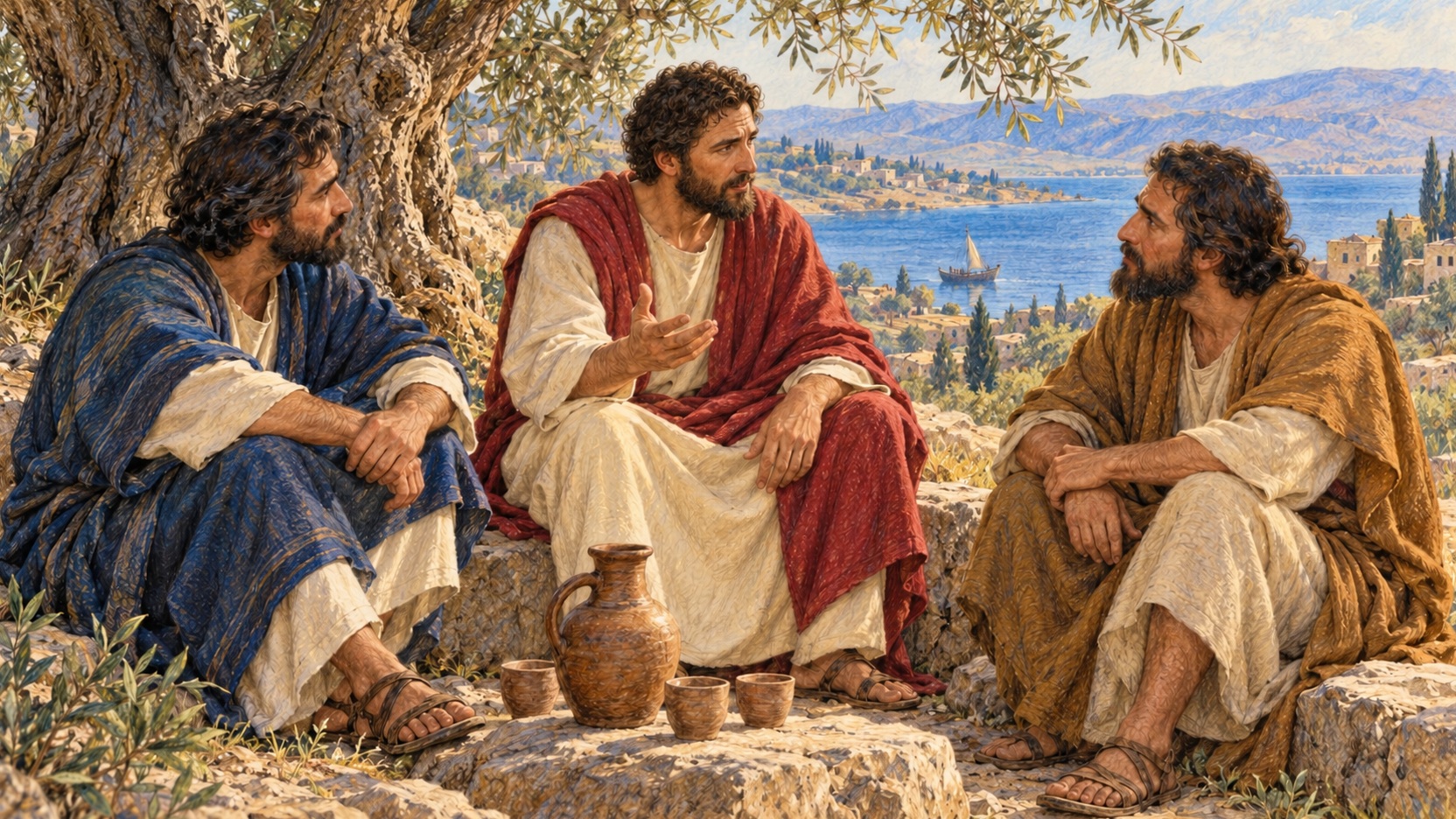
Jesus chose both Simon the Zealot and Matthew the tax collector to belong to the Twelve. Their labels could have placed them on opposite sides of Roman rule, yet both followed Him. Scripture does not describe private arguments between them, and Simon’s political background is less certain than popular accounts suggest. What we do know is that Jesus called these men to serve together under His authority. That calling reaches into how we think about money, government, and people whose former loyalties differ from ours.
Roman Taxes Made Political Allegiance Personal
A tax demand made foreign rule a practical concern for a family trying to make a living. Merchants also faced customs charges and tolls as they moved goods along roads or across boundaries. The local men who collected that money represented a system many of their neighbors resented, even when the collector had not set the amount himself.
Those collectors did not all work for the same administration. During Jesus’ ministry, Judea was governed directly by Rome through officials such as Pontius Pilate, while Galilee remained under Herod Antipas, a local ruler whose authority depended on Rome. A payment at a Galilean tax office was therefore not necessarily the same kind of tax as imperial tribute in Judea. Keeping the jurisdictions distinct helps us understand why the Gospels describe both collectors at their offices and a dispute about money owed specifically to Caesar.
Foreign rule also confronted Israel with a question about allegiance to God. The Lord had delivered His people from Pharaoh, given them His Law, and promised a king from David’s line. Now Rome exercised power over their land while honoring false gods. Some Jews cooperated with the authorities, others endured their demands, and some believed faithfulness required armed resistance. The Law’s instructions for an Israelite king help explain why a foreign ruler’s claim could provoke such a serious dispute.
“When you come to the land which the LORD your God is giving you, and possess it and dwell in it, and say, ‘I will set a king over me like all the nations that are around me,’ you shall surely set a king over you whom the LORD your God chooses; one from among your brethren you shall set as king over you; you may not set a foreigner over you, who is not your brother.”
God’s chosen king was to come from among Israel’s own people and remain subject to the Law he administered. He had to write out a copy and read it throughout his life, learning to fear the LORD and obey Him. The restrictions on accumulating horses, wives, and wealth restrained ways a ruler could exalt himself or turn away from God. Royal office gave him responsibility for his brethren, not permission to consider himself above them (Deuteronomy 17:14-20).
I need to distinguish that command about Israel’s choice of a king from instructions to someone already living under conquest. Deuteronomy does not tell every such person to refuse every tax. Daniel served pagan governments without worshiping their gods, and Jeremiah told the exiles to seek Babylon’s peace. Neither example declared those governments righteous. They show that service under a ruler need not surrender the worship and final obedience owed to God.
The census associated with Quirinius in AD 6 brought the tax dispute into open revolt. In Antiquities 18, Josephus describes Judas the Galilean and Zadok urging resistance to an assessment they regarded as slavery. He also says Judas’s followers insisted that God alone was their ruler and lord. Acts 5:37 recalls Judas rising “in the days of the census,” gathering followers, and then perishing, with his followers scattered.
That earlier resistance does not give us Simon’s biography. In Jewish War 4, Josephus uses the name Zealots for a violent Jerusalem faction during the First Jewish War, decades after Jesus chose the Twelve. We should not assume an uninterrupted organization connecting that faction with Judas’s followers or with Simon. Zeal could describe religious devotion as well as revolutionary commitment. The later factions’ part in the war and the murders Josephus recounts warn us that a claim to defend God’s rule can accompany conduct God condemns. Their actions do not establish what Simon had done.
Luke records both the Lord’s prayer before choosing His apostles and the names of the men He selected.
Now it came to pass in those days that He went out to the mountain to pray, and continued all night in prayer to God. And when it was day, He called His disciples to Himself; and from them He chose twelve whom He also named apostles: Simon, whom He also named Peter, and Andrew his brother; James and John; Philip and Bartholomew; Matthew and Thomas; James the son of Alphaeus, and Simon called the Zealot; Judas the son of James, and Judas Iscariot who also became a traitor.
Luke identifies Simon as “the Zealot,” and Acts retains that title. Matthew and Mark use the corresponding name Cananaean, also rendered “Canaanite.” It comes from an Aramaic term connected with zeal, so the title does not establish Canaanite ancestry. Simon may have had nationalist or revolutionary associations, or he may have been known for religious zeal without belonging to an organized political party. The New Testament leaves that question unanswered.
It does not call Simon an assassin or describe him renouncing a violent career. What it records is his place among the apostles and his presence with the believers after Christ’s ascension. Whatever associations lay behind his title, Jesus had called him to serve under His authority and proclaim His kingdom. We can follow that change of allegiance without inventing the rest of Simon’s past.
Jesus Called Tax Collectors to Repentance, Not Respectability
Matthew’s occupation is much clearer. The New Testament word telonai includes collectors of customs and tolls, although those officials had varying responsibilities. The older English word “publican” can mislead us if we picture every local collector as a wealthy Roman contractor. A man working at a local office might collect money under a different arrangement, but he still stood between the authority demanding payment and the people required to pay.
That position offered opportunities for extortion, taking money through threats or the misuse of authority. A collector could demand more than was due and intimidate someone who objected. Those abuses, along with resentment of the rulers the collectors served, help explain their association with sinners in the Gospels. We should not assume every individual had committed every abuse, but neither should we minimize the injury dishonest collectors caused. John the Baptist addressed their conduct when they came to him for baptism.
Then tax collectors also came to be baptized, and said to him, “Teacher, what shall we do?” And he said to them, “Collect no more than what is appointed for you.” Likewise the soldiers asked him, saying, “And what shall we do?” So he said to them, “Do not intimidate anyone or accuse falsely, and be content with your wages.”
John told the collectors to take no more than the appointed amount. He did not require every man to resign, which shows that honest collection was possible. Repentance did require them to stop using their position to take money they had no right to demand. A collector could not claim to have turned from sin while deliberately continuing the extortion his work made possible.
The soldiers likewise had to stop intimidating people and making false accusations, and be content with their wages. Someone confronted by an armed man or an official demanding money might have little practical protection against him. John’s instructions required repentance to reach those encounters, because continued abuse would leave other people suffering under the same threats. Honest financial records and restraint could not purchase forgiveness, but changed conduct would give evidence that repentance was genuine.
Matthew received a call that did require him to leave his office and follow Jesus personally.
As Jesus passed on from there, He saw a man named Matthew sitting at the tax office. And He said to him, “Follow Me.” So he arose and followed Him. Now it happened, as Jesus sat at the table in the house, that behold, many tax collectors and sinners came and sat down with Him and His disciples. And when the Pharisees saw it, they said to His disciples, “Why does your Teacher eat with tax collectors and sinners?” When Jesus heard that, He said to them, “Those who are well have no need of a physician, but those who are sick. But go and learn what this means: ‘I desire mercy and not sacrifice.’ For I did not come to call the righteous, but sinners, to repentance.”
Matthew got up when Jesus said, “Follow Me.” The meal that followed brought other tax collectors and sinners into Jesus’ company, and the Pharisees challenged His willingness to eat with them. Jesus answered by comparing their need with that of sick people who require a physician. His appeal to Hosea’s teaching about mercy explained why He received sinners: He had come to call them to repentance. His presence offered them help without approving the conduct from which they needed to turn.
Mark and Luke call the man Levi, and I understand their parallel accounts to describe the same disciple. Luke tells us he left all, while Matthew says more briefly that he arose and followed. Reading the accounts together gives us that fuller picture without attributing Luke’s wording to Matthew. Jesus called him while he was still at the office. Matthew did not have to make himself respectable enough to deserve Christ’s invitation.
Once Matthew followed Jesus, his money and treatment of other people came under his new Lord’s authority. A former occupation could no longer excuse dishonesty, nor could leaving the office substitute for obedience in the rest of his life. Later in Jesus’ ministry, the encounter with Zacchaeus shows how repentance could reach a collector’s wealth and the people he might have harmed (Luke 19:1-10).
Then Zacchaeus stood and said to the Lord, “Look, Lord, I give half of my goods to the poor; and if I have taken anything from anyone by false accusation, I restore fourfold.” And Jesus said to him, “Today salvation has come to this house, because he also is a son of Abraham; for the Son of Man has come to seek and to save that which was lost.”
Zacchaeus received Jesus joyfully while the crowd complained about the company He kept. This rich chief tax collector then declared that he would give half his goods to the poor and restore fourfold whatever he had taken by false accusation. His response put substantial wealth at the service of others, including anyone he had defrauded. I don’t understand that restitution as a payment for forgiveness. Jesus announced that salvation had come to the house and explained why He had come: to seek and save the lost.
A person who has defrauded others should address the loss he caused as far as he can. Grace gives him no excuse to hold on to stolen money, though repayment cannot cleanse his sin before God. The complete study on Zacchaeus examines his declaration, the restitution laws, and the use of his wealth in greater detail.
Matthew and Simon Came Under One Greater Lord
Matthew’s call brings us back to the men Jesus chose to serve together. A former collector and a man known for zeal belonged to the same Twelve, although their labels could have supplied reasons for hostility. Scripture records no quarrel or political reconciliation between them. Their shared place among the apostles is established by Jesus’ choice and their allegiance to Him, not by a scene we supply to make their differences more dramatic.
Following the same Lord still left both men accountable for their conduct. Matthew could not excuse exploitation because it served a revenue authority, and Simon could not appeal to zeal to justify a sinful method. These are implications of Christ’s authority, not accusations that Scripture records against either man. Their backgrounds might explain former loyalties, but those loyalties could not become a higher authority than the Lord they now served.
That helps me think about political differences within the church. We should examine policies honestly and oppose what Scripture condemns, while refusing to make a label from the left or right the measure of someone’s salvation. Another believer may need correction, and so may I. Learning obedience together requires us to speak truthfully and receive biblical correction without treating contempt as evidence of conviction. Unity cannot depend on hiding sin or surrendering truth.
During His final week in Jerusalem, Jesus addressed the underlying question of allegiance when His opponents asked whether paying Caesar’s tax was lawful. The question sounded like a request for instruction, but Matthew tells us it was devised as a trap (Matthew 22:15-22).
“Tell us, therefore, what do You think? Is it lawful to pay taxes to Caesar, or not?” But Jesus perceived their wickedness, and said, “Why do you test Me, you hypocrites? Show Me the tax money.” So they brought Him a denarius. And He said to them, “Whose image and inscription is this?” They said to Him, “Caesar’s.” And He said to them, “Render therefore to Caesar the things that are Caesar’s, and to God the things that are God’s.” When they had heard these words, they marveled, and left Him and went their way.
The Pharisees’ disciples approached Jesus with the Herodians, supporters associated with Herod’s ruling house. The Pharisees were known for their attention to the Law and inherited traditions, yet here they cooperated with men whose political allegiance served a different interest. Their praise of Jesus’ honesty was calculated: they wanted an answer they could use against Him.
The question concerned the kensos, the imperial tribute or poll tax. If Jesus approved payment, His opponents could present Him as accepting pagan domination. If He refused, they could accuse Him of opposing Rome’s revenue. He had them produce the coin and identify Caesar’s image and inscription before answering. They were asking Him to choose between two charges they hoped to make, but His reply distinguished what was due to Caesar from what belonged to God.
The verb translated “render,” apodidomi, can mean give back, repay, or pay what is owed. Jesus recognized a real civil obligation without declaring Caesar righteous or divine. A person could pay with the emperor’s currency without worshiping the emperor pictured on it. At the same time, the obligation to give God what was His placed Caesar’s demand beneath an authority Caesar could never possess.
Some teachers connect the image on the coin with God’s image in humanity. I find that a useful application from Genesis, provided we distinguish it from Jesus’ actual words. He did not ask, “Whose image is on you?” A coin could be handed over in payment, but the person paying belonged to God, whose claim reached his body, mind, possessions, and worship. A ruler has no right to own that person’s conscience or become the final authority on good and evil. Even the emperor depended on God for life and would answer to Him.
Civil Authority Is Real, but Its Claim Has a Boundary
Paul applied the obligation to pay what is due to Christians living under Roman government. He did not make submission depend on the rulers sharing their faith.
Let every soul be subject to the governing authorities. For there is no authority except from God, and the authorities that exist are appointed by God. Therefore whoever resists the authority resists the ordinance of God, and those who resist will bring judgment on themselves. For rulers are not a terror to good works, but to evil. Do you want to be unafraid of the authority? Do what is good, and you will have praise from the same. For he is God’s minister to you for good. But if you do evil, be afraid; for he does not bear the sword in vain; for he is God’s minister, an avenger to execute wrath on him who practices evil. Therefore you must be subject, not only because of wrath but also for conscience’ sake. For because of this you also pay taxes, for they are God’s ministers attending continually to this very thing. Render therefore to all their due: taxes to whom taxes are due, customs to whom customs, fear to whom fear, honor to whom honor.
Paul describes civil authority as an office under God, charged with restraining wrongdoing and serving the good of those it governs. Its right to bear the sword includes real force against evildoers. That responsibility also makes its abuses culpable. Scripture condemns corrupt judges and murderous kings, so Paul’s description cannot mean that every official is honest or every law just. An official remains accountable to the God whose authority he is supposed to serve.
The commands to pay taxes and customs apply even when we resent the ruler receiving them. Disagreement with his conduct cannot excuse a dishonest tax return or keeping revenue we owe. Peter likewise directs believers to honor people and the king while fearing God. The ruler deserves proper respect, while God receives the reverence and ultimate allegiance that belong to Him alone. Paying a tax need not approve every use of public money, any more than using a denarius meant worshiping Caesar.
Applying those principles requires care when a tax system is complicated. We should keep truthful records and obtain qualified help when an obligation is unclear. Lawful challenges to unjust demands and proposals for reform remain possible, but complaints about waste do not authorize fraud. I am still responsible for honesty when I believe public officials are failing in their own responsibilities.
Submission has a clear limit when a human command forbids obedience to God. The apostles faced that conflict when the council ordered them to stop teaching about Jesus.
And when they had brought them, they set them before the council. And the high priest asked them, saying, “Did we not strictly command you not to teach in this name? And look, you have filled Jerusalem with your doctrine, and intend to bring this Man’s blood on us!” But Peter and the other apostles answered and said: “We ought to obey God rather than men.”
The council’s command directly conflicted with the commission Christ had given the apostles. Their declaration “We ought to obey God rather than men” identified whose authority must prevail when the two commands could not both be obeyed. They continued preaching and endured arrest and beating for it. Their refusal concerned an actual demand to disobey Christ; it did not release them from every other obligation to people in authority.
Daniel’s friends had faced the same kind of conflict when Babylon ordered them to bow to an image. Daniel also continued to pray when a royal decree forbade it. Before I appeal to their example, I need to identify how a demand conflicts with Scripture. Disliking a policy is not enough, and saying “God told me” cannot justify fraud, vengeance, or unlawful violence. Our conscience needs instruction from God’s Word rather than an assumption that every strong impulse comes from Him.
When obedience to a human command would require sin, we must refuse it, even at personal cost. We may use honest appeals where they are available, and accepting punishment for faithfulness does not oblige us to call the punishment just. Daniel and the apostles teach us to honor God’s authority through a specific refusal while continuing to do good. They give no warrant for contempt toward every civil office.
Christ’s Kingdom Does Not Advance Through Worldly Force
The accusation made against Jesus before Pilate shows how readily His opponents distorted His teaching about civil obligations. Luke records their charge at the beginning of the hearing.
Then the whole multitude of them arose and led Him to Pilate. And they began to accuse Him, saying, “We found this fellow perverting the nation, and forbidding to pay taxes to Caesar, saying that He Himself is Christ, a King.” Then Pilate asked Him, saying, “Are You the King of the Jews?” He answered him and said, “It is as you say.” So Pilate said to the chief priests and the crowd, “I find no fault in this Man.”
That accusation contradicted what Jesus had actually taught about Caesar’s tax. He truly was Christ the King, but His accusers joined that truth to a false charge of forbidding payment, presenting Him as a threat to Roman rule. Pilate initially declared Him innocent. John’s account takes us into Pilate’s questioning and explains more fully what Jesus said about His kingdom.
Jesus answered, “My kingdom is not of this world. If My kingdom were of this world, My servants would fight, so that I should not be delivered to the Jews; but now My kingdom is not from here.” Pilate therefore said to Him, “Are You a king then?” Jesus answered, “You say rightly that I am a king. For this cause I was born, and for this cause I have come into the world, that I should bear witness to the truth. Everyone who is of the truth hears My voice.” Pilate said to Him, “What is truth?” And when he had said this, he went out again to the Jews, and said to them, “I find no fault in Him at all.
Jesus explained that His kingdom did not originate in this rebellious world. He was not denying His authority over the earth or His future reign here. If His kingdom had belonged to the present worldly order, His servants would have fought to prevent His being handed over. Instead, He bore witness to the truth even before a ruler who could order His execution. Those who belong to the truth hear His voice and receive His authority.
Christ will return bodily to reign as King. Until then, the church is entrusted with proclaiming His message through truthful witness empowered by the Holy Spirit. Prayer, service, and biblical discipline belong to that calling, and faithfulness may bring suffering. Taking control of an institution or killing an opponent cannot make someone believe or give him new birth. People need to hear the Gospel and respond to Christ in repentance and faith.
Civil government has a different responsibility to restrain wrongdoing. Its authority to use force does not make armed conquest the church’s commission. Christians can consider questions of policy and civil duty within biblical limits without confusing those responsibilities with the work of making disciples. The biblical study on war and fighting examines those questions more fully.
The false charge about taxes exposes two responsibilities I must keep together. I need to speak accurately about an opponent, and I must live honestly so that my conduct does not make an accusation of fraud or lawless violence true. Neither duty requires me to flatter government or conceal corruption. Even when a cause is just, exposing wrongdoing gives me no right to invent allegations, make unlawful threats, or cultivate hatred toward the people involved.
Believers may disagree about tax rates, budgets, and proposed reforms without disagreeing about the Gospel. We should consider evidence and biblical principles carefully rather than turn every policy preference into a test of salvation. Where voting, petitions, and appeals are available, we can use them to challenge exploitation and seek responsible spending. Those means allow us to pursue change while remaining accountable for how we treat other people.
These convictions reach ordinary financial decisions as well as public debate. If I conceal income or accept a bribe, another official’s corruption does not excuse me. If I misrepresent an opponent, the fact that I am angry cannot make the accusation true. We can assist people who have been mistreated and pray for rulers without approving their wrongdoing. Belonging to Christ governs how we take part in public life, as the study on ambassadors of Christ explains.
The Gospel Gives Us a Greater Allegiance
No political cause can reconcile sinners to God. Paul explains how Christ’s blood brought together people separated by something deeper than a disagreement about government (Ephesians 2:11-22).
But now in Christ Jesus you who once were far off have been brought near by the blood of Christ. For He Himself is our peace, who has made both one, and has broken down the middle wall of separation, having abolished in His flesh the enmity, that is, the law of commandments contained in ordinances, so as to create in Himself one new man from the two, thus making peace, and that He might reconcile them both to God in one body through the cross, thereby putting to death the enmity. And He came and preached peace to you who were afar off and to those who were near. For through Him we both have access by one Spirit to the Father.
Paul is speaking directly about Jews and Gentiles being reconciled through Christ. Matthew and Simon were both Jewish, so their different backgrounds are not the two groups named here. The passage does show why former hostility cannot govern fellowship among people who have been reconciled to God. They have access to the same Father by the same Spirit and belong to one household built on Christ.
The peace Paul describes rests on Christ’s blood, because every person has sinned and needs reconciliation with God. Jesus is the eternal Son, who became fully man without ceasing to be fully God. He was born of a virgin and remained entirely without sin. His perfection made Him the perfect sacrifice, and He voluntarily gave Himself to be slain for us. Wicked men inflicted His bodily torture and death. His shed blood and death completed His saving sacrifice before His burial, and He then rose bodily from the grave.
The Father did not punish, curse, abandon, strike, bruise, or pour wrath upon Jesus. Father, Son, and Holy Spirit acted in unity to redeem us. Christ died for the whole world, making God’s offer of salvation genuine for every person, although people may resist and reject Him. Those who repent and believe are forgiven and justified, declared righteous before God. Their acceptance by God rests on Christ’s completed sacrifice rather than the respectability of their former occupation or the intensity of their convictions.
The believer is born again, made new, and indwelt and sealed by the Holy Spirit, secure in the eternal life God gives. Obedience grows from that new life; it neither earns nor keeps salvation. A shallow profession of faith is no substitute for genuine repentance and faith, though genuine faith does not make a person sinless. Matthew’s departure from the tax office could not save him, Simon’s zeal could not save him, and Zacchaeus could not buy forgiveness through restitution. Christ saves, and His people learn to obey Him with the money and influence entrusted to them.
Someone who has profited from corruption is not beyond Christ’s mercy, nor is someone whose resistance has become sinful. Usefulness to a cause cannot earn either person a place in God’s household. Repentance and faith bring both to the same Savior, where neither can demand that the other remain an outsider because of his past alone. Their fellowship grows through submission to Christ and His truth, including the correction each may need.
My Final Thoughts
Jesus called Matthew and Simon to serve the same Lord. Their place among the apostles does not excuse exploitation, justify violent zeal, or give Caesar the authority that belongs to God. It makes me examine whether my own convictions are governed by Christ or by a loyalty I refuse to question.
That submission includes paying what I owe, seeking justice honestly, and refusing any command that requires sin. It also means receiving a fellow believer whom Christ has received, even if his past associations once gave me reason to distrust him. The Lord who called Matthew and Simon has authority over my money, conscience, and relationships. I want my use of citizenship and my treatment of other people to reflect that I belong to Him.