
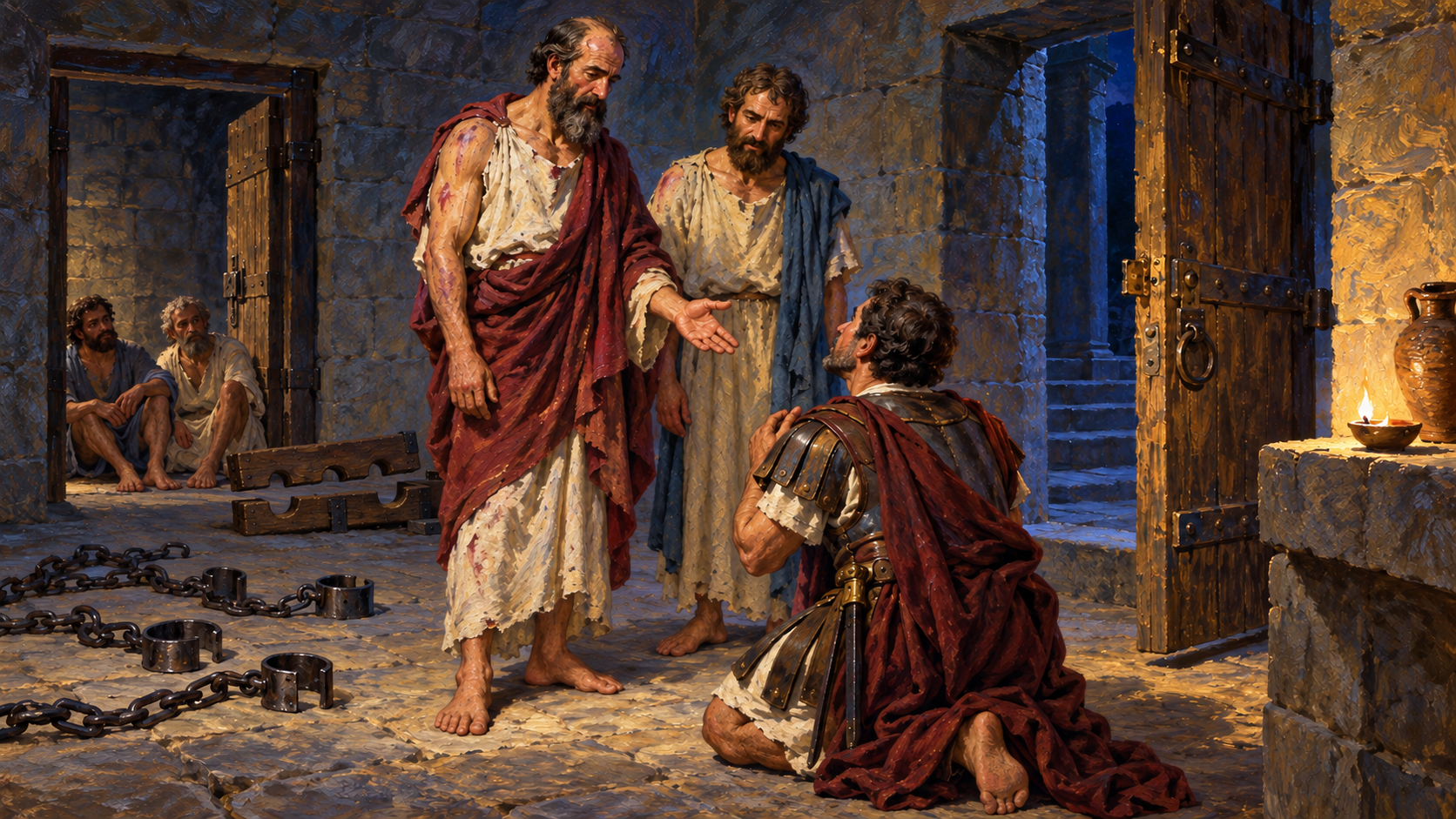
Paul and Silas were praying and singing when God shook the prison in Philippi. Its doors opened and the chains were loosened, yet Paul was still there to stop the jailer from killing himself. The man’s question, “What must I do to be saved?” led to a greater deliverance than release from a prison. Acts 16 brings us from the missionaries’ suffering to the salvation proclaimed through their witness.
Philippi, Profit, and the Arrest
The Holy Spirit had redirected the missionary team before Paul received a night vision calling them into Macedonia. They came to Philippi, a leading city of the district and a Roman colony. On the Sabbath they went outside the city to a riverside place of prayer, where they spoke to the women gathered there. Lydia heard the message, and the Lord opened her heart to receive it. She believed and welcomed the missionaries into her home.
Paul and Silas were obeying the Lord’s direction when opposition came. Their imprisonment was not evidence that they had chosen the wrong city or wandered away from His calling. The Lord had already begun a work among people who heard the gospel, even though preaching it would bring the missionaries into conflict with others. The study on the book of Acts follows the advance of that message more fully.
A slave girl with a spirit of divination followed them for many days, announcing that they served the Most High God and proclaimed the way of salvation. Her owners made a great deal of money through her fortune-telling. Paul became greatly annoyed and commanded the spirit to leave her in the name of Jesus Christ. It came out immediately. Although its words sounded favorable, Paul would not make a demonic spirit a partner in preaching the gospel.
Luke does not describe the girl’s later life, but he tells us exactly what upset her owners: their hope of profit was gone. They had been making money from her bondage, and her deliverance from the spirit ruined that income. They seized Paul and Silas and dragged them before the magistrates. Instead of complaining about lost profits, they emphasized that these men were Jews and accused them of introducing customs unlawful for Romans. Their appeal to the city’s Roman identity concealed the financial grievance that had brought them there.
Then the multitude rose up together against them; and the magistrates tore off their clothes and commanded them to be beaten with rods.
The magistrates gave way to the crowd and ordered a public beating without a lawful hearing. Paul and Silas were stripped and struck repeatedly with rods. The officials then handed them over to a jailer with orders to keep them secure:
And when they had laid many stripes on them, they threw them into prison, commanding the jailer to keep them securely. Having received such a charge, he put them into the inner prison and fastened their feet in the stocks.
The jailer carried out those orders by putting them in the inner prison and fastening their feet in stocks. They were still wounded from the beating, and the stocks prevented them from moving freely.
God would overrule the injustice without making it righteous. The owners’ greed and the magistrates’ abuse of authority remained wrong. I cannot treat obedience as a bargain that obliges God to keep me comfortable, or assume that suffering means He has abandoned His work. He had led these men to Philippi, and their ministry there was not finished.
Prayer, Praise, and the Open Prison
At midnight, with their wounds still painful and their feet confined, Paul and Silas turned to God in prayer and song:
But at midnight Paul and Silas were praying and singing hymns to God, and the prisoners were listening to them.
The other prisoners heard Paul and Silas honoring God in the same place where they were suffering. Their worship bore witness to Him before the doors opened or their chains came loose.
Then God intervened through a sudden earthquake:
Suddenly there was a great earthquake, so that the foundations of the prison were shaken; and immediately all the doors were opened and everyone’s chains were loosed.
Luke uses aphnō, meaning suddenly or unexpectedly, to describe the earthquake that shook the prison’s foundations. Every door opened and every prisoner’s chains came loose. Paul and Silas were not the only men released from their bonds.
Prayer and praise had not become a technique for controlling God. He was worthy of worship before the earthquake, and He chose how to act in Philippi. Paul later wrote from prison without every chain immediately falling away. Earlier, Acts 12 records James being killed and Peter being delivered from imprisonment. We cannot turn this particular rescue into a promise that every faithful believer will receive the same outward deliverance.
I have no right to tell a suffering believer that a longer prayer or louder singing would have secured his release. God can change the circumstances, and we should ask Him for help, but unchanged circumstances do not prove that someone’s faith or worship is insincere. Paul and Silas trusted Him while their situation was still painful and uncertain.
Why They Stayed
The jailer awoke, saw the open doors, and assumed the prisoners had escaped. If those in his custody were gone, he could face severe punishment and disgrace, possibly even death. He drew his sword to kill himself, but Paul’s warning stopped him:
And the keeper of the prison, awaking from sleep and seeing the prison doors open, supposing the prisoners had fled, drew his sword and was about to kill himself. But Paul called with a loud voice, saying, “Do yourself no harm, for we are all here.”
Every prisoner was still there. Paul and Silas had suffered an unjust beating, but Paul spoke loudly to stop the jailer from taking his life. His concern reached beyond his own release to a man about to die. The man who had confined them now had reason to listen to them.
The jailer called for light, came trembling before Paul and Silas, and asked how he could be saved:
Then he called for a light, ran in, and fell down trembling before Paul and Silas.
And he brought them out and said, “Sirs, what must I do to be saved?”
So they said, “Believe on the Lord Jesus Christ, and you will be saved, you and your household.”
The Greek verb sōzō can mean to save, rescue, or deliver. Paul’s answer concerns more than rescue from the jailer’s immediate crisis. Paul had already assured him that the prisoners were present. Avoiding punishment for an escape could not reconcile the jailer to God; he needed the salvation found in Jesus Christ.
Paul and Silas did not tell him to earn forgiveness through penance, perform a ritual, or reform the prison before God would receive him. Even a sincere promise to become a better man could not remove his guilt. They told him whom to trust: the Lord Jesus Christ. He is Lord over the jailer and every sinner, the Savior who came in the flesh, and the Christ, God’s promised Messiah. Believing on Him means receiving Him for who He is, rather than using His name as temporary help for a frightening night.
The Word Reaches His Household
Paul and Silas included the jailer’s household in the promise of salvation. Luke immediately describes how those people heard the message for themselves:
Then they spoke the word of the Lord to him and to all who were in his house. And he took them the same hour of the night and washed their stripes. And immediately he and all his family were baptized. Now when he had brought them into his house, he set food before them; and he rejoiced, having believed in God with all his household.
Paul and Silas spoke the word of the Lord to everyone in the house. The jailer’s faith did not automatically save his family; they needed to hear and receive the gospel themselves. A father’s conversion can give those under his roof an opportunity to hear about Christ, but it cannot replace their own response to Him.
Earlier that night the jailer had fastened Paul and Silas in stocks. Now he washed their wounds and brought them into his home for food. His care for them showed the effect of grace on his conduct; it did not purchase the forgiveness he had received through faith.
The members of the household believed and were baptized, publicly identifying themselves with Christ. The water did not cause the new birth or complete an unfinished salvation. They obeyed that night, before they could have developed the maturity that comes through years of following the Lord.
The Greater Freedom Christ Gives
The prisoners’ chains had really come loose, but the jailer needed Christ to free him from his sins. Sin can master someone who has never been inside a prison. Jesus described that bondage and the freedom He gives:
Jesus answered them, “Most assuredly, I say to you, whoever commits sin is a slave of sin. And a slave does not abide in the house forever, but a son abides forever. Therefore if the Son makes you free, you shall be free indeed.”
The word doulos means a slave or bondservant. Jesus describes sin as a master that holds people in bondage, rather than an inconvenient habit they can put aside whenever they please. The Son frees people from that mastery and brings them into His own household. Paul likewise describes salvation as a change in whom we serve:
But now having been set free from sin, and having become slaves of God, you have your fruit to holiness, and the end, everlasting life.
Christian liberty does not leave us answerable to no one. We are freed from sin to belong to God, and that new allegiance produces holy conduct. Someone who uses grace as permission to keep serving sin has misunderstood the freedom Christ gives. The study on freedom found in Christ develops this teaching further.
Our freedom rests on Christ’s finished work, rather than the worthiness of the person asking to be saved. Jesus is fully God and fully man, completely without sin. Wicked men tortured and crucified Him, inflicting real suffering on His innocent body. He willingly gave Himself to be slain as the perfect sacrifice for our sins. His shed blood and death completed His saving sacrifice before He was buried and rose bodily from the grave. The Father did not punish, curse, abandon, strike, bruise, or pour wrath on Jesus. The three distinct Persons of the Trinity remained united in the work of redemption. The study on the gospel examines His death, burial, and bodily resurrection more fully.
Christ’s finished work gives the believer assurance even when human authorities condemn him unjustly. Paul explains the believer’s standing before God:
There is therefore now no condemnation to those who are in Christ Jesus.
God declares the believer righteous through faith in Christ. A prison may close its doors again, but no human court can reverse that verdict before God. Christ died for the whole world, so the invitation to repent and believe is genuine for every person. People can resist His grace, but everyone who receives Christ in faith is forgiven, born again, and made new. The Holy Spirit indwells and seals that believer, who is eternally secure in the Savior.
We cannot earn forgiveness by religious effort or by trying to make up for past sins. Paul explains salvation as God’s gift:
For by grace you have been saved through faith, and that not of yourselves; it is the gift of God, not of works, lest anyone should boast.
Ephesians 2:10 goes on to say that we are created in Christ Jesus for good works. Obedience grows out of salvation; it does not earn eternal life or keep us saved. Eternal security gives no permission for lawlessness, because someone who has genuinely been born again has received new life and belongs to Christ. The jailer’s care for Paul and Silas illustrates how that life begins to show itself in a person’s actions.
Faithfulness After the Doors Open
When daylight came, the magistrates sent officers with permission for Paul and Silas to leave. The jailer passed on the message, but Paul refused to be dismissed quietly. Both men were Roman citizens, yet they had been beaten publicly and imprisoned without a conviction. He demanded that the magistrates come themselves and bring them out.
The officials became afraid when they learned that Paul and Silas were Roman citizens. They came, pleaded with the men, brought them out, and asked them to leave the city. Paul had required the magistrates to confront their wrongdoing instead of allowing them to dismiss the men quietly. The officials’ response could also help steady the young church, whose teachers had been publicly beaten. The study on the apostle Paul follows his ministry and the opposition he faced more broadly.
Paul and Silas went to Lydia’s house, encouraged the believers, and then left Philippi. Release from prison had not ended their responsibility toward the people who would remain there.
Staying in Philippi’s prison does not establish a rule that a believer must never escape danger. Paul escaped a plot against his life in Damascus, for example. At Philippi, however, remaining gave him the opportunity to preserve another man’s life and speak the gospel. We should recognize that mercy without treating every open door as an instruction to leave immediately.
I should not wait until every wrong against me has been put right before I am willing to help someone else. Paul was still wounded when he spoke to the jailer, and the man’s need did not become less urgent because Paul had legitimate grievances of his own. Christ frees us to love people even while we are hurting.
That compassion did not require Paul to pretend the beating had been lawful. He could protect the jailer and challenge the magistrates’ conduct without contradiction. Christian patience does not mean concealing injustice, and telling the truth about mistreatment does not prevent us from showing mercy. We can seek lawful accountability while continuing to care for the people God places before us.
My Final Thoughts
The earthquake displays God’s power, but the jailer’s salvation keeps me from treating Acts 16 as a lesson in getting what I want through praise. Paul and Silas worshiped before their circumstances changed, and they cared for another man while they were still wounded. I want to receive relief gratefully without becoming so absorbed in my own situation that I overlook someone who needs Christ. The Lord who opened that prison gives freedom from sin and condemnation to everyone who believes.