
What did Jacob actually see when he dreamed of a ladder reaching into heaven? He was running from home with the consequences of his deception behind him, yet God met him before he had learned to stop grasping for what only God could give. Following the vision through Genesis and into John 1 takes us from a lonely place called Bethel to Jesus Christ, the true meeting place between heaven and earth.
Jacob on the Run
Genesis 28 begins in a wounded family. Isaac favored Esau, while Rebekah favored Jacob. Esau treated his birthright with contempt and sold it to Jacob for food, showing how lightly he regarded the privileges of the firstborn. Years later, with Rebekah’s help, Jacob disguised himself as Esau and deceived the aged Isaac so that he would receive the spoken blessing. Those events are sometimes blended together, but Genesis keeps them distinct. Esau was responsible for despising his birthright. That did not make Jacob and Rebekah right to deceive Isaac.
Esau became angry enough to plan Jacob’s murder after Isaac died. Rebekah therefore arranged for Jacob to leave Beersheba and go to her brother Laban in Haran. The journey would put Jacob beyond Esau’s immediate reach and allow him to seek a wife from the extended family rather than from the Canaanites.
Before Jacob left, Isaac knowingly blessed him and commanded him not to marry a Canaanite woman. He sent Jacob to Padan Aram and explicitly called upon “the blessing of Abraham.” This detail keeps us from reading the dream as though God secretly reversed Isaac’s decision. Isaac had now recognized Jacob as the covenant heir. At Bethel, the LORD personally confirmed that same line of promise.
None of this excuses Jacob’s sin. Scripture does not need to turn a person into a flawless hero before showing him mercy. Jacob had a place in God’s covenant purpose, yet he remained responsible for the way he grasped and deceived. Much of his life from this point forward would teach him that human cleverness cannot secure what God alone has promised to give.
Jacob traveled north toward Haran, a journey far longer than one night’s walk. The text later tells us that the nearby settlement was then called Luz, but Jacob did not arrive looking for a famous sanctuary. The sun went down, so he stopped in “a certain place” and lay on the ground with one of its stones near his head. He was a tired fugitive far from the tents that had once sheltered him, with no idea how long his exile would last.
So he came to a certain place and stayed there all night, because the sun had set. And he took one of the stones of that place and put it at his head, and he lay down in that place to sleep. Then he dreamed, and behold, a ladder was set up on the earth, and its top reached to heaven; and there the angels of God were ascending and descending on it.
What catches my attention is the plainness of “a certain place.” Jacob thought he had found somewhere to survive the night, while God had chosen that place to reveal Himself. Jacob was not reaching upward after a season of spiritual victory. God was reaching down in covenant mercy while Jacob slept.
This is why the passage is so deeply about grace. God met Jacob before his years under Laban had begun and before he had become a steady man of faith. His fear was still unsettled, and his motives still needed honest examination. The ladder and the angels were striking, but the LORD who spoke was the center of the scene. He promised His presence and assured Jacob that His word would be completed.
Genesis 28 also needs the rest of Scripture around it. Genesis 12 records the covenant first given to Abraham, and Genesis 26 shows the LORD confirming it to Isaac. Genesis 35 brings Jacob back to Bethel after years of change. Later, 1 Kings 12, Amos 5, and Hosea 10 show how that same place was corrupted by false worship. John 1 then takes the language of the vision and places it upon Christ. Reading those passages together keeps us from stopping at the dream’s most unusual image and missing where the biblical story leads.
The Ladder, the Angels, and the Promise
The dream showed a ladder set on the earth with its top reaching heaven. The Hebrew word is sullam, and this is its only occurrence in the Old Testament. It may describe a ladder, a stairway, or a raised way. Because Scripture gives us no architectural drawing and no other passage using the word, we should be humble about its exact shape. Its function in the dream is clear even when its form is not: God showed a connection set upon the earth and reaching heaven.
That keeps us from turning the vision into a moral ladder Jacob had to climb. He did not build the structure, and the text never says that he tried to ascend it. God revealed something Jacob could not discover or produce through effort. The connection was there because God chose to make it known.
The scene may remind us of Babel. There, human beings tried to build a city and a tower whose top reached heaven so that they could make a name for themselves. Here Jacob constructed nothing. God set the connection on earth, and the promise served God’s covenant purpose rather than Jacob’s self-exaltation. I think the contrast is helpful, but Genesis 28 does not state it directly, so it should remain an observation rather than become the foundation of the interpretation.
The angels of God ascended and descended upon the ladder. They are real created servants, not symbols of Jacob’s imagination and not divine beings who deserve worship. The vision lets Jacob see that the visible world is not closed off from the unseen realm. God is not absent, and His messengers move under His authority.
Some readers notice that the angels ascend before they descend, when we might have expected the order to begin in heaven. That observation may fit Jacob’s later confession that the LORD was already in the place although Jacob did not know it. Still, the order should not be made to carry more doctrine than the text gives it. Scripture does not tell us what mission each angel had or why the movement appears in that sequence.
Nor does the dream tell Jacob to call upon angels or issue commands to them. It gives him no reason to chase another angelic experience. They are present because God is active, but they are not the point of the vision. Hebrews 1:14 calls angels ministering spirits sent to serve those who will inherit salvation, so believers need not deny their activity. At the same time, our prayer and trust belong to God. In Revelation 22, an angel refuses John’s worship and tells him to worship God. Christ is Lord over every visible and invisible power. A fuller study of angels must keep them in that created and obedient place.
The LORD’s speech, not the movement of the angels, is the heart of Jacob’s dream.
And behold, the LORD stood above it and said: “I am the LORD God of Abraham your father and the God of Isaac; the land on which you lie I will give to you and your descendants. Also your descendants shall be as the dust of the earth; you shall spread abroad to the west and the east, to the north and the south; and in you and in your seed all the families of the earth shall be blessed. Behold, I am with you and will keep you wherever you go, and will bring you back to this land; for I will not leave you until I have done what I have spoken to you.”
The LORD identified Himself as the God of Abraham and Isaac before repeating the covenant promises given in Genesis 12 and Genesis 26. He promised Jacob the land beneath him and descendants who would spread in every direction. Through Jacob and his seed, blessing would reach all the families of the earth. God was not handing Jacob a vague message about having a better future. He was bringing him into a revealed covenant already unfolding through his family.
That plan would continue through Jacob’s sons and particularly through Judah until it reached the Messiah. The promise has a national part and a worldwide part. The land and multiplied descendants concern Jacob’s physical offspring, the nation of Israel. The blessing for every family reaches its highest fulfillment in Jesus Christ, the promised Seed through whom salvation goes to the nations. Christ’s fulfillment does not cancel the land promise or turn Israel into another name for the church.
God also spoke directly to Jacob’s fear: “I am with you.” Jacob had left the protection of home, but he had not left God’s sight. He was headed toward Laban’s household, where he would experience conflict and learn painful lessons. God’s promise did not mean Jacob would escape discipline, sorrow, or the consequences of his choices. It meant the LORD would keep him, bring him back, and refuse to abandon what He had spoken.
There is a strong comfort here, but it is not a promise that every frightening journey will unfold as we prefer. The assurance rests in God’s faithfulness to His own word. Jacob’s circumstances would change repeatedly, while the LORD’s covenant purpose would not.
The words “I will not leave you until I have done what I have spoken to you” also show that God’s keeping has a purpose. He was not merely helping Jacob feel less alone for one night. The LORD was carrying forward promises that began before Jacob was born and would continue long after his death. Jacob could neither speed that plan through deception nor destroy it through weakness. God would discipline him without surrendering the covenant He had freely made.
Bethel, Jacob’s Vow, and His Return
When Jacob awoke, he understood that God had been present and active before Jacob recognized Him. He responded with both fear and wonder. This had not been an entertaining dream; Jacob had been confronted by the living God.
Then Jacob awoke from his sleep and said, “Surely the LORD is in this place, and I did not know it.” And he was afraid and said, “How awesome is this place! This is none other than the house of God, and this is the gate of heaven!”
Jacob was not saying that God began to exist in that location when he arrived. His ignorance had never made God less present. What changed was Jacob’s awareness because God revealed what he could not see. He called the place Bethel, meaning house of God, and described it as the gate of heaven.
We should honor that language without turning Bethel into a controllable portal or a machine for spiritual encounters. The place received its meaning because God had chosen to speak there. It did not give Jacob power over God, and it did not promise later worshipers that a location could open heaven on demand.
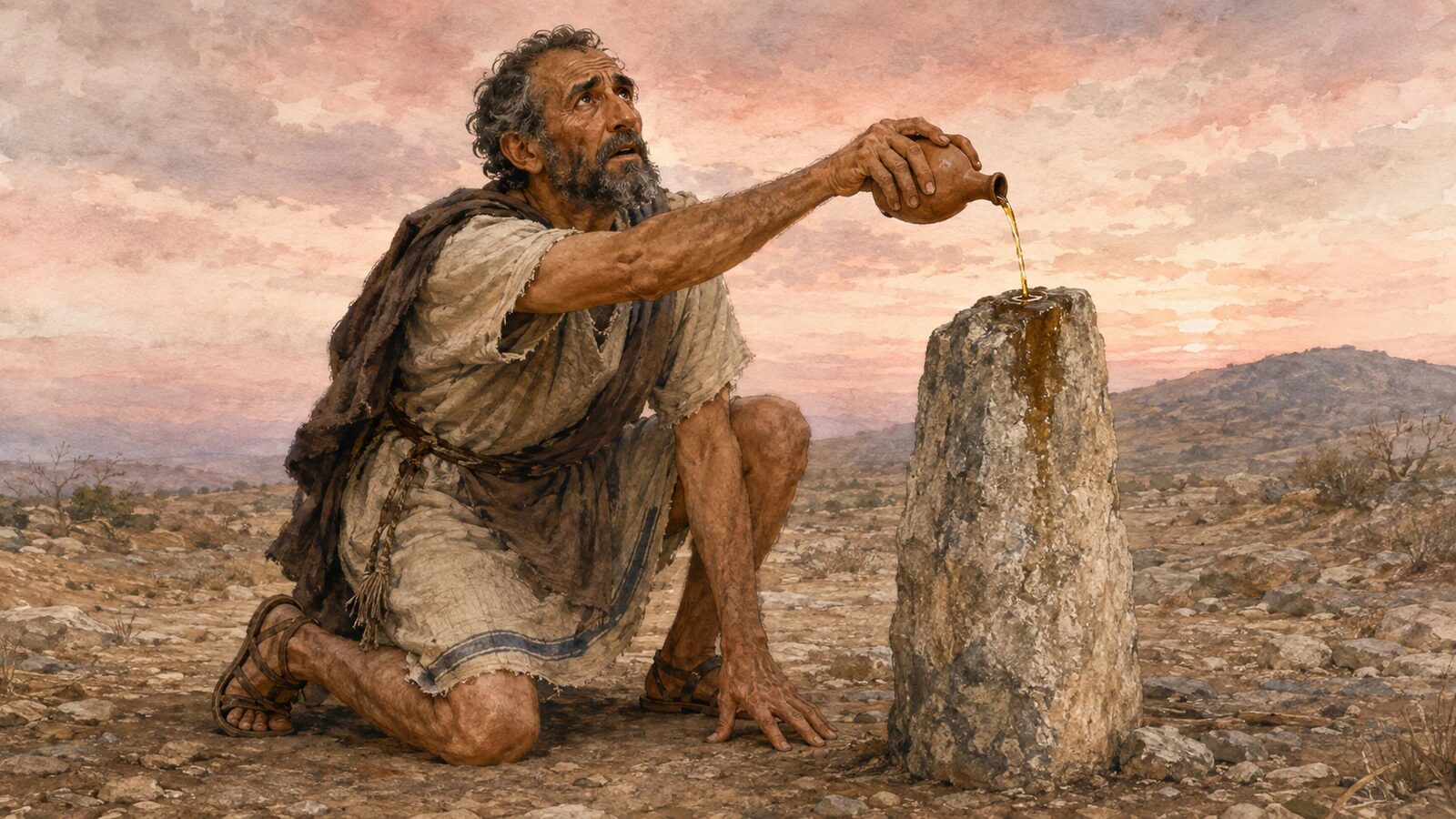
Then Jacob rose early in the morning, and took the stone that he had put at his head, set it up as a pillar, and poured oil on top of it. And he called the name of that place Bethel; but the name of that city had been Luz previously.
The stone became a memorial, not an idol. Jacob did not worship it. He marked the place where the LORD had confirmed His promise, and then he answered with a vow.
Then Jacob made a vow, saying, “If God will be with me, and keep me in this way that I am going, and give me bread to eat and clothing to put on, so that I come back to my father’s house in peace, then the LORD shall be my God. And this stone which I have set as a pillar shall be God’s house, and of all that You give me I will surely give a tenth to You.”
The vow can sound as though Jacob is bargaining with God, and I do not think we should brush that tension aside. God had already promised to be with Jacob, keep him, bring him home, and complete His word. Jacob then said, “If God will be with me,” and named the bread, clothing, and peaceful return he desired. His faith was responding to God, but it still had much to learn about resting in a promise rather than negotiating for security.
Some interpreters understand the opening Hebrew particle as “if.” Others argue that it can carry the sense of “since” or “when,” which makes the vow sound more confident. The wording deserves careful discussion, but the order of events is beyond dispute. God gave His unconditional covenant promise first. Jacob answered afterward, so no reading of the opening word should make Jacob’s response the cause of God’s faithfulness.
We also need to be careful with Jacob’s promised tenth. He made this vow before the Law of Moses and before Israel’s Levitical system of tithes, so Genesis 28 does not establish a church-age tax. Generosity still belongs in the life of worship. Jacob promised to honor the LORD from what God would provide after bringing him home, but giving must never be treated as a payment that purchases protection or grace.
Jacob’s words let us see spiritual growth in process rather than pretending it happened all at once. He had heard the LORD and responded, yet he still sounded ready to negotiate for a secure future. Genesis does not hide that mixture. God patiently taught Jacob the difference between grasping and trusting, and He did so through years in which Jacob often had to live without control. The promise remained firm while the man who received it was still being formed.
Many difficult years separated this night from Jacob’s return. He served Laban and was himself deceived. He married Leah and Rachel, became the father of a large household, fled Haran, wrestled with God, met Esau again, and endured the terrible violence connected with Shechem. The life of Jacob shows God patiently working with a man whose faith was genuine but whose character was unfinished.
In Genesis 35, God told Jacob to arise and return to Bethel. This time Jacob was not a solitary traveler with a stone beside his head. He had to lead an entire household back to the God who had answered him in distress. Jacob told them to put away their foreign gods and purify themselves. He also commanded them to change their garments, and then he built an altar at Bethel. The return became an act of renewed obedience.
Bethel’s later history gives the passage a sober edge. After the united kingdom divided, Jeroboam feared that worship at the Jerusalem temple would draw the northern tribes back to David’s house. He responded by establishing rival shrines at Bethel and Dan with a golden calf at each. Then he appointed priests God had not authorized and devised his own feast. Bethel’s old association with Jacob did not make this new worship acceptable because God had not commanded it.
Amos and Hosea later spoke against Bethel as a center of Israel’s idolatry. A place with a holy memory had become a place of rebellion. Sacred history cannot protect worship that refuses God’s word. Religious language and a meaningful location are no substitute for obedience to the Lord who revealed Himself there.
Jesus Christ, the True Meeting Place
John 1 gives us the clearest New Testament use of Jacob’s vision. Philip told Nathanael that they had found the One written about by Moses and the prophets. Nathanael doubted that anything good could come from Nazareth, but Jesus revealed that He had seen him under the fig tree. Nathanael knew Jesus could not have gained that knowledge naturally, so he confessed Him as the Son of God and the King of Israel.
Jesus had called Nathanael an Israelite in whom there was no deceit. That description sounds like a quiet contrast with Jacob’s earlier life of grasping and deception. Jesus then promised that Nathanael would see something greater than the sign that had first amazed him. Heaven would be open, and the whole scene would center upon the Son of Man.
And He said to him, “Most assuredly, I say to you, hereafter you shall see heaven open, and the angels of God ascending and descending upon the Son of Man.”
Jesus did not merely point back to Bethel as an inspiring religious memory. He placed the ascending and descending angels upon Himself. The true connection between heaven and earth is not a geographical site, a stone pillar, or even a dream that someone tries to reproduce. It is Jesus Christ.
The title “Son of Man” does not deny His deity. It affirms that the eternal Son became truly human, and it also recalls Daniel 7. There, One like the Son of Man comes with the clouds and receives everlasting dominion from the Ancient of Days. Jesus is fully God and fully man, so He alone can stand as the Mediator between God and humanity. Understanding the deity of Jesus helps us see why Christ can be the living connection Jacob’s dream anticipated.
Christ’s fulfillment does not erase the reality of Jacob’s experience. Jacob truly saw what Genesis records, and the LORD genuinely confirmed His covenant. Bethel became a place of holy remembrance. Yet the whole line of promise was moving toward Christ. The promised Seed brings blessing to every family of the earth, and the Savior opens the way to God instead of leaving sinners to climb through their own effort.
For there is one God and one Mediator between God and men, the Man Christ Jesus,
Jesus can be that Mediator because He is fully God and fully man. The eternal Son came in genuine human flesh through the virgin birth and lived completely without sin. Wicked men physically tortured and punished Him on the cross, and He willingly bore that real punishment for our sins in His innocent body. His blood was shed for the whole world. He truly died and was buried before rising bodily from the dead.
The Father did not punish, curse, abandon, strike, bruise, or pour wrath on Jesus. Father and Son remained united in the saving work. Christ granted access to God because He came down willingly, gave Himself for sinners, and rose again. No one reaches the Father by climbing high enough through effort, ritual, or spiritual experience.
Therefore, brethren, having boldness to enter the Holiest by the blood of Jesus, by a new and living way which He consecrated for us, through the veil, that is, His flesh,
Hebrews explains this access with the language of the tabernacle. Under the Mosaic covenant, a veil guarded the Most Holy Place. Only the high priest entered once each year, and he entered with blood. Christ’s shed blood provides a new and living way that repeated animal sacrifices could never create. Believers draw near with assurance because His finished work has opened the way.
I think the difference between Jacob’s vision and the believer’s access helps us see what Christ has accomplished. Jacob saw a God-given connection from a distance and awoke in reverent fear. Through Christ, those who have believed are invited to draw near. This does not make God casual or remove reverence. It means we do not overcome the barrier of sin by our own achievement. Jesus has opened the way, and the Holy Spirit brings believers into a living relationship with the Father through Him.
This brings us to the gospel meaning toward which Jacob’s ladder points. An angelic encounter cannot open heaven to sinners. Curiosity is not enough, and neither sacred geography nor religious performance can bring us to God. Believers come to the Father through the Son by the Holy Spirit. Their confidence rests upon the blood, death, burial, and bodily resurrection of Jesus Christ.
God genuinely offers salvation to everyone, although people can resist and reject Him. Anyone who repents and believes in Jesus is forgiven. God justifies that believer, which means He declares the person righteous before Him. The believer is born again and becomes a new creation. The Holy Spirit comes to dwell within and seals that person, who is eternally secure in Christ. This security never makes lawlessness acceptable, and a shallow profession by itself does not prove that someone has truly been born again.
A believer does not need to chase a private Bethel moment in order to know that God is near. The Lord may meet His children in lonely places and fearful seasons, just as He met Jacob. Our foundation, however, is not a location or a dramatic experience. It is Christ Himself. Other passages about doors in heaven also make the most sense when they lead our attention to the One who gives real access to the Father.
This gives us a sound way to think about powerful experiences. A dream may arrest someone’s attention, and a place can carry a strong memory. Even a moment of genuine awe cannot replace the gospel or become a second mediator. Every experience must remain under Scripture. An interpretation has gone wrong if it draws attention away from Christ. The same is true when it encourages devotion to angels or makes a person trust a location more than the Lord, because Genesis 28 and John 1 support none of those conclusions.
What the Vision Keeps Us From Getting Wrong
Jacob’s ladder cannot be made into a technique for climbing into heaven through secret knowledge, moral effort, or emotional intensity. Jacob was asleep. He did not build the connection, and he did not ascend it. God revealed the way and spoke first, so grace stands before Jacob’s answer.
The angels must not replace the LORD at the center of the passage. They are real servants acting under His command, but they never become the objects of Jacob’s prayer or worship. In John 1, even their movement is placed upon the Son of Man. The vision directs our attention through the angels to the Lord who rules them.
Bethel also warns us against trusting a sacred place merely because God once worked there. Jacob’s memorial was meaningful, but Jeroboam later used the same location for worship God had forbidden. A remembered encounter cannot make present disobedience holy. God’s word, rather than nostalgia, must govern worship.
Finally, Jacob’s vow does not show that a tenth purchased mercy. The LORD’s covenant promise was already complete before Jacob spoke. Jacob’s answer belonged after grace, not before it. The same order protects Christian giving and obedience today. We do not buy God’s favor; we respond to what He has freely given.
When these boundaries remain in place, the vision offers real comfort. God knew where Jacob lay before Jacob knew that God was near. He did not approve Jacob’s deception, yet He did not abandon His covenant purpose. The LORD would patiently discipline him and bring him home. God’s faithfulness, rather than Jacob’s ability to control his future, carried the promise forward.
My Final Thoughts
After following Jacob from that lonely night to Christ’s words in John 1, I do not believe the ladder is mainly about finding a spiritual method or recreating a dramatic experience. God opened the way by His own grace, and Jacob could only receive what was shown to him. Jesus is the true meeting place between heaven and earth, and His shed blood gives believers the access no effort or sacred location can provide. That lets us face our own weak and unfinished places honestly: the Lord does not excuse sin, but He remains faithful to His word and patiently teaches His children to trust what He alone can give.