
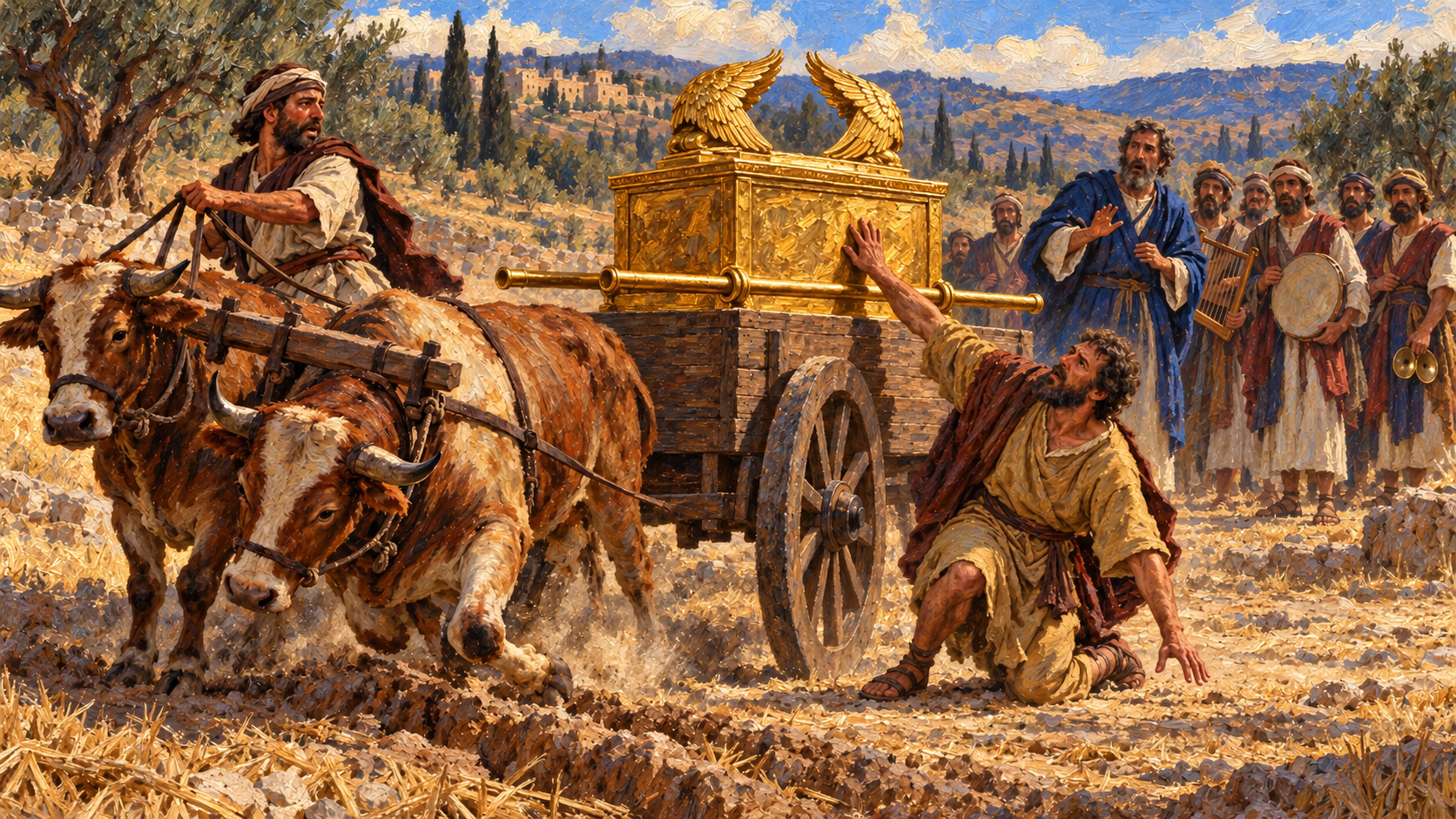
The death of Uzzah is hard to read. He reaches out when the oxen stumble, and the judgment feels so sudden that many of us ask whether he was only trying to help. I think the answer becomes clearer when we go back to what God had already said about the ark and then follow David into the corrected second procession.
The Ark Was Holy, and God Had Already Spoken
The scene begins with joy. David gathers Israel, music sounds before the LORD, and the ark is moving toward Jerusalem. Then the oxen stumble. Uzzah takes hold of the ark, and God strikes him there. Scripture does not ask us to hide the honest questions this raises, but it does require us to read the moment with the commands that came before it.
A careful reading therefore begins before 2 Samuel 6. Exodus 25 explains what the ark meant. Numbers 4 and 7 identify the men who carried the holy furnishings and the method they were to use. Then 1 Chronicles 13 gives a second account of the failed procession, while 1 Chronicles 15 records David’s confession and corrected attempt. Hebrews finally shows how the old covenant holy places point to access through Christ.
The ark was never common cargo. God had explained its purpose and assigned particular people to carry it in a particular way. He had also forbidden them to touch the holy things. Uzzah’s hand crossed that boundary, but the procession was already outside God’s order before he ever reached for the ark.
Exodus 25 describes the ark in careful detail. It was made from acacia wood and covered with pure gold. Poles passed through rings on its sides so it could be carried without being touched. Above it, cherubim overshadowed the gold mercy seat. God connected this ark with His covenant meeting place.
And there I will meet with you, and I will speak with you from above the mercy seat, from between the two cherubim which are on the ark of the Testimony.
Once each year on the Day of Atonement, the high priest brought sacrificial blood into the innermost room and sprinkled it at the mercy seat according to God’s command. The ark therefore stood within a larger message. God truly dwelt among His people, but sinful people did not approach Him however they wished. Nearness involved mercy, priesthood, blood, and God’s revealed boundaries.
Paul, the author of Hebrews, recalls the covenant tablets, the golden pot of manna, and Aaron’s rod that budded when he describes the tabernacle. The tablets testified to God’s law. The manna recalled His provision, while Aaron’s rod showed His choice of the priestly line and His judgment against rebellion. The ark was holy because God had set it apart within this covenant order. It was not a lucky object, a weapon, or a container of power that Israel could manage.
Each item helped Israel remember that the LORD had defined the relationship. His law revealed the covenant standard, His manna testified that the people lived by His provision, and Aaron’s rod answered rebellion against the priesthood He chose. The mercy seat did not erase those truths. It stood above the testimony and received sacrificial blood, showing that a holy God made a merciful way for a sinful people to draw near.
This background keeps us from imagining that God suddenly became protective of an unstable religious object. The ark taught that His presence was real and that His people had to approach Him according to the order He provided. The related study on the ark of the covenant examines that meaning more fully.
God also designed the ark so it could be moved without human hands touching it. The carrying poles were not decoration.
You shall put the poles into the rings on the sides of the ark, that the ark may be carried by them. The poles shall be in the rings of the ark; they shall not be taken from it.
Numbers makes the boundary even plainer. Aaron and his sons first covered the sanctuary furnishings. The Kohathites then carried the most holy things, but their privileged assignment did not give them permission to touch what they carried. God stated the consequence before Uzzah was born.
And when Aaron and his sons have finished covering the sanctuary and all the furnishings of the sanctuary, when the camp is set to go, then the sons of Kohath shall come to carry them; but they shall not touch any holy thing, lest they die.
Numbers 7 adds a detail that I do not think we should overlook. The Levitical families of Gershon and Merari received carts for curtains, frames, and other parts of the tabernacle. The Kohathites received no carts because their burden was the holy furnishings, which had to be carried on their shoulders. Israel did not lack transportation equipment. God had deliberately given a different order for these holy things.
The safeguards were careful from beginning to end. Aaron’s priestly family covered the holy furnishings before the Kohathites approached, and Numbers 4 also warned the carriers not to enter and watch while the holy things were being covered. Their calling brought them close, but it did not make every form of nearness safe. God supplied a way to serve without touching or gazing upon what He had forbidden.
The New Cart Was Already the Wrong Order
By 2 Samuel 6, David was king over all Israel and had made Jerusalem his capital. Bringing the ark there would publicly center the kingdom upon the LORD’s covenant rule rather than David’s political achievement. His desire was not wicked. The people played music before the LORD, and the procession looked like an enthusiastic national act of devotion.
Yet the ark was placed on a new cart. Something new can look careful without being obedient.
So they set the ark of God on a new cart, and brought it out of the house of Abinadab, which was on the hill; and Uzzah and Ahio, the sons of Abinadab, drove the new cart.
The cart also had an uncomfortable history. During Eli’s days, Israel had carried the ark into battle as though its presence could guarantee victory while the nation remained disobedient. The Philistines captured it, but the LORD humiliated Dagon and afflicted the cities where the ark was taken. Frightened Philistine leaders eventually returned it on a new cart.
From the outside, David’s new cart may have looked like an honor. It had not been worn down by common labor, and the leaders were not treating the ark as unwanted cargo. That appearance is part of the warning. Respectful materials and public enthusiasm do not tell us whether worship is obedient. God’s own instruction must answer that question.
God used that return to display His power and remove the ark from enemy control, but He never gave the Philistine method to Israel as a pattern for worship. The Philistines acted with limited knowledge while testing whether Israel’s God had judged them. Israel possessed God’s revealed law. A pagan emergency measure could not replace the order He had given His own people.
After judgment at Beth Shemesh, the ark was taken to Abinadab’s house at Kirjath Jearim and remained there for years. Uzzah grew familiar with its presence in his father’s household. Familiarity, however, did not remove the boundary or turn the ark into ordinary furniture.
That long residence may help explain why Uzzah felt able to react as he did, though Scripture never tells us exactly what he was thinking. He had lived near the ark and was trusted to guide the cart with Ahio. Yet long exposure to a holy thing is not the same as permission to handle it. Familiarity can quietly weaken reverence when a person stops listening to the command that made the thing holy.
The cart solved a practical transportation problem while ignoring the command about holiness. This is what makes the account so searching. God’s people can borrow a method because it seems effective and then assume good results will make it acceptable. David’s intention, the nation’s music, and the new appearance of the cart did not cancel what God had already said.
Good intentions do not make disobedience holy. Religious excitement can even hide neglect when everyone moves together and the celebration feels sincere. The ark did not need a better transportation idea. Israel needed to listen to the Word of God.
Uzzah’s Touch and David’s Fear
When the oxen stumbled at Nachon’s threshing floor, Uzzah reached out and took hold of the ark. From a human point of view, the reflex looks understandable. Scripture does not deny that the situation felt urgent. It defines the act by God’s command rather than by our instinctive sympathy.
And when they came to Nachon’s threshing floor, Uzzah put out his hand to the ark of God and took hold of it, for the oxen stumbled. Then the anger of the LORD was aroused against Uzzah, and God struck him there for his error; and he died there by the ark of God.
The text does not describe a natural accident or an impersonal force released by the ark. It says the LORD’s anger was aroused and that God struck Uzzah for his error. Numbers 4:15 had already forbidden the touch and named death as the consequence.
Uzzah was not the only person who had failed. The leaders had not sought God’s command, and the whole procession used the wrong method. The celebration was not submitted to the revealed order. Uzzah’s hand was the point where the breach became visible, but the scene had been arranged in a way that made the crisis possible.
We need to keep this wider failure in view when someone objects that Uzzah was merely helping and the judgment was unfair. The text is not describing an uninformed passerby surprised by a hidden rule. Israel had possessed the command for generations, and its leaders were responsible to seek it. The immediate touch crossed the stated boundary, while the cart explains why the ark was lurching with the oxen in the first place.
The account also does not reveal Uzzah’s eternal state. It records immediate physical death as judgment within Israel’s covenant history. Scripture gives no scene of his final judgment and no statement that allows us to declare whether he possessed saving faith. We should take his death as seriously as the text does without claiming knowledge God did not give us.
Temporal judgment and eternal destiny are not interchangeable questions. God sometimes ended a person’s earthly life in a covenant judgment, but the historical account does not always tell us everything about that person’s heart before Him. Saying less than Scripture would weaken the warning. Saying more would turn our inference into revelation.
One observation is both painful and helpful. Uzzah acted as though the ark was in greater danger from the ground than from his disobedient hands. God had never said dirt was the danger. He had said touching the holy things was the danger. Human instinct had reversed the meaning of holiness. Uzzah may have felt that he was protecting God’s honor while ignoring God’s word.
The death stopped the procession. David became angry because of the LORD’s outbreak and named the place Perez Uzzah, meaning a breach or outbreak. His anger then gave way to fear, and he asked the question the event had forced upon him.
David was afraid of the LORD that day; and he said, “How can the ark of the LORD come to me?”
David’s question reaches beyond transportation. How can a sinner come near a holy God without being destroyed? Under the old covenant, God answered through the priesthood and sacrificial blood. The holy things were covered, and clear boundaries governed the approach. Fear was not the complete answer, but it corrected joy that had become careless.
David’s anger did not give him the explanation he needed. His fear led him to recognize that the real issue was approach to the LORD. More confidence would not answer his question, and neither would louder music or a stronger cart. David needed to learn the order God had already provided, just as every sinner needs the access God provides rather than a method invented by human instinct.
The ark then remained in the house of Obed-Edom for three months. Scripture does not explain every detail of how it was placed or guarded there, so we should not invent them. It tells us something clearer.
The ark of the LORD remained in the house of Obed-Edom the Gittite three months. And the LORD blessed Obed-Edom and all his household.
The blessing shows that the ark was not cursed and God’s presence was not poisonous. Judgment had fallen beside this ark, yet now the same ark stood in a home God blessed. The difference was never an unstable power inside the object. The issue was whether people approached what God had made holy according to His word.
Obed-Edom’s blessing also prevents us from reducing holiness to danger alone. God’s covenant presence was good, and nearness according to His provision brought blessing. The problem in the first procession was not that God was looking for someone to destroy. The people had ignored the boundary that allowed holy service without forbidden contact.
David Returned to the Proper Order
Chronicles tells us exactly what David learned. Before the second attempt, he gathered the priests and Levites and declared that no one but the Levites should carry the ark. He then confessed why the LORD had broken out against them the first time.
For because you did not do it the first time, the LORD our God broke out against us, because we did not consult Him about the proper order.
The Hebrew word behind “proper order” is mishpat. It can refer to a judgment, ordinance, or prescribed order. Here it points to the revealed rule God had already given for handling the ark. David did not need a safer cart. He needed to return to God’s command.
The second attempt was not empty ritualism. The Levites carried the ark on their shoulders with the poles, sacrifices were offered, and David rejoiced before the LORD. Obedience did not kill the joy. It restored joy to its rightful place.
I find David’s confession especially helpful because it interprets the earlier disaster for us. He did not blame the oxen, the road, or Uzzah’s reflex alone. He said “we” had failed to seek the LORD by the proper order. The correction began when the leader accepted responsibility and returned to the written command.
Some people treat reverence as coldness and joy as freedom from all order, but Scripture refuses that division. Joy separated from obedience becomes presumption. Order without the heart becomes dead formality. God calls His people to rejoice before Him while remaining shaped by His word.
The related study on the sons of Kohath examines the Levitical family entrusted with this burden. Their assignment helps explain why David’s correction involved people as well as poles. God had named both the carriers and the method.
We have to apply this carefully to the church. Christians are not commanded to copy David’s procession, and a leader cannot label personal taste “proper order” to bind consciences where Scripture leaves freedom. Reverence submits to what God wrote. Legalism adds human rules and then speaks as though they came from Him.
This distinction protects both obedience and Christian liberty. If Scripture commands something, calling it a mere preference does not free us to ignore it. If Scripture leaves a matter open, calling our preference holy does not give us authority over another believer’s conscience. Uzzah’s story should make us more attentive to God’s Word, not more confident in rules of our own making.
The church should obey what Christ and His apostles actually command. Its doctrine must be truthful, and its leaders must meet biblical qualifications. Baptism follows salvation, while communion remembers Christ. Believers are also called to worship in an orderly way, live holy lives, love one another, and serve each other. These commands come from Scripture rather than from our preferred style.
Holiness, Strange Fire, and Access Through Christ
Leviticus 10 records another severe judgment near the beginning of Israel’s worship. Nadab and Abihu offered profane fire before the LORD that He had not commanded. Fire came from the LORD and consumed them.
So fire went out from the LORD and devoured them, and they died before the LORD. And Moses said to Aaron, “This is what the LORD spoke, saying: ‘By those who come near Me I must be regarded as holy; And before all the people I must be glorified.'”
The parallel must be handled carefully. Uzzah was not a priest offering incense, and Nadab and Abihu were not moving the ark. The acts differ, but both passages show that God decides how He is approached. Religious privilege increases responsibility. Familiarity with holy things becomes dangerous when reverence fades.
Uzzah had lived near the ark for years. He was not a stranger who accidentally wandered into the procession. His story warns us that someone can spend years around the things of God and hear His Word regularly while slowly losing the fear of Him. The related study on Nadab and Abihu’s strange fire develops that parallel in its own setting.
If we are going to apply Uzzah’s story today, we have to do so through the finished work of Jesus because the church has no ark to move. We have no temple veil or mercy seat in Jerusalem and no Levitical assignment for holy furniture. Jesus fulfilled the shadows of the old covenant sacrificial system. He is the true High Priest who offered the true sacrifice and gives real access to the Father.
Therefore, brethren, having boldness to enter the Holiest by the blood of Jesus, by a new and living way which He consecrated for us, through the veil, that is, His flesh,
Boldness in Hebrews is not casualness. It is confidence grounded in the blood of Christ. Jesus is the eternal Son, fully God and fully man, who lived completely without sin. He physically bore the punishment for our sins in His innocent body through real torture, the shedding of His blood, and death. The Father did not punish, curse, abandon, strike, bruise, or pour wrath on Jesus. Christ willingly offered Himself, was buried, and rose bodily from the dead. Because of Him, a believer comes near by grace through faith.
Uzzah reached out as though a human hand could solve the holy crisis. The gospel shows why human effort cannot steady our way into God’s presence. We need the Mediator God has provided. Jesus does not make sin small or make the Father less holy. He deals with sin and brings sinners near through His blood.
The lesson is therefore not that God is holy and we must stay away. God is holy, so we must come by the way He has given. Under the new covenant, that way is Jesus Christ alone.
This is the comfort at the center of the warning. The holiness that exposed Israel’s disobedient approach has not changed, but Christ has opened a new and living way. Believers do not stand at a distance wondering whether their own hands can make them acceptable. They rest in the finished work and blood of the One God appointed.
Christ died for the whole world, and God’s offer of salvation is genuine. People can resist and finally reject it. God calls every person to repent and trust in Jesus Christ. The believer is forgiven and born again as a new creation. The Holy Spirit indwells and seals him, and he is eternally secure in Christ. Eternal security never gives permission for lawlessness, and a shallow profession without new life does not prove genuine conversion. Grace gives secure access and teaches us to worship with reverence rather than presumption.
This also answers the most common objections. Uzzah’s helpful-looking intention cannot erase the warning in Numbers 4:15. Obed-Edom’s blessing proves the ark itself was not cursed or poisonous. Grace does not remove the passage’s application, because Hebrews 12 still calls believers to serve God acceptably with reverence and godly fear. Access through Christ is far better than distance from God, but it never makes Him common.
The practical question is not whether our worship resembles David’s procession. It is whether God’s Word has authority over what we believe and do. Religious familiarity can dull reverence, while convenience can tempt us to trust whatever seems effective. Confidence before God must rest in Christ’s blood rather than our sincerity. When it does, reverence and joy no longer compete with each other.
My Final Thoughts
After following the story back through Exodus and Numbers, I do not believe Uzzah’s death was an arbitrary response to an innocent mistake. God had made the boundary clear, and the procession was already ignoring His order before Uzzah reached for the ark. David learned that sincere worship still has to listen to God’s Word, and his corrected obedience brought reverence and joy back together. We do not carry an ark today, but we come before the same holy God through Jesus Christ, the way He has provided. That should give us confidence without casualness and obedience without fear-driven distance.