
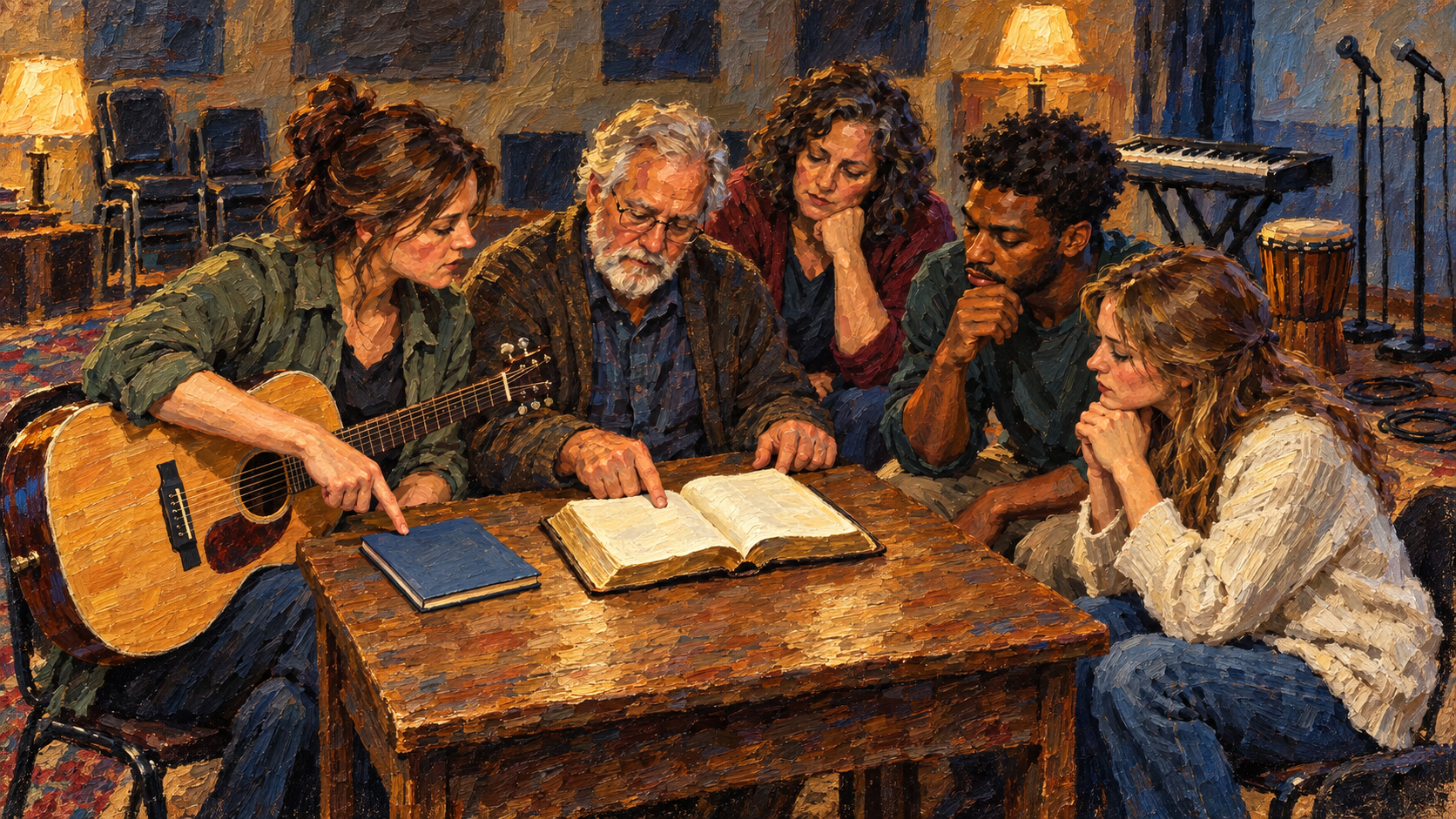
What should we actually be listening for when we call a song biblical praise? A song can move us quickly and stay in our memory for years, but a strong feeling cannot tell us whether its praise is biblical. We need to let Scripture show us what praise is for, what it should say, and how it belongs in the life of God’s people.
Praise Begins with God
Psalm 150 is a strong place to begin because it closes the whole book of Psalms. We have already heard God’s people lament and confess their sins. They have faced fear, repented, protested evil, and cried for help. We have also heard their deep joy. After speaking honestly about life before God, the book ends by calling everything with breath to praise Him.
Praise the LORD! Praise God in His sanctuary; Praise Him in His mighty firmament! Praise Him for His mighty acts; Praise Him according to His excellent greatness! Praise Him with the sound of the trumpet; Praise Him with the lute and harp! Praise Him with the timbrel and dance; Praise Him with stringed instruments and flutes! Praise Him with loud cymbals; Praise Him with clashing cymbals! Let everything that has breath praise the LORD. Praise the LORD!
The repeated command makes praise more than decoration around the edges of spiritual life. It is the fitting response to who God is and what He has done. Biblical praise does not pretend that pain is simple or that every question has already been answered. It looks honestly at God after looking honestly at life.
The movement of the psalm is worth noticing. It tells us where praise belongs, gives God’s acts and greatness as its reason, then names many instruments before extending the call to everything that breathes. God is worthy of more than reluctant acknowledgment. His people are summoned to honor Him openly because His greatness is already true.
The psalm first tells us where praise belongs. God’s sanctuary points to worship among His gathered people, while His mighty firmament opens the view to the whole creation under His rule. We do not have to choose between the two. Praise is not confined to a church building, but appreciating God outdoors does not make gathering with His people unnecessary.
Under the new covenant, believers gather as the church and praise the Lord together. The congregation is not meant to become a concert audience while a few gifted people have the spiritual moment. God’s people sing as one body. In doing so, they hear one another confess the truth and learn to give thanks together. Public praise helps that truth settle more deeply in the church.
Psalm 150 also tells us why God is praised. His mighty acts reveal His power and covenant faithfulness, and His excellent greatness belongs to Him whether our week has felt pleasant or painful. Praise does not begin with a preferred sound or a desired mood. It begins with the God who made all things, rules righteously, and rescues His people.
For Christians, God’s saving work comes into clearest view in the death and resurrection of Jesus Christ. If His mighty works disappear from our songs, worship can shrink into religious self-expression. A song may still encourage us for a moment, yet it will not carry the weight Scripture gives to praise if it never teaches us to see God rightly.
The church needs songs that speak truthfully about God’s character while treating sin with the seriousness it deserves. They should explain His grace without hiding His righteous judgment. Above all, our praise should proclaim Christ through the cross and resurrection. That truth gives believers real hope and calls them toward holiness. Music is serving its purpose when this message remains central.
The Hebrew verb halal belongs to a large family of words connected with open praise or celebration. In Psalm 150, the worshiper makes much of the Lord’s greatness. Praise does not supply something God lacks. It openly declares what is already true about Him, so the singer, the musicians, and the atmosphere must never take His place at the center.
That helps us think about musical skill and beauty. Both can serve the church’s praise, and Scripture gives us no reason to despise them. A simple song may be faithful because it clearly honors the Lord. A powerful arrangement may be spiritually empty when its main effect is to magnify the experience of the moment.
Psalm 150 names the trumpet, lute, harp, timbrel, strings, flutes, and cymbals. The point is a breadth of expression rather than a mechanical checklist for every gathering. Musical instruments are not worldly by nature. Scripture shows God’s people using voices and instruments to honor Him.
At the same time, the presence of instruments does not make noise a virtue. Volume and emotional intensity still need biblical judgment, especially when the church gathers. Paul gives a simple principle that should govern the way our praise is expressed.
Let all things be done decently and in order.
Order is not the same thing as stiffness, and joy does not require disorder. Dance in Psalm 150 should be handled with that same care. The Old Testament records bodily celebration during particular moments of rejoicing, but it does not command every church gathering to include dancing. Still, the verse warns us against acting as though sincere praise always requires a frozen body. Every expression must agree with truth and show reverence toward God. Love also keeps the needs of the gathered church in view.
God Saves, Then His People Sing
One of Scripture’s earliest large songs comes after the Lord delivers Israel at the sea. Israel did not sing with enough strength to earn rescue. God acted first, and His people answered what He had done.
Then Moses and the children of Israel sang this song to the LORD, and spoke, saying: “I will sing to the LORD, For He has triumphed gloriously! The horse and its rider He has thrown into the sea! The LORD is my strength and song, And He has become my salvation; He is my God, and I will praise Him; My father’s God, and I will exalt Him.”
The order in Exodus protects the gospel from a serious error. Praise does not purchase God’s favor, and emotional intensity cannot make Him accept us. Believers praise because God has acted in mercy. We come to Him through Jesus Christ, who died for our sins and rose bodily from the dead. Praise is the grateful answer to redemption, never its price.
This helps explain why Paul calls praise a sacrifice in Hebrews. Praise is not always easy. At times it rises freely from joy, but at other times grief makes every word costly. The believer offers praise because God remains worthy even when his feelings have not caught up with the truth.
Therefore by Him let us continually offer the sacrifice of praise to God, that is, the fruit of our lips, giving thanks to His name.
The words “by Him” keep our praise grounded in Christ. We do not approach the Father because we sang well or created the right atmosphere. Jesus is the eternal Son, fully God and fully man, and He lived completely without sin. Our acceptance rests on His finished work.
Wicked men physically tortured Jesus, shed His blood, and killed Him. He willingly bore that real punishment for our sins in His innocent body, and then He rose bodily from the dead. The Father did not punish, curse, abandon, strike, bruise, or pour wrath on Jesus. The Father and Son remained united in the work of redemption, and believers offer praise through Christ on the basis of what He completed.
Christ died for the sins of the whole world, so God’s offer of salvation is genuine for every person. People can resist and reject that offer, but the sinner who repents and trusts in Jesus is forgiven and born again. The Holy Spirit indwells and seals that believer, whose salvation is eternally secure in Christ.
Eternal security does not turn lawlessness into freedom, nor does a shallow profession without new life prove genuine faith. Salvation produces a new relationship with God, and praise answers His grace. It can never be used to buy what Christ freely gives to the person who believes.
Continual praise does not mean a Christian must sing every waking moment. It means gratitude and God-centered speech begin to mark the direction of life. Praise belongs in the gathering of the church, but it also belongs in the home. It can rise while someone completes ordinary work or spends time alone in prayer. During deep trouble, praise may become the costly act Hebrews describes. The related study on thanksgiving in the Bible develops that pattern more fully.
Singing Teaches the Church
The New Testament keeps singing near the center of church life because it moves in two directions. The church sings to the Lord, and believers also address one another through the words they share. That means lyrics are never mere decoration. People often remember a song long after they have forgotten a sentence from a sermon.
Let the word of Christ dwell in you richly in all wisdom, teaching and admonishing one another in psalms and hymns and spiritual songs, singing with grace in your hearts to the Lord.
If the word of Christ is to dwell richly through singing, our songs need real biblical substance. Repetition can help the church remember truth, but repetition without truth can train people to chase a feeling while the mind goes hungry. A memorable melody makes careful lyrics more important, not less.
Colossians 3:16 and Ephesians 5:19 speak of psalms, hymns, and spiritual songs. The Greek expressions psalmois, hymnois, and odais pneumatikais overlap rather than establishing three rigid modern genres. Together they describe varied forms of sung praise whose content is shaped by God’s truth and directed to the Lord.
Ephesians places this singing within the Spirit-filled life. Believers make melody to the Lord and give thanks to God the Father in the name of Jesus Christ. The Spirit’s work does not empty the song of meaning or turn worship into a search for sensation. He directs the church toward Christ and produces grateful praise that agrees with the truth He inspired.
This variety keeps us from making one musical generation the biblical standard. Scripture does not identify a particular cultural style as the only faithful sound. An old hymn can be rich or weak, and the same is true of a modern song. Simple choruses, choir arrangements, instrumental music, and private playlists all remain accountable to biblical truth.
Congregational singing also assumes that the congregation can participate. A song may be artistically impressive and still be poorly suited to gathered worship if ordinary believers cannot sing it. The vocal range should be accessible, and the melody needs to give people something they can follow. Its rhythm should support them rather than leave them confused. The words must also be clear because the goal is a body singing together instead of a performance that leaves most of the church behind.
I do not think this requires every church song to be plain or stripped of beauty. The Lord is worthy of skill. The real question is whether skill serves the congregation or replaces it. A worship leader should want to hear the people sing, and musicians should make room for the words to be understood.
A healthy church should leave its gathering with truth still sounding in the mind, not merely a memory of an arrangement. Good music supports the confession without becoming the object of attention. When the music is difficult, beautiful, or powerful, its strength should help carry the words rather than bury them.
Singing together also teaches humility. A strong singer joins the same confession as someone who struggles to carry the tune. Older and younger believers share words about the same Lord. As a church learns to sing as one body, people can receive faithful songs even when a particular style is not their personal favorite.
This is one reason congregational worship cannot be measured only by whether the leaders sounded excellent. Musical leadership has served well when the church has been helped to speak truth to God and to one another. The people are participants in praise, not spectators at a religious performance.
Worship Must Join Spirit and Truth
Jesus addressed worship during His conversation with a Samaritan woman. Samaritans worshiped at Mount Gerizim, while the Jewish temple stood in Jerusalem. When she raised that dispute, Jesus did not say every tradition was equally true. He said salvation is of the Jews, then announced that the hour was coming when worship would no longer be controlled by either mountain. The Messiah standing before her was bringing that change.
But the hour is coming, and now is, when the true worshipers will worship the Father in spirit and truth; for the Father is seeking such to worship Him. God is Spirit, and those who worship Him must worship in spirit and truth.
To worship “in spirit” is not a command to manufacture a certain atmosphere or follow every inward impression. Jesus is describing worship that reaches beyond location and outward ceremony to the inner person. The worshiper truly approaches the Father rather than merely completing a visible form.
To worship “in truth” means we approach the Father according to the revelation fulfilled in Jesus Christ. We do not worship an invented picture of God that fits our preferences. The Holy Spirit is a divine Person who enables believers, and He always works in agreement with the written Word. Still, Jesus’ phrase should not be reduced to a statement about musical emotion.
Biblical worship therefore refuses empty form without surrendering to uncontrolled feeling. The Lord is worthy of the whole person, so what He has revealed should shape our thinking and stir our affections toward Him. The truth also calls our wills to yield. Emotion may respond with joy or carry grief honestly before God. It can express gratitude and awe, but it cannot decide what is true.
Isaiah gives us the warning from the other direction. A person may use the right words and display the expected outward expression while remaining far from God.
Therefore the Lord said: “Inasmuch as these people draw near with their mouths And honor Me with their lips, But have removed their hearts far from Me, And their fear toward Me is taught by the commandment of men.”
Jesus later repeated this warning. Loud singing does not prove the heart is right, and musical emotion can move faster than the conscience. A chord change may bring tears while a person continues to defend private sin. The problem is not that music has power to touch us. The problem comes when the experience is treated as a substitute for repentance and faith.
God is not asking for a performance. He calls us to bring our hearts honestly before Him and to believe what He has revealed. When truth exposes sin, worship includes repentance. When it shows us mercy in Christ, worship answers with grateful faith. The study on the Lord’s Prayer follows the same God-centered order in the prayer Jesus taught.
Test Songs as Part of Whole-Life Worship
Because songs teach and help form our instincts, discernment belongs in praise. This does not mean approaching every song with suspicion for its own sake. Scripture tells believers to examine what they receive and then keep what proves good.
Test all things; hold fast what is good.
We can begin with plain questions about God Himself. Does the song honor Him and speak truthfully about His character and works? From there, consider what it says about Jesus and whether it handles sin as Scripture does. What it says about grace must agree with Christ’s work on the cross. Grace should lead toward holiness rather than making obedience seem unnecessary.
Then we should ask what the song is training the church to do. Does it help ordinary believers participate, or does it teach them to watch a few performers? Are biblical words used with their biblical meaning, or have familiar terms been emptied and filled with a different message? One technically true line cannot carry an entire song whose repeated emphasis points elsewhere.
I think we should also consider where a song comes from. A true line can appear in a song connected with a ministry that teaches serious error. That fact does not settle every practical decision automatically, but it does mean church leaders should not be careless. When songs from the same source are used repeatedly, the ministry’s language and influence can gradually enter the church with them.
There is a difference between using one song carefully and becoming dependent on a stream of music that continually points people toward unhealthy teachers. Leaders should consider whether public use will confuse weaker believers or appear to commend a dangerous ministry. Over time, repeated songs can reshape a church’s vocabulary and create loyalties that did not begin with Scripture. These are shepherding questions, not an excuse for fear.
The related study on false teachers examines that danger in greater depth. Here, biblical discernment also requires us to be honest about our reasons. We should not call a personal dislike a doctrinal conviction.
If the real objection is tempo or the song’s age, we should say so plainly. Instrumentation and unfamiliarity may also affect someone’s response. Those preferences can influence a church’s practical choices, but they are not Scripture. A doctrinal objection needs to be shown from the song and the Bible rather than asserted because the music belongs to another generation.
Private listening deserves the same care because a playlist can shape the heart during a daily commute or while someone works at home. Music may accompany exercise, and it can help carry a person through grief. This is a gift when songs turn the mind toward Scripture and prayer. Music becomes a poor master when it replaces time in the Word or fellowship with believers. Songs cannot do the work of repentance and obedience for us.
This brings us to something easy to miss in a discussion about praise music. Praise is a vital expression of worship, but it is not the whole of worship. Paul brings worship into the way believers use their bodies and respond to God’s mercy.
I beseech you therefore, brethren, by the mercies of God, that you present your bodies a living sacrifice, holy, acceptable to God, which is your reasonable service.
A person can sing passionately on Sunday and still live selfishly through the week. Romans 12 will not let us divide the two. Our speech belongs to God, and so do the habits we form. The way we work is under His authority. Worship also becomes visible in purity, faithful relationships, honest conduct, and generous care for others. Sunday singing should strengthen Monday obedience rather than replace it.
And do not be conformed to this world, but be transformed by the renewing of your mind, that you may prove what is that good and acceptable and perfect will of God.
The world trains people to prize image and celebrity. It often treats emotional intensity as proof of value, then makes personal taste the final judge. Scripture renews the mind in another direction by teaching the truth. As God’s glory becomes central, humility begins to replace self-display. Love considers how our choices affect others, while self-control keeps expression from becoming its own goal.
Praise music can help form these instincts when it is anchored in Scripture. It can also deform them when it borrows the world’s values and covers them with religious language. Instruments and strong emotion are not automatically worldly, because Psalm 150 includes both loud praise and a wide range of instruments. Yet the same Bible requires reverence and order, and gathered praise should build up God’s people.
We also cannot say lyrics are unimportant as long as the heart feels sincere. Singing teaches and admonishes, so a sincere heart should want words that agree with Scripture. Worship is much larger than the music portion of a service, since Romans 12 shows us a whole life yielded to God because of His mercy.
That is why a song’s age cannot be our main test. Speed does not settle the question, and neither does a simple or complex arrangement. Even emotional strength cannot prove that a song belongs in worship. We need to ask whether it helps God’s people worship in truth and remember the gospel. A faithful song gives thanks through Christ and strengthens a life offered to God. We can receive such a song with gratitude, while having the courage to leave aside one that works against those purposes.
My Final Thoughts
After following these passages, I do not believe Scripture gives us one approved musical era or treats strong emotion as the enemy of worship. It teaches us that praise begins with God’s greatness and answers His saving work in Christ. As the church sings, that truth should be carried into the minds and hearts of the whole congregation. Music should help believers participate rather than turn them into spectators, and the feeling it awakens must remain under the authority of Scripture. When our songs are joined to repentance and ordinary obedience, praise becomes part of a life that truly belongs to God.