
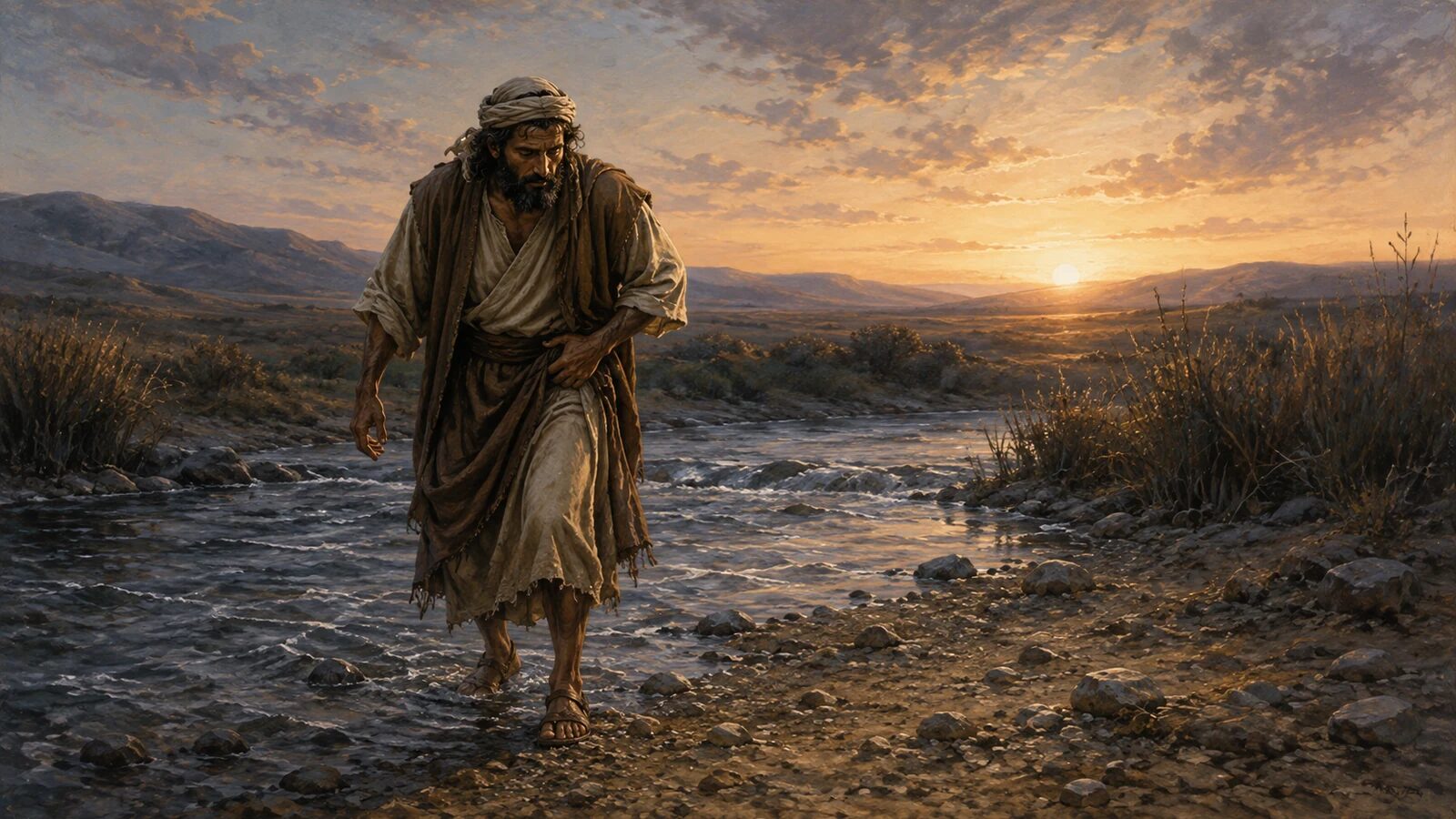
Jacob’s life is difficult to read because God’s promise runs through a man who repeatedly tries to secure what God had already declared. I have often wondered how to keep both truths in view: Jacob’s choices were often sinful, yet the Lord’s word about the younger son was never uncertain. Genesis shows a patient God who changes and disciplines a man who could not become Israel through cleverness.
God’s Choice and Human Responsibility
Jacob’s story begins before he ever makes a choice. Rebekah’s pregnancy is difficult, and she goes to inquire of the LORD. The struggle in her womb is not random. God tells her that two nations and two peoples are there, and that the older will serve the younger.
And the LORD said to her: “Two nations are in your womb, Two peoples shall be separated from your body; One people shall be stronger than the other, And the older shall serve the younger.”
I think this prophecy gives us the clearest starting point for Jacob and Esau. Under ordinary custom, the firstborn would receive the primary inheritance rights and leadership within the family. God announces beforehand that He will carry the covenant line in a way that overturns this normal expectation. The same pattern appears when God receives Abel rather than Cain and carries the promise through Isaac rather than Ishmael. He chooses Jacob rather than Esau. Later, He gives Ephraim the greater blessing instead of Manasseh.
Paul cites this history in Romans 9 while explaining God’s freedom in the covenant history of Israel. Genesis itself says that two nations and peoples are in view, and the later statement “Jacob I have loved, but Esau I have hated” comes from Malachi’s message about Israel and Edom centuries after the twins lived. The passage does not teach that God created Esau for unavoidable personal damnation or that individual sinners are unable to respond to His genuine offer. It establishes God’s right to choose the line and role through which His promise advances.
Still, prophecy is not permission to sin. God’s word tells where history is going, but the people in the story remain responsible for their actions. Jacob’s later deception is not justified because God had already spoken. God keeps His promise through Jacob, and God disciplines Jacob for his crookedness.
The Birthright and the Blessing
Jacob and Esau are different from the beginning. Esau is a skillful hunter, a man of the field. Jacob is a mild man dwelling in tents. The home is divided too. Isaac loves Esau because he eats of his game, and Rebekah loves Jacob. Favoritism gives sin room to grow.
The first defining conflict comes when Esau comes in weary and Jacob has stew. Jacob demands the birthright in exchange for food. Esau treats the birthright as something less valuable than immediate relief.
And Esau said, “Look, I am about to die; so what is this birthright to me?” Then Jacob said, “Swear to me as of this day.” So he swore to him, and sold his birthright to Jacob.
Hebrews later identifies Esau’s action as profane, meaning that he treated what was holy as common. He valued an immediate appetite above his spiritual inheritance. The warning is not limited to the ancient world because people still trade eternal things for temporary relief or pleasure. Someone may compromise rather than risk another person’s disapproval. Anger can make a bad bargain feel justified in the moment, while the desire for money or control can make temporary gain look more valuable than what God calls holy.
lest there be any fornicator or profane person like Esau, who for one morsel of food sold his birthright.
Jacob is not innocent in the scene. He sees Esau’s weakness and presses it, wanting what God had already said would be tied to him but reaching for it with grasping hands. Esau despises the birthright, and Jacob exploits the moment. Scripture gives us enough honesty to condemn both errors.
Jacob’s name is connected with the heel-grasping scene at his birth and with the idea of supplanting. Genesis lets that connection stay in view as his early character unfolds.
The conflict over the blessing brings the family’s sin into full view. Isaac intends to bless Esau, while Rebekah secretly plots on Jacob’s behalf. Jacob carries out the plan by lying to his father, and Esau later responds with hatred and a desire to kill. Genesis does not let us blame only one person. Favoritism has divided the whole household and given scheming, fear, and unchecked appetite room to grow.
Rebekah prepares food and covers Jacob’s smooth hands and neck with goatskins so the nearly blind Isaac will mistake him for Esau. Jacob does not merely allow a misunderstanding. He says, “I am Esau your firstborn,” and even invokes the LORD when Isaac asks how the game was found so quickly. The promised heir uses God’s name to support a lie. Naming that plainly keeps readers from romanticizing the deception as clever faith.
The birthright and the blessing are related, but they are not identical. The birthright concerns firstborn status and inheritance rights. The blessing is the patriarch’s formal pronouncement concerning future direction and covenant leadership. Jacob wants the blessing, but he takes a crooked road to reach it.
So Jacob went near to Isaac his father, and he felt him and said, “The voice is Jacob’s voice, but the hands are the hands of Esau.” And he did not recognize him, because his hands were hairy like his brother Esau’s hands; so he blessed him.
Jacob receives the blessing, but he does not enjoy peace. Esau’s rage rises, and Jacob must flee. That is a hard lesson: getting what you wanted by sin can still leave you miserable. God had already spoken about the older serving the younger. Jacob did not need deception to make God faithful.
Rebekah’s plan also costs her dearly. She sends Jacob away to protect him, but the story never shows her seeing him again. Sin promises to manage the future. It often steals the very future it promised to protect.
Bethel, Haran, and God’s Patient Discipline
Jacob leaves home carrying fear and guilt but very little else. This is not a journey of victory. He sleeps outdoors with a stone near his head because he is fleeing from consequences he helped create. God meets him in that humbled condition.
Then he dreamed, and behold, a ladder was set up on the earth, and its top reached to heaven; and there the angels of God were ascending and descending on it.
The word often translated ladder likely refers to something like a stairway or ramp. Its exact shape is less important than what Jacob sees: a real connection between heaven and earth that he did not build and could not control.
The Lord then identifies Himself as the God of Abraham and Isaac. He promises Jacob the land and descendants who will spread abroad. Through this family, blessing will reach all the families of the earth. God also promises His presence and protection as Jacob travels. He will bring Jacob home and remain faithful until everything He has spoken is fulfilled.
Behold, I am with you and will keep you wherever you go, and will bring you back to this land; for I will not leave you until I have done what I have spoken to you.
This is grace, because Jacob did not earn the meeting and God is not calling his deception good. God is committing Himself to His covenant word, so the promise rests on the Lord rather than Jacob’s maturity.
Jacob responds with awe, names the place Bethel, meaning “house of God,” and sets up the stone as a pillar. His vow still sounds conditional: if God keeps him, feeds him, clothes him, and brings him home, then the LORD will be his God and Jacob will give a tenth. The vow may express emerging faith, but it also shows how much growth remains. God has spoken an unconditional covenant promise, while Jacob answers in the cautious language of a man still learning to trust.
Jesus later applies the imagery of Bethel to Himself. He tells Nathanael that he will see heaven opened with the angels of God ascending and descending upon the Son of Man. The true connection between heaven and earth is not a ladder that Jacob can climb. It is Christ Himself. The Son of Man is fully God and fully man and is the only Mediator between God and humanity.
And He said to him, “Most assuredly, I say to you, hereafter you shall see heaven open, and the angels of God ascending and descending upon the Son of Man.”
Jacob arrives in Haran and meets Rachel, but he soon experiences the kind of deception he practiced at home. He agrees to work seven years for Rachel, only for Laban to give him Leah instead. Jacob is now the one deceived, and the question he asks Laban cuts close to home: why have you deceived me?
So it came to pass in the morning, that behold, it was Leah. And he said to Laban, “What is this you have done to me? Was it not for Rachel that I served you? Why then have you deceived me?”
Genesis is not mocking Jacob for entertainment but showing how God disciplines His people within the real circumstances of life. Jacob practiced deception in his father’s tent and then spent years under a man who repeatedly deceived him. These consequences were not random because the Lord was working upon Jacob’s character.
The family that grows in Haran is marked by pain. Leah is unloved, while Rachel is loved but remains barren for a time. The sisters compete with one another, and their children are born into that rivalry. Genesis records this polygamous household without romanticizing it. The family becomes fruitful, but much of that fruit comes through sorrow.
God still builds the family that will become Israel. That is not approval of the sin and pain in the home. It is proof that the Lord can carry His promise through tangled lives while still exposing what is broken.
Jacob is also exploited in his work. Laban changes his wages and tries to control the outcome, but God protects Jacob and provides for him. Jacob eventually recognizes that the increase came from God.
So God has taken away the livestock of your father and given them to me.
Haran slows Jacob down. He arrives as a young man who is running from his past. When he leaves, he carries the responsibilities of a large family and the scars of many difficult years. He also possesses a growing awareness that the Lord can provide without Jacob scheming to control every outcome.
Returning to the Land
After years in Haran, the Lord commands Jacob to return to the land of his fathers. Jacob is not returning because he feels brave. He is returning because God speaks and promises to be with him.
Then the LORD said to Jacob, “Return to the land of your fathers and to your family, and I will be with you.”
Obedience does not always remove fear before the first step. As Jacob draws near to Esau, his old fear rises because Esau is coming with four hundred men. Jacob divides the camp and sends gifts. Some of that is prudence, but none of it can cleanse his old guilt.
Jacob’s prayer in Genesis 32 shows real growth. He appeals to God’s command and promise, and he confesses that he is not worthy of the least of the Lord’s mercies.
I am not worthy of the least of all the mercies and of all the truth which You have shown Your servant; for I crossed over this Jordan with my staff, and now I have become two companies.
This is not the same Jacob who once sounded as though he could manage everything. Fear remains, and he is still making plans, but he now speaks to God from the ground of promise and unworthiness. That is real spiritual growth. Sanctification is often slower than we want, and God often uses pressure to expose the places where we still trust our reflexes more than His word.
The God Who Changes Jacob
At the Jabbok, Jacob is left alone and a Man wrestles with him until daybreak. The passage is mysterious, but its main point is clear. Jacob experiences a divine encounter. Genesis says that he names the place Peniel because he has seen God face to face. Hosea later confirms that Jacob struggled with God and with the Angel.
Then Jacob was left alone; and a Man wrestled with him until the breaking of day. Now when He saw that He did not prevail against him, He touched the socket of his hip; and the socket of Jacob’s hip was out of joint as He wrestled with him.
Jacob does not overpower God because the Man can disable him with a single touch. The wrestling continues only because God allows it. The account shows Jacob being humbled rather than proving his strength. He moves from striving against God to clinging to Him.
And He said, “Let Me go, for the day breaks.” But he said, “I will not let You go unless You bless me!” So He said to him, “What is your name?” He said, “Jacob.” And He said, “Your name shall no longer be called Jacob, but Israel; for you have struggled with God and with men, and have prevailed.”
When the Man asks, “What is your name?” Jacob must acknowledge who he has been. His name identifies him as the heel-grabber and supplanter who has spent his life getting around other people. God then gives him the new name Israel. His life will bear the marks of struggling with God and men and being changed through that struggle.
He took his brother by the heel in the womb, And in his strength he struggled with God. Yes, he struggled with the Angel and prevailed; He wept, and sought favor from Him.
I understand this as a true divine encounter, consistent with the Old Testament pattern of the LORD making Himself known. We should not turn every angel reference into Christ, but Hosea’s language and Genesis 32’s “face to face” testimony show that Jacob’s encounter is more than an ordinary human contest.
The Man who wrestles with Jacob is a preincarnate appearance of the eternal Son, a Christophany. Hosea can call Him the Angel while also saying Jacob struggled with God and sought favor from the LORD God of hosts. This is the distinctive divine Messenger, not an ordinary created angel and not Jesus beginning to exist before Bethlehem.
The name Israel is tied to striving with God. It is not a trophy for self-reliance. It marks Jacob as a man humbled and reshaped by his encounter with God.
Jacob limps away, and that limp is an expression of mercy. God leaves him with a bodily reminder that his future will not rest upon natural strength. Neither clever hands nor quick schemes can secure God’s blessing. The man who spent his life grasping now walks with a weakness that reminds him where blessing comes from.
Scripture continues to use both names after this event. “Israel” marks the identity God gives him and becomes the name of the nation, but Genesis still calls the man Jacob in later scenes. The new name signals God’s transforming claim rather than pretending every old weakness disappeared in a moment.
Jacob’s Legacy and Israel’s Future
After Jabbok, Jacob meets Esau. He expected danger, and Esau embraces him. That does not erase the past, and it does not mean every broken relationship will be restored the same way. But it does show the Lord can go ahead of His people and soften what they cannot control.
But Esau ran to meet him, and embraced him, and fell on his neck and kissed him, and they wept.
Jacob’s later years bring deep grief. Rachel dies, and after Joseph is sold, Jacob spends many years believing his son is dead. Faith does not make a man emotionally numb, so Genesis lets the patriarch grieve honestly. Yet God’s promise is still moving even when Jacob cannot see the full story.
There is also serious family sin between the reconciliation with Esau and the loss of Joseph. Dinah is violated at Shechem, and Simeon and Levi answer deceitfully before slaughtering the city’s males. Jacob condemns their action, though his first response focuses heavily on the danger it brings to his household. God then commands him to return to Bethel. Jacob orders his household to put away foreign gods, purify themselves, and change their garments before he builds an altar where God first met him in flight. Returning to Bethel becomes a concrete return to worship and separation from household idolatry.
Years later, famine brings Jacob’s family to Egypt after Joseph is revealed alive and serving under Pharaoh. God tells Jacob not to fear the descent because He will make Israel a great nation there and will bring the family up again. Jacob arrives as a dependent immigrant, yet he blesses Pharaoh and testifies that his years have been difficult. Before dying, he adopts Joseph’s sons Ephraim and Manasseh and deliberately places the greater blessing on the younger Ephraim. The younger-son pattern that shaped Jacob’s own life appears again, this time through his conscious prophetic act rather than deception.
Near the end of his life, Jacob blesses his sons. These words are not casual wishes. They set directions for the tribes. Judah receives a kingly promise that points beyond Judah’s immediate descendants to the Messiah.
The scepter shall not depart from Judah, Nor a lawgiver from between his feet, Until Shiloh comes; And to Him shall be the obedience of the people.
The covenant line moved through Abraham before continuing through Isaac and Jacob. It now points toward Judah and ultimately to Christ. Jacob the schemer has become the prophetic patriarch whose words reach far beyond his own household.
Scripture also uses Jacob’s name for the nation that comes from him. Jeremiah speaks of a future time of severe distress called the time of Jacob’s trouble, followed by deliverance. That belongs to Israel’s future and should not be flattened into a generic metaphor. The trouble is real, and God’s promised deliverance is real.
Alas! For that day is great, So that none is like it; And it is the time of Jacob’s trouble, But he shall be saved out of it.
The pattern in Jacob’s life also fits the nation that comes from him. Both are chosen according to God’s Word and disciplined because of sin. Yet the Lord preserves them because He does not abandon His promises. Jacob’s life therefore reaches beyond a personal biography. It becomes part of Israel’s history and the coming of Messiah. Above all, it testifies to God’s faithfulness.
This future distress belongs within the literal Tribulation that precedes Christ’s bodily return and kingdom reign. Jeremiah’s promise does not say Israel will be erased or replaced. The nation descended from Jacob will be brought through judgment and delivered according to God’s covenant faithfulness.
Jacob’s story does not allow us to use God’s promise as permission to sin. He was chosen before birth, but his deception was still evil. A true promise from God should lead us toward obedience instead of persuading us to manipulate what He has already said He will do.
Esau also warns us not to treat holy things as small when an immediate desire is pressing on us. Jacob’s years in Haran show another side of the story. God’s discipline was painful, yet it exposed Jacob’s grasping heart and taught him that the Lord could provide without his constant control.
By the time Jacob prays before meeting Esau, he is no longer speaking as though he can manage his own future. At Jabbok, the man who spent his life grabbing is brought to cling to God. The change does not erase every weakness at once, but it shows what grace does in a life that learns to trust the Lord.
My Final Thoughts
After working through Jacob’s story, I do not think the lesson is that deception somehow helps God accomplish His will. God had spoken before the twins were born, and He did not need Jacob’s schemes to preserve the covenant. Yet He did not abandon Jacob to the consequences of those schemes. The Lord met him at Bethel and disciplined him through hard years. He also brought Jacob home and gave him the name Israel. That gives us hope without excusing sin, because God’s grace is strong enough to transform a crooked heart while teaching us to trust His word instead of forcing our own future.