
Giants appear at several important moments in the Bible, but the passages raise different questions. Who were the sons of God and the Nephilim before the Flood, and were they connected to the giant peoples later found in Canaan? I also want to understand why these enemies caused such fear, while being careful not to fill Scripture’s silences with theories of my own.
Genesis 6 and the Rebellion Before the Flood
Taking these passages seriously means neither explaining them away nor claiming more than they say. Some readers develop theories about secret bloodlines and hidden races that go far beyond Scripture. Others find the passages so strange that they explain away their substance. We need to let the text speak even when it leaves questions unanswered.
What Scripture records about giants shows us more than their unusual size. We see evil becoming bold and God’s people speaking out of fear as though they no longer knew Him. Yet the Lord kept His promises when His people felt weak, and every intimidating power remained subject to His judgment. Those are reasons to study these accounts beyond satisfying our curiosity.
Genesis 6 introduces the Nephilim before the Flood, while Job helps us understand the Old Testament phrase sons of God. Jude and 2 Peter also describe angelic rebellion under judgment. Later, Numbers and Deuteronomy name giant peoples around Canaan. Joshua records victory over the Anakim, and the books of Samuel describe Israel’s encounters with Goliath and later warriors from Gath.
Genesis 6 describes the world as the Flood approached. Moses was preparing us to understand that judgment, not adding a strange legend for color. Human sin remains central, but Genesis 6:1-4 also describes something abnormal and corrupting alongside humanity’s growing wickedness.
Now it came to pass, when men began to multiply on the face of the earth, and daughters were born to them,
that the sons of God saw the daughters of men, that they were beautiful; and they took wives for themselves of all whom they chose.
And the LORD said, “My Spirit shall not strive with man forever, for he is indeed flesh; yet his days shall be one hundred and twenty years.”
There were giants on the earth in those days, and also afterward,
when the sons of God came in to the daughters of men and they bore children to them.
Those were the mighty men who were of old, men of renown.
Moses introduced the strange union and named the Nephilim before describing the wickedness and violence that filled the earth. The union belongs to the setting for God’s response, but Scripture never makes the Nephilim the only reason for the Flood. Humanity was collapsing morally while this other corruption twisted God’s design.
I need to follow that sequence rather than let the Nephilim draw all my attention. The human population multiplied before the sons of God took the daughters of men. God then spoke about His Spirit striving with flesh. After naming the Nephilim, Moses turned to the thoughts of the human heart and the violence covering the earth. The strange rebellion belongs in our reading, but mankind’s moral collapse remains central. God grieved over the world humanity had corrupted.
To understand who the sons of God were, I look at how Job uses the phrase. There these beings presented themselves before the LORD in a heavenly court, and Satan came among them.
Now there was a day when the sons of God came to present themselves before the LORD, and Satan also came among them.
Job 2:1 uses the phrase in that same setting, and Job 38:7 uses it in describing the earth’s creation. These passages lead me to understand the sons of God in Genesis 6 as heavenly beings who rebelled. The Sethite view instead identifies them as godly men from Seth’s line who married women from Cain’s line. That reading recognizes the moral contrast in Genesis and understands the union as ordinary marriage.
My difficulty with the Sethite reading is that Genesis never calls these men sons of Seth. Moses uses the established phrase sons of God, then describes the unusual outcome involving the Nephilim, who became mighty men of renown. The Sethite view can be argued, but I find the angelic reading more consistent with how the Old Testament uses the phrase.
We also need to account for those figures of extraordinary power and renown beside the union. Ordinary intermarriage between faithful and unfaithful families is sinful when it draws people away from God, but Genesis places this union beside figures remembered for extraordinary power and renown. Jude’s account of angels leaving their proper domain further supports the understanding that a boundary God established had been crossed.
Later Scripture also points back to a grave angelic rebellion. Jude speaks of angels who abandoned their proper domain:
And the angels who did not keep their proper domain, but left their own abode, He has reserved in everlasting chains under darkness for the judgment of the great day;
Peter places his reminder of sinning angels beside the judgment of the ancient world:
For if God did not spare the angels who sinned, but cast them down to hell and delivered them into chains of darkness, to be reserved for judgment; and did not spare the ancient world, but saved Noah, one of eight people, a preacher of righteousness, bringing in the flood on the world of the ungodly;
These passages establish that spiritual beings rebelled and that God judged them. They do not tell me how the events in Genesis 6 took place. I can accept what Scripture reveals without constructing a system of modern bloodlines from what it leaves unsaid. A fuller discussion of created heavenly beings appears in A Complete Bible Study on Angels.
Created angels must also be kept distinct from divine appearances in the Old Testament. That separate subject is examined in Christophanies in the Old Testament. The beings in Genesis 6 are rebels under God’s authority, not divine rivals to Him.
I understand the 120 years in Genesis 6 as a period of patience before the Flood, rather than a rule that immediately shortened every person’s lifespan. God said He would not keep striving with man forever, yet He allowed a measured time before judgment. He warned the world and restrained wickedness for a time. When He finally acted, His judgment was not random.
God’s patience did not mean He was indifferent to evil. By announcing a limit, He made clear that the ancient world could not continue on that course forever. He gave time before acting, and judgment came at the appointed time.
The Nephilim and the Limits of What We Know
The rare Hebrew term Nephilim is difficult to define. The NKJV translates it as “giants” in Genesis 6:4 and Numbers 13:33. Its often-proposed connection with falling has led some to understand it as fallen ones, while others understand it as people who cause others to fall. Knowing those possibilities helps us recognize the uncertainty rather than hide it. The setting is ominous, but a debated word root cannot bear the weight of a doctrine.
Genesis 6:4 includes the phrase “and also afterward.” I cannot take those few words as proof that the Nephilim survived the Flood, because the passage does not say that. It also leaves unexplained how a similar giant presence appeared later. The phrase prepares us to encounter giant language after the Flood without treating it as an entirely new subject.
Because the word is rare, I want to let Genesis 6 and Numbers 13 determine how I understand Nephilim, instead of making it support a theory neither passage states. How to Study the Bible Properly develops that wider principle. We can speak confidently about what God has revealed without pretending to know what He has left unsaid.
Giants in Canaan and the Fear at Kadesh Barnea
When Israel reached the edge of the promised land, the presence of giants raised a different question. Much about Genesis 6 remains obscure, but the military danger in Numbers 13 was plain. Real enemies occupied fortified cities. Israel had to decide whether to trust God’s promise when those enemies looked overwhelming.
Ten spies returned with a report shaped by fear. They admitted that the land was good, but spoke as though God could not bring Israel into it:
"There we saw the giants (the descendants of Anak came from the giants);
and we were like grasshoppers in our own sight,
and so we were in their sight."
The spies’ grasshopper comparison tells me how they were measuring Israel. What they could see and feel had become more convincing to them than God’s promise. Yet He had already redeemed the nation from Egypt by blood and power. They had crossed the Red Sea and lived by His provision in the wilderness. Their fear did not erase any of that, but made His past acts seem distant beside the danger in front of them.
Under the influence of that report, Israel viewed itself as grasshoppers certain to be crushed rather than as the people God had redeemed. This was more than a passing anxious moment. Their fear was shaping what they believed could happen, and that judgment contradicted the word of the God who had brought them there.
The spies said they had seen the Nephilim and connected them with Anak’s descendants. But Numbers places that claim within a report already distorted by fear. The ten men went from describing strong people and fortified cities to calling the land one that devoured its inhabitants and claiming all its people were tall. They may have been using the oldest frightening name they knew for unusually large men.
There may have been a deeper connection, but Scripture never explains one. I don’t want to dismiss the giants the spies saw, and I cannot use their frightened report to settle a question God left open. What we can see clearly is the effect on Israel. These enemies appeared beyond ordinary human strength, so their presence tested whether Israel would trust Him.
Caleb answered without pretending that the enemy was small. Joshua joined him in insisting that Israel could obey because the LORD was with them:
"Only do not rebel against the LORD, nor fear the people of the land, for they are our bread;
their protection has departed from them, and the LORD is with us. Do not fear them."
Fear can shape our thinking until defeat seems certain and obedience appears pointless. Joshua and Caleb understood the danger in light of God’s presence instead. The generation that rejected their counsel died in the wilderness, showing that the God who kept His promise also disciplined unbelief.
Kadesh Barnea warns me against assuming that past experience of God’s deliverance makes present obedience automatic. That generation had truly been delivered, yet refused to move forward when trust was required. Joshua and Caleb knew the same dangers as the other spies. They differed in allowing the LORD’s presence to determine what those dangers meant.
Deuteronomy identifies several tall and formidable peoples under the broad ancient designation Rephaim. The Moabites called those who had lived in their territory Emim, while the Ammonites called a comparable people Zamzummim. The Anakim were descendants of Anak, particularly associated with Hebron and the surrounding hill country.
These post-Flood groups were human peoples with their own lands and rulers, and Scripture records their histories. It never says they originated in the same forbidden event described in Genesis 6. Although Numbers 13 records the spies’ use of Nephilim language, it does not supply an exact genealogy connecting the pre-Flood Nephilim with every later giant clan.
Og king of Bashan is identified as one of the remaining Rephaim. Deuteronomy records the extraordinary size of his bed to show that he was not an easy opponent on human terms:
For only Og king of Bashan remained of the remnant of the giants. Indeed his bedstead was an iron bedstead.
(Is it not in Rabbah of the people of Ammon?) Nine cubits is its length and four cubits its width, according to the standard cubit.
The measurements of Og’s bed make it clear that Israel faced an unusually formidable opponent. I don’t need to minimize his strength to understand the victory. His strength was real, but it could not protect him from the LORD’s decree.
Deuteronomy also notes that tall peoples had been displaced before Israel arrived. Their earlier defeat showed that no giant was truly unbeatable:
(That was also regarded as a land of giants; giants formerly dwelt there.
But the Ammonites call them Zamzummim, a people as great and numerous and tall as the Anakim.
But the LORD destroyed them before them, and they dispossessed them and dwelt in their place,
Some of the difficulty with these names comes from Deuteronomy describing related groups as different nations knew them. Moabites and Ammonites had their own names for the peoples displaced from their territories. Their neighbors remembered these clans and their histories, so Israel was encountering known peoples, not a hidden race we must reconstruct through speculation.
God had already removed giant-like groups from other regions. Israel could regard such enemies as invincible only by treating their visible strength as beyond His power. We do not need every detail of their genealogy to understand why Israel could prevail. Its own strength would not explain the victory; God’s faithfulness to His word would.
Joshua, Caleb, and God’s Judgment in Canaan
The conquest shows God fulfilling His covenant promises while judging wickedness that had continued for generations. Israel’s natural bravery does not account for it. Long before Joshua, the LORD had told Abraham that judgment would wait because the Amorites’ iniquity was not yet complete.
"But in the fourth generation they shall return here, for the iniquity of the Amorites is not yet complete."
God withheld judgment patiently until the appointed time. When He commanded Israel to act, He did so at a unique moment in history. That direct command never gave the nation unrestricted permission for violence.
God also showed mercy within that judgment. Rahab was spared when she responded in faith, and the Gibeonites lived after seeking terms with Israel. I need to see both His right to judge and the mercy Scripture records, rather than letting one obscure the other.
Joshua eventually cut the Anakim off from the hill country. A remnant remained on the Philistine coast:
And at that time Joshua came and cut off the Anakim from the mountains: from Hebron, from Debir, from Anab,
from all the mountains of Judah, and from all the mountains of Israel; Joshua utterly destroyed them with their cities.
None of the Anakim were left in the land of the children of Israel; they remained only in Gaza, in Gath, and in Ashdod.
The giants who had once paralyzed Israel could not hold their ground when God fulfilled His word. Decades after Kadesh Barnea, Caleb asked for the very hill country associated with the Anakim. Instead of seeking an easy retirement, he still trusted God’s promise concerning that land:
"Now therefore, give me this mountain of which the LORD spoke in that day;
for you heard in that day how the Anakim were there, and that the cities were great and fortified.
It may be that the LORD will be with me, and I shall be able to drive them out as the LORD said."
Caleb was asking for the specific ground that fear had once kept Israel from taking. His confidence rested in the LORD’s presence, not in his own ability. I see his request as continued trust in the promise, even after all those years.
Joshua and Caleb recognized the size of their enemies without treating them as greater than the LORD. Their courage was more than optimism about how events might turn out. They were acting on a promise God had actually given Israel, which is what made their confidence different from wishful thinking.
Goliath, Later Giants, and the Meaning of Their Defeat
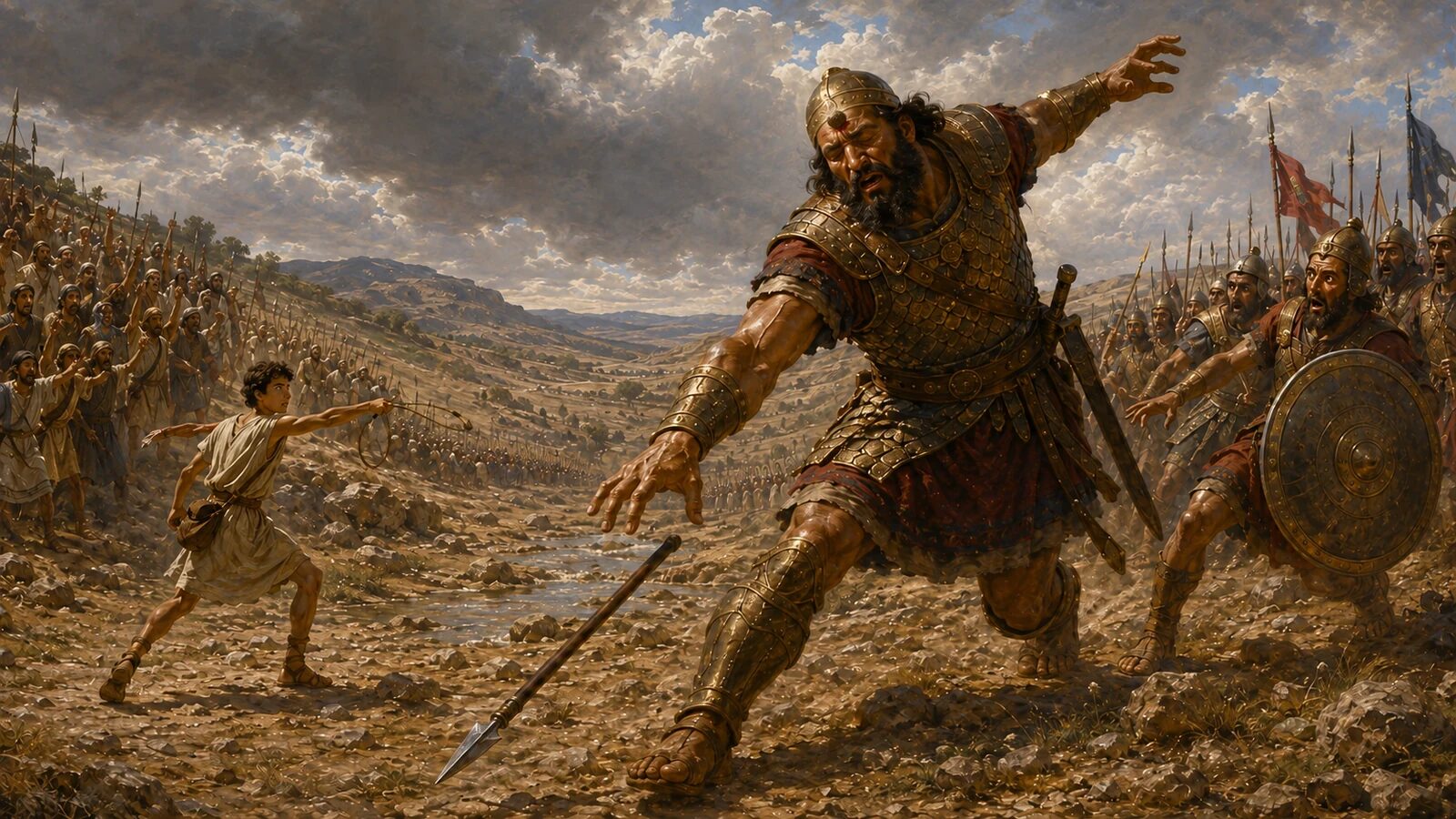
The remnant in Gath helps us understand why giant champions appeared again in Israel’s history. By 1 Samuel 17, the Philistines were pressing hard against Israel and Goliath had stepped forward from Gath as their champion. He relied on repeated challenges as well as his skill in battle, until fear began to feel normal and courage seemed unrealistic.
Goliath prolonged the confrontation through intimidation. Each challenge that went unanswered made another day of shame seem more likely to Israel’s army. Saul and his men still had weapons and military experience, but their words reflected fear rather than confidence in the God of Israel.
When Saul and all Israel heard these words of the Philistine, they were dismayed and greatly afraid.
David heard a direct challenge to the living God. His response gives us no reason to turn this encounter into a lesson about self-esteem:
Then David spoke to the men who stood by him, saying,
"What shall be done for the man who kills this Philistine and takes away the reproach from Israel?
For who is this uncircumcised Philistine, that he should defy the armies of the living God?"
When David called Goliath uncircumcised, he was speaking about covenant standing, not making a racial insult. Circumcision marked Israel as set apart to the LORD. This Philistine had no covenant standing from which to mock God’s people as though their God were powerless.
David remembered the LORD’s help against the lion and the bear. He was trusting the God who had delivered him before, not merely looking back with nostalgia:
Moreover David said, "The LORD, who delivered me from the paw of the lion and from the paw of the bear,
He will deliver me from the hand of this Philistine." And Saul said to David, "Go, and the LORD be with you!"
David’s faith rested on who God is and what He had done, rather than on a technique for making himself feel confident. He removed Saul’s armor because he had not tested it and went into battle with the ordinary means God had trained him to use.
The sling and stone were ordinary tools, not magic, and David used them in trust toward the LORD. He then finished the victory with Goliath’s own sword. God brought down proud strength in a way that prevents me from explaining the outcome by human skill alone.
Goliath was not the last giant warrior from Gath. Later men connected with that city fell to David’s servants:
These four were born to the giant in Gath, and fell by the hand of David and by the hand of his servants.
These later victories remind me that Goliath was not an isolated oddity. Physically imposing champions repeatedly intimidated Israel, and God repeatedly gave victory through faithful servants. That history cannot be reduced to a lesson in positive thinking.
The emphasis develops as we move from Genesis to Samuel. Before the Flood, evil became unusually bold and corrupting. In Canaan, the giant peoples tested Israel’s faith through intimidation, and Goliath brought that pressure back after earlier victories. God’s people could still be vulnerable to a tactic they had faced before. Its repetition did not make the LORD any less faithful.
The New Testament never tells believers to become experts in giant lore. It does teach that spiritual conflict is real:
For we do not wrestle against flesh and blood, but against principalities, against powers,
against the rulers of the darkness of this age, against spiritual hosts of wickedness in the heavenly places.
Paul directs believers to stand firm with the armor God provides. The conflict is spiritual, but our response is to hold to truth and obey faithfully. Fascination with forbidden knowledge and hidden lore is no substitute for what God has told us to do.
Colossians 1:16 says that every visible and invisible power was created through Christ and for Him. That includes the beings now acting in rebellion. Whatever authority they exercise is borrowed and limited, so I should never regard them as God’s equals. Jesus Christ is their Creator and rightful Lord.
Genesis 6 does not tell us how angelic sin occurred, so we cannot invent those details. I also want to represent the Sethite reading fairly, even though Job’s use of sons of God and the later passages about angelic judgment leave me less persuaded by it.
Nor does the Bible authorize secret bloodline theories or modern giant conspiracies simply because we are curious. But avoiding speculation should not lead us to reduce Goliath to a lesson about believing in ourselves. The account concerns God’s name and His covenant people, and shows Him defeating proud defiance.
I would also be careful about calling every hardship a “giant.” A diagnosis is not Goliath in the historical sense, nor are repeated temptations or financial pressures. The same is true of a hostile workplace or strained relationship. The comparison helps only where visible danger intimidates us until obedience seems impossible. At that point I need to decide whether fear will determine my conclusion or whether I will trust what God has actually said.
Genesis 6 should make us sober about rebellion because evil can become organized and bold enough to corrupt an entire society. God still sees it clearly. Nothing rebellious in the human or spiritual realm can remain hidden from Him.
We should take the Bible’s information about the unseen realm and ancient giant peoples seriously without pretending to know details it never reveals. That restraint is not unbelief. It honors the difference between what God has revealed and what we would like to know.
When obedience feels costly, I need to remember the difference between the ten spies and Joshua and Caleb. They saw the same genuine danger, but the ten were more convinced of the threat than of God’s promise. Joshua and Caleb trusted the LORD’s presence, as David later did when Goliath tried to paralyze Israel through fear. In each case, God kept His word despite what threatened His people.
Giants belong within Scripture’s larger accounts of corruption before the Flood and judgment in Canaan. They also appear in the defiance directed against God’s covenant people. Scripture gives us enough information to take them seriously without making them its central subject or dismissing them as a sideshow. The Lord’s authority governs these events.
Christ’s victory is not an inspiring metaphor for overcoming intimidating circumstances. The Son of God defeated sin and death through events that happened in history. Wicked men physically tortured and punished Jesus before killing Him, and He willingly bore that real punishment for our sins in His innocent body. He shed His blood and truly died. After His burial, He rose bodily.
The Father did not punish or curse Jesus, nor did He abandon Him or strike or bruise Him. He never poured wrath on the Son. Father and Son remained united in redeeming us. Christ made salvation available to the whole world, and God genuinely offers it even though people can resist and reject Him. He calls every person to repent and believe in Jesus Christ.
Those who trust Him receive forgiveness and justification, which means God declares them righteous. He gives them new birth and makes them new. The Holy Spirit comes to live within them and seals them, so their salvation is eternally secure. That security gives no permission for lawlessness, and a superficial profession does not prove that someone has truly been born again.
My Final Thoughts
I believe Genesis 6 describes a real angelic rebellion, but I do not want to claim more than the passage reveals. The later giant clans and champions were real enemies too, yet none could overturn God’s promise or escape His judgment. Joshua, Caleb, and David understood the danger without granting it more authority than the LORD. Their responses help me remain sober about evil without becoming absorbed in speculation. When obedience seems beyond my strength, I need to return to what God has said and trust Him to keep His word.