
Nebuchadnezzar was one of the most powerful kings in the ancient world, yet Daniel keeps drawing our attention to the God who stood above him. How could Babylon conquer Jerusalem and still be serving a purpose it did not understand? The more we follow the king through Daniel 1-4, the clearer it becomes that even his greatest victories never placed him beyond the reach of the Most High.
Judah Falls, but God Still Rules
Nebuchadnezzar enters Daniel as the conquering king of Babylon. His army comes against Jerusalem during the reign of Jehoiakim. Selected Judeans are carried into exile, and sacred articles are removed from the temple. From a human perspective, it looks as if a pagan empire has defeated Judah and taken trophies from the house of God. Daniel does not let us read the event that way.
And the Lord gave Jehoiakim king of Judah into his hand, with some of the articles of the house of God, which he carried into the land of Shinar to the house of his god; and he brought the articles into the treasure house of his god.
Daniel 1:2, NKJV
The first explanation belongs to the Lord: He gave Jehoiakim into Nebuchadnezzar’s hand. Babylon had real military strength, and its soldiers brought real suffering to Jerusalem. The king remained responsible for what he did. Yet Judah’s fall did not mean that God had become weak or lost control. The covenant warnings were being fulfilled, and the prophets had spoken truthfully. God was disciplining His people while preserving His larger purpose.
Daniel 1 uses the Hebrew title Adonai, meaning Lord or Master, for the One who gave Judah’s king into Nebuchadnezzar’s hand. I find that choice fitting because Babylon seemed to be the master of the moment. Nebuchadnezzar could command armies and remove treasures from Jerusalem, but Daniel begins by identifying the true Master of history.
This keeps us from making either of two mistakes. The suffering of God’s people does not mean that He has lost control. At the same time, God’s use of a nation in judgment does not prove that the nation is righteous. Babylon could serve as a rod of discipline and still be held accountable for its idolatry, pride, and violence. Habakkuk wrestled with this same truth. The Chaldeans served a purpose in God’s hand, but they would still answer to the God they refused to honor.
Daniel’s captivity belonged to the first deportation, commonly associated with 605 BC. Nebuchadnezzar took only some of the temple articles at that time. A larger deportation followed with King Jehoiachin in 597 BC, and Jerusalem was finally destroyed after Zedekiah’s rebellion in 587 or 586 BC. The judgment unfolded over years, which explains how Daniel could already be serving in Babylon while prophets continued warning those who remained in Jerusalem. Even in exile, God was placing Daniel and his friends inside the royal court where His truth would confront Babylon’s king.
The articles from the temple were carried to Shinar, a name that reaches back to Babel in Genesis 11. The people there gathered to build a city and make a name for themselves apart from obedience to God. Their tower was more than a construction project. It expressed organized pride and a desire for greatness on human terms.
Babylon carried that older spirit forward. The empire educated its captives in Babylonian learning so they could serve its purposes. It replaced their Hebrew names with names tied to Babylon’s gods and offered them food from the royal table. That same system could threaten or kill anyone who resisted. By placing the temple vessels in the treasury of his god, Nebuchadnezzar made the usual claim of a victorious ancient king: his god had defeated the God of the conquered people.
Daniel quietly overturns that claim with the words, “the Lord gave.” Babylon’s theology was false even when its army won. The LORD could allow His temple articles to be carried away without surrendering His throne. In time, He would judge Babylon and bring His people home. We should remember this whenever the world points to the church’s visible weakness as if worldly power could decide who possesses the truth. God may discipline His people, but He is never defeated.
The way Babylon treated its captives also helps us understand the pressure Daniel and his friends faced. The empire did not begin by asking them to abandon everything openly. It placed them inside a program meant to train them in Babylonian language and learning. Their Hebrew names were replaced with names tied to Babylon’s gods, and the king appointed food from his own table. Babylon wanted useful servants whose identity had been reshaped by the court. Daniel’s refusal of the food in chapter 1 shows that faithful service in exile required discernment. He could learn the language and carry out honest work without allowing the king to define whom he worshiped.
God honored that faithfulness by giving the four young men knowledge and skill, while Daniel received understanding in visions and dreams. Their ability did not come from Babylon’s gods, even though it was exercised in a Babylonian court. This prepares us for the crisis in chapter 2. The empire’s own experts will fail, and an exile from Judah will receive the answer from the God whose temple Babylon claimed to have defeated.
The Dream and the Kingdoms to Come
Daniel 2 moves from conquest to crisis. Nebuchadnezzar has a dream that deeply troubles him, so he calls for the men associated with Babylon’s religious wisdom. He demands that they reveal both the dream and its interpretation. Readers debate whether he forgot what he saw or withheld it to test them, but the chapter does not explain his private reason. What the demand accomplishes is much clearer: it exposes the limits of Babylon’s religious system.
The Chaldeans answered the king, and said, “There is not a man on earth who can tell the king’s matter; therefore no king, lord, or ruler has ever asked such things of any magician, astrologer, or Chaldean. It is a difficult thing that the king requests, and there is no other who can tell it to the king except the gods, whose dwelling is not with flesh.”
Daniel 2:10-11, NKJV
Their confession is more important than they realize. Their honored positions and religious arts cannot reach the answer. They can interpret a dream after hearing it, but they cannot uncover what has been hidden from them. The living God is about to reveal what Babylon’s wisest men cannot discover.
Nebuchadnezzar responds like an absolute ruler who does not fear God. He orders the wise men killed, which places Daniel and his friends in danger even though they were not responsible for the failure. Exile meant that their lives could be threatened by another man’s panic and pride. Scripture never promises that faithfulness will keep God’s people away from such pressure. Daniel shows that God still rules in the middle of it.
Daniel asks for time and goes to Hananiah, Mishael, and Azariah. He does not treat prophecy like a performance or act as though courage means never asking for mercy. He brings the danger to faithful companions, and together they seek the God of heaven.
Then Daniel went to his house, and made the decision known to Hananiah, Mishael, and Azariah, his companions, that they might seek mercies from the God of heaven concerning this secret, so that Daniel and his companions might not perish with the rest of the wise men of Babylon. Then the secret was revealed to Daniel in a night vision. So Daniel blessed the God of heaven.
Daniel 2:17-19, NKJV
What catches my attention is the order. Their need sends them to prayer, where God answers with mercy. Daniel worships before he speaks to the king because revealed truth is not material for human pride. It is a gift that should humble the person who receives it.
Daniel also remembers the companions who prayed with him. When the king later promotes him, Daniel requests positions for Shadrach, Meshach, and Abed-Nego rather than treating the revelation as his private road to advancement. They had sought God together when their lives were in danger, and Daniel did not forget them after God answered. The chapter therefore presents wisdom as something received in dependence upon God and used with gratitude and concern for others.
Daniel 2 repeatedly calls the dream a raz, an Aramaic word for a secret or mystery. The Aramaic portion of Daniel begins in Daniel 2:4, and the word helps make the chapter’s point. Daniel does not decode the future through a technique that other people could learn if they were clever enough. God discloses what human wisdom cannot reach. Biblical prophecy should therefore lead us to reverence and obedience rather than pride in our ability to make a chart.
Daniel’s praise gives us one of the main themes of the whole book. Times and seasons change under God’s authority. Wisdom comes from Him, and He can reveal what human beings cannot see. Kings rise and fall at His command. Nebuchadnezzar is still responsible for his cruel order, but the king is not deciding the final course of history. He moves within what God permits and remains subject to God’s purpose.
I think this is an important detail to keep in view throughout Nebuchadnezzar’s story. God’s rule does not turn the king into a puppet with no moral responsibility. Nebuchadnezzar chooses to threaten his wise men and later commands the world to worship an image. Daniel never excuses those acts. Yet the king’s rebellion cannot force God to abandon His plan. God rules the outcome, while Nebuchadnezzar remains responsible for his choices.
In the dream, Nebuchadnezzar sees a great image whose splendor is frightening. Its head is gold. Silver forms its chest and arms, bronze its belly and thighs, and iron its legs. The feet are a mixture of iron and clay. Then a stone cut without hands strikes the feet, crushes the entire image, and grows into a mountain that fills the earth.
“You, O king, were watching; and behold, a great image! This great image, whose splendor was excellent, stood before you; and its form was awesome. This image’s head was of fine gold, its chest and arms of silver, its belly and thighs of bronze, its legs of iron, its feet partly of iron and partly of clay.”
Daniel 2:31-33, NKJV
The image looks unified, but it is not stable. Its materials move from precious gold to the brittle mixture at its feet. Daniel calls the kingdom after Babylon inferior, but we should not turn the metals into a claim that every later empire was smaller or weaker in every way. They portray different qualities of rule, while the divided feet expose the weakness of the final stage. Human dominion may shine and intimidate, but the whole image remains temporary.
Nebuchadnezzar is the head of gold. Babylon’s wealth and royal splendor fit the picture, yet Daniel’s explanation cuts at the root of the king’s pride. The glory he possesses has been given to him.
You, O king, are a king of kings. For the God of heaven has given you a kingdom, power, strength, and glory.
Daniel 2:37, NKJV
Nebuchadnezzar could look at Babylon and say, “I built this.” Daniel reminds him that God gave it. Human rulers have real authority, but it comes from God and lasts only as long as He permits. This remains true even when a ruler does not worship Him. Nebuchadnezzar was still a pagan king in Daniel 2, yet his kingdom and ability to rule had come from the God of heaven. That did not excuse his idolatry. It made him accountable for what he did with everything he had received.
After Babylon comes a second kingdom, then a third and a fourth. Daniel 2 does not name all three successors, so their identification should be traced through the rest of the book. Daniel 5 records the Medes and Persians taking Babylon. Daniel 8 identifies the ram with Media and Persia, then names Greece through the goat. The fourth kingdom follows Greece and has iron-like crushing strength. I understand it as Rome, extending prophetically toward the divided final stage shown in the feet. The inspired book gives clear Medo-Persian and Greek anchors even though interpreters dispute the fourth kingdom’s final form.
The silver kingdom is called inferior within the image’s scale of metals. It did not have to be smaller in territory or weaker in every military sense for Daniel’s statement to be true. As the metals become less precious, the image’s glory declines. Its unity and stability also weaken.
Isaiah’s prophecy concerning Cyrus shows the same God ruling the changes between empires. Long before Cyrus permitted Jewish exiles to return and rebuild, the LORD named him and said He would hold his right hand. God was not reacting to Persia after the fact. He could name the ruler before his arrival and use him without making Cyrus the source of the plan.
Greece is represented by bronze in this understanding of the image. Greek conquest spread its language and culture widely. That influence was not righteous in itself, but God later used the common language and the connections between regions as the gospel moved across the ancient world.
Daniel compares the fourth kingdom to iron and emphasizes its power to crush. Rome fits that description through its disciplined military and far-reaching rule. Its laws and roads helped hold the empire together, while taxation brought its authority into daily life. Rome also formed the political setting for Christ’s first coming and crucifixion. Human rulers made responsible choices, and wicked men intended evil. The Lord still carried forward His saving purpose through the death and bodily resurrection of His Son.
The feet and toes contain both iron and clay. Some iron-like strength remains, but the mixture is divided and brittle. Daniel says the parts will mingle without truly adhering to each other.
As you saw iron mixed with ceramic clay, they will mingle with the seed of men; but they will not adhere to one another, just as iron does not mix with clay.
Daniel 2:43, NKJV
We do not need strange theories about “the seed of men” to understand Daniel’s main point. Human beings repeatedly attempt unity apart from submission to God. Empires have pursued it by conquest, while alliances have tried to hold rival powers together through agreement. Economic ties can make nations depend on one another, but dependence is not the same as unity. An ideology or new technology may promise to overcome old divisions for a season. The fracture caused by rebellion against God remains.
The final form of the image is therefore strong enough to threaten and fragile enough to fall. It may coerce people and impress the world, but it cannot make itself permanent. Its deepest weakness is spiritual because the whole structure stands under God’s judgment.
The dream does not end with one human empire reforming the others. A stone from outside the image strikes its feet and brings the entire structure down. It is cut without hands, which points to divine action rather than human origin. Military force and political planning cannot produce this kingdom. It does not arise from human philosophy either. The God of heaven establishes it.
And in the days of these kings the God of heaven will set up a kingdom which shall never be destroyed; and the kingdom shall not be left to other people; it shall break in pieces and consume all these kingdoms, and it shall stand forever.
Daniel 2:44, NKJV
This everlasting kingdom is centered in the Messiah. Jesus applies the rejected stone of Psalm 118 to Himself and speaks of the stone crushing the one upon whom it falls. Daniel 2 is not the only Old Testament stone passage behind His words, so we should respect the context of each passage. The larger biblical connection is still clear: God’s kingdom comes through His appointed King, and Jesus Christ will bring rebellious dominion to an end.
Christ came first in humility, taking true humanity without ceasing to be God. He lived without sin. He willingly suffered in His body and shed His blood when He died for our sins. He then rose bodily from the dead and is exalted now. Daniel 2 points forward to His public reign. When the stone becomes a mountain that fills the earth, the picture reaches beyond a private spiritual experience. The King will reign openly.
This keeps us from trying to build the stone kingdom by taking control of the image. The church’s mission is not to seize an earthly empire for Christ. We must also resist the opposite error of making the prophecy so inward and spiritual that its public force disappears. Christ’s kingdom is present in the King and is received now through repentance and faith. It will be displayed openly when He returns. Daniel 2:44 therefore belongs with Revelation 11:15, where the kingdoms of this world become the kingdoms of our Lord and of His Christ. The Bible’s hope is not a perfected human empire. It is Christ reigning.
I think the timing in Daniel 2 is another detail we should not overlook. The stone strikes the image at its feet, during the final divided stage, rather than beginning as one more metal at the head. It then crushes the metals together before filling the earth. I do not think that sequence fits the idea that gradual human progress will quietly improve the kingdoms until they become God’s kingdom. The kingdom comes from God and brings judgment upon the rebellious structure that came before it.
Believers already belong to Christ and live under His authority, so His kingdom is not absent from Christian life now. Still, our present spiritual allegiance does not exhaust Daniel’s promise. The same Jesus who saves now will return bodily and rule openly. Keeping both truths together protects us from political triumphalism on one side and from a hope with no future earthly fulfillment on the other.
The Furnace and the Demand for Worship
Daniel 3 shows that hearing truth is not the same as allowing it to govern us. Nebuchadnezzar has learned that he is the head of gold and that his kingdom will not last forever. He later makes an enormous gold image and commands the gathered peoples to worship it. Scripture does not say that the image was a portrait of the king or that he deliberately made it to contradict his dream. Those ideas are possible, but they remain inferences. The chapter states plainly that imperial authority has entered worship. Everyone must bow when Babylon gives the signal.
Shadrach, Meshach, and Abed-Nego refuse. They know that God can deliver them from the furnace, but their obedience does not depend upon receiving the rescue they desire.
If that is the case, our God whom we serve is able to deliver us from the burning fiery furnace, and He will deliver us from your hand, O king. But if not, let it be known to you, O king, that we do not serve your gods, nor will we worship the gold image which you have set up.
Daniel 3:17-18, NKJV
Their answer is an act of worship rather than fatalism. God had the power to save them, but He also had the right to choose how He would act. Nebuchadnezzar could threaten their bodies without purchasing their allegiance. He could heat the furnace, but he could not make himself God.
God delivers them in a way that terrifies the king. Nebuchadnezzar first describes the fourth figure with the language of a pagan ruler trying to explain what he sees. Later, he says that God sent His Angel. His wording alone is not a complete statement of Christian doctrine. I nevertheless believe the divine Messenger in the furnace is likely a Christophany, which means an appearance of the eternal Son before His incarnation. The passage gives fewer identifying details than the Angel of the LORD accounts in Genesis and Exodus, so I would not speak with more certainty than the text allows.
The central point is beyond dispute. The living God is present with His servants and can overrule the king’s command. Babylon binds faithful men and throws them into the fire, but it cannot make the fire master over God’s purpose. Their faithfulness also teaches us not to measure obedience by whether God prevents suffering. He remains worthy when rescue comes, and He remains worthy when His servants must endure.
Nothing in their answer suggests that they were careless about life. They did not seek the furnace or try to provoke the king. They simply reached the point where obeying the government would have required disobeying God. Their respectful words did not weaken their refusal. They spoke to Nebuchadnezzar as king while making it clear that worship belonged to God alone.
This gives Christians a sober pattern for civil obedience. Scripture ordinarily calls us to respect governing authorities, but no ruler receives authority to command idolatry. When obedience to a human order would require sin, loyalty to God comes first. We should not promise ourselves that every stand will end with visible rescue. The faith of these men rested in who God is, not in their ability to predict what He would do next.
The King Is Humbled
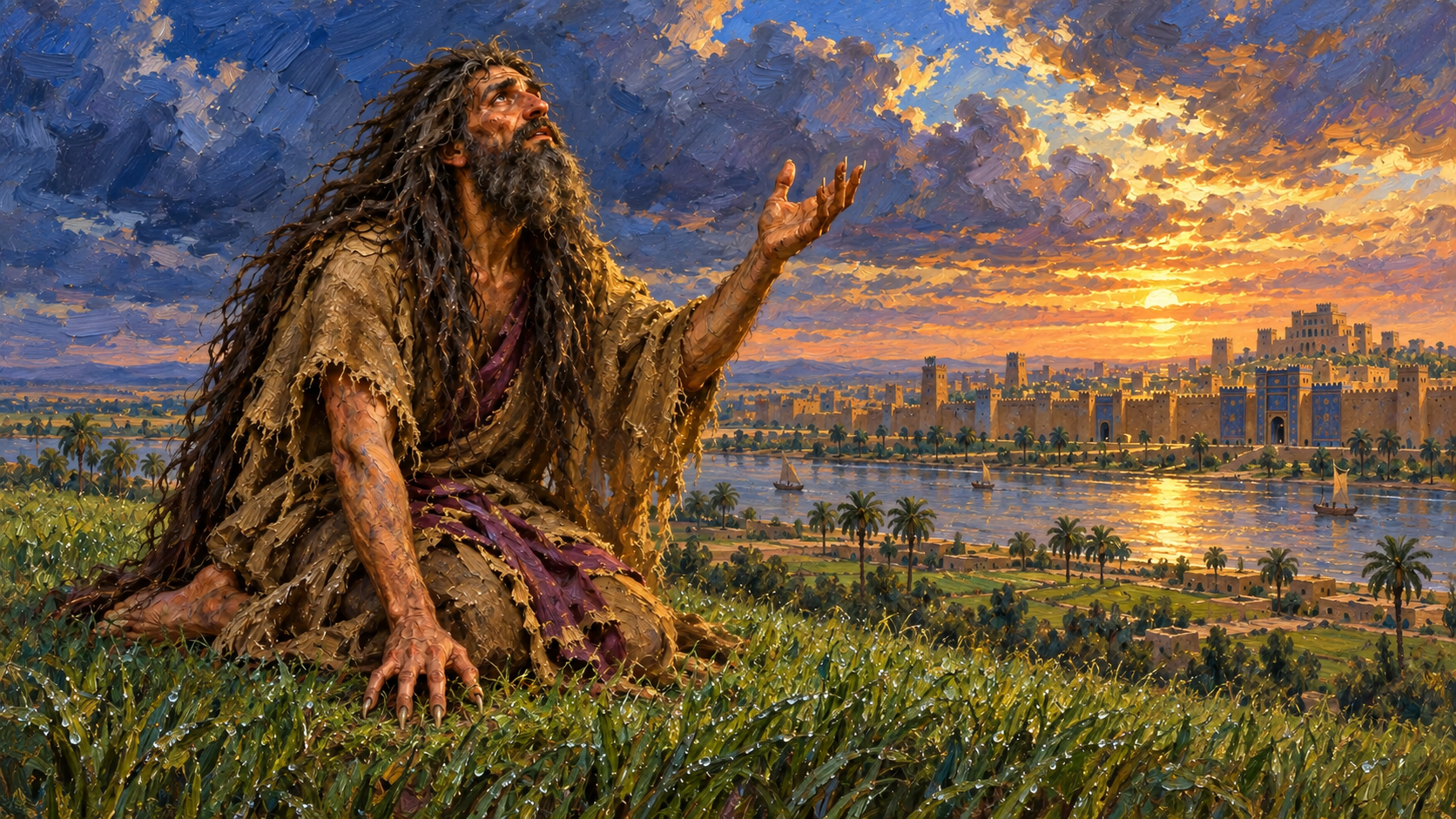
Daniel 4 is presented as Nebuchadnezzar’s public testimony. The king sees another dream in which a great tree is visible from the ends of the earth. It supplies food and shelter until a command from heaven orders it cut down. Daniel is troubled when he hears the dream because its meaning concerns the king. Nebuchadnezzar is the tree. His greatness has grown, but he will be brought low until he learns that heaven rules.
They shall drive you from men, your dwelling shall be with the beasts of the field, and they shall make you eat grass like oxen. They shall wet you with the dew of heaven, and seven times shall pass over you, till you know that the Most High rules in the kingdom of men, and gives it to whomever He chooses.
Daniel 4:25, NKJV
Daniel does not take pleasure in the humiliation that is coming. He warns the king and urges him to break with his sins by doing what is right and showing mercy to the poor. God gives a warning before judgment falls. That warning is an act of kindness. The Lord confronts pride truthfully while giving Nebuchadnezzar time to respond.
The king ignores the warning. Twelve months later he walks through the royal palace and boasts about the great Babylon he has built by his own power for the honor of his majesty. Judgment falls while the words are still in his mouth. His reason leaves him, and he lives like an animal until the appointed time has passed.
The form of his humiliation fits his sin. Nebuchadnezzar had exalted himself as though he were more than a man, so God allowed him to lose the dignity of reason and live like a beast. Pride had already been making him less able to receive truth and less merciful toward other people. The judgment exposed what his self-exaltation was doing inside him.
At the appointed time, Nebuchadnezzar’s understanding returns. He blesses the Most High and acknowledges that God’s dominion lasts forever. The man who once demanded worship now confesses that God acts according to His will in heaven and among the inhabitants of the earth. No one can restrain His hand or demand an answer from Him.
This raises a question that readers often ask: was Nebuchadnezzar truly saved? Daniel 4 records a genuine change in his public confession. We should take his closing words seriously because they sound nothing like casual politeness.
Now I, Nebuchadnezzar, praise and extol and honor the King of heaven, all of whose works are truth, and His ways justice. And those who walk in pride He is able to put down.
Daniel 4:37, NKJV
Even so, Daniel does not describe every inward reality of the king’s soul or give us a direct statement about his new birth. I do not think we should declare more than Scripture reveals. Some readers are certain that Nebuchadnezzar was converted because the ending is encouraging. Others deny that any meaningful change occurred because his earlier pride was so severe. Daniel lets his confession stand without making his spiritual biography the center of the chapter.
The focus remains on the Most High. He warned a proud pagan ruler, humbled him, and restored his reason. Public praise came from the mouth that had once boasted in its own glory. Whether or not we can answer every question about Nebuchadnezzar’s eternal state, the chapter leaves no doubt that God can put down anyone who walks in pride.
Daniel’s manner toward the king should not be overlooked. He was disturbed by the dream and wished that its meaning applied to Nebuchadnezzar’s enemies instead. Daniel had suffered because of Babylon, yet he did not speak as though the king’s collapse were entertainment. He told him the truth and urged him to turn from sin. Faithfulness required a clear warning, but it did not require personal delight in another person’s judgment.
The twelve-month delay shows the patience of God without suggesting that the warning was empty. Nebuchadnezzar received time in which he could have humbled himself. When he continued boasting, the announced judgment arrived at the exact moment God chose. The delay was mercy, and the fulfillment proved that divine patience should never be mistaken for indifference.
There is a personal warning here for anyone who has received authority, success, or public honor. Gratitude sees a gift and remembers the Giver. Pride looks at the same gift and turns it into proof of self-made greatness. Nebuchadnezzar’s experience shows how quickly that lie can blind a person to his dependence upon God. The breath with which a ruler boasts is itself something he did not create.
From Babylon to Christ’s Kingdom
Daniel’s prophecy does not end with ancient Babylon. Revelation develops the same pattern of beastly power demanding worship and persecuting God’s people before judgment comes. Daniel gives the broad outline of Gentile dominion through the statue. Revelation focuses on the final rebellion under the beast and the decisive victory of Jesus Christ.
When I compare these passages, I do not think they give us permission to force every headline into Daniel 2 or start naming modern rulers before Scripture does. The Bible tells us enough to recognize where rebellious world power is headed without encouraging reckless guesses. The final system will look strong, but Daniel has already shown the weakness in its feet. Revelation shows the same truth from another angle: it may terrify the world for a time, but it cannot withstand the returning King.
Then the seventh angel sounded: And there were loud voices in heaven, saying, “The kingdoms of this world have become the kingdoms of our Lord and of His Christ, and He shall reign forever and ever!”
Revelation 11:15, NKJV
The stone becomes a mountain, and the kingdom stands forever. I understand these prophecies from a futurist and premillennial perspective. The church will be gathered to Christ before the coming worldwide Tribulation. After that period, Christ will return publicly and defeat the rebellious powers gathered against Him. He will establish His literal thousand-year reign. Daniel’s statue does not supply every detail of that sequence, but it fits the wider prophetic hope. The related studies on the end-times timeline and Matthew 24-25 examine those passages more fully.
Revelation 13 shows the final beast using authority to draw the world into worship, which echoes the pressure of Daniel 3 on a far greater scale. Revelation 19 then shows Christ returning and defeating the beast along with the rulers gathered against Him. Revelation 20 follows with the thousand-year reign. Daniel gives the outline through the statue, while Revelation shows the last rebellion and its defeat in greater detail. Together they direct our hope toward the appearing of Christ rather than toward the survival of any present political order.
Nebuchadnezzar’s life should also keep us from reducing Daniel to either a pride lesson or a political chart. Pride and humility are central, but God also gave a real prophetic outline of kingdoms. The prophecy should lead to worship and courage because the God who reveals mysteries remains in control. It should also produce repentance. Studying the statue while refusing Daniel’s warning about pride would miss the point of the king’s story.
Daniel’s prophecy has sometimes been treated as late history written after the events because some readers begin by assuming that genuine prediction cannot occur. That assumption is not neutral. If the living God can reveal a forgotten dream, He can also reveal the kingdoms that will follow Babylon. I receive Daniel as inspired prophecy and believe the accuracy of the sequence displays God’s knowledge rather than a later author’s disguise.
We should also refuse to turn the stone kingdom into mere human progress or an inward spiritual feeling. People receive the King now through repentance and faith, but Daniel points to Christ’s open future reign. A fuller comparison of the kingdom’s present and future aspects appears in the study of the Kingdom of Heaven and the Kingdom of God.
Daniel helps believers look at the world without panic or naive trust. Governments can preserve order and benefit people, but rulers can also persecute and do terrible harm. No ruler is final, and no empire is permanent. The God who changes times and seasons remains above every human institution.
That truth would have strengthened the first readers of Daniel. They lived far from Jerusalem under rulers who did not share their faith. They could not control the empire, yet they were not abandoned inside it. Daniel carried out his work with integrity. When his life was threatened, he prayed, and God enabled him to speak the truth to a dangerous king. His friends continued serving in Babylon until the empire demanded worship, and then they refused. Faithfulness in exile was neither withdrawal from every public duty nor surrender to the values of the court.
I think this should humble our political pride. Christians should care about public righteousness and defend what is true, but politics cannot save us. Babylon’s splendor did not make it permanent, and Rome’s power could not preserve that empire forever. The final beast system will also terrify the world for only a time. The stone will strike the image, and Christ will reign.
Nebuchadnezzar also warns us about personal pride. His sin was not simply that he ruled an empire. He treated received glory as though he had created it for himself. That temptation reaches ordinary people too. We may look at our work or abilities and quietly imagine that we made ourselves. Daniel 4 calls us to give thanks before pride turns God’s gifts into evidence against us.
The story also teaches us how to handle biblical prophecy. God revealed the dream so His servants could trust Him, not so they could become proud of possessing secret information. We should study the kingdoms carefully and compare Daniel with Revelation. We should also be willing to stop where Scripture stops. A confident hope in Christ’s return does not require us to attach a modern name to every symbol or set dates God has not given.
The answer is not to make ourselves small enough to earn God’s favor. We must bow before Jesus Christ. The eternal Son became fully man without ceasing to be fully God. He obeyed the Father without sin. Wicked men tortured Him and shed His innocent blood, but He willingly gave Himself and bore the punishment for our sins in His body. He died and rose bodily from the dead. Salvation cannot be earned through religious effort or personal improvement. God offers salvation by grace to every person. We receive it when we turn to the crucified and risen Lord in repentance and faith.
My Final Thoughts
After following Nebuchadnezzar through Daniel 1-4, I keep coming back to the sentence that opens his story: the Lord gave. Babylon won only because God allowed it, and the king’s authority never became independent of Him. Even the return of Nebuchadnezzar’s reason remained in God’s hand. His life warns me not to turn received gifts into reasons for pride. His dreams also give God’s people courage when earthly power looks permanent. Every empire will pass, but Jesus Christ will return and establish the kingdom that can never be destroyed.