
Water sustains life, but Scripture also records occasions when it brought death. The flood and Israel’s crossing of the Red Sea cannot be explained simply by calling water a symbol of cleansing. We need to understand what God was doing in each event and how Scripture explains it. The same Bible that describes those real events also uses water to picture the cleansing and life that sinners receive through Christ.
Water Under God’s Rule
God created water and gave it its place. It has no spiritual power independent of Him, whether a passage describes a drink for someone who is thirsty or a sea too dangerous to cross. Genesis begins with God ordering His creation by His word:
Then God said, “Let there be a firmament in the midst of the waters, and let it divide the waters from the waters.”
The Hebrew word mayim is the ordinary word for water or waters. Its use does not turn the water into a divine force competing with its Creator. God speaks, separates the waters, and orders what He has made. Later passages may describe water bringing judgment or providing life, but none gives it an authority of its own.
The sea’s turbulence reminds us how little we can command, but the psalmist addresses the LORD as its ruler:
You rule the raging of the sea; When its waves rise, You still them.
The water that overwhelms human strength has not escaped God’s rule. When He commands it to serve His purpose, its danger cannot thwart Him. That is true when He judges through the waters and when He makes a path through them.
Scripture also uses the sea to portray turmoil that people cannot control. Revelation 13 shows a beast emerging from it, an image of rebellious power arising amid the upheaval of the world:
Then I stood on the sand of the sea. And I saw a beast rising up out of the sea, having seven heads and ten horns, and on his horns ten crowns, and on his heads a blasphemous name.
That image does not make saltwater morally evil. We need to distinguish the created sea from the rebellion pictured through it. Isaiah uses its restless movement to describe wicked people who cannot find peace:
But the wicked are like the troubled sea, When it cannot rest, Whose waters cast up mire and dirt.
Someone can become more disciplined or repair his public reputation while still refusing to repent before God. Those improvements may benefit his daily life, but they cannot remove the guilt that separates him from his Maker; he needs the reconciliation God provides through Christ.
Judgment and Rescue Through the Waters
By the time of Noah, the world had become corrupt and violent. God did not treat that wickedness as harmless, but neither did He judge in an uncontrolled outburst. He was patient, and His warning made clear that His patience would not continue indefinitely:
And the LORD said, “My Spirit shall not strive with man forever, for he is indeed flesh; yet his days shall be one hundred and twenty years.”
Genesis says Noah found grace in the eyes of the LORD before describing his obedience. God told him to build an ark, and he acted on that word instead of inventing his own way to survive. The refuge and the warning both came from the LORD, who announced the coming judgment:
And behold, I Myself am bringing floodwaters on the earth, to destroy from under heaven all flesh in which is the breath of life; everything that is on the earth shall die.
The waters engulfed the old world, while God preserved Noah and his family in the ark. Their survival did not make the judgment less real. God had provided a refuge before it came, and Noah’s obedient faith responded to His grace. I need to recognize both His mercy and His judgment instead of using one to explain the other away. The study on Noah and the ark follows the full account.
The ark’s place as God’s appointed refuge points forward to Christ. Our guilt cannot be removed by optimism or advice about improving ourselves, because we need a Savior from sin and judgment. Jesus, the sinless Son of God, willingly bore the punishment for our sins in His innocent body while wicked men tortured and killed Him. His shed blood and death accomplished His saving work before He was buried and rose bodily from the dead. The Father did not punish, curse, abandon, strike, bruise, or pour wrath on Jesus. He provided our refuge through the Son who willingly gave Himself.
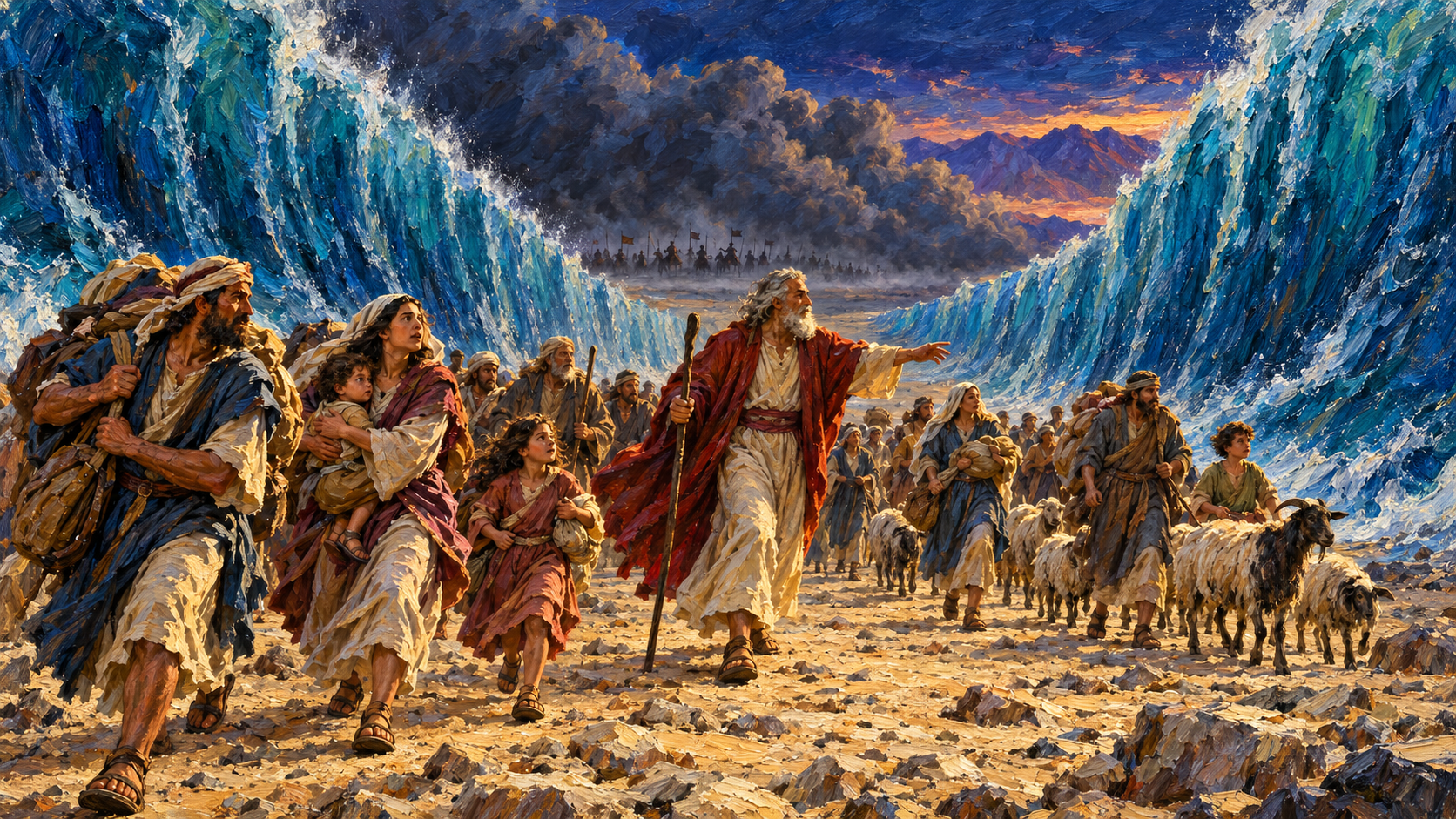
Centuries before Christ’s coming, Israel faced Pharaoh’s army with the sea blocking their escape. In Exodus 14, God commanded them to move forward, then made a path they could not have produced for themselves:
Then Moses stretched out his hand over the sea; and the LORD caused the sea to go back by a strong east wind all that night, and made the sea into dry land, and the waters were divided. So the children of Israel went into the midst of the sea on the dry ground, and the waters were a wall to them on their right hand and on their left.
Israel crossed on dry ground, but Pharaoh’s pursuing army met judgment in the same place. The difference came from the LORD’s action toward His people and their enemies, rather than some moral quality in the water. He made a way for Israel while bringing judgment on those who persisted in opposing Him. The study on the Exodus places this rescue within Israel’s deliverance from Egypt.
When Israel later came to enter the promised land, the Jordan was overflowing its banks. The priests carrying the ark of the covenant went ahead of the people, and their feet touched the water before the river stopped. Joshua describes what followed:
that the waters which came down from upstream stood still, and rose in a heap very far away at Adam, the city that is beside Zaretan. So the waters that went down into the Sea of the Arabah, the Salt Sea, failed, and were cut off; and the people crossed over opposite Jericho.
The ark testified to God’s covenant presence; the priests were not controlling the river through a ritual. They acted on His command, and He stopped the water so the nation could cross. Their steps did not purchase the miracle, but faith required them to respond to what He had said. We should not confuse obedience with earning God’s help, or dependence on Him with indifference to His commands.
Paul later looked back specifically to the Red Sea crossing when he described Israel’s identification with Moses:
Moreover, brethren, I do not want you to be unaware that all our fathers were under the cloud, all passed through the sea, all were baptized into Moses in the cloud and in the sea,
Being baptized into Moses identified the people under the leader God had appointed. It did not mean the seawater had washed away their guilt. Paul went on to warn the Corinthians through Israel’s later failures, because sharing in extraordinary spiritual privileges did not excuse disobedience. We cannot use God’s past kindness as permission to become careless about what He commands now.
Baptism and True Cleansing
Christian baptism likewise identifies the believer with the One he follows. The New Testament gives it to people who have believed in Christ, as a public testimony of salvation. It does not produce the new birth or remove guilt by washing the body. If I trust the act while refusing Christ, I have put my confidence in something that cannot save me.
The Greek verb baptizō can describe dipping, immersion, or washing, depending on its use. Those meanings describe an action, but they do not establish what that action accomplishes spiritually. We have to read what the passages teach about Christ and faith. Baptism publicly portrays a believer’s union with Him in burial and resurrection; it does not create that union through the application of water. The study on baptism in the Bible examines the relevant passages more fully.
Peter’s statement that baptism now saves us deserves careful attention. He has just described eight people being brought safely through the flood in Noah’s ark. Baptism corresponds to that deliverance, but Peter immediately qualifies what he means:
There is also an antitype which now saves us–baptism (not the removal of the filth of the flesh, but the answer of a good conscience toward God), through the resurrection of Jesus Christ,
He excludes the removal of bodily dirt and speaks instead of a good conscience toward God, through Jesus Christ’s resurrection. Noah’s family had not been rescued by floodwater cleaning their bodies. God’s ark carried them through the judgment. I understand baptism here as the outward confession of trust in the crucified and risen Savior who delivers us, rather than the physical means of making a sinner spiritually alive.
The expression translated “the answer of a good conscience toward God” has been understood as an appeal to God for a clear conscience, or as an answer or pledge expressing allegiance to Him. The debate concerns the Greek noun eperōtēma. Either reading directs attention to a person’s response to God, while Peter explicitly grounds the deliverance in Jesus Christ’s resurrection.
Paul describes the inward cleansing in his letter to Titus as God’s merciful work through the Holy Spirit:
not by works of righteousness which we have done, but according to His mercy He saved us, through the washing of regeneration and renewing of the Holy Spirit,
Regeneration means the new birth, the Spirit’s renewing work that makes someone a new creation. Neither the pastor performing a baptism nor the person receiving it can accomplish that inward renewal by carrying out the physical act. Baptism should testify to what God has done through Christ. For someone who has genuinely been born again, it is obedience and public confession, not a payment for eternal life.
Jesus Over the Waters and Death
The Old Testament’s teaching that God rules the sea prepares us to recognize what Jesus was doing when He walked toward His disciples on the water. Their boat was being battered by waves, and the wind was against them. When they saw Him approaching, they mistook Him for a ghost and cried out:
Now in the fourth watch of the night Jesus went to them, walking on the sea. And when the disciples saw Him walking on the sea, they were troubled, saying, “It is a ghost!” And they cried out for fear. But immediately Jesus spoke to them, saying, “Be of good cheer! It is I; do not be afraid.”
Peter asked Jesus to command him to come out onto the water. At His word, Peter left the boat and walked toward Him, but the wind frightened him and he began to sink. He cried to the Lord to save him, and Jesus immediately took hold of him:
And immediately Jesus stretched out His hand and caught him, and said to him, “O you of little faith, why did you doubt?”
When they entered the boat, the wind ceased, and the disciples worshiped Jesus as the Son of God. Peter’s brief walk had depended on Jesus’ command and power; it did not give him authority over the sea. Jesus was the One who came to them, enabled Peter to walk, and rescued him when his courage gave way.
Jesus reassured them with the words “It is I,” ego eimi in Greek. Those words can simply identify the speaker, but here the speaker was walking over the sea and giving Peter power to do the same. Alongside the Old Testament teaching about God’s rule over the waters, His actions reveal His divine authority. The study of Jesus walking on water follows the full passage.
Jesus confronted Peter’s doubt, so we should not excuse unbelief as though it did no harm. Yet Peter was rescued by the Lord’s hand, not by recovering perfect composure while he sank. If I am afraid, I need to turn to Christ instead of waiting until I feel strong enough to ask for help.
Earlier, in Matthew 12, Jesus had used Jonah’s experience to point to His death, burial, and bodily resurrection. Scribes and Pharisees demanded a sign while resisting the words and works already before them. He answered that, as Jonah was three days and three nights in the great fish, the Son of Man would be three days and three nights in the heart of the earth.
Jonah had gone down into the sea because of his disobedience, and God appointed the fish that preserved him and returned him to land alive. Christ, however, was completely sinless and willingly accomplished the saving work to which Jonah’s deliverance pointed. Jonah did not atone for anyone’s sins. The study on Jonah considers the whole book.
Living Water and Everlasting Life
At Jacob’s well, Jesus offered a Samaritan woman something the well could never provide. Ordinary water would relieve her thirst for a time, but the water He gave would bring everlasting life:
Jesus answered and said to her, “Whoever drinks of this water will thirst again, but whoever drinks of the water that I shall give him will never thirst. But the water that I shall give him will become in him a fountain of water springing up into everlasting life.”
Jesus exposed her sin without leaving her with nothing but shame. He revealed Himself as the Messiah and offered life that she could not earn through religious achievement. The gift came through Him personally, not through a sacred substance separate from Him. His promise answers a need deeper than physical thirst: sinners need the life that only the Savior can give. The study on living water explores that promise further.
John 7 records a public invitation at the Feast of Tabernacles in Jerusalem. The crowd was divided over Jesus, and the authorities opposed Him, yet on the last day He called the thirsty to come to Him and drink:
He who believes in Me, as the Scripture has said, out of his heart will flow rivers of living water.
John explains that Jesus meant the Holy Spirit whom believers would receive after His glorification. Everyone who believes in Christ now receives the Spirit to dwell within him; the life and cleansing are God’s gifts, received through faith. The conduct of a genuinely born-again person should then show the effects of that new life.
Jesus called the thirsty to Himself while people argued about His identity. Attendance at the feast could not give them what He offered, and no sacred object could replace Him. We need personal faith in Christ, because the living water describes His gift of life and the Spirit He gives, not a spiritual power we can possess independently of the Savior.
The Deepest Crossing
A passage through water could preserve someone’s physical life without cleansing his conscience or making him spiritually alive. Jesus addresses that deeper need directly in John 5:24:
“Most assuredly, I say to you, he who hears My word and believes in Him who sent Me has everlasting life, and shall not come into judgment, but has passed from death into life.
The person who hears and believes already has everlasting life, has passed from death into life, and will not come under condemnation. Jesus does not leave him waiting to discover whether his religious performance will eventually make him acceptable. The Red Sea and Jordan crossings were real events, as were Noah’s preservation and Jonah’s deliverance, but our salvation rests in Christ Himself. He completed His saving work through His shed blood and death and rose bodily from the dead.
Christ died for the whole world, and God’s offer is genuine even though people can resist His grace. Everyone who repents and believes is forgiven and declared righteous before God. He gives that person the new birth, and the Holy Spirit indwells and seals him so that he is eternally secure in Christ. This assurance gives no permission for lawlessness. Someone who has truly received new life should show evidence of it in his conduct; a superficial profession cannot prove that regeneration has occurred. Obedience is the fruit of salvation, rather than the price we pay for it.
If you have believed but have not been baptized, baptism is the proper public step of identification with Christ. If you have been baptized, do not use that memory to excuse neglecting Him now. The act should confess your trust in the Savior, and the water must never become a substitute for the One who gives life.
Revelation shows the future awaiting Christ’s people in the new heaven and new earth. John says there is no more sea, and he places that statement alongside God’s promise that death, sorrow, and pain will be gone. Earlier in the book, the sea has been associated with danger and the rise of beastly power. I understand its absence as belonging to the passing of that former order, including its threat and separation. This does not mean the oceans were morally evil or that John has explained every feature of the new earth’s geography.
Nor does the absence of the sea mean the absence of all water. Revelation 22 shows the river of the water of life flowing from the throne of God and of the Lamb. His people will dwell with Him, free of the death and danger that belonged to the old order. The water is part of the life He provides, and its source directs our attention to the God who gives it. For those who belong to Christ, the future is everlasting life with Him instead of judgment.
My Final Thoughts
I cannot cleanse my own guilt any more than I could have stopped the Red Sea. God has provided the Savior I need, and Christ calls me to receive His life by faith. My obedience, including baptism, should testify to that trust instead of becoming an excuse to rely on a religious act. These passages give us reason to take God’s judgment seriously and receive the refuge He provides, with our hope resting in the Son who brings sinners from death into life.