
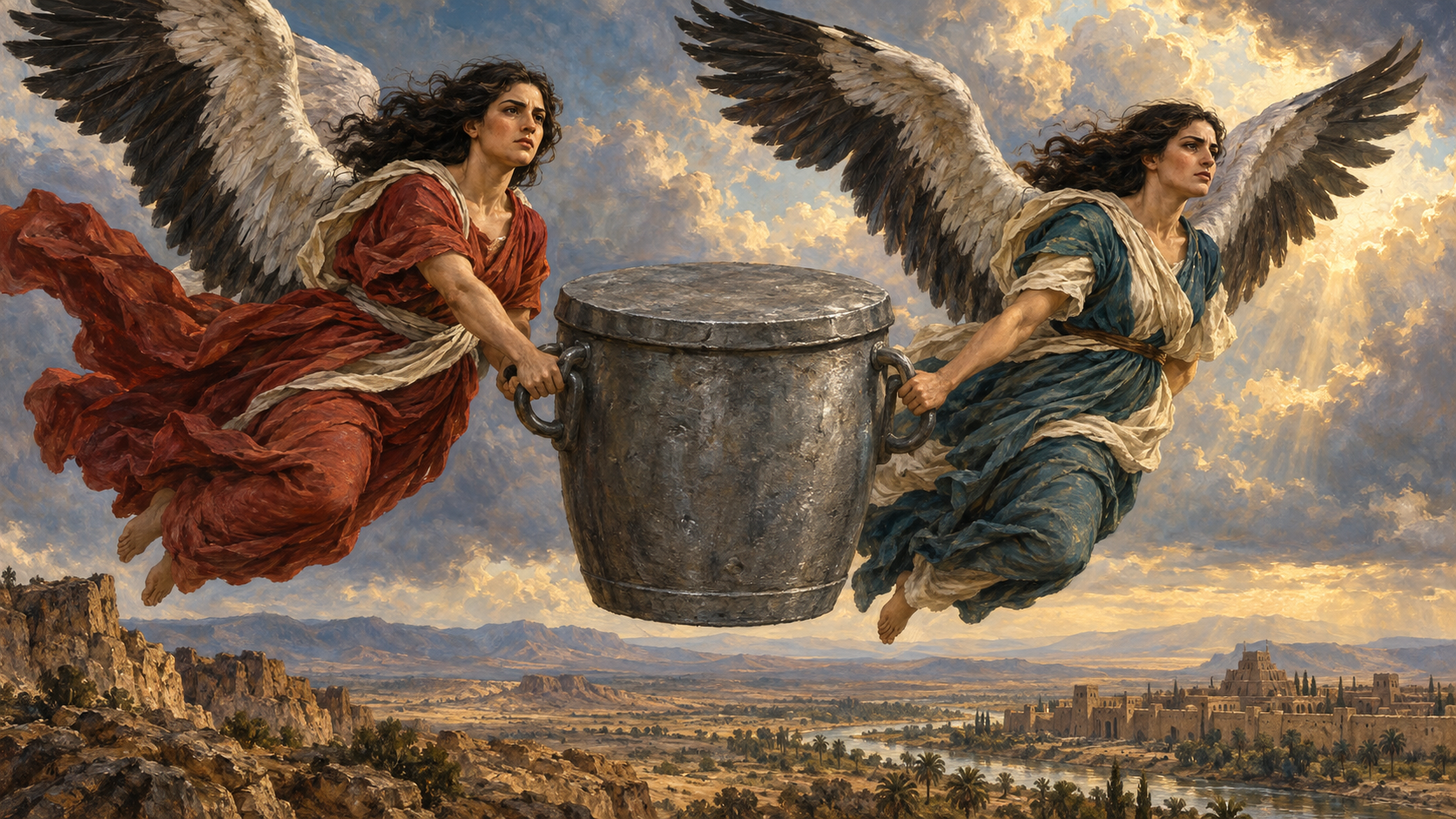
Zechariah saw a woman confined inside a measuring basket, then watched two winged women carry it away. The angel identified the woman as Wickedness and named the destination as Shinar. To understand why God showed him such an unusual vision, we need to begin with the Jewish people rebuilding Jerusalem after their return from exile.
Zechariah’s Setting
Zechariah ministered among Jews who had returned from the Babylonian exile. Babylon had conquered Judah, destroyed Jerusalem and Solomon’s temple, and carried many people into captivity. After Persia defeated Babylon, Cyrus permitted exiles to return and rebuild the Lord’s house. Calling Zechariah a post-exilic prophet simply places his ministry after the exile, among the remnant who had come home.
Their situation was far removed from the prosperous kingdom David and Solomon had ruled. They faced opposition and limited resources, and work on the temple had stalled. Ezra 4:24-5:2 records Haggai and Zechariah ministering to the people as the rebuilding resumed. They encouraged and helped the people do the work God had given them.
Zechariah’s connected night visions address both the people’s need for encouragement and their need for correction. God comforts Jerusalem, confronts the powers that have opposed her, and speaks about the priesthood and temple work. He also confronts wickedness within the community. The returned remnant needed more than relief from their enemies; they needed to live faithfully before the God whose house they were rebuilding.
In Zechariah 5, the prophet first sees a flying scroll. The angel explains that it carries a curse against thieves and people who swear falsely by the Lord’s name.
Then he said to me, “This is the curse that goes out over the face of the whole earth: Every thief shall be expelled, according to this side of the scroll; and, Every perjurer shall be expelled, according to that side of it.”
The Lord says this curse will enter an offender’s house and consume its timber and stones. Theft injured a neighbor, and a false oath used God’s own name to support a lie. These were not minor private flaws that He would overlook because the offenders belonged to the returned remnant. Public worship gave them no exemption from His concern about what they did at home or how they treated other people.
The vision that follows carries the judgment further by showing Wickedness confined and removed. Reading it after the scroll keeps us from treating the chapter only as a condemnation of the nations around Israel. God was dealing with the sin of His own covenant people.
The Ephah
The angel calls Zechariah’s attention to something going forth. When the prophet asks what he is seeing, the answer names a familiar object:
Then the angel who talked with me came out and said to me, “Lift your eyes now, and see what this is that goes forth.” So I asked, “What is it?” And he said, “It is a basket that is going forth.”
The Hebrew word translated basket is ephah. It names a dry measure for grain and can also refer to a container of that capacity. People used such measures in buying and selling, so I believe the choice of an ephah directs our attention to ordinary economic life. Wickedness could be at work in a transaction that looked perfectly routine.
The wording in the rest of verse 6 is difficult. The NKJV describes the basket as the people’s resemblance throughout the earth, while some translations use iniquity, following a reading found in ancient versions. I understand the image as representing wickedness spread through the community, not only one person’s isolated wrongdoing. The angel’s name for the woman is broader than dishonest commerce alone.
The Woman Named Wickedness
Here is a lead disc lifted up, and this is a woman sitting inside the basket; then he said, “This is Wickedness!” And he thrust her down into the basket, and threw the lead cover over its mouth.
The woman personifies wickedness, meaning that the vision represents moral evil as a person. Proverbs uses the same kind of imagery when Wisdom and Folly are depicted as women calling to people in public. Zechariah is not being shown that women are especially wicked, nor is he being asked to identify a particular woman from history. The angel has supplied the figure’s meaning. Using this passage to vilify a woman we resent would disregard the explanation we have been given.
After identifying her, the angel thrusts Wickedness back into the basket and closes it with the heavy lead cover. I understand the lid as restraint, because he puts it in place after exposing what is inside. This is not primarily an image of a sinner concealing wrongdoing. The flying scroll has already shown that God will not be fooled by sin hidden in someone’s house. Here the angel confines Wickedness for removal from the land, rather than allowing her to go where she pleases.
Zechariah raises his eyes again and sees two women lifting the basket. They have the wind in their wings, which resemble those of a stork.
Then I raised my eyes and looked, and there were two women, coming with the wind in their wings; for they had wings like the wings of a stork, and they lifted up the basket between earth and heaven.
Leviticus 11:19 includes the stork among the birds Israel was forbidden to eat. That gives the imagery an association with ceremonial uncleanness, although an unclean animal was not morally sinful. I would not use the resemblance to identify these carriers as demons. Zechariah does not call them demons or ordinary angels; he describes what they look like and what they do. Their precise identity is left unexplained.
Why Shinar Is Important
The destination receives a much more definite answer. Zechariah asks where the women are taking the basket:
So I said to the angel who talked with me, “Where are they carrying the basket?” And he said to me, “To build a house for it in the land of Shinar; when it is ready, the basket will be set there on its base.”
Shinar is the Mesopotamian land associated with Babel and later Babylon. Genesis 11 places the builders of the city and tower on a plain there. They stated that they wanted to avoid being scattered and make a name for themselves.
And they said, “Come, let us build ourselves a city, and a tower whose top is in the heavens; let us make a name for ourselves.”
God had commanded mankind to fill the earth, but these people devised a project intended to keep them together around a city of their own making. Their stated ambitions put them in opposition to His command. Shinar consequently recalls an organized refusal to follow God, rather than serving merely as an unfamiliar place name.
In Zechariah’s vision, a house will be prepared there and the basket set on its base. Wickedness is removed from the land, but it has not ceased to exist. It is given a settled place in the region associated with Babel’s rebellion. God could remove it from the covenant community, which gave the remnant reason for confidence. At the same time, they could not faithfully rebuild His house while tolerating wickedness in their own homes.
The choice of a grain measure also becomes easier to understand when we read what Scripture says about dishonest business practices. A merchant could appear respectable while arranging a transaction to defraud his neighbor. God was concerned about the accuracy of the measure, even when the buyer could not see how he was being cheated.
Dishonest scales are an abomination to the LORD, But a just weight is His delight.
Amos describes merchants impatient for the New Moon and Sabbath to end so they can resume selling grain. Their plan involved giving less grain than the buyer expected, demanding more silver, and falsifying the scales.
Making the ephah small and the shekel large, Falsifying the scales by deceit, That we may buy the poor for silver, And the needy for a pair of sandals.
Those men observed the religious calendar while resenting the interruption to their fraud. They intended to cheat their customers as soon as business resumed. God was not going to overlook their exploitation of the poor because they had observed a religious occasion. The seller’s worship could not be separated from the way he treated the person buying his grain.
The angel’s name for the woman also challenges the milder descriptions we sometimes give to conduct we do not want to confront. Pressure may explain why someone was tempted to cheat, but it cannot make the cheating honest. I can acknowledge a person’s hardship without pretending that clear wrongdoing was only a misunderstanding. If I refuse to admit that the act was wrong, I am helping the person defend it instead of helping him repent.
I need to examine my own dealings before applying this passage to a distant institution. If I conceal a costly fee in paperwork because I expect a customer to miss it, I should not congratulate myself merely because the transaction is technically legal. I am using his failure to notice the fee to get his agreement before he understands the cost. Nor does a dishonest practice become acceptable because an entire industry uses it or an institution has made it policy.
The house prepared in Shinar points beyond an individual merchant’s fraud. At an earlier stage of Judah’s defeat, long before Zechariah’s ministry, Nebuchadnezzar had carried articles from God’s temple to the house of his god in that same land.
And the Lord gave Jehoiakim king of Judah into his hand, with some of the articles of the house of God, which he carried into the land of Shinar to the house of his god.
Daniel describes sacred vessels placed in a pagan house in Shinar, while Zechariah describes a house being prepared there for Wickedness. These are different events, but they belong to the same history of rebellion. The region associated with Babel had become the seat of the empire that conquered Judah and carried away the temple vessels.
Revelation develops the Babylon theme further. Chapter 17 depicts a corrupt woman associated with blasphemy and abomination. Chapter 18 exposes the luxury from which kings and merchants profit, along with the violence and deception beneath it. I understand Babylon there as a final world system involving false religion, economic seduction, and hostility toward God’s people. Its resemblance to Zechariah’s vision should help us follow the theme without making every detail of the two visions interchangeable.
And I heard another voice from heaven saying, “Come out of her, my people, lest you share in her sins, and lest you receive of her plagues.”
God’s people are called to separate from Babylon’s sins. If I am benefiting from a system, I may be reluctant to question how it operates or what it encourages. Its success can become an excuse to overlook the corruption from which that success came. We need to judge what it offers by God’s Word, even when doing so means refusing something profitable or culturally admired.
That still does not authorize me to use Babylon as a dramatic insult for whichever nation, church, or political movement I dislike. Scripture develops the theme from Babel through the historical empire to the final system in Revelation. We should identify the rebellion and corruption the passages actually describe before assigning the name to anything around us.
Some readers turn from the basket’s destination to its flying carriers, associating them with UFOs or alien theories. I do not find that identification in the passage. Neither the prophet’s description nor the angel’s explanation mentions beings from another planet, modern aircraft, or secret programs. Those ideas have been brought to the text; they do not explain why Wickedness is confined and taken to Shinar.
We do not have to invent that identification to take spiritual deception seriously. Paul describes a conflict involving powers beyond the human beings who oppose us:
For we do not wrestle against flesh and blood, but against principalities, against powers, against the rulers of the darkness of this age.
Paul directs believers to stand in the armor God provides. We need to hold to His truth and test what we hear by Scripture, rather than pursue occult knowledge in the hope that it will protect us. We can recognize that demonic deception is real without chasing every report that claims to explain the unseen world.
Paul also gives a particular warning about deception in the final rebellion, when the coming lawless one will use impressive signs to serve a lie.
The coming of the lawless one is according to the working of Satan, with all power, signs, and lying wonders, and with all unrighteous deception among those who perish.
In the surrounding verses, Paul connects that deception with refusing the love of the truth and taking pleasure in unrighteousness. We can be susceptible to a lie because it accommodates what we want to believe. A dramatic experience cannot therefore settle whether a spiritual claim is true. John gives believers a responsibility to examine such claims:
Beloved, do not believe every spirit, but test the spirits, whether they are of God.
In the next two verses, John identifies the confession that Jesus Christ has come in the flesh as a test of the spirits. The standard is the true Christ taught by the apostles. We cannot accept a message that denies His genuine humanity or His deity, and neither can we accept a substitute gospel that sets aside His shed blood and bodily resurrection. A teacher who excuses sin or offers secret knowledge as the way of salvation does not become trustworthy because something impressive accompanies his teaching.
I can apply that test even when I cannot explain an experience someone reports. If the message draws people away from the biblical Christ, I have a reason to refuse it without solving the phenomenon first. We should not let our curiosity about an unusual event make us disregard what we already know about the Lord.
The powers opposing Christ are still creatures. Wickedness was confined and carried away in Zechariah’s vision, and the New Testament identifies the Lord whose authority extends over the entire unseen realm.
For by Him all things were created that are in heaven and that are on earth, visible and invisible.
Every rank of power was created through Christ and for Him. Fallen powers have rebelled, but that rebellion has not made them His equals or placed them beyond His judgment. Money and political influence can make corruption difficult for us to oppose, but no institution or evil spirit can set itself beyond Christ’s reach. We can take spiritual evil seriously without giving it authority that belongs only to the Creator.
Jesus is the eternal Son, fully God and fully man, who lived without sin. Wicked men inflicted the torture and death He willingly endured on the cross, and in His innocent body He bore the punishment for our sins. His shed blood and death accomplished our redemption before He was buried and rose bodily from the dead. Exposing corruption or improving a law may be right, but neither can cleanse me of my own sin. I need the salvation Christ provides.
I could discuss Babylon at length while rationalizing dishonesty in my work or refusing to repent of something I do in private. Understanding the vision would not make that conduct any more acceptable. I need to confess the wrongdoing plainly and turn from it, whether it concerns my dealings with another person, what I do online, or the thoughts I choose to entertain. The Lord who exposes sin is merciful to those who repent and trust His shed blood.
Christ died for the whole world, so God’s offer of salvation is genuine for every person. People can resist His grace and finally reject Him, but everyone who repents and believes in Christ is forgiven and born again. No religious performance or personal improvement can earn what He gives by grace.
When I speak of regeneration, I mean that God has genuinely made someone a new creation. The Holy Spirit lives in and seals that person, who is eternally secure in Christ. We should therefore expect to see evidence of new life in how he lives. That obedience does not earn his salvation, but claiming to be a Christian while defending a settled life of lawlessness gives us no grounds to assume he has been born again.
My Final Thoughts
I do not need to identify the winged carriers to understand the angel’s name for what is inside the basket. He calls it Wickedness, confines it, and announces its removal to Shinar. I want to carry that same honesty into the way I examine my own conduct, because knowing how to explain Babylon will be of little use if I refuse to repent of dishonesty in my own life. Christ will judge every rebellious system, and He calls us to follow Him now while we wait for His righteous kingdom.