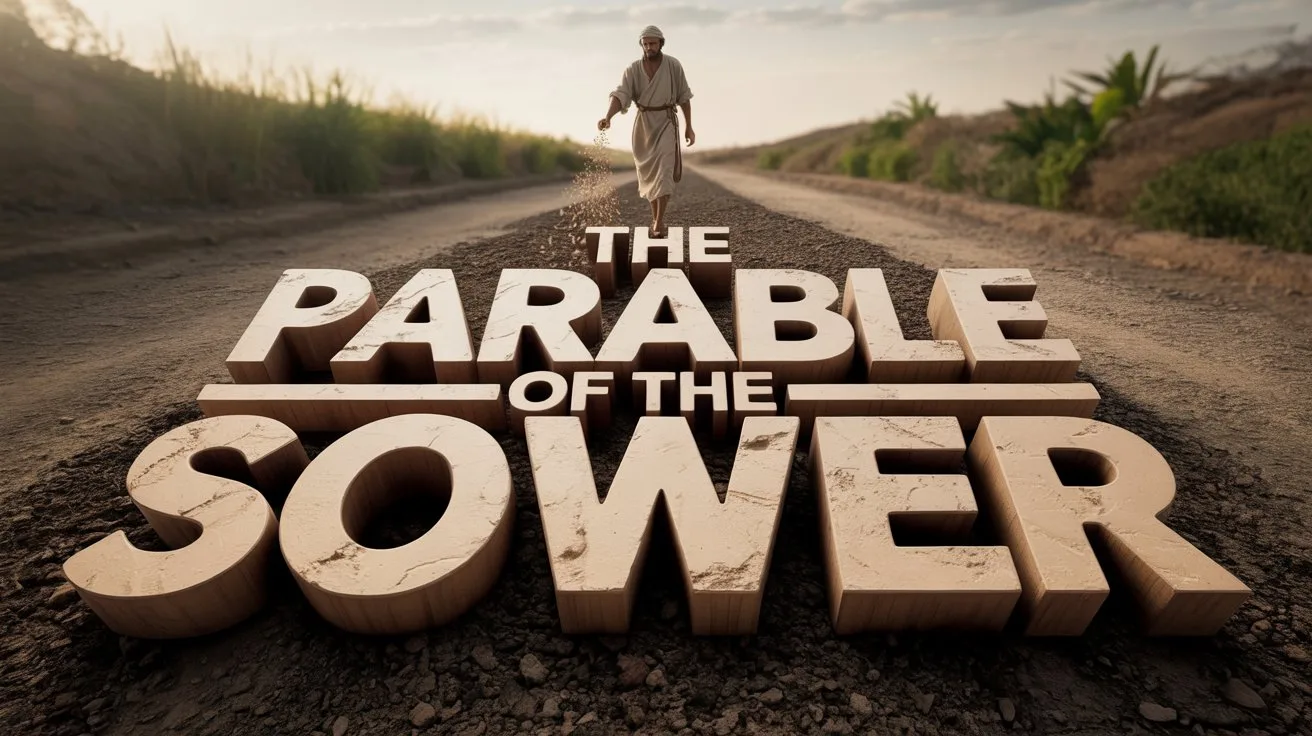
Jesus knew people could sit under the same teaching and walk away with completely different outcomes. In Matthew 13:1-23, He explains why, using what we call the Parable of the Sower. It is not really about farming techniques. It is about what happens when the Word of God hits the human heart, and why the kingdom message produces fruit in some lives but not in others.
Why Jesus Used Parables
Matthew puts this parable at a real hinge point. Jesus is drawing crowds, but the reactions are all over the place. Some are following. Some are sizing Him up. Some are already against Him. In that setting, Jesus teaches with parables, everyday comparisons that make you listen with your mind and your conscience, not just your ears.
A parable is simple enough for a child to understand on the surface, but it also tests the listener. A person who wants the truth will lean in and ask, and God will give more light. A person who is set on resisting will hear the same words and stay closed. Jesus says that plainly in this chapter.
Therefore I speak to them in parables, because seeing they do not see, and hearing they do not hear, nor do they understand. (Matthew 13:13)
We do need to keep this straight. Jesus is not hiding truth from somebody who honestly wants to know God. The issue is the heart. When a person keeps refusing what God has already made clear, the result is not more light. The heart gets dull. Isaiah spoke about that long before Jesus came, and Jesus says it still fits the crowd in front of Him.
There is also a principle in the chapter that explains why the same sermon can produce opposite results. A person who receives what God gives is given more. A person who keeps pushing it away loses even what light he had.
For whoever has, to him more will be given, and he will have abundance; but whoever does not have, even what he has will be taken away from him. (Matthew 13:12)
Hearing that receives
Matthew 13 keeps circling back to hearing. Jesus ends the parable with a call to hear, and then He explains why some do not understand. In the Bible, understanding is not just getting the facts right. It includes welcoming the truth and letting it have its rightful place. A person can be clever and still refuse God. That is not an intelligence problem. It is a heart problem.
Here is a detail many people miss: in Jesus’ explanation, the Word is said to be sown in the heart even when the person never benefits from it. The problem is not that the Word never reached them. The problem is what happens next.
What sowing looked like
In that time, a sower often scattered seed by hand as he walked. Fields were not as neatly separated as a modern garden plot. There were footpaths through the field where people walked. There were shallow spots where stone sat just under the surface. There were edges where thorns already had a head start. The sower is not being careless. He is being normal and generous, throwing seed broadly and letting the ground show what it is once the seed lands.
Jesus identifies the seed as the Word. Matthew calls it the word of the kingdom. Mark calls it the word. Luke calls it the word of God. However you phrase it, the power is in what God has said, centered on the King and His gospel.
"Now the parable is this: The seed is the word of God. (Luke 8:11)
That keeps us grounded. The seed is not our personality, our sales pitch, or our ability to work a crowd. God uses human messengers, but the life is in the Word.
The Four Soils
Jesus tells the parable first, then He explains it. That keeps us from guessing. The soils are different kinds of hearers, meaning different heart conditions as the Word is heard. The seed stays the same. The outcomes change because the hearts are different.
The hardened path
The first soil is the wayside, the packed-down path. The seed cannot sink in, so it stays on top and is quickly taken away. Jesus says this pictures the person who hears the word of the kingdom and does not understand it, and then the evil one snatches away what was sown in the heart.
When anyone hears the word of the kingdom, and does not understand it, then the wicked one comes and snatches away what was sown in his heart. This is he who received seed by the wayside. (Matthew 13:19)
Notice the wording. The Word was sown in the heart, but it never penetrated. It stayed on the surface. That is why it is so easily removed. Matthew is not describing a person who never heard the message. He is describing a person who heard it, but would not receive it.
Mark’s account makes the spiritual conflict explicit. Satan comes immediately and takes away the word that was sown. Gospel preaching is not just a friendly exchange of opinions. There is real opposition aimed at keeping the Word from settling in long enough for repentance and faith.
And these are the ones by the wayside where the word is sown. When they hear, Satan comes immediately and takes away the word that was sown in their hearts. (Mark 4:15)
Hardness is not presented as a mechanical fate. Scripture calls people to respond and warns them not to harden their hearts. Hardness grows through repeated refusal, pride, and clinging to sin. When a person keeps pushing away the truth, it gets easier to push it away the next time.
If you are sowing the Word into someone like this, you cannot argue a heart into softness. But you can pray, keep speaking truth plainly, and keep your own tone clean. God can break hard ground. The parable does not tell you to stop sowing. It tells you not to be shocked when some seed lands on a path.
The shallow ground
The second soil is stony ground. There is a thin layer of soil with rock underneath. The seed springs up quickly, but there is no depth for roots. When heat comes, the plant withers. Jesus says this is the person who hears the Word and receives it with joy, but has no root and only lasts for a while. When tribulation or persecution comes because of the Word, he falls away.
But he who received the seed on stony places, this is he who hears the word and immediately receives it with joy; yet he has no root in himself, but endures only for a while. For when tribulation or persecution arises because of the word, immediately he stumbles. (Matthew 13:20-21)
This warns us not to confuse quick excitement with the new birth. Joy can absolutely come with real faith. The gospel is good news. But joy by itself is not proof of conversion. Some people love the idea of forgiveness or community or a fresh start. Then the Word starts confronting sin, or following Christ starts costing them something, and they decide they are done.
Matthew says the person stumbles. The Greek word is skandalizo, the idea behind our word scandalize. It means to be tripped up, to take offense, to fall away. The Word collides with their expectations, and instead of yielding, they get offended.
We should be careful here. True believers can struggle, and they can go through real seasons of weakness. Scripture is honest about that. But Jesus’ emphasis here is no root. There is no lasting attachment to Christ Himself. The Word never went down into the core of the person.
This shapes discipleship. Be thankful when someone responds quickly, but do not treat a quick response as the finish line. People need grounding in Scripture, prayer, fellowship, and simple obedience. If you only aim for fast sprouts, you should not be surprised when the sun exposes how shallow the ground really was.
The crowded heart
The third soil is thorny ground. The seed starts to grow, but thorns rise up and choke it. Jesus says this is the person who hears the Word, but the cares of the world and the deceitfulness of riches choke the Word, and it becomes unfruitful.
Now he who received seed among the thorns is he who hears the word, and the cares of this world and the deceitfulness of riches choke the word, and he becomes unfruitful. (Matthew 13:22)
This one can look normal for a long time. There is no immediate rejection. There might be real interest and even some growth. Then, little by little, the Word gets crowded out. It is not that the seed is dead. It is that it is being strangled.
Jesus names common thorns. Cares are anxieties, the mental load that eats up attention. Riches are deceitful, meaning they promise what they cannot give. Money promises safety, identity, and satisfaction. It cannot deliver what it advertises. Luke adds pleasures of life, the steady pull of comfort and entertainment that keeps a person busy and numb at the same time.
Now the ones that fell among thorns are those who, when they have heard, go out and are choked with cares, riches, and pleasures of life, and bring no fruit to maturity. (Luke 8:14)
Luke’s wording is painful: no fruit comes to maturity. There is growth, but it never ripens. The plant exists, but it does not fulfill its purpose.
This is where self-examination has to get honest. What shapes your schedule? What do you protect when the Word confronts it? What always gets time, and what always gets squeezed out? Responsibilities are not sinful, but they can become ruling loves. Thorns do not die because you feel bad about them. They get removed by repentance and deliberate choices. You say no to some things so you can say yes to the Word.
For those sowing into others, thorny ground teaches patience. Thorns take time to choke. You might not see the problem in week one. Discipleship has to deal with worry, money, habits, priorities, and the quiet idols that make a person busy but barren.
The good soil
The final soil is good ground. The seed takes root and produces fruit, with different yields. Matthew lists thirty, sixty, and a hundredfold. The point is not competition. The point is that good soil produces fruit.
But he who received seed on the good ground is he who hears the word and understands it, who indeed bears fruit and produces: some a hundredfold, some sixty, some thirty." (Matthew 13:23)
Luke adds that the good soil hears the Word with a good and honest heart, holds it fast, and bears fruit with patience.
But the ones that fell on the good ground are those who, having heard the word with a noble and good heart, keep it and bear fruit with patience. (Luke 8:15)
Hold it fast is a good phrase. It means to keep it, guard it, cling to it. The Word is not treated like a passing thought. It is treated like something true that you live under. Patience means the fruit takes time. Real growth is usually not loud. It is steady.
Good soil is not a sinless person. It is a responsive person. When the Word corrects, the good soil yields instead of arguing. When the Word comforts, the good soil believes instead of doubting God’s character. When the Word commands, the good soil obeys. Not perfectly, but truly, with a real direction of life toward Christ.
One more detail from the passage should sober us. Jesus describes four responses, but only one results in fruit. The other three are different kinds of failure: the Word is snatched, the Word withers, or the Word is choked. It is possible to hear the Word often, feel something at times, and still never bear fruit because the heart never truly received it.
Hearts Over Time
This parable also forces a question: how does a heart become one kind of soil rather than another? Scripture shows our response to light is not neutral. When a person receives truth, he becomes more open to truth. When a person resists truth, he becomes more calloused. John explains that some refuse because light exposes deeds they do not want exposed.
And this is the condemnation, that the light has come into the world, and men loved darkness rather than light, because their deeds were evil. For everyone practicing evil hates the light and does not come to the light, lest his deeds should be exposed. (John 3:19-20)
That helps explain the hardened path. Some reject not because the Word is unclear, but because it is unwanted. And once a person makes a habit of pushing God away, the heart does not stay soft by accident.
The hopeful side is also true: soil can change. God can break up hard places. God can deepen what is shallow. God can clear thorns. We should not talk like people are stuck in one category forever. The parable is describing real patterns, not handing us a list of permanent labels.
If you are a true believer, your salvation is not hanging by a thread. Eternal life is God’s gift, received by grace through faith in Jesus Christ alone. But this parable still warns believers about usefulness and fruitfulness. A Christian can let thorns grow. A Christian can live shallow. Not because salvation is fragile, but because fellowship and obedience can be harmed when we stop yielding to the Word.
Sowing Without Quitting
This parable not only diagnoses hearts. It steadies the hands of the sower. If you share Scripture, teach, raise kids, preach, counsel, or witness at work, you are going to see all four soils. Jesus was preparing His disciples for that reality.
When the same Word goes out and produces different results, we are tempted to draw the wrong conclusions. We might think the seed is weak, so we dress it up with gimmicks. Or we assume the sower failed, so we carry guilt that does not belong to us. Jesus will not let us do that. The seed is the Word. The sower sows. The hearer is responsible to respond. God sees the whole field.
Keep the message clear
The parable keeps bringing us back to the message. The seed is not motivational talk. It is the Word of God. In Matthew it is tied to the kingdom, meaning God’s rightful rule, God’s King, and God’s call to repent and believe.
Clarity here is simple and non-negotiable. Jesus Christ, the sinless God-man, died for our sins and rose again. Salvation is received by grace through faith in Him, not earned by works. Works are fruit, not the cause. When a person believes, God gives real new life, and that life starts producing fruit over time.
Expect pushback
The birds in the first soil are not random. Jesus points to a real enemy who works to remove the Word quickly. That should shape how we pray. It should also shape our patience. Some conversations seem to evaporate as soon as they happen. Do not assume nothing happened just because you did not see an immediate result.
At the same time, the parable keeps the hearer responsible. People are not robots. They are called to repent and believe. When someone refuses, we do not excuse it as if they had no choice. We also do not become nasty. We stay clear and kind and leave room for God to work.
Let time speak
Stony ground and thorny ground both involve time. Shallow growth can look impressive early. Thorny growth can look fine until it slowly chokes. That means you should be careful with quick labels. Do not pronounce someone mature because they had an emotional week. And do not write someone off because they are slow. Jesus builds time into the way He explains the soils.
If you are discouraged in ministry, this parable is one of the Lord’s kindnesses. It tells you ahead of time that some seed will be snatched, some will wither, some will be choked, and some will bear fruit. Your job is not to control outcomes. Your job is to sow faithfully, speak truthfully, love people, and keep your hands clean.
My Final Thoughts
Matthew 13:1-23 asks a simple question that reaches deep: what kind of soil am I when the Word of God is sown into me? The seed does not change. The difference is the heart, and Jesus names the common dangers: hardness, shallowness, and a crowded life.
If you want to be good soil, do not overcomplicate it. Keep coming to the Word with a teachable spirit. Receive what God says, hold it fast, and obey the next clear thing. Pull thorns instead of petting them. Ask the Lord to break up any hard places. Then sow the seed where you can, and do it without despair, because Jesus already told you what a real field looks like.



 Get the book that teaches you how to evangelize and disarm doctrines from every single major cult and religion.