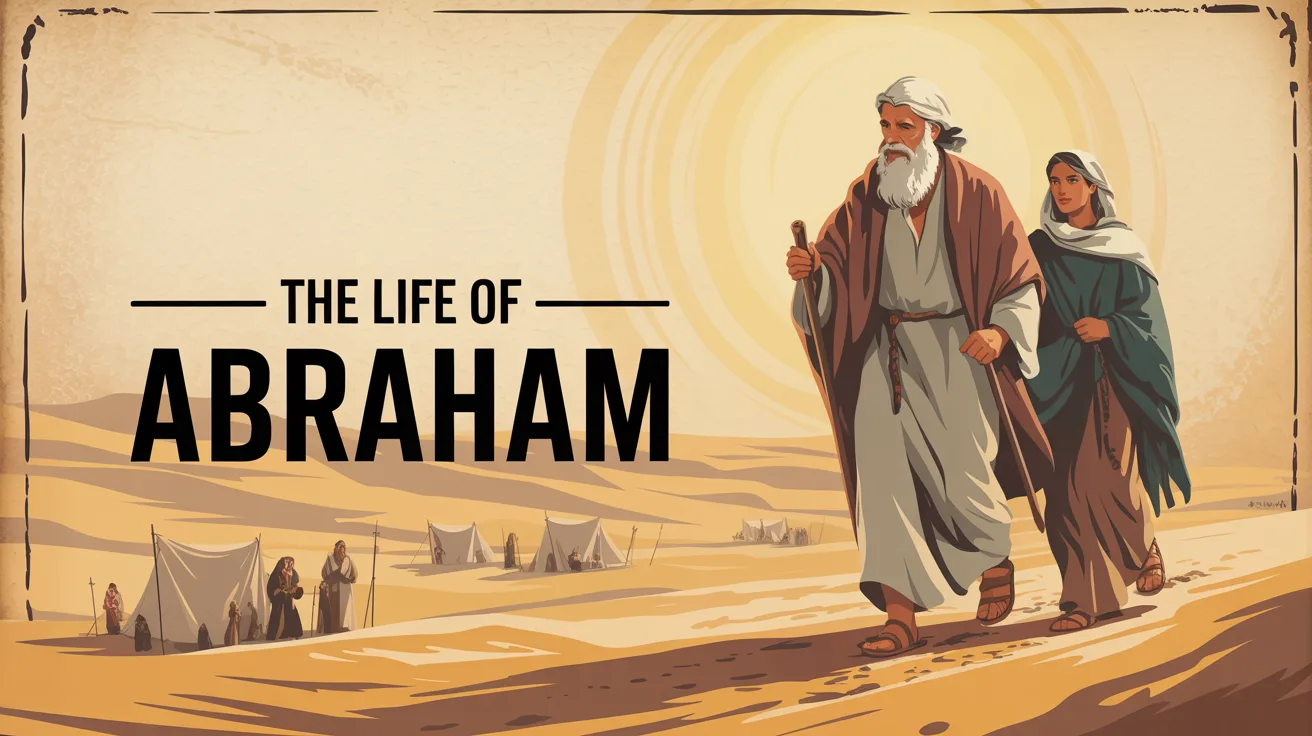

Abraham stands at the headwaters of biblical history as one of the most important figures in all of Scripture. He is the patriarch of Israel, the bearer of covenant promises, and the example of what it means to walk by faith. Over 300 times, his name appears in the Bible. But Abraham”s greatness was not in his power, wealth, or perfection… it was in his obedience to God and his belief in promises yet unseen.
His account unfolds primarily in Genesis 11 through Genesis 25, and it is within these chapters that we witness the transformation of a man from pagan obscurity to prophetic prominence. From Ur of the Chaldeans to the dusty hills of Canaan, Abraham’s life is marked by divine encounters, personal failures, covenantal milestones, and enduring faith.
It is Abraham to whom God first reveals the outline of His redemptive plan. In him, the covenant becomes personal and permanent. Through him, all the families of the earth will be blessed (Genesis 12:3). And from his seed comes the promised Messiah, Jesus Christ, who fulfills every covenant word.
The New Testament often looks back to Abraham to explain the gospel and the nature of saving faith. Paul writes:
“For what does the Scripture say? “Abraham believed God, and it was accounted to him for righteousness.””
(Romans 4:3)
Hebrews highlights his example:
“By faith Abraham obeyed when he was called to go out to the place which he would receive as an inheritance. And he went out, not knowing where he was going.”
(Hebrews 11:8)
And Jesus Himself testified of Abraham”s spiritual insight:
“Your father Abraham rejoiced to see My day, and he saw it and was glad.”
(John 8:56)
This study is not just a biography. It is a journey through one of the richest lives in the Bible, filled with patterns, shadows, and truths that reach far beyond Abraham himself. We will walk through each chapter of his life: from the call to leave everything behind, to his mistakes in Egypt, to the great covenant in Genesis 15, to the birth of Ishmael and the covenant of circumcision, and ultimately to the binding of Isaac, his greatest test of faith.
We will also note the promises, the Psalms and prophets that recall his name, and the New Testament”s bold affirmation that those who are of faith are sons of Abraham (Galatians 3:7).
“Therefore know that only those who are of faith are sons of Abraham.”
(Galatians 3:7)
Abraham is not only the father of a nation; he is the spiritual father of all who believe. His story teaches us how to live in covenant with a holy God.
From Ur to Canaan: The Call of God
The first time we meet Abram, he is living in Ur of the Chaldeans, a prominent and wealthy city in ancient Mesopotamia. Scripture offers no record of God”s dealings with Abram before the call, but when God speaks, Abram obeys. This moment becomes the hinge on which redemptive history turns.
“Now the Lord had said to Abram: “Get out of your country, from your family and from your father”s house, to a land that I will show you. I will make you a great nation; I will bless you and make your name great; and you shall be a blessing. I will bless those who bless you, and I will curse him who curses you; and in you all the families of the earth shall be blessed.””
(Genesis 12:1–3)
The Obedience of Faith
This call required total trust. God did not tell Abram where he was going, only that it was a land He would show him. Abram”s response was immediate and decisive:
“So Abram departed as the Lord had spoken to him, and Lot went with him. And Abram was seventy-five years old when he departed from Haran.”
(Genesis 12:4)
Abram left behind familiarity, security, inheritance, and identity. He left the center of civilization for an unknown future based solely on God”s word. This act defines what it means to walk by faith and not by sight (2 Corinthians 5:7).
The writer of Hebrews affirms this:
“By faith he dwelt in the land of promise as in a foreign country, dwelling in tents with Isaac and Jacob… for he waited for the city which has foundations, whose builder and maker is God.”
(Hebrews 11:9–10)
The Journey Begins
Abram traveled first to Haran with his father Terah, where they paused until Terah”s death (Genesis 11:31–32). From there, God renewed the call, and Abram entered the land of Canaan.
He passed through Shechem, where God appeared to him again:
“Then the Lord appeared to Abram and said, “To your descendants I will give this land.” And there he built an altar to the Lord, who had appeared to him.”
(Genesis 12:7)
The altar-building marks the beginning of Abram”s relationship with God. Everywhere he went, he established worship before settlement. His life was built around the presence of God.
From Shechem to Bethel, he continued:
“And he moved from there to the mountain east of Bethel, and he pitched his tent with Bethel on the west and Ai on the east; there he built an altar to the Lord and called on the name of the Lord.”
(Genesis 12:8)
The tent and the altar are symbols of the pilgrim life: temporary in the world, anchored in heaven.
A Covenant People Begins
Though he was old, childless, and landless, Abram believed God. This act of faith, rooted in a divine promise, would ultimately lead to the formation of Israel. And through Israel, to the birth of Christ.
“And the Scripture, foreseeing that God would justify the Gentiles by faith, preached the gospel to Abraham beforehand, saying, “In you all the nations shall be blessed.””
(Galatians 3:8)
The covenant began with a command and a promise: leave your country, and I will bless you. In every way, Abram”s faith was shown in his action. He believed God enough to move.
This is how Abraham becomes the prototype of saving faith. He took God at His word, even when the details were hidden.
“Abraham believed God, and it was accounted to him for righteousness.”
(Romans 4:3)
Abraham in Egypt and the Separation from Lot
Though Abram believed God, his journey was not without flaws. The call of faith was tested early when famine struck the land. Instead of seeking God”s direction, Abram went down to Egypt, a decision that would carry consequences.
“Now there was a famine in the land, and Abram went down to Egypt to dwell there, for the famine was severe in the land.”
(Genesis 12:10)
In Egypt, fear overtook faith. Abram lied about Sarai, saying she was his sister to protect himself. This deception led Pharaoh to take Sarai into his house, bringing plagues upon Egypt. When the truth was revealed, Pharaoh rebuked Abram and sent him away:
“What is this you have done to me? Why did you not tell me that she was your wife?”
(Genesis 12:18)
Abram left Egypt wealthier but spiritually humbled. It was a lesson: faith falters when fear takes over. Yet God”s grace covered Abram, protecting Sarai and preserving the promise.
Back to the Land of Promise
From Egypt, Abram returned to Bethel, where he had first built an altar. There he worshiped again, restoring his fellowship with God.
“And he went on his journey from the South as far as Bethel… to the place of the altar which he had made there at first. And there Abram called on the name of the Lord.”
(Genesis 13:3–4)
This return to worship shows the heart of Abram: he knew where to go when he failed. He didn”t remain in Egypt”s compromise; he returned to God”s presence.
The Separation from Lot
As Abram and Lot grew in wealth, conflict arose between their herdsmen. Abram, as the elder and leader, sought peace and proposed separation:
“Please let there be no strife between you and me… Is not the whole land before you? Please separate from me. If you take the left, then I will go to the right.”
(Genesis 13:8–9)
Lot chose the fertile plains of Jordan, pitching his tent toward gomorrah/”>Sodom. Abram remained in Canaan. Though Lot”s choice appeared prosperous, it would prove dangerous.
After Lot departed, God reaffirmed His promise to Abram. This was a turning point, the land was truly his now, in promise and separation.
“Lift your eyes now and look from the place where you are… all the land which you see I give to you and your descendants forever.”
(Genesis 13:14–15)
Abram responded not by grasping for land, but by building another altar and walking through the land in obedience and worship.
“Arise, walk in the land through its length and its width, for I give it to you.” Then Abram moved his tent, and went and dwelt by the terebinth trees of Mamre, which are in Hebron, and built an altar there to the Lord.
(Genesis 13:17–18)
A Heart of Peace and Faith
This chapter of Abram”s life shows the mixture of human weakness and spiritual growth. He stumbled in Egypt but returned in repentance. He deferred to Lot and trusted God for his inheritance. He worshiped through it all.
“Mark the blameless man, and observe the upright; for the future of that man is peace.”
(Psalm 37:37)
Abram”s peace came not from land or livestock, but from trusting the promises of God and staying close to the altar.
The Rescue of Lot and the Blessing of Melchizedek
As Lot settled in Sodom, a coalition of kings rose against the city. Lot, along with many others, was taken captive. When Abram heard of this, he didn”t hesitate. Though he had separated from Lot, his love remained. Abram armed his trained servants and pursued the invaders far north, trusting God for the outcome.
“Now when Abram heard that his brother was taken captive, he armed his three hundred and eighteen trained servants… and pursued them as far as Dan.”
(Genesis 14:14)
With a surprise night attack, Abram recovered all the goods and rescued Lot and the other captives. This was not a political conquest; it was an act of loyalty and courage. Abram risked everything for the sake of his nephew, embodying the very heart of a shepherd-warrior.
Melchizedek: The King-Priest and Preincarnate Christ
After Abram”s victorious rescue of Lot and the defeat of the kings, he was met by a most mysterious figure: Melchizedek. His name means “king of righteousness,” and he ruled over Salem, meaning “peace.” He was not merely a king, he was also “priest of God Most High.” In this short encounter, we witness a powerful revelation of Christ before the incarnation.
“Then Melchizedek king of Salem brought out bread and wine; he was the priest of God Most High. And he blessed him and said: “Blessed be Abram of God Most High, possessor of heaven and earth.””
(Genesis 14:18–19)
This is the first mention of a priest in Scripture, and Melchizedek stands apart from the Levitical order that would come centuries later. He offered Abram bread and wine, symbols that would later be associated with Christ”s body and blood in the New Covenant (Matthew 26:26–28). His very role combines kingship and priesthood, something forbidden under the Mosaic Law, but perfectly fulfilled in Christ alone.
Abram, discerning the significance of this encounter, gave Melchizedek a tenth of all. This tithe was not coerced or commanded, it was a response of worship. Abram was recognizing someone greater than himself.
“Now beyond all contradiction the lesser is blessed by the better.”
(Hebrews 7:7)
The writer of Hebrews makes it unmistakable: Melchizedek is more than just a type of Christ. He is described as:
“…without father, without mother, without genealogy, having neither beginning of days nor end of life, but made like the Son of God, remains a priest continually.”
(Hebrews 7:3)
He was not merely like Christ, He is the eternal priest, the one who continues forever. This cannot apply to a mere man. There is no record of his origin or death because Melchizedek was not bound by natural lineage. He is a Christophany in the Old Testament: a preincarnate appearance of the Son of God, revealing the eternal priesthood that would one day replace the temporary shadow of Aaron”s line.
Psalm 110, a Messianic prophecy, confirms the eternal nature of this priesthood:
“The LORD has sworn and will not relent, “You are a priest forever according to the order of Melchizedek.””
(Psalm 110:4)
Jesus is the fulfillment of this eternal order. He is both King and Priest, offering Himself as the perfect sacrifice, and He ever lives to make intercession for us (Hebrews 7:25). In blessing Abram, Melchizedek affirmed the covenant promise and revealed the righteousness and peace that would one day come through Christ alone.
Refusing the Rewards of Men
Afterward, the king of Sodom offered Abram a reward, but Abram refused. He would not enrich himself by human means or allow anyone to claim they made him wealthy. His provision would come from God alone.
“But Abram said to the king of Sodom, “I have raised my hand to the LORD, God Most High, the Possessor of heaven and earth, that I will take nothing… lest you should say, “I have made Abram rich.””
(Genesis 14:22–23)
Abram”s integrity in victory is as remarkable as his bravery in battle. He honored God not just in war, but in his handling of wealth and alliances. His faith was not situational, it was consistent and anchored in the promise of God.
This season reveals a more mature Abram: bold in defense, humble in success, discerning in worship. He did not seek reward from kings, but blessing from God. His journey wasn”t only about the land, it was about knowing and serving the Most High.
The Covenant Confirmed: God”s Promise of an Heir
After the victory over the kings and the blessing from Melchizedek, the Lord appeared again to Abram, not with a command to move or fight, but with a promise and assurance.
“Do not be afraid, Abram. I am your shield, your exceedingly great reward.”
(Genesis 15:1)
This was deeply personal. Abram had refused the riches of Sodom, and now God Himself promised to be his reward. But Abram”s heart was still burdened, because he had no heir. Despite all the blessings, the covenant promises still seemed unfulfilled without a child.
“Lord God, what will You give me, seeing I go childless…?”
(Genesis 15:2)
God answered, not with rebuke but with a reaffirmation of His word. Abram would have a son, and that son would come from his own body. Then God took Abram outside to gaze at the night sky.
“Look now toward heaven, and count the stars if you are able to number them… So shall your descendants be.”
(Genesis 15:5)
In this moment, Abram believed, he trusted beyond his understanding or ability. And what follows is one of the clearest statements of justification by faith in the entire Bible.
“And he believed in the Lord, and He accounted it to him for righteousness.”
(Genesis 15:6)
The Covenant Ritual
To seal the promise, God initiated a covenant ceremony. Animals were brought and divided. This was a common ancient practice to affirm an unbreakable oath. But Abram did not walk between the pieces. Instead, God alone passed through, in the form of a smoking oven and a burning torch.
“On the same day the Lord made a covenant with Abram, saying: “To your descendants I have given this land…””
(Genesis 15:18)
This covenant was unilateral. God alone guaranteed its fulfillment. It wasn”t dependent on Abram”s performance, but on God”s faithfulness. This moment set the tone for all future covenants: man”s role is to believe, and God”s role is to fulfill.
Faith that Waits
Though the promise was now confirmed by covenant, the fulfillment would still require waiting. Abram would not see all of it come to pass in his lifetime. Yet the assurance of God”s word was enough. The stars above became the banner of his hope.
“For all the promises of God in Him are Yes, and in Him Amen, to the glory of God through us.”
(2 Corinthians 1:20)
This chapter teaches us that faith is not only about stepping out, it is also about holding on. Abram didn”t have a son yet, but he had a promise. And that was enough to believe.
The Birth of Ishmael: A Delay and a Detour
Years passed, and still Abram and Sarai remained childless. Though God had promised, the waiting tested their faith. Sarai, now nearly eighty, believed it was impossible for her to conceive. In desperation, she devised a plan… one born from culture, not from faith.
“See now, the Lord has restrained me from bearing children. Please, go in to my maid; perhaps I shall obtain children by her.”
(Genesis 16:2)
Abram listened. Hagar, Sarai”s Egyptian servant, became pregnant. But what followed was not peace or joy, but strife. Hagar”s pride clashed with Sarai”s jealousy, and Abram found himself in the middle of a broken household.
“Then Sarai dealt harshly with her, and she fled from her presence.”
(Genesis 16:6)
Hagar fled to the wilderness. Alone and pregnant, she encountered the Angel of the Lord. This was not just a messenger, this was the Lord Himself appearing in pre-incarnate form. He saw her affliction and gave her a promise.
“Behold, you are with child, and you shall bear a son. You shall call his name Ishmael, because the Lord has heard your affliction.”
(Genesis 16:11)
Hagar returned, and in due time, Ishmael was born. Abram was now eighty-six years old. Yet Ishmael was not the child of promise. He was the result of human effort and impatience—a detour from God”s perfect timing.
The Cost of Impatience
The consequences of this decision would reverberate through history. While God would bless Ishmael as Abram”s son, the conflict between Ishmael”s descendants and Isaac”s would create generational tension (Genesis 25:18).
This chapter reminds us that even when God delays, He has not forgotten. Faith that endures waits on God”s timing rather than forcing an outcome.
“Rest in the Lord, and wait patiently for Him…”
(Psalm 37:7)
God”s promises do not need our shortcuts. They require our trust.
The Covenant Renewed and the Name Changed
Thirteen years passed after the birth of Ishmael. Abram was now ninety-nine years old, and Sarai eighty-nine. The promises of God lingered unfulfilled in their household. Then, once again, the Lord appeared… not with rebuke, but with renewal.
“I am Almighty God; walk before Me and be blameless. And I will make My covenant between Me and you, and will multiply you exceedingly.”
(Genesis 17:1–2)
This was not a new covenant, but a reaffirmation of the one already given. Yet this time, the language sharpened, the clarity deepened, and the expectation became more personal. Abram fell on his face before the presence of God. The Lord now did something symbolic and powerful: He changed Abram”s name.
“No longer shall your name be called Abram, but your name shall be Abraham; for I have made you a father of many nations.”
(Genesis 17:5)
From “exalted father” (Abram) to “father of a multitude” (Abraham), the name signaled a turning point. It was not merely prophetic, it was covenantal. The promise would not be fulfilled through human striving, but by God”s power.
The Covenant Sign and the Laughter of Faith
God also established a physical sign of the covenant: circumcision. Every male descendant of Abraham would bear this mark as a symbol of separation and belonging to the Lord.
“This is My covenant which you shall keep… Every male child among you shall be circumcised.”
(Genesis 17:10)
It was a seal, a reminder that this nation would not be like others. Their identity was rooted in divine calling, not natural birth. Sarai too received a new name. She would no longer be Sarai (“my princess”), but Sarah (“princess of nations”).
“Then God said to Abraham, “As for Sarai your wife, you shall not call her name Sarai, but Sarah shall be her name. And I will bless her and also give you a son by her.””
(Genesis 17:15–16)
Abraham laughed… not in doubt, but in reverent awe. The Hebrew word for laughed here is tsachaq (צָחַק). While this word can sometimes imply mockery, in this context it expresses stunned joy and wonder. Abraham was nearly a hundred, and Sarah almost ninety. The promise defied reason, but God’s Word would not return void. The child of promise would come. His name would be Isaac, meaning “he laughs.”
“Then Abraham fell on his face and laughed, and said in his heart, “Shall a child be born to a man who is one hundred years old? And shall Sarah, who is ninety years old, bear a child?””
(Genesis 17:17)
Abraham”s laughter was worship. He marveled, not mocked. The name change, the covenant sign, and the renewed word all pointed forward to the impossible becoming reality through the faithfulness of God.
The Three Visitors and the Promise Reaffirmed
Not long after the covenant was renewed, Abraham received an unexpected visit. He was sitting in the heat of the day by the oaks of Mamre when three men appeared. Without hesitation, Abraham ran to meet them, bowed low, and offered them hospitality.
“My Lord, if I have now found favor in Your sight, do not pass on by Your servant. Please let a little water be brought, and wash your feet, and rest yourselves under the tree.”
(Genesis 18:3–4)
These were no ordinary men. One was the LORD Himself in visible form, and the other two were angels. As Abraham served them, they spoke once again of the promise, that within a year, Sarah would give birth to a son.
“I will certainly return to you according to the time of life, and behold, Sarah your wife shall have a son.”
(Genesis 18:10)
Sarah, listening from the tent, laughed in disbelief. She, too, was struck by the absurdity of the idea. Yet the LORD responded with a question that still echoes through the corridors of faith:
“Is anything too hard for the Lord? At the appointed time I will return to you… and Sarah shall have a son.”
(Genesis 18:14)
This moment was not only a reaffirmation of the promise but a test of belief. It drew Sarah into the story of faith, not merely as Abraham”s wife, but as the one through whom the miracle would come. Her laughter would be turned into joy. Isaac, the child of laughter, would be born to testify that God keeps His word, even when all human hope is gone.
As the visitors rose to leave, Abraham was given insight into another matter: the sin of Sodom and Gomorrah. The LORD would not hide His plans from Abraham, His covenant friend. Abraham then demons/”>demonstrated his compassion and intercessory heart as he pleaded with God to spare the city for the sake of the righteous.
“Shall not the Judge of all the earth do right?”
(Genesis 18:25)
Though the cities would fall under divine judgment, Abraham’s role as an intercessor reveals his growing closeness to the LORD. He not only believed the promises, but he also reflected the compassion of the God who gave them.
The Birth of Isaac and the Banishment of Ishmael
At long last, the appointed time came. God had kept His word. The barren womb of Sarah gave way to life, and the son of promise was born. Abraham named him Isaac, which means “laughter”, a reminder of Sarah”s initial doubt and the joy that now filled their home.
“And the Lord visited Sarah as He had said, and the Lord did for Sarah as He had spoken. For Sarah conceived and bore Abraham a son in his old age, at the set time of which God had spoken to him.”
(Genesis 21:1–2)
The miracle child brought joy, but not without conflict. Ishmael, now a young man, mocked Isaac. This mockery stirred something in Sarah, and she demanded that Hagar and Ishmael be sent away. Abraham was distressed. Ishmael was his son too. But God directed Abraham to listen to Sarah, assuring him that the covenant line would continue through Isaac.
“Do not let it be displeasing in your sight because of the lad or because of your bondwoman. Whatever Sarah has said to you, listen to her voice; for in Isaac your seed shall be called.”
(Genesis 21:12)
With a heavy heart, Abraham sent Hagar and Ishmael away. Yet even this separation came with a promise. God would make a nation from Ishmael as well. In the wilderness, when all seemed lost, God opened Hagar”s eyes, and she saw a well of water. The God who sees was watching over them still.
This account, though painful, underscored the uniqueness of Isaac”s role in redemptive history. The promise was through him. The covenant would flow through the line of the miraculous, not the natural. Isaac was not merely a son, he was a signpost pointing forward to another miraculous Son, born of a woman, sent to bring salvation to the nations.
The Testing of Abraham: Offering Isaac
God had fulfilled His promise. Isaac, the son of laughter, the son of promise, was growing. Then came the most staggering command Abraham had ever received. God would test his faith, not with mere words, but with the ultimate request: to offer up Isaac as a burnt offering.
“Take now your son, your only son Isaac, whom you love, and go to the land of Moriah, and offer him there as a burnt offering on one of the mountains of which I shall tell you.”
(Genesis 22:2)
There is no record of Abraham”s internal anguish. No protest, no delay. Early the next morning, he rose and set out with Isaac. Faith obeys, even when the heart breaks. As they journeyed, Isaac noticed something missing.
“But Isaac spoke to Abraham his father and said, “My father!” And he said, “Here I am, my son.” Then he said, “Look, the fire and the wood, but where is the lamb for a burnt offering?” And Abraham said, “My son, God will provide for Himself the lamb for a burnt offering.””
(Genesis 22:7–8)
Atop Mount Moriah, Abraham built the altar, bound his beloved son, and raised the knife. But the Angel of the LORD intervened. God had seen Abraham”s obedience. His faith had passed the ultimate test.
“Do not lay your hand on the lad, or do anything to him; for now I know that you fear God, since you have not withheld your son, your only son, from Me.”
(Genesis 22:12)
Abraham looked up and saw a ram caught in the thicket. The LORD had indeed provided. This moment became a prophetic picture of substitutionary sacrifice, pointing directly to Calvary. The name Abraham gave the place still echoes today:
“And Abraham called the name of the place, The-LORD-Will-Provide; as it is said to this day, “In the Mount of the LORD it shall be provided.””
(Genesis 22:14)
In this chapter, we see the clearest shadow of the Gospel in all of Genesis. A beloved son, offered on a mountain, yet spared by a substitute. Thousands of years later, on a hill near that same region, another beloved Son would not be spared, but through His death, the world would be saved.
The Death of Sarah and the Cave of Machpelah
Sarah, the only woman in Scripture whose age at death is recorded, died at 127 years old. Her death marked the end of a long and faithful journey beside Abraham, one filled with trials, joy, and the miraculous birth of Isaac. When she died in Hebron, Abraham mourned deeply and set out to find a burial place, not only for Sarah, but as a permanent family resting place in the Promised Land.
“So Sarah died in Kirjath Arba (that is, Hebron) in the land of Canaan, and Abraham came to mourn for Sarah and to weep for her.”
(Genesis 23:2)
Abraham approached the sons of Heth with great humility and asked for a burial site. They honored him as “a mighty prince among us” and offered any of their tombs. Yet Abraham insisted on purchasing a specific site, the Cave of Machpelah owned by Ephron the Hittite.
“Let me give you the cave of Machpelah which I have, which is at the end of my field; I will give it to you… But Abraham insisted… saying, “I will give you money for the field; take it from me, and I will bury my dead there.””
(Genesis 23:9,13)
Ephron named a price, four hundred shekels of silver, a considerable sum. Abraham paid it without bargaining. This purchase was a prophetic act. Though he owned none of the land that was promised to him yet, this transaction legally secured a piece of Canaan. It was faith in action: Abraham bought a grave in the very land his descendants would one day inherit fully.
“So the field of Ephron which was in Machpelah… was deeded to Abraham as a possession… And after this, Abraham buried Sarah his wife in the cave of the field of Machpelah before Mamre (that is, Hebron) in the land of Canaan.”
(Genesis 23:17,19)
The cave became the ancestral tomb of the patriarchs and matriarchs: Abraham and Sarah, Isaac and Rebekah, and Jacob and Leah. Even in death, Abraham”s family remained rooted in the land of promise. The Cave of Machpelah is a testimony of enduring hope, pointing forward to the resurrection, when even the tomb shall give way to everlasting life.
The Marriage of Isaac and God”s Continued Covenant
As Abraham grew older, his concern turned to Isaac”s future. Knowing that God had promised descendants through Isaac, Abraham took action to secure a wife for his son, not from the Canaanites, but from his own people. This was not simply cultural preference, but spiritual conviction. Abraham wanted a wife who would align with the covenant purposes of God.
“You shall not take a wife for my son from the daughters of the Canaanites… but you shall go to my country and to my family, and take a wife for my son Isaac.”
(Genesis 24:3–4)
Abraham sent his most trusted servant, likely Eliezer of Damascus (Genesis 15:2), on this sacred mission. The servant prayed for divine guidance and was led to Rebekah at a well in Mesopotamia. His prayer was answered with exactness and speed, confirming God”s hand upon the choice.
“And he said, “O LORD God of my master Abraham, please give me success this day… let it be that the young woman to whom I say, “Please let down your pitcher that I may drink”… let her be the one You have appointed for Your servant Isaac.””
(Genesis 24:12–14)
Rebekah”s family agreed to the proposal, recognizing that this was from the LORD. The servant brought her back to Canaan, and the Scripture records the touching moment of Isaac”s first encounter with his bride.
“Then Isaac brought her into his mother Sarah”s tent; and he took Rebekah and she became his wife, and he loved her. So Isaac was comforted after his mother”s death.”
(Genesis 24:67)
This union marked the continuation of God”s covenant promise through the chosen seed. It also demonstrated how faith, prayer, and obedience were woven together in the lives of Abraham and his household. God had faithfully guided the servant”s journey and fulfilled Abraham”s desire to see Isaac married in the will of God.
The marriage of Isaac and Rebekah not only secured the next generation of the covenant but also reflected the principle that God is intimately involved in the details of our lives. He had promised a nation, and now the foundation was laid for that nation to grow through the lineage of Isaac and Rebekah.
Abraham”s Final Years and His Death
After securing a wife for Isaac, Abraham lived many more years. Scripture records that he took another wife named Keturah, through whom he had several sons. Yet the covenant remained with Isaac alone. Abraham, acting in faith and order, gave gifts to the sons of his concubines and sent them away to the east, ensuring that the inheritance of the covenant remained with the promised son.
“But Abraham gave gifts to the sons of the concubines which Abraham had; and while he was still living he sent them eastward, away from Isaac his son, to the country of the east.”
(Genesis 25:6)
This act preserved the separation of the chosen lineage, and once again displayed Abraham”s clarity about the promise of God. He did not act out of favoritism but in submission to divine instruction. Isaac was the son of promise, and the future of the covenant rested with him.
Abraham lived to be one hundred seventy-five years old. His life was marked by obedience, faith, trials, victories, failures, and restorations. He walked with God across deserts, through wars, family strife, and unimaginable testing. And at the end of it all, Scripture gives a simple yet profound summary of his death:
“Then Abraham breathed his last and died in a good old age, an old man and full of years, and was gathered to his people.”
(Genesis 25:8)
He was buried alongside Sarah in the Cave of Machpelah, the first piece of the promised land ever secured by the patriarchs. Isaac and Ishmael came together to bury him, a quiet moment of reconciliation over the body of their father.
“And his sons Isaac and Ishmael buried him in the cave of Machpelah… there Abraham was buried, and Sarah his wife.”
(Genesis 25:9–10)
Though he died in faith without receiving the fullness of the promise, Abraham saw the beginnings. His faith reached beyond his lifetime. As Hebrews testifies:
“These all died in faith, not having received the promises, but having seen them afar off were assured of them… for He prepared a city for them.”
(Hebrews 11:13–16)
Abraham”s death was not the end, but the transition into the fulfillment of everything he believed. His life continues to speak to us about faith, covenant, obedience, and the eternal purposes of God that never fail.
My Final Thoughts
Abraham’s life was one of journey, obedience, faith, and covenant. He did not begin with spiritual greatness, but with a simple call to leave his homeland. What followed was a life defined by trusting the voice of God even when the path was unclear, the cost was great, and the promises seemed distant.
Abraham believed God. He built altars, interceded for cities, waited for promises, offered his only son, and walked through the ups and downs of life with a heart that leaned toward God. Scripture does not hide his failures, whether it was lying about Sarah, fathering Ishmael, or doubting God’s timing. Yet in every moment, God remained faithful to His covenant.
“He did not waver at the promise of God through unbelief, but was strengthened in faith, giving glory to God.”
(Romans 4:20)
Abraham”s legacy is not one of perfection, but of persistent trust. He is the father of all who believe. Through his seed came the nation of Israel, the giving of the Law, and most importantly, the Messiah… Jesus Christ, the true fulfillment of the covenant.
“Now to Abraham and his Seed were the promises made. He does not say, “And to seeds,” as of many, but as of one, “And to your Seed,” who is Christ.”
(Galatians 3:16)
The entire redemptive arc of Scripture flows through Abraham”s life: faith in the unseen, the promise of a nation, and the hope of a Savior. His life reminds us that our journey with God will not always be simple, but it will always be significant if we walk by faith.
“By faith Abraham obeyed… And he went out, not knowing where he was going.”
(Hebrews 11:8)
May we walk as Abraham walked: not by sight, but by faith, always trusting the God who calls, who leads, and who fulfills every promise He has made.
 Get the book that teaches you how to evangelize and disarm doctrines from every single major cult and religion.