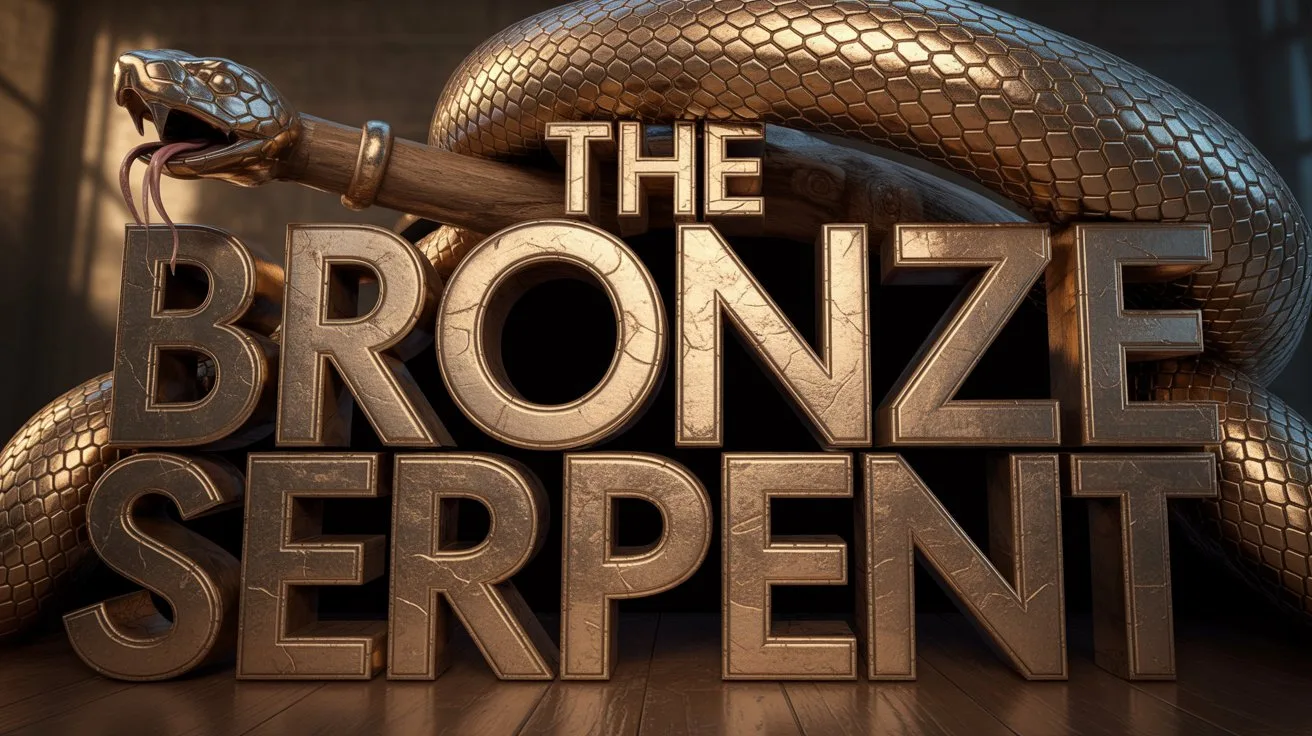

The bronze serpent is one of the clearest pictures in the Old Testament of how God saves sinners by grace through faith. It is simple enough for a child to understand, yet deep enough to strengthen any believer’s confidence in the gospel. In this study we will walk through the original account in Numbers, then follow the Lord Jesus as He applies it to His own cross, and then we will draw out the practical lessons God meant His people to learn.
The Story in the Wilderness
God did not give the bronze serpent as a religious object for Israel to admire. He gave it as an urgent remedy for a deadly judgment. To understand the picture, we need the setting.
“Then they journeyed from Mount Hor by the Way of the Red Sea, to go around the land of Edom; and the soul of the people became very discouraged on the way. And the people spoke against God and against Moses: ‘Why have you brought us up out of Egypt to die in the wilderness? For there is no food and no water, and our soul loathes this worthless bread.’” (Numbers 21:4-5)
Israel had been redeemed from Egypt by the blood of the Passover lamb. God had carried them, fed them, and guided them. Yet in discouragement they turned their mouths against God and against the leader God had appointed. Their complaint was not only about circumstances. It was about God’s goodness.
They called the manna “worthless bread.” That manna was a daily miracle, a daily reminder that God could be trusted. When people despise God’s provision, they are not merely having a hard day. They are accusing God in their heart.
God’s Judgment Was Real and Personal
“So the LORD sent fiery serpents among the people, and they bit the people; and many of the people of Israel died.” (Numbers 21:6)
This is blunt. God’s judgment was not theoretical. The serpents came “among the people.” The bites were real. The deaths were many. Sin is not a light thing, and God is not indifferent to rebellion.
Also notice the fairness of God’s judgment. Israel had chosen the way of unbelief and complaint. God allowed a terror to come into their camp that matched what was already in their hearts. They had despised God’s life-giving provision. Now death stared them in the face.
Repentance and Intercession
“Therefore the people came to Moses, and said, ‘We have sinned, for we have spoken against the LORD and against you; pray to the LORD that He take away the serpents from us.’ So Moses prayed for the people.” (Numbers 21:7)
This is a turning point. They confessed plainly, “We have sinned.” They did not rename it. They did not blame their feelings. They admitted they had spoken against the LORD.
Then they asked for prayer. Moses, the one they had spoken against, prayed for them anyway. God often uses a mediator figure in Scripture to point us forward to the true Mediator, Jesus Christ. Moses’ prayer did not earn their healing, but it did show God’s willingness to show mercy when people humble themselves.
God’s Remedy: Look and Live
“Then the LORD said to Moses, ‘Make a fiery serpent, and set it on a pole; and it shall be that everyone who is bitten, when he looks at it, shall live.’ So Moses made a bronze serpent, and put it on a pole; and so it was, if a serpent had bitten anyone, when he looked at the bronze serpent, he lived.” (Numbers 21:8-9)
God could have removed the serpents immediately. He could have healed the people privately in their tents. Instead He chose a public remedy with a clear requirement: the bitten person must look.
That “look” was not magic. It was obedience. It was faith in God’s word. The promise was simple: “when he looks at it, shall live.” The remedy was outside of them. The cure was not in their willpower, their works, or their strength. Their part was to respond to God’s promise in the way God commanded.
Also notice that the object was lifted up “on a pole.” God designed the whole scene to be visible and unmistakable. Anyone could look. Anyone could live. A weak person could look. A child could look. A dying person who could barely lift his head could look.
Why a Serpent? What the Picture Means
At first, it can feel strange that God used the image of the very thing that was killing them. But God was teaching something that would later be made perfectly clear in Christ.
Sin Brings Death
The snakes were not random. They were judgment. That judgment reminds us of the basic reality of sin. Sin is not only a mistake. Sin is rebellion against God. And sin leads to death.
“For the wages of sin is death, but the gift of God is eternal life in Christ Jesus our Lord.” (Romans 6:23)
Wages are earned. That is what we deserve by nature and by choice. Israel’s bites picture the deadly consequence of sin. The gospel begins with the truth that we are not okay on our own.
God Provides a Substitute Remedy
God did not tell the bitten Israelites to suck out venom, or to run, or to fight. He gave them a remedy He provided. The bronze serpent was not a “good luck charm.” It was God’s appointed way of life for condemned people.
“But God demonstrates His own love toward us, in that while we were still sinners, Christ died for us.” (Romans 5:8)
In the wilderness, the remedy came from God’s mercy. In the gospel, the remedy is Christ’s death for sinners. God does not wait for people to fix themselves before He offers salvation.
Faith Is Personal and Practical
Numbers says, “everyone who is bitten, when he looks at it, shall live.” Nobody could look for you. You could not ride on your parents’ faith. You could not borrow a neighbor’s obedience. Each bitten person had to respond to God’s word personally.
“So then faith comes by hearing, and hearing by the word of God.” (Romans 10:17)
The bitten Israelite heard God’s promise, then acted on it by looking. In the same way, saving faith today is not a feeling you manufacture. It is a response to God’s word about His Son.
Jesus Connects the Bronze Serpent to the Cross
The Old Testament story is not merely a moral lesson about complaining. Jesus Himself tells us what it ultimately points to.
Jesus and Nicodemus
“And as Moses lifted up the serpent in the wilderness, even so must the Son of Man be lifted up, that whoever believes in Him should not perish but have eternal life.” (John 3:14-15)
Jesus took this famous wilderness story and applied it to His own death. “Lifted up” points to the cross, where Jesus would be publicly displayed. The message is not complicated: as the bitten Israelites looked and lived, sinners believe in Christ and receive eternal life.
Jesus also makes the invitation wide: “whoever believes in Him.” That matches the wilderness scene. Any bitten person could look. Any sinner can believe.
“For God so loved the world that He gave His only begotten Son, that whoever believes in Him should not perish but have everlasting life.” (John 3:16)
God’s love moved Him to give. The Son was not taken unwillingly. He was given. The condition is believing, and the promise is everlasting life. This does not mean everyone is automatically saved, but it does mean the offer is sincere and broad. God’s heart is to save.
The Problem Jesus Solves Is Deeper Than Circumstances
“He who believes in Him is not condemned; but he who does not believe is condemned already, because he has not believed in the name of the only begotten Son of God.” (John 3:18)
Israel’s problem was not just snakes. It was sin that brought them under judgment. Our problem is not just suffering, stress, or confusion. Without Christ, we are “condemned already.” The good news is that belief in Jesus brings deliverance from condemnation.
Notice the seriousness of refusing Christ. The refusal is not neutral. It leaves a person where they already are, under condemnation. That is why the gospel call matters. People are not being invited from “good” to “better.” They are being called from death to life.
What “Look and Live” Teaches Us About Saving Faith
The bronze serpent gives us a clean, simple model of faith. Faith is not a work that earns God’s favor. Faith is taking God at His word and receiving what He provides.
Faith Is Not Self-Improvement
In Numbers 21, the bitten man did not heal himself. He did not overcome poison by discipline. He looked. That is humbling. People prefer to contribute something. But God designed the remedy so that the glory would go to Him alone.
“For by grace you have been saved through faith, and that not of yourselves; it is the gift of God, not of works, lest anyone should boast.” (Ephesians 2:8-9)
Grace means God’s undeserved kindness. Faith is the open hand that receives. Works are what we do to earn. God shuts the door to boasting by saving us in a way that leaves no room for personal credit.
Faith Has an Object: God’s Promise in Christ
The Israelites did not have faith in faith. They had faith in what God said about the bronze serpent. If someone said, “I believe,” but refused to look, their “belief” was empty. In the same way, saving faith is not vague optimism. It rests in a Person and a promise.
“Nor is there salvation in any other, for there is no other name under heaven given among men by which we must be saved.” (Acts 4:12)
The object is Christ. The name matters because the Person matters. God did not provide ten remedies. He provided one Savior. That is not narrow-mindedness. It is mercy, because the way is clear.
Faith Is Simple Enough for Anyone
Looking does not require education. Looking does not require money. Looking does not require a lifetime of religious training. It only requires that a person admit their need and trust God’s remedy.
“Sirs, what must I do to be saved? So they said, ‘Believe on the Lord Jesus Christ, and you will be saved, you and your household.’” (Acts 16:30-31)
That answer is not shallow. It is powerful. “Believe on the Lord Jesus Christ.” He is Lord, meaning He has the right to rule. He is Jesus, the Savior. He is the Christ, God’s Anointed One. The promise is “you will be saved.”
The “Lifting Up” of Christ and What Happened at the Cross
Jesus said the Son of Man “must” be lifted up. That means the cross was not an accident. It was God’s plan to deal with sin in righteousness and mercy at the same time.
Christ Bore Our Sin
“For He made Him who knew no sin to be sin for us, that we might become the righteousness of God in Him.” (2 Corinthians 5:21)
Jesus “knew no sin.” He was spotless. Yet God “made Him…to be sin for us.” That does not mean Jesus became a sinner in His nature. It means our sin was laid on Him as our sacrifice. He took our place so that we could receive righteousness in Him.
That helps explain why the symbol in Numbers was a serpent. The serpent is connected with the curse and with sin’s deadly bite. In the picture, the judgment was confronted publicly. On the cross, Jesus confronted sin and its curse openly.
Christ Bore the Curse
“Christ has redeemed us from the curse of the law, having become a curse for us (for it is written, ‘Cursed is everyone who hangs on a tree’).” (Galatians 3:13)
The cross was not only physical suffering. It was Christ taking the curse that sin deserves. He redeemed us, meaning He bought us out of bondage. The payment was Himself.
So when Jesus says He must be lifted up, He is saying the only way to save sinners was to take the curse and judgment in their place.
The Cross Was Public and Sufficient
“And as they came out, they found a man of Cyrene, Simon by name. Him they compelled to bear His cross. And when they had come to a place called Golgotha, that is to say, Place of a Skull, they gave Him sour wine mingled with gall to drink. But when He had tasted it, He would not drink. Then they crucified Him, and divided His garments, casting lots, that it might be fulfilled which was spoken by the prophet.” (Matthew 27:32-35)
The death of Christ was public. It happened in history, in a known place, in front of witnesses. God did not ask the world to trust a hidden myth. He gave a cross that could be seen, testified, and preached.
And His sacrifice is sufficient. The bronze serpent did not need to be remade for each person. It stood as God’s provision for the bitten. In a far greater way, Christ’s cross is God’s provision for the world.
“Who Himself bore our sins in His own body on the tree, that we, having died to sins, might live for righteousness; by whose stripes you were healed.” (1 Peter 2:24)
He bore our sins “on the tree.” That is substitution. The result is not only forgiveness, but a new direction: “might live for righteousness.” God saves us from sin’s penalty and also from sin’s power, as we walk with Him.
A Warning: When a Picture Becomes an Idol
The bronze serpent began as a God-given remedy. Later, it became a stumbling block when people treated it as sacred in itself. God records this to warn us.
“He removed the high places and broke the sacred pillars, cut down the wooden image and broke in pieces the bronze serpent that Moses had made; for until those days the children of Israel burned incense to it, and called it Nehushtan.” (2 Kings 18:4)
Over time, the people began to burn incense to the bronze serpent. They gave a special name to it. They treated it like a holy object. That is exactly what human hearts tend to do. We take what God used, and we start trusting the thing instead of the God who saves.
Hezekiah did the right thing. He broke it. He called it what it had become to them, “Nehushtan,” a mere piece of bronze. That was not disrespect to God. That was obedience to God. Anything that competes with God for trust must be put away.
Idolatry Can Be Very Religious
“Little children, keep yourselves from idols. Amen.” (1 John 5:21)
Idols are not only statues in pagan temples. An idol is anything we trust, love, or fear more than God. It can be a tradition, a ritual, a symbol, a preacher, a church name, or even a spiritual experience. If it takes the place of Christ, it is dangerous.
The lesson is plain: God’s remedy is not found in objects. Salvation is in the living Christ.
Practical Lessons for the Church Today
God did not preserve this account only to teach history. He preserved it to shape our hearts and keep our faith simple and strong.
Don’t Underestimate the Danger of Complaining
Israel’s words mattered. They “spoke against God.” Complaining can feel small, but it often reveals unbelief underneath. It says, “God is not good,” or “God is not wise,” or “God is not paying attention.”
“Do all things without complaining and disputing, that you may become blameless and harmless, children of God without fault in the midst of a crooked and perverse generation, among whom you shine as lights in the world.” (Philippians 2:14-15)
This does not mean we cannot pour out grief to God. The Psalms are full of cries and questions. The difference is whether we bring our burden to God in faith, or whether we accuse Him in unbelief. God wants His people to shine, not to poison the atmosphere with constant murmuring.
When Convicted, Confess Quickly
Israel said, “We have sinned.” That is the right response when God corrects us. Confession is agreeing with God about our sin. It is not excuses. It is honesty.
“If we confess our sins, He is faithful and just to forgive us our sins and to cleanse us from all unrighteousness.” (1 John 1:9)
God is “faithful and just” to forgive because Christ has already paid for sin. Confession does not buy forgiveness. It receives it and restores fellowship. A soft heart stays close to God.
Keep the Gospel Clear: Look to Christ
The bronze serpent points to a gospel that is clear and direct. People need to know what to do with their guilt. God’s answer is not “try harder.” God’s answer is Christ crucified and risen.
“Moreover, brethren, I declare to you the gospel which I preached to you, which also you received and in which you stand, by which also you are saved, if you hold fast that word which I preached to you, unless you believed in vain. For I delivered to you first of all that which I also received: that Christ died for our sins according to the Scriptures, and that He was buried, and that He rose again the third day according to the Scriptures.” (1 Corinthians 15:1-4)
The gospel has content. Christ died for our sins. He was buried. He rose again. It happened “according to the Scriptures.” This is what we must keep central in preaching, witnessing, and counseling. People do not need endless religious advice. They need the saving message of Jesus.
Don’t Add Human Requirements to God’s Remedy
Imagine if someone in the camp said, “Looking is not enough. You must also crawl to the pole,” or “You must promise never to be bitten again,” or “You must prove you are sincere by doing ten hard tasks.” That would have been deadly. It would have taken a simple act of faith and buried it under man-made conditions.
“Now to him who works, the wages are not counted as grace but as debt. But to him who does not work but believes on Him who justifies the ungodly, his faith is accounted for righteousness.” (Romans 4:4-5)
God justifies the ungodly. That is good news for sinners. This does not produce lazy living. It produces grateful living. When someone is truly saved, God changes their heart and they begin to follow Christ. But we must not confuse the root with the fruit. The root is faith in Christ. The fruit is a changed life.
Once Saved, Walk in the Light You Have Received
The people who lived after looking still had a wilderness journey. They still needed daily dependence, obedience, and trust. In the same way, salvation is the beginning of a walk with God, not the end.
“As you therefore have received Christ Jesus the Lord, so walk in Him, rooted and built up in Him and established in the faith, as you have been taught, abounding in it with thanksgiving.” (Colossians 2:6-7)
We receive Christ by faith. We also walk by faith. The Christian life stays anchored in the same posture as the moment of salvation: dependence on Christ, gratitude, and obedience to His word.
My Final Thoughts
The bronze serpent is a mercy story. Real sin brought real judgment, but God provided a real remedy. The dying did not have to earn healing. They had to look where God told them to look and trust what God said.
Jesus said that story was about Him. He was lifted up on the cross so that whoever believes in Him should not perish but have eternal life. That means salvation is not a mystery reserved for the strong. It is open to the weak, the guilty, the wounded, and the ashamed. You do not have to clean yourself up first. You come as you are, and you look to Christ.
If you have never trusted Jesus, do not delay. Sin’s bite is real, and death is not a theory. God’s promise is also real. Believe on the Lord Jesus Christ. If you are already saved, keep the gospel simple in your own heart. Guard yourself from idols, even religious ones. Do not start burning incense to “bronze” when God has given you His Son. Keep your eyes on Christ, and you will find that the same God who heals also leads, provides, and finishes what He began.


 Get the book that teaches you how to evangelize and disarm doctrines from every single major cult and religion.