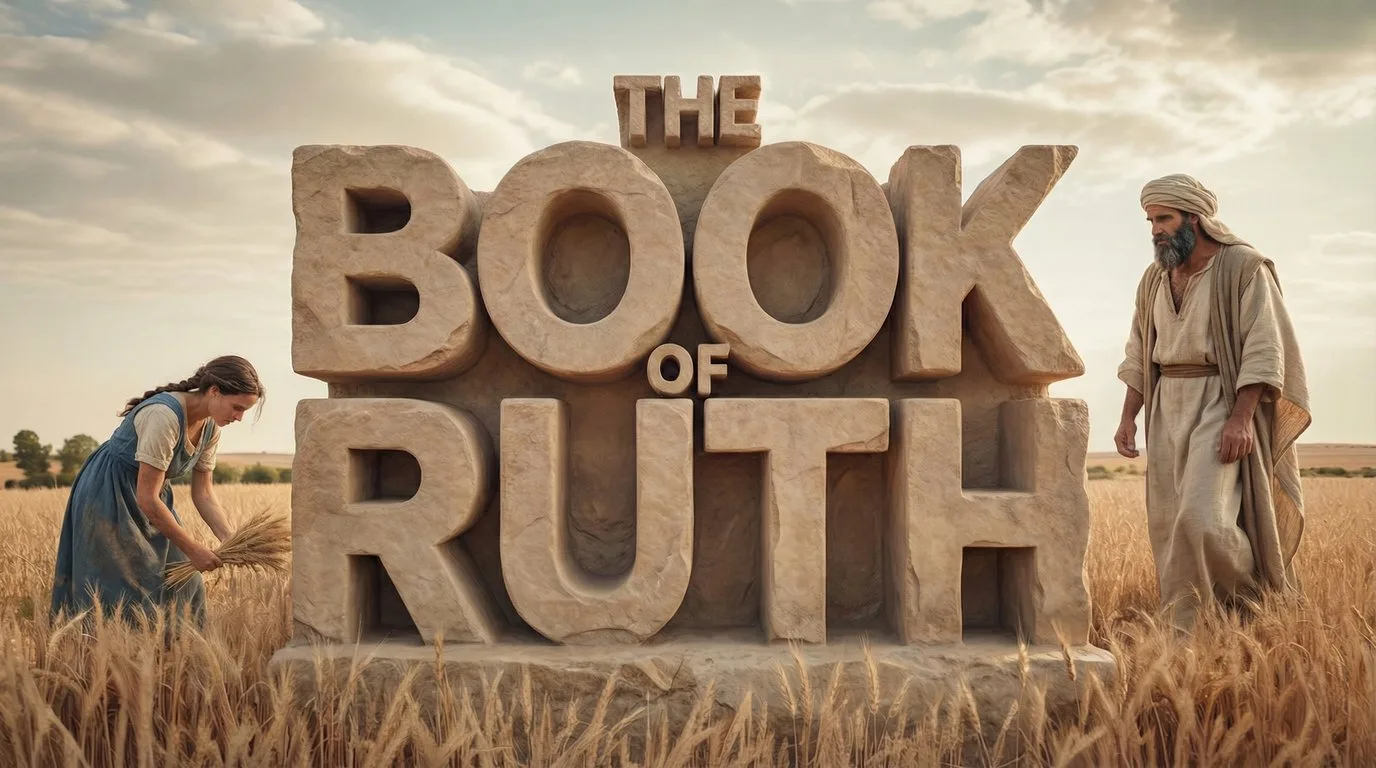

The account of Ruth is a profound narrative of redemption, loyalty, and God’s providence. Found in the Old Testament, the book of Ruth not only recounts the journey of a Moabite widow who finds favor in the eyes of Boaz but also foreshadows the ultimate redemption through Jesus Christ, our Kinsman Redeemer.
As we walk through Ruth, we will pay close attention to the text itself, the historical setting in the days of the judges, and the covenant framework that makes sense of practices like gleaning and the kinsman redeemer. Then we will trace how the book points forward to Christ without forcing meanings that the passage does not support. Ruth is simple to read, but it is spiritually deep, and it trains us to see God working through ordinary faithfulness.
The Dark Days Background
The book begins with an intentionally sobering timestamp. Ruth is set “in the days when the judges ruled,” which matters because Judges describes a repeated cycle of compromise, oppression, and spiritual confusion. Yet Ruth shows that even in a messy era God was not absent, and faithful individuals still existed.
“Now it came to pass, in the days when the judges ruled, that there was a famine in the land. And a certain man of Bethlehem, Judah, went to dwell in the country of Moab, he and his wife and his two sons.” (Ruth 1:1)
Bethlehem means “house of bread,” and yet a famine hits the “house of bread.” Scripture does not explicitly tell us why the famine came, but in the covenant life of Israel, famine could function as discipline meant to turn hearts back to the Lord. Ruth does not linger on the cause. It presents the pressure: an Israelite family leaves the land of promise to survive. The man’s name, Elimelech, means “My God is King,” which is striking because the days of the judges were marked by people acting as though God were not King.
Naomi’s family relocates to Moab, a nation with a complicated relationship to Israel. Moab’s origins go back to Lot (Genesis 19), and in later history Moab often opposed Israel. The text does not explicitly condemn Elimelech for moving, but it does show the bitter fruit that follows: death, loss, and emptiness. There is a quiet warning here about leaving the place of God’s provision, even when circumstances are hard. At the same time, the book will also show that God can meet people in their failure and pain, and can guide them back.
The narrative’s realism is important for our discipleship. Ruth does not present life with God as untouched by suffering. It shows that suffering is real, decisions have consequences, and yet God’s hand is still at work. The question Ruth presses is not, “Will hard things happen?” but, “What will God do with hard things when His people turn back to Him?”
Loss That Empties Naomi
The tragedy in Ruth 1 comes quickly. Elimelech dies. Naomi’s sons marry Moabite women, Ruth and Orpah, and then the sons die as well. In a patriarchal economy where family land and future were tied to male heirs, Naomi is left without natural protection and without the normal path to restoration. The text wants us to feel the emptiness.
“Then Elimelech, Naomi’s husband, died; and she was left, and her two sons. Now they took wives of the women of Moab: the name of the one was Orpah, and the name of the other Ruth. And they dwelt there about ten years. Then both Mahlon and Chilion also died; so the woman survived her two sons and her husband.” (Ruth 1:3-5)
Naomi hears that the Lord had visited His people by giving them bread, and she decides to return to Bethlehem. Her turning back is significant. She is not returning simply to a location, but to the covenant community and to the God whose presence was uniquely tied to the land and people under the Old Covenant.
“And she arose with her daughters-in-law that she might return from the country of Moab, for she had heard in the country of Moab that the LORD had visited His people by giving them bread.” (Ruth 1:6)
Along the road, Naomi urges her daughters-in-law to return to their mothers’ homes. She is honest about her lack of resources and prospects. She even says, “the hand of the LORD has gone out against me” (Ruth 1:13). Naomi’s speech shows a wounded theology. She still speaks of the Lord, but she cannot yet see His kindness. It is possible to believe in God’s reality while struggling to believe in God’s goodness. Ruth does not hide that tension; it invites us to bring our pain honestly before the Lord.
When Naomi arrives in Bethlehem, she asks to be called Mara, “Bitter,” because, as she says, “the Almighty has dealt very bitterly with me” (Ruth 1:20). But the reader knows something Naomi does not yet see: God has already been working through the very person walking beside her, Ruth. Ruth is a sign that Naomi is not as empty as she feels, though it will take time for Naomi to recognize it.
Ruth’s Covenant Loyalty
In the middle of Naomi’s grief stands Ruth’s remarkable commitment. Orpah kisses Naomi and returns, which is understandable and even affectionate. Ruth, however, clings. The Hebrew idea behind Ruth’s loyalty is more than emotional attachment. It is a durable, covenant-like kindness. Ruth does not simply choose Naomi; she chooses Naomi’s people and Naomi’s God. This is a turning point in the book and one of the clearest expressions of conversion in the Old Testament.
“But Ruth said: ‘Entreat me not to leave you, Or to turn back from following after you; For wherever you go, I will go; And wherever you lodge, I will lodge; Your people shall be my people, And your God, my God. Where you die, I will die, And there will I be buried. The LORD do so to me, and more also, If anything but death parts you and me.’” (Ruth 1:16-17)
This declaration not only reflects Ruth’s love for Naomi but also her conversion to faith in the God of Israel. Ruth invokes the covenant name “the LORD” (YHWH), and she calls down covenant sanctions upon herself if she fails. That is not casual sentiment; it is solemn commitment. In a world of fragile relationships, Ruth models faithfulness that reflects the character of God.
Ruth’s background as a Moabite matters, because under the Law, Moab had a troubled place in Israel’s memory (Deuteronomy 23:3-6), and yet Ruth’s account shows that the Lord’s mercy is not limited by ethnicity. The Old Testament never taught salvation by bloodline alone. It taught covenant faith, and it always left room for outsiders to join themselves to the Lord through faith and submission to Him. Ruth is one of the clearest examples of that truth.
Ruth also quietly confronts Israel’s spiritual condition in the days of the judges. The book of Judges repeatedly shows Israelites acting faithlessly. Ruth shows a foreigner acting faithfully. The point is not to shame Israel for its ethnicity but to expose how far mere religious identity can drift from genuine devotion. God is looking for hearts that trust Him.
Providence in the Gleaning Fields
When Ruth and Naomi return to Bethlehem, there is no quick miracle, only the humble pathway of work. Ruth goes to glean behind the reapers. Gleaning was God’s built-in mercy within Israel’s agricultural economy. Landowners were not to harvest every edge or pick up every leftover. The poor and the stranger were allowed to gather what remained. That means Ruth’s daily bread would come through God’s Law put into practice by God’s people.
“When you reap the harvest of your land, you shall not wholly reap the corners of your field, nor shall you gather the gleanings of your harvest. And you shall not glean your vineyard, nor shall you gather every grape of your vineyard; you shall leave them for the poor and the stranger: I am the LORD your God.” (Leviticus 19:9-10)
Ruth 2 highlights what we often call providence. The text says she “happened” to come to the part of the field belonging to Boaz. The writer uses ordinary language to describe an extraordinary reality. To human eyes it looks like coincidence. To eyes trained by Scripture, it is the Lord’s invisible guidance.
“Then she left, and went and gleaned in the field after the reapers; and she happened to come to the part of the field belonging to Boaz, who was of the family of Elimelech.” (Ruth 2:3)
Boaz is introduced not just as wealthy but as worthy, a man of standing and character. His first recorded words to his workers are spiritual: “The LORD be with you!” (Ruth 2:4). That sets the tone. In the days of the judges, here is a man who still honors the Lord. He becomes an instrument of God’s kindness, not merely through private belief but through public practice.
Boaz notices Ruth and asks about her. When he learns who she is and what she has done for Naomi, he blesses her with a profound statement: she has come to take refuge under the Lord’s wings. This is a tender picture. In Scripture, wings evoke protection, shelter, and covenant care (see also Psalm 91:4).
“The LORD repay your work, and a full reward be given you by the LORD God of Israel, under whose wings you have come for refuge.” (Ruth 2:12)
Boaz then expresses that refuge through concrete generosity: protection from harassment, access to water, permission to glean among the sheaves, and extra grain intentionally left for her. This is not romantic sentiment. It is righteous stewardship. Boaz shows what it looks like for a godly man to use authority to protect, not exploit. Ruth responds with humility and gratitude, recognizing she is a foreigner, and yet she is being treated with dignity.
At the end of the day, Ruth brings home an abundant amount. Naomi’s questions are filled with renewed energy. The emptiness begins to crack. Naomi recognizes God’s kindness behind Boaz’s kindness. This is one way God restores us: He allows us to taste His care through the faithful actions of His people.
Boaz as the Kinsman Redeemer
When Ruth and Naomi return to Bethlehem, Ruth begins gleaning in the fields to provide for them. By divine providence, she ends up in the field of Boaz, a wealthy and godly man who is a close relative of Naomi’s deceased husband, Elimelech (Ruth 2:1-3). Boaz notices Ruth’s faithfulness and character, commending her for seeking refuge under the wings of the God of Israel (Ruth 2:12).
In Ruth 3, Naomi instructs Ruth to present herself to Boaz as a kinsman redeemer. The concept of the kinsman redeemer comes from Leviticus 25:25-49 and Deuteronomy 25:5-10, where God established laws for protecting the lineage and property of an Israelite family. A kinsman redeemer was a close relative who had the right and responsibility to redeem a family member’s property, marry a widow, and preserve the family line.
“If one of your brethren becomes poor, and has sold some of his possession, and if his redeeming relative comes to redeem it, then he may redeem what his brother sold.” (Leviticus 25:25)
“If brothers dwell together, and one of them dies and has no son, the widow of the dead man shall not be married to a stranger outside the family; her husband’s brother shall go in to her, take her as his wife, and perform the duty of a husband’s brother to her.” (Deuteronomy 25:5)
It helps to remember that in Israel, land was not merely real estate. It was inheritance tied to God’s promises to the tribes. Losing land could mean generational destabilization. The redeemer was a God-given mechanism to prevent permanent ruin. The Hebrew word often used for this role is related to “go’el,” meaning one who buys back, rescues, or reclaims what has been lost. In other Old Testament contexts, God Himself is called Redeemer, the One who rescues His people (for example in Isaiah). Ruth shows that God’s character is reflected in His laws and in the redeemer who obeys them.
Naomi’s plan in Ruth 3 can feel unfamiliar to modern readers, but the account emphasizes honor, not impropriety. Ruth approaches Boaz at the threshing floor after he has finished work and is resting. She uncovers his feet and lies down, a posture of humility and request. When Boaz awakes, Ruth asks him to spread his wing over her, for he is a close relative. The word translated “wing” is closely related to the word for the corner of a garment, and it echoes Boaz’s earlier prayer that Ruth would find refuge under the Lord’s wings. Ruth is essentially asking, “Be the instrument of that refuge.”
“Then she said, ‘I am Ruth, your maidservant. Take your maidservant under your wing, for you are a close relative.’” (Ruth 3:9)
Boaz, recognizing his role as a kinsman redeemer, responds to Ruth with kindness and integrity. However, he acknowledges that another relative is a closer kinsman. This detail matters. Boaz will not manipulate the law for personal desire. He will do what is right, even if it costs him what he wants. His righteousness is seen in his restraint, his protection of Ruth’s reputation, and his promise to resolve the matter quickly and legally.
Boaz’s words also reveal that he has been watching Ruth’s character all along. He calls her request a kindness, because she did not chase younger men, whether poor or rich (Ruth 3:10). In other words, Ruth’s request is not driven by romance alone but by covenant responsibility and concern for Naomi’s future. Ruth is seeking redemption for the family, not merely a husband for herself.
Boaz sends Ruth home with grain, a tangible pledge of his intention. Naomi reads the sign correctly: Boaz will not rest until the matter is settled. Redemption in Ruth is never presented as vague spiritual language. It is concrete, legal, costly, and public.
Redemption Settled at the Gate
The city gate was the place of legal transactions and public witness. Boaz goes there early, gathers elders, and calls the nearer kinsman to sit down. The account underscores that redemption is not secret or private. It is established openly, in a way that protects the vulnerable and honors righteousness.
“Now Boaz went up to the gate and sat down there; and behold, the close relative of whom Boaz had spoken came by. So Boaz said, ‘Come aside, friend, sit down here.’ So he came aside and sat down.” (Ruth 4:1)
Boaz presents the situation carefully. Naomi is selling the land that belonged to Elimelech. The closer relative has the first right to redeem. At first, the man says he will redeem it. But when Boaz clarifies that redemption involves taking Ruth as wife to raise up the name of the dead on his inheritance, the man declines, saying it would ruin his own inheritance (Ruth 4:5-6). The text does not need to vilify him. It simply shows the cost. Redemption always costs the redeemer something. The nearer kinsman is unwilling to pay it.
“And the close relative said, ‘I cannot redeem it for myself, lest I ruin my own inheritance. You redeem my right of redemption for yourself, for I cannot redeem it.’” (Ruth 4:6)
Boaz, however, is willing. He acquires the right, purchases the land, and takes Ruth as his wife. The people and elders witness it and speak blessing. Their blessing intentionally connects Ruth to the matriarchs of Israel and invokes fruitfulness and reputation in Bethlehem. In other words, the community recognizes that something bigger than a private marriage is happening. A broken line is being restored.
“And all the people who were at the gate, and the elders, said, ‘We are witnesses. The LORD make the woman who is coming to your house like Rachel and Leah, the two who built the house of Israel; and may you prosper in Ephrathah and be famous in Bethlehem.’” (Ruth 4:11)
The legal custom of removing a sandal is mentioned as a sign of the transaction (Ruth 4:7-8). It is an embodied way of saying, “I transfer my right to walk on this land, to claim it, to another.” Again, Ruth anchors redemption in reality. God’s kindness is not imaginary. It moves through legal processes, honest speech, witnesses, and covenant commitments.
Then the Lord grants conception, and Ruth bears a son. The women of the town speak to Naomi, saying the Lord has not left her without a redeemer, and that the child will be a restorer of life. This is one of the most tender reversals in the book. Naomi began empty, convinced that bitterness was her new name. She ends full, holding a child, surrounded by community, seeing that the Lord has been kind even through her sorrow.
Jesus as the Ultimate Kinsman Redeemer
The role of Boaz in Ruth’s life foreshadows the work of Jesus Christ as our ultimate Kinsman Redeemer:
A Willing Redeemer: Boaz willingly took on the responsibility of redemption, even when it involved personal cost. Similarly, Jesus willingly laid down His life to redeem us.
“No one takes it from Me, but I lay it down of Myself. I have power to lay it down, and I have power to take it again. This command I have received from My Father.” (John 10:18)
A Close Relative: To qualify as a kinsman redeemer, Boaz had to be a close relative. Jesus, by taking on human flesh, became our brother and fulfilled this requirement.
“Inasmuch then as the children have partaken of flesh and blood, He Himself likewise shared in the same, that through death He might destroy him who had the power of death, that is, the devil,” (Hebrews 2:14)
Redemption through Payment: Boaz redeemed Ruth and Naomi by paying the necessary price to secure their inheritance. Jesus, in a far greater act, redeemed us by paying the price of sin with His blood.
“In Him we have redemption through His blood, the forgiveness of sins, according to the riches of His grace” (Ephesians 1:7)
Restoration and Inclusion: Boaz’s redemption of Ruth restored her and Naomi to a place of security and honor. Even more, Ruth, a Moabite, was brought into the covenant community of Israel and became part of the lineage of the Messiah (Matthew 1:5). In Christ, we too are brought into the family of God, no matter our background.
“There is neither Jew nor Greek, there is neither slave nor free, there is neither male nor female; for you are all one in Christ Jesus.” (Galatians 3:28)
When we call Jesus our Redeemer, we are not using poetic language detached from history. The New Testament uses redemption vocabulary that matches the Old Testament picture: a price paid, bondage relieved, inheritance secured. The Greek term often translated “redeem” carries the idea of buying out of a marketplace. The point is not that God owes anyone money, but that our sin-debt is real, our bondage is real, and the cost to set us free is real. Jesus does not merely sympathize with our poverty; He acts to rescue.
Also notice the moral beauty of Jesus compared to the nearer kinsman who said, “I cannot.” Jesus, though perfectly righteous, did not refuse because of the personal cost. He did not protect His own inheritance at the expense of ours. He took our burden to give us His riches. Ruth provides a framework for appreciating that redemption is costly and voluntary. Nobody forced Boaz, and nobody forced Jesus. Love moved them to redeem.
At the same time, the picture is not identical in every detail. Boaz redeems within a national covenant context and restores a family line in Israel. Jesus redeems sinners from every nation and brings us into the New Covenant by His blood. The shadow is real, but the substance is greater. Ruth helps us see the contours of the gospel: God moves toward the helpless, provides a qualified redeemer, pays the price, and brings the outsider into covenant blessing.
Ruth’s Faith and Redemption’s Fruit
The Biblical account of Ruth also highlights the role of faith and obedience in receiving redemption. Ruth’s choice to leave Moab and follow Naomi to Bethlehem mirrors our decision to turn away from the world and follow Christ. Her humility and boldness in approaching Boaz reflect the believer’s reliance on God’s grace and provision.
“So she fell on her face, bowed down to the ground, and said to him, ‘Why have I found favor in your eyes, that you should take notice of me, since I am a foreigner?’” (Ruth 2:10)
Ruth did not earn Boaz’s kindness as a wage. She received favor. That is a helpful picture of grace. Grace is not God pretending sin is small. Grace is God choosing to bless the undeserving because of His mercy, and in our case, because the price has been paid by Christ. Ruth’s posture of humility is the opposite of entitlement. She does not march into Bethlehem demanding rights. She comes with a willing heart, ready to work, ready to serve, and ready to trust.
Boaz’s actions point to Christ’s love and sacrifice, but they also remind us that redemption involves restoration. Through Boaz’s redemption, Ruth becomes the great-grandmother of King David, placing her in the direct lineage of Jesus Christ (Ruth 4:17). This highlights God’s providence and His ability to bring beauty from ashes, as He did for Naomi and Ruth.
“Also the neighbor women gave him a name, saying, ‘There is a son born to Naomi.’ And they called his name Obed. He is the father of Jesse, the father of David.” (Ruth 4:17)
The fruit of redemption in Ruth is not only a wedding and a child, but a restored future. Naomi, who once said she went out full and came back empty (Ruth 1:21), is now surrounded by women praising the Lord for His kindness. Redemption changes what the future means. It does not erase the past, but it transforms the meaning of the past by placing it inside God’s larger plan.
For believers today, the fruit of redemption includes forgiveness, a new identity, and a new way of life. Redemption does not simply cancel penalty; it also brings us into belonging. Ruth becomes part of Israel’s community, and later Scripture makes clear that in Christ we become members of God’s household. That belonging should shape how we treat others. Ruth challenges the church to be a place where outsiders can come to the God of Israel, now revealed fully in Jesus, and find refuge, not suspicion.
Ruth also shows that faith often looks ordinary. It looks like gleaning day after day. It looks like honoring wise counsel. It looks like speaking truthfully and acting with integrity. Some believers want their lives to be dramatic, but Ruth teaches us that God often does His most important work through steady faithfulness.
Theological Themes in Ruth
The book of Ruth is rich in theological truths. First, it underscores God’s providence: from Ruth’s arrival in Boaz’s field (Ruth 2:3) to Boaz’s willingness to redeem, every step of the story reflects God’s hand. Second, it emphasizes God’s inclusive grace. Ruth, a Moabite, becomes part of the covenant people, prefiguring the inclusion of the Gentiles in Christ’s salvation (Ephesians 2:11-13). Finally, the Book of Ruth reveals God’s redemptive love. Just as Boaz redeemed Ruth, Jesus redeems us from sin, restoring us to fellowship with God and securing an eternal inheritance.
“Therefore remember that you, once Gentiles in the flesh, who are called Uncircumcision by what is called the Circumcision made in the flesh by hands, that at that time you were without Christ, being aliens from the commonwealth of Israel and strangers from the covenants of promise, having no hope and without God in the world. But now in Christ Jesus you who once were far off have been brought near by the blood of Christ.” (Ephesians 2:11-13)
Providence in Ruth is especially instructive because it is quiet. There are no recorded miracles like the parting of the sea, no visions, no prophets confronting kings. Yet the Lord’s name is honored, His Law is functioning, His people are being cared for, and His promises are moving forward. That is often how God works in our lives. He guides through open doors, faithful relationships, wise timing, and righteous decisions. The phrase “she happened” (Ruth 2:3) reminds us that what looks accidental to us is ordered by God’s wise care.
Inclusive grace does not mean that sin is ignored or that all religions are equal. Ruth does not remain in Moab worship and simply add a bit of Israelite culture. She confesses, “Your God, my God.” She turns from her old identity to the Lord. The inclusion is real, but it is covenant inclusion. In the same way, the gospel goes to all nations, calling all people to repent and believe in Jesus Christ. The church is not a club for one ethnicity or class. It is a redeemed people gathered around one Savior.
Redemptive love in Ruth is also practical. God’s love is seen in food provided, safety given, dignity preserved, and a future restored. That trains us not to separate doctrine from discipleship. If we say we believe in redemption, we should also care about the vulnerable. Boaz did not only talk about the Lord. He behaved like a man who feared the Lord. We should ask ourselves: Do our decisions at work, our use of money, and our treatment of others reflect the character of the Redeemer we claim to know?
Finally, Ruth ends with a genealogy. That might feel anticlimactic, but it is theologically loaded. God is not merely helping two widows survive. He is advancing His plan to bring the Messiah through David’s line. The personal and the prophetic meet in one book. God’s care for individuals is not separate from His great plan of redemption. He works on both levels at once, and Ruth teaches us to trust Him in the small details because He is also faithful in the grand promises.
My Final Thoughts
The account of Ruth and Boaz is not just an inspiring narrative of loyalty and love; it is a picture of the gospel. Boaz, the kinsman redeemer, points us to Jesus Christ, who willingly paid the ultimate price to redeem us from sin and death. As Ruth took refuge under Boaz’s protection, we are called to take refuge under the wings of Christ, our Savior. In Him, we find redemption, restoration, and an eternal inheritance.
Just as Naomi and Ruth found hope through Boaz, we have a living hope through Jesus Christ, the ultimate Kinsman Redeemer. Bring your emptiness to the Lord with honest faith, and let His Word shape your next steps of obedience. God is still writing redemption into the lives of those who trust Him, often through daily faithfulness that seems small, but is precious in His sight.



 Get the book that teaches you how to evangelize and disarm doctrines from every single major cult and religion.