
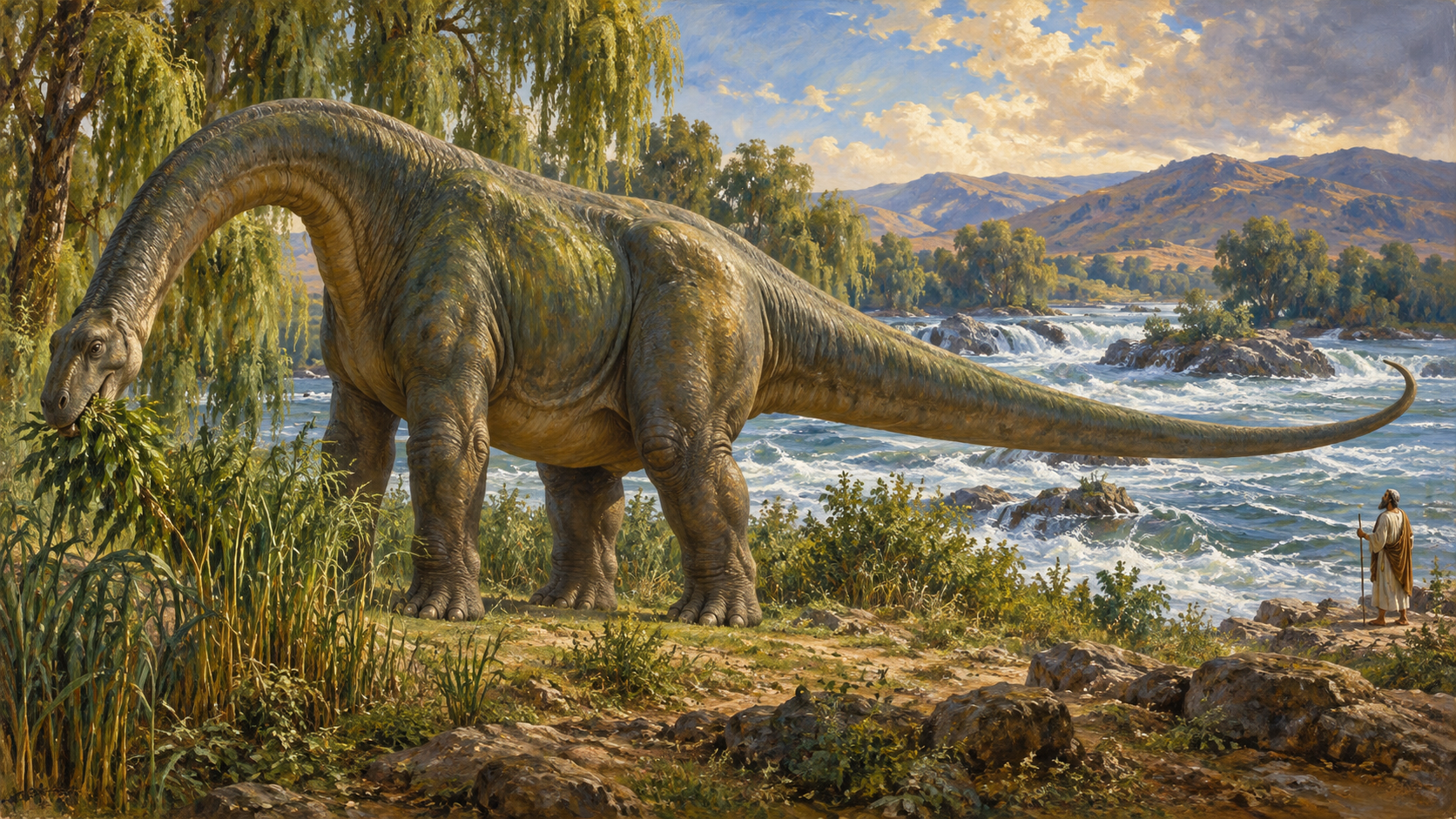
What was Behemoth, and why did God describe it to Job? The creature’s identity deserves attention, but the physical description serves a larger purpose. God directs a suffering man to an animal whose strength he cannot control, then calls him to reckon with the power and wisdom of its Maker. I want to understand both the creature and the reason God brings it into His answer.
Behemoth Appears in God’s Answer to Job
Job had lost his children, possessions, and health. His friends insisted that his suffering exposed wrongdoing, but their accusations did not explain what had happened. Job defended his integrity and wanted an audience with God. The book has already identified him as a man who feared God; his losses were not evidence that the friends’ charges were true. The study on the book of Job follows that dispute and the wider setting of the Lord’s answer.
When the Lord answered from the whirlwind, He did not disclose every hidden reason for Job’s pain. In Job 38–39, He questioned him about the earth’s foundations, the sea’s boundaries, the morning, light, and snow. He also described animals whose lives continued beyond human management: wild goats, the wild donkey, the ostrich, the horse, the hawk, and the eagle. Job lived among works of wisdom he had neither designed nor sustained.
In Job 40:8–14, God makes the challenge concerning justice direct. Could Job condemn God in order to establish his own righteousness? Could he humble the proud and judge the wicked throughout the earth? Before claiming the ability to assess God’s government of the world, Job needed to consider whether he possessed the wisdom and power that governing it required.
Behemoth follows those questions. If Job could not master even this creature, he could not assume the Creator’s place in ruling the whole world. That argument does not make his grief trivial. It exposes the limits of his judgment without endorsing his friends’ explanation of his suffering.
What Job 40 Actually Says About the Creature
The creature called Behemoth appears in Job 40:15–24. The Hebrew name is בְּהֵמוֹת (behemot), a form related to the word for beast or cattle. Although plural in form, it refers here to one creature. Some understand that form as emphasizing an extraordinary beast. The name itself does not require us to imagine a mythical animal.
God begins by placing Behemoth beside Job as another creature He made:
“Look now at the behemoth, which I made along with you; He eats grass like an ox. See now, his strength is in his hips, And his power is in his stomach muscles.”
“He moves his tail like a cedar; The sinews of his thighs are tightly knit. His bones are like beams of bronze, His ribs like bars of iron.”
Behemoth eats grass like an ox, yet its body displays exceptional strength. God calls attention to its hips and stomach muscles, its tail, tightly knit thighs, and powerful frame. The bones and ribs are compared with bronze and iron. Those comparisons describe strength rather than claim the animal was literally made of metal.
The cedar comparison deserves the same care. A cedar suggests impressive strength and stature, but the verse gives no measurement for the tail. The verb is translated in terms of movement or making the tail stiff; the NET note on Job 40:17 discusses that difficulty. I would not turn the image into a claim that the tail must have been exactly as large as a mature cedar. Neither would I dismiss the comparison when considering which animal fits.
The next verse identifies Behemoth’s standing among God’s works and its dependence on its Maker:
“He is the first of the ways of God; Only He who made him can bring near His sword.”
I understand “The first of the ways of God” as describing foremost rank or greatness, rather than requiring Behemoth to have been the first animal created chronologically. The second line, as quoted here, places its overwhelming strength under the authority of the One who made it. Job could not bring such a creature under his command merely because he wished to do so. Its Maker was not confronted by that limitation.
Verses 20–24 add its feeding grounds and habitat. The mountains provide food, and it rests among lotus trees, reeds, and the shade of willows near water. It remains untroubled when a river rages, even when the Jordan surges toward its mouth. The passage ends by asking about capturing it or piercing its nose with a snare. Its diet, bodily strength, shelter, and composure in turbulent water all belong to the description we need to explain.
Which Identification Fits Best?
A hippopotamus is a serious proposal because it is a powerful plant-eater closely associated with water. The habitat and diet fit several details. Its short tail, however, is difficult for me to reconcile naturally with the cedar comparison. A hippopotamus identification therefore needs to explain how that short tail fits the comparison.
An elephant also offers great size and strength, but its comparatively small tail leaves a similar difficulty. A crocodile has a substantial tail and is formidable near water, yet its predatory diet does not fit an animal said to eat grass like an ox. We need an explanation that accounts for the whole creature rather than selecting whichever feature favors a preferred answer.
Other readers understand Behemoth as a mythic figure representing chaos or forces beyond human control. The poetry and extraordinary description can be read in that direction, but I understand the context differently. God has been directing Job to creatures He made and sustains, and He explicitly places Behemoth alongside Job as His work. I read the description as poetic language about a real animal. Poetry can describe an actual creature without turning it into a myth.
Within that reading, a massive extinct herbivore, or plant-eater, seems to fit more naturally than the familiar hippo or elephant proposals. A sauropod, one of the large plant-eating dinosaurs, had the enormous body and substantial tail that make this a reasonable possibility. I think a sauropod-like creature is a strong proposal within the biblical creation framework, while recognizing that Job does not identify the animal by that term.
The passage gives comparisons, habits, and habitat, but it does not give enough detail to assign a particular species with certainty. I can explain why I favor a sauropod-like animal without treating that identification as a name Scripture has supplied.
Behemoth in the Biblical Creation Account
God’s words “made along with you” place Job and Behemoth together in dependence on their Creator. I also understand them in harmony with Genesis, which places land creatures and mankind on the sixth day:
Then God said, “Let the earth bring forth the living creature according to its kind: cattle and creeping thing and beast of the earth, each according to its kind”; and it was so.
Then God said, “Let Us make man in Our image, according to Our likeness; let them have dominion over the fish of the sea, over the birds of the air, and over the cattle, over all the earth and over every creeping thing that creeps on the earth.”
I read these as six literal creation days, so I do not accept a reading that requires the land animals in question to have existed millions of years before mankind. That is the creation framework within which I consider Behemoth. The study on the literal six days of creation explains this reading of Genesis, while the study on the age of the earth addresses the chronology more fully.
That reading supports the coexistence of mankind and land animals without identifying which extinct species survived into Job’s lifetime. Job 40 does not give a timeline of their disappearance or tell us how long each kind continued after the flood. If Behemoth was an animal that has since become extinct, its life in Job’s world fits the biblical sequence of creation, the fall, the flood, and life afterward. I should not turn that possibility into a detailed account of its later extinction when the passage supplies none.
Confidence in the creation account does not require certainty about a modern label for this animal. Nor should uncertainty over its species make us overlook what God states directly: He made it, knew its ways, and possessed power Job did not. The creature’s strength could not make it independent of its Maker.
Job 41 continues the challenge with Leviathan, another creature whose power Job could not command:
“Can you draw out Leviathan with a hook, Or snare his tongue with a line which you lower?”
God’s question about a hook makes the limitation concrete. Job could not simply capture and manage Leviathan, any more than he could bring Behemoth under his authority. Neither creature was beyond God’s power. In Job 42, Job acknowledges that the Lord can do everything and that His purpose cannot be thwarted. He withdraws his presumptuous words and repents in dust and ashes.
The dependence of every creature on its Maker is a recurring theme in Scripture. Psalm 104:24–31 praises God’s wisdom and describes creatures receiving life and provision from Him. Romans 1:20 directs us to His power revealed through what He made. Colossians 1:16–17 identifies Christ as the One through whom and for whom all things were created and in whom they consist. Behemoth belongs among those created things; however impressive it was to Job, it was sustained by the Creator.
Why God Shows Behemoth to a Suffering Man
Job needed correction in what he had said about God’s justice, but that correction must not be confused with the friends’ accusations. They had used his losses as evidence against him. God’s answer exposed his limited understanding without proving that a secret wicked life had caused his suffering. I would misuse this passage if I used it to tell a grieving person that suffering proves hidden sin.
The Lord knew the creature’s bones and muscles, what it ate, where it rested, and how it behaved near a river. He also knew Job’s losses and the words spoken against him. His command of creation gave Job reason to trust Him without possessing a complete explanation for everything that had happened. Job could acknowledge his limits without accepting the false charges of his friends.
When I cannot explain a painful event, I need to be careful about turning my unanswered questions into an accusation against God. There is a difference between saying that I do not understand His dealings and claiming that He has no just reason for them. My inability to explain an event does not give me the knowledge needed to govern the world better. God’s answer calls me to recognize the wisdom He displays throughout creation before concluding that my perspective is sufficient to judge Him.
That does not forbid honest grief or asking for help. Job’s children had died, his body was afflicted, and the debate had added distress rather than relieved it. Nothing in the description of Behemoth requires him to pretend those wounds were small. Trust means bringing our questions to the God who knows the whole situation while recognizing that He may not give us every explanation we want.
Defending the creation account should lead to that trust and reverence. I can explain why I prefer a large extinct herbivore and why I reject a chronology that overrides my reading of Genesis. But if the discussion ends with winning an argument about dinosaurs, I have stopped before the purpose of God’s answer. The creature was meant to turn Job’s attention toward its Maker, whose knowledge and power exceeded his own.
My Final Thoughts
I believe Behemoth was a real, massive animal, and a large extinct herbivore fits the description better than the usual hippo or elephant proposals. Something sauropod-like is a reasonable possibility, while an exact species remains uncertain. The greater point is that a creature Job could not master was still entirely subject to God. When suffering leaves us without the answer we want, we can acknowledge our limits and trust the Creator whose wisdom and power reach beyond what we can see.