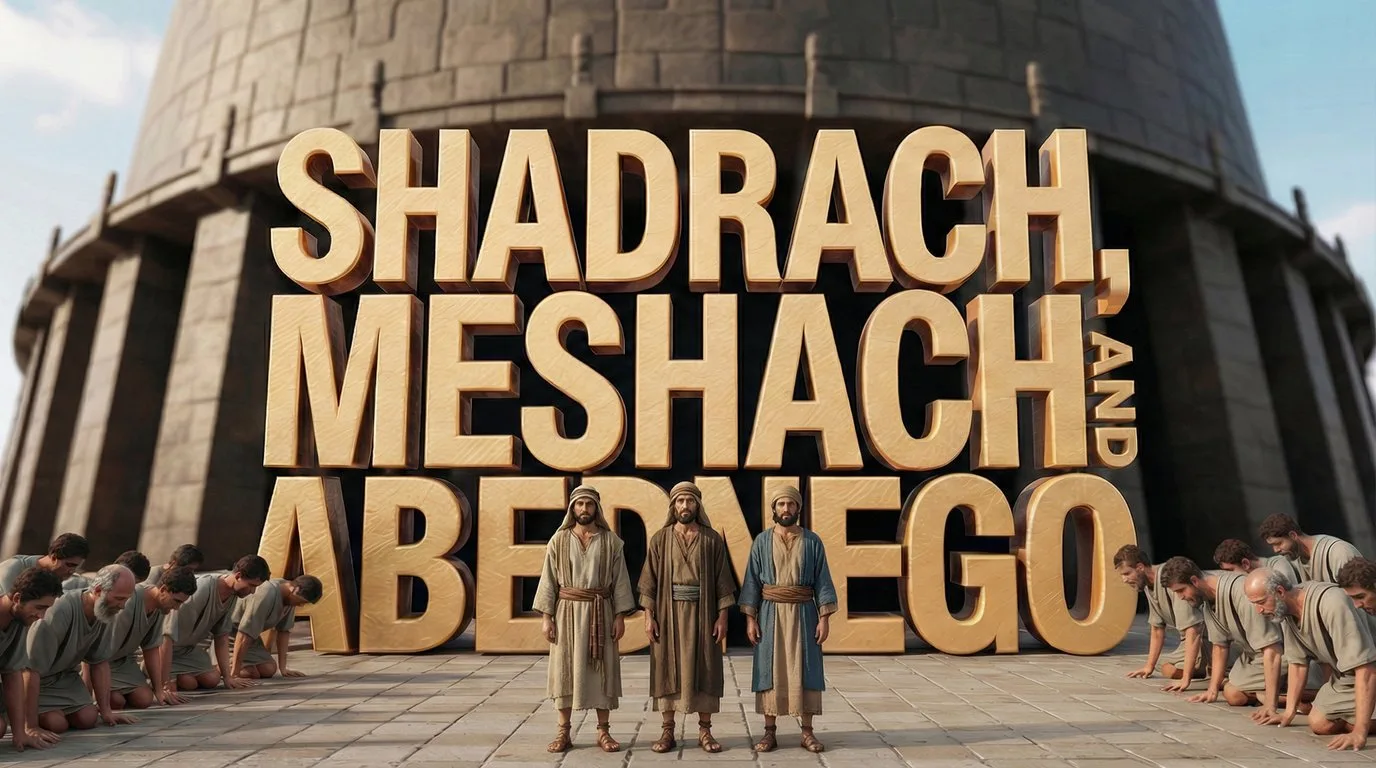
Daniel 3 is set in a real place and time where God’s people lived under pressure to blend in and keep quiet. Shadrach, Meshach, and Abednego did not grow their backbone overnight. Their stand in the plain of Dura makes more sense when you remember how Babylon targeted them from the start, especially in Daniel 1:3-4, where the king’s officials selected young men to be reshaped for Babylon’s purposes.
Babylon wanted allegiance
Daniel does not describe exile as only a change of address. Judah’s captivity in Babylon was discipline God had warned about for generations, and it exposed what was really in the heart. Babylon was not satisfied with controlling land and labor. Babylon aimed to shape conscience and worship.
That strategy shows up early. The king orders certain young men from Judah to be brought in, trained, and placed into service. It sounds like opportunity until you look at the goal: to remake them into Babylonian men who think Babylonian thoughts and serve Babylonian interests, including Babylon’s gods.
Then the king instructed Ashpenaz, the master of his eunuchs, to bring some of the children of Israel and some of the king's descendants and some of the nobles, young men in whom there was no blemish, but good-looking, gifted in all wisdom, possessing knowledge and quick to understand, who had ability to serve in the king's palace, and whom they might teach the language and literature of the Chaldeans. (Daniel 1:3-4)
Chosen and reshaped
Daniel 1:3-4 gives the selection criteria. These were young men with no physical defect, good appearance, and the ability to learn. Babylon wanted the best of Judah’s next generation. A conquered people is easier to manage if you can take their brightest youth, feed them at your table, educate them in your system, and place them in your administration.
One detail people miss on a first read is that Babylon’s pressure is not only threat. It is also privilege. The palace is safe. The food is rich. The education is prestigious. That kind of pressure can be more dangerous than open persecution because compromise starts to feel like common sense.
Language and literature
The passage says they were taught the language and literature of the Chaldeans. That is more than vocabulary. In that world, literature carried the stories of the gods, the explanations of how the world works, and the values a culture wants to pass down. Learning a language is not sin. Daniel and his friends learned it. The issue is the purpose: Babylon was training them to see life through Babylon’s lens.
Daniel keeps showing this tug of war. Empires try to claim what only God deserves, ultimate loyalty. By the time you reach Daniel 3, the golden image is not a random event. It is the public demand that the private reshaping was aiming at.
Names and ownership
Along with education came renaming. In the ancient world, a name often carried identity and allegiance. Babylon acts like it has the right to define who these men are. That is not an innocent nickname. It is a claim of ownership.
To them the chief of the eunuchs gave names: he gave Daniel the name Belteshazzar; to Hananiah, Shadrach; to Mishael, Meshach; and to Azariah, Abed-Nego. (Daniel 1:7)
The Hebrew names of these three young men mattered. Hananiah points to the Lord’s grace. Mishael is a question that exposes idols because it asks who can compare with God. Azariah says the Lord helps. Their Babylonian names were tied to Babylon’s gods and hopes. You can hear the message: forget your God, forget your past, become one of us.
Here is something the text shows without stopping to comment on it. Daniel often uses the Babylonian names, but it never shows these men living like Babylon. The labels changed, but the loyalties did not. A person can be renamed by the world without being owned by the world.
Daniel 3 is where that hidden loyalty becomes public. Babylon’s training program runs straight into God’s command about worship, and there is no middle ground.
The test of worship
Nebuchadnezzar sets up a golden image and demands public worship. The whole event is built like a state ceremony with music, officials, and a penalty designed to make dissent unthinkable. Political power is reaching for a religious response.
The image on Dura
The chapter begins with the image itself, huge and impossible to ignore. The plain of Dura would have made it visible and central. It becomes a rally point for unity, but it is unity built on idolatry. The king gathers officials from every level. When leaders bow, it pressures everyone else to bow.
When the text describes everyone falling down at the sound of the music, it shows you a crowd moving like one body. Idolatry often spreads this way. It is not only argued for. It is normalized, celebrated, and enforced. Once it is the public norm, faithfulness starts to look like troublemaking.
Plain idolatry
For a Jewish believer, the issue was settled long before the music started. God had already spoken plainly about worship. The first and second commandments leave no room for bowing to images as an act of worship. Shadrach, Meshach, and Abednego were not being stubborn. They were obeying God.
"You shall have no other gods before Me. "You shall not make for yourself a carved image–any likeness of anything that is in heaven above, or that is in the earth beneath, or that is in the water under the earth; you shall not bow down to them nor serve them. For I, the LORD your God, am a jealous God, visiting the iniquity of the fathers upon the children to the third and fourth generations of those who hate Me, (Exodus 20:3-5)
People sometimes try to soften Daniel 3 into a mere political loyalty test, like saluting a flag. But the chapter treats it as worship. The command is to worship the image. The penalty is tied to refusing that worship. And when the men answer the king, they speak in terms of serving God and refusing to serve the king’s gods. The lines are clear.
The king’s challenge
When the three refuse, they are accused and brought before the king. Nebuchadnezzar offers one more chance, then he asks his famous question about who can deliver them from his hand.
Now if you are ready at the time you hear the sound of the horn, flute, harp, lyre, and psaltery, in symphony with all kinds of music, and you fall down and worship the image which I have made, good! But if you do not worship, you shall be cast immediately into the midst of a burning fiery furnace. And who is the god who will deliver you from my hands?" (Daniel 3:15)
The king’s question is not curiosity. It is a threat wrapped in pride. He assumes the furnace is final and his reach is absolute. He is demanding the place in their lives that belongs only to the Lord.
Notice how the men resist. There is no record of insults or theatrics. They simply will not do what God forbids. Sometimes the strongest courage is quiet obedience that will not budge.
Faith under fire
The heart of the chapter is the response of these three men and God’s answer to the king’s arrogance. Their words are respectful and steady. They trust God’s ability, but they do not pretend they can control His plan.
A settled answer
They tell the king they do not need to defend themselves in this matter. They confess that their God is able to deliver them, and they also say that even if He does not, they still will not worship the image.
Shadrach, Meshach, and Abed-Nego answered and said to the king, "O Nebuchadnezzar, we have no need to answer you in this matter. If that is the case, our God whom we serve is able to deliver us from the burning fiery furnace, and He will deliver us from your hand, O king. But if not, let it be known to you, O king, that we do not serve your gods, nor will we worship the gold image which you have set up." (Daniel 3:16-18)
The line people remember is the simple surrender of faith: even if not. That is not doubt. That is faith that refuses to use God as a bargaining chip. They are not saying God might be weak. They are saying God is free. He is able to deliver, and He is wise in how He delivers.
That kind of faith does not usually appear out of nowhere in an emergency. Daniel 1 already showed them drawing lines about obedience when the pressure was quieter. Private convictions become public courage when the pressure turns up.
Heated seven times
Nebuchadnezzar’s reaction is raw anger. He orders the furnace heated far hotter than normal and has the men bound and thrown in. The heat is so extreme it kills the soldiers who carry out the order.
That detail is not there just for drama. It shows how reckless this is. The king’s rage harms his own men. Sin does that. It promises control, but it spreads destruction to anyone close enough.
And yet the chapter is setting up God’s answer. The furnace is meant to prove the king is untouchable. Instead, it becomes the place where the king learns his limits.
The fourth man
When Nebuchadnezzar looks, he sees not three men destroyed, but four men walking around unharmed. The text is careful about what the king knows and how he describes what he sees, but the point is plain: God has entered the furnace with His servants.
Then King Nebuchadnezzar was astonished; and he rose in haste and spoke, saying to his counselors, "Did we not cast three men bound into the midst of the fire?" They answered and said to the king, "True, O king." "Look!" he answered, "I see four men loose, walking in the midst of the fire; and they are not hurt, and the form of the fourth is like the Son of God." (Daniel 3:24-25)
Christians have discussed whether this is an angel or an appearance of the pre-incarnate Christ. Daniel 3:28 later says God sent His angel, which points toward an angelic messenger. Also, the king’s wording in 3:25 reflects his own pagan way of talking. We do need to keep this straight: the passage clearly teaches God’s real presence and protection, but it does not force us to speak dogmatically about the exact identity of the fourth figure.
Slow down and catch an easy-to-miss observation. They were thrown in bound, but they are seen walking around free. The fire does not burn them, but it burns what bound them. God did not keep them from the furnace. He met them in it, and the only thing that gets destroyed is what restrained them.
From Daniel 2:4 through the end of Daniel 7, the book is written in Aramaic, not Hebrew. In Daniel 3, when the men refuse to serve the king’s gods, the Aramaic verb for serve carries the idea of worshipful service. It is devotion, not just doing a task. This is not three employees refusing to follow a work policy. This is three believers refusing to give religious honor to anyone but the Lord.
When God delivers them, the description is thorough: no harm, no singed hair, no damaged clothing, not even the smell of fire. The text stacks up detail so nobody can claim it was luck, exaggeration, or a quick escape. God can rescue completely when He chooses.
And the satraps, administrators, governors, and the king's counselors gathered together, and they saw these men on whose bodies the fire had no power; the hair of their head was not singed nor were their garments affected, and the smell of fire was not on them. (Daniel 3:27)
Nebuchadnezzar responds by praising the God of these men and admitting that no other god can deliver like this. Read that carefully. He praises their God, but he still speaks like a man surrounded by idols and pride. His confession is real as far as it goes, but the book will keep dealing with his heart in later chapters.
Still, God turns the king’s propaganda event into a public witness. The same officials who gathered to bow now gather to see the living God overrule the furnace. The threat meant to silence worship becomes the stage where God is honored.
There is a straight line from Daniel 1 to Daniel 3. Babylon tried to reshape these young men by education, naming, and status.
Then the king instructed Ashpenaz, the master of his eunuchs, to bring some of the children of Israel and some of the king's descendants and some of the nobles, young men in whom there was no blemish, but good-looking, gifted in all wisdom, possessing knowledge and quick to understand, who had ability to serve in the king's palace, and whom they might teach the language and literature of the Chaldeans. (Daniel 1:3-4)
Daniel 3 shows what Babylon was aiming at all along: worship. And it shows what believers must keep clear: respect for rulers does not include worship, and obedience to government ends where disobedience to God begins.
For believers today, the pressure may not come as a golden statue on a plain, but the demand is often similar. Give your deepest loyalty to something other than God. Measure your life by what the crowd celebrates. Keep your faith private when it gets costly. Daniel 3 answers that with the simplest kind of strength: we will not.
My Final Thoughts
Daniel 3 calls for worship that is settled before the music starts. Shadrach, Meshach, and Abednego show faith that trusts God’s ability without demanding a certain outcome. God may deliver from the fire, or He may carry His people through the fire, but He is always worthy of obedience.
If Babylon can rename a man, educate him, and promote him, it will still try to claim his worship. Daniel 1:3-4 shows the plan, and Daniel 3 shows the moment of truth. Ask the Lord for a clean conscience and a steady heart, then live faithful in the small choices. When the big pressure comes, you will not be inventing faith on the spot. You will be standing on what you already believed about God.



 Get the book that teaches you how to evangelize and disarm doctrines from every single major cult and religion.