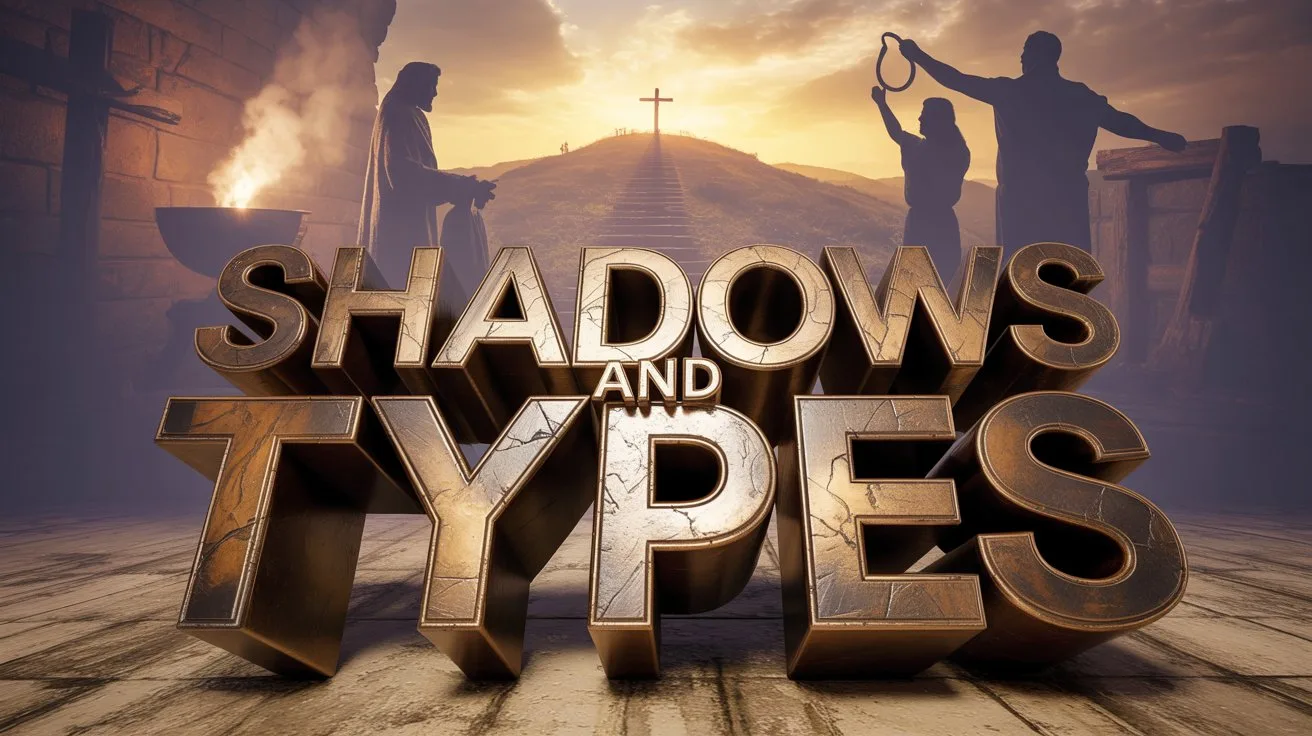
The Old Testament is full of real people, real events, and real commands God gave in history. Hebrews helps us understand why God built it that way. Hebrews 10:1 says the law had a shadow of the good things to come, which means it could point forward, train the conscience, and teach the need for atonement, but it could not be the final remedy for sin. If we treat the shadow like it is the substance, we will either miss Christ or keep trying to get from old rituals what only Jesus can give.
Shadow and substance
Hebrews 10 is not attacking the Old Testament. It is explaining its purpose. The law could show what holiness looks like, expose sin, and set up God’s categories: clean and unclean, priest and sacrifice, guilt and atonement. But it could not finish the job. The writer’s main evidence is repetition. If those sacrifices truly fixed the worshiper all the way down, they would have stopped. They kept going year after year because they were never meant to be the final payment for sin.
For the law, having a shadow of the good things to come, and not the very image of the things, can never with these same sacrifices, which they offer continually year by year, make those who approach perfect. (Hebrews 10:1)
Here is something people miss on a first read. Hebrews is not mainly saying Israel failed because they did not try hard enough. It is saying the law itself, by design, was not the very image of the thing. God did not set up the tabernacle system as a permanent solution and then later change plans. He set it up to point forward.
What shadow means
The word translated shadow in Hebrews 10:1 is the normal Greek word skia. It means a shadow, not a fake thing, but not the thing itself either. A shadow gives you a real outline, but it cannot give you the weight or the fullness of what made it. You can learn the shape, but you cannot hold it in your hands. That is what the law was like. The sacrifices taught real truth: sin brings death, God requires cleansing, and a substitute is needed. But animal blood could not carry the moral weight of human sin, so it could not bring final cleansing of the conscience.
Hebrews 10:1 contrasts the shadow with the very image. That wording is worth noticing. The law was not a lie. It was a God-given preview that was always meant to lead you to something better.
Types and guardrails
Alongside the idea of a shadow, the Bible also uses the idea of a type. A type is a real person, office, event, or institution God arranged to correspond to a later and greater reality. The safest place to stand is where Scripture itself points out the connection. Romans says Adam functioned as a type in this sense: his act affected the people connected to him. That prepares you to understand Christ’s representative work. Adam and Christ are not alike in character. They are alike in how their actions affect others, with Christ as the righteous fulfillment.
Nevertheless death reigned from Adam to Moses, even over those who had not sinned according to the likeness of the transgression of Adam, who is a type of Him who was to come. (Romans 5:14)
Two guardrails keep you steady. First, lean hard on places where the New Testament explains the meaning. That keeps you from treating the Old Testament like a codebook where you get to invent private meanings. Second, the shadow points forward to Christ. We do not shrink Jesus down to fit the shadow. We let Jesus, and the apostles, explain what the shadow was showing.
Why repetition matters
Hebrews says the repeated sacrifices served as a reminder of sins. That surprises people because we often assume sacrifice equals final relief. But under that system, the Day of Atonement came every year, and the ordinary sacrifices kept coming, and the worshiper kept being reminded that sin was still there and death was still the penalty. God was teaching that guilt is not solved by time or by effort. It has to be dealt with by a sufficient sacrifice.
For then would they not have ceased to be offered? For the worshipers, once purified, would have had no more consciousness of sins. But in those sacrifices there is a reminder of sins every year. (Hebrews 10:2-3)
This is not just an interesting Bible theme. Hebrews is dealing with assurance. If your conscience is always being poked by guilt and you keep trying to quiet it by doing more, you may be asking a shadow to do what only the substance can do.
Pictures that point
Once you see how Hebrews teaches us to read the Old Testament, you start noticing that God repeated certain patterns on purpose. These are not made-up illustrations. They are historical events where God built in meaning. The New Testament treats them as part of one unified plan that comes to fulfillment in Christ.
The Passover lamb
The Passover in Exodus 12 is a strong example because it is not vague. God gives direct instructions: a lamb without blemish, killed at the appointed time, with blood applied where God said to apply it. Judgment was coming on Egypt, and Israel was not told to escape by moral improvement. They were told to shelter under the sign God provided.
One detail is easy to miss. The blood was not mainly a message to the Egyptians, and it was not mainly a badge of Israel’s courage. It was directed Godward. God said He would look for it. They were safe because God promised safety where the blood was applied, exactly as He commanded. This also shows an important background point: in the Old Testament, blood on the altar or on the appointed place was not magic. It was a God-assigned sign that life had been given in the place of life.
And they shall take some of the blood and put it on the two doorposts and on the lintel of the houses where they eat it. (Exodus 12:7)
When you carry that forward into the New Testament, you can see why Jesus is called our Passover. The point is not that we copy ancient rituals to get saved. The point is that God taught substitution and deliverance through a substitute. The lamb’s life in the place of the household was a shadow. Jesus is the substance, the sinless One who died in our place. We are not saved by personal sincerity or religious energy. We are saved by taking refuge in what God has provided in His Son, by grace through faith.
The bronze serpent
Numbers 21 shows the shape of the gospel in a plain way. Israel sinned, judgment came, and people were dying. When they confessed and asked Moses to intercede, God provided a remedy that seems almost too simple: Moses was to lift up a bronze serpent, and the bitten person would live when he looked.
Then the LORD said to Moses, "Make a fiery serpent, and set it on a pole; and it shall be that everyone who is bitten, when he looks at it, shall live." (Numbers 21:8)
The power was not in the bronze itself. The power was in God’s promise attached to God’s appointed provision. Their part was not to earn healing but to trust God enough to look. A person could have strong opinions about serpents, strong feelings about Moses, and strong regret about sin, but if he refused to look where God said to look, he would die. And if he did look, he would live. That is faith. Faith is not a work that pays God back. It is receiving what God gives.
Jesus Himself says this event was pointing forward to Him. He compares the lifting up of the serpent to His own lifting up, and He ties the saving response to believing.
And as Moses lifted up the serpent in the wilderness, even so must the Son of Man be lifted up, that whoever believes in Him should not perish but have eternal life. (John 3:14-15)
Many people miss how direct that parallel is. In Numbers, the dying person’s problem was not a lack of information or a lack of effort. It was poison in his body, and the cure was outside him. In the same way, our problem is sin and the death it brings, and the cure is outside us, in Christ crucified and risen. Salvation is not self-repair. It is looking to the One God lifted up for us.
Priest and sacrifice
Hebrews spends a lot of time on priesthood and sacrifice because people are tempted to go back to shadows. The tabernacle, priests, and offerings were given by God. They were effective for what God assigned them to do: they taught holiness, regulated worship in Israel, and provided ceremonial cleansing. But they could not cleanse the conscience in the final sense. Hebrews says Christ came as High Priest and entered once for all, obtaining eternal redemption.
Not with the blood of goats and calves, but with His own blood He entered the Most Holy Place once for all, having obtained eternal redemption. (Hebrews 9:12)
That phrase once for all is a big hinge in Hebrews. Under the old covenant, repetition was normal because the sacrifices were not sufficient to settle the matter forever. Under the new covenant, Christ’s sacrifice is sufficient. His work is finished, and the result lasts. That is why assurance is tied to Him, not to our performance.
Leviticus explains why blood is central in atonement: life is given in place of life. Sin brings death, and a substitute bears that death. Hebrews shows the fulfillment: Christ offered Himself without spot. He was not paying for His own guilt. He gave His life as the sinless God-man to pay for ours through His suffering and physical death, and He rose again. The Father and the Son were not split. The Son willingly bore our sins and finished the payment the law’s shadows could only outline.
For the life of the flesh is in the blood, and I have given it to you upon the altar to make atonement for your souls; for it is the blood that makes atonement for the soul.' (Leviticus 17:11)
This is where you need to be honest with yourself. If you keep trying to handle guilt by piling up religious activity, you may be treating the conscience like it can be scrubbed clean by effort. Hebrews calls that kind of approach dead works, not because obedience is bad, but because works cannot give life. Works are the fruit of a cleansed conscience, not the price of cleansing.
This connects to security too. If Christ obtained eternal redemption, and if His sacrifice was once for all, then the truly born-again believer is not kept by a cycle of self-payment. We grow, we confess sin when we fail, and we learn obedience, but our standing rests on Christ’s finished work. He saves by grace through faith, and He keeps the one He saves.
Reading life through Christ
The Old Testament does not only point to Christ through rituals. It also does it through repeated patterns in real lives, especially suffering followed by exaltation. God used that pattern to prepare His people to understand a Messiah who would suffer and then enter glory. The climax is Jesus Himself, but God showed the shape of it ahead of time in the life of Joseph.
Joseph’s pattern
Joseph was rejected by his brothers, sold, falsely accused, and imprisoned. None of that was imaginary, and none of it was morally neutral. His brothers sinned. Potiphar’s wife lied. Yet God was working through the mess without excusing the evil. Later, when Joseph had the power to crush the very men who harmed him, he refused to take God’s place as final judge, and he also refused to pretend the evil never happened.
Joseph said to them, "Do not be afraid, for am I in the place of God? But as for you, you meant evil against me; but God meant it for good, in order to bring it about as it is this day, to save many people alive. (Genesis 50:19-20)
Joseph says two things that belong together: you meant evil, and God meant it for good. That is not a cute line. It is a clear confession that human responsibility is real and God’s purpose is real at the same time. Joseph did not call evil good. He also did not act like evil had the final word over his life.
This pattern prepares you for the cross. Jesus was rejected, falsely accused, condemned, and crucified. The New Testament does not treat that as a tragic accident. It also does not treat the men who did it as innocent tools. Human guilt was real, and God’s plan was real. God used the very act of rejection to accomplish salvation for the world. Joseph could preserve physical life through wise leadership. Christ gives eternal life through His death and resurrection.
Dim sight now
We do need to keep our balance when we study types and patterns. Scripture really does reveal Christ in the Old Testament, but we are not promised that we will see every connection with perfect clarity in this life. Paul says our present sight is indirect, not face to face. That keeps us humble, and it keeps us from building convictions on clever connections instead of clear teaching.
For now we see in a mirror, dimly, but then face to face. Now I know in part, but then I shall know just as I also am known. (1 Corinthians 13:12)
This also protects the gospel. Salvation is not a prize for the sharpest Bible student. Salvation is by grace through faith in Jesus Christ. The shadows help, but the shadows do not save. Christ saves. And once a person is truly born again, their security rests on Christ’s finished work, not on how well they can map every pattern.
How to live it
Hebrews presses a simple response: rest your conscience in Christ. When you sin as a believer, you confess it to the Lord and deal with it honestly, but you do not run back to a system of self-payment. You do not punish yourself to feel forgiven. You come back to the sufficiency of Christ’s once-for-all offering and keep walking with Him.
And when you suffer, Joseph helps you keep your feet under you. You may not know why God allowed a certain wound, and you may not see the good He intends right away. But you can refuse revenge, refuse bitterness, and refuse the lie that evil has absolute control over your life. God’s purposes are not fragile. The same Lord who turned the cross into salvation is able to work in the middle of your hard chapters too.
My Final Thoughts
Hebrews 10:1 teaches you how to read your Bible with gratitude and clarity. The law was a real shadow that taught real truth about sin, holiness, and the need for atonement, but it was never the substance. When you see the Passover, the bronze serpent, and the priesthood, let them do their job: point you to Jesus and steady you in what He finished.
Do not turn Bible study into a hunt for hidden codes. Stay with what Scripture actually says, and let clear passages guide you. If your conscience is burdened, the answer is not more self-effort. Look to Christ, trust Him, and serve the living God from forgiveness, not for forgiveness.


 Get the book that teaches you how to evangelize and disarm doctrines from every single major cult and religion.