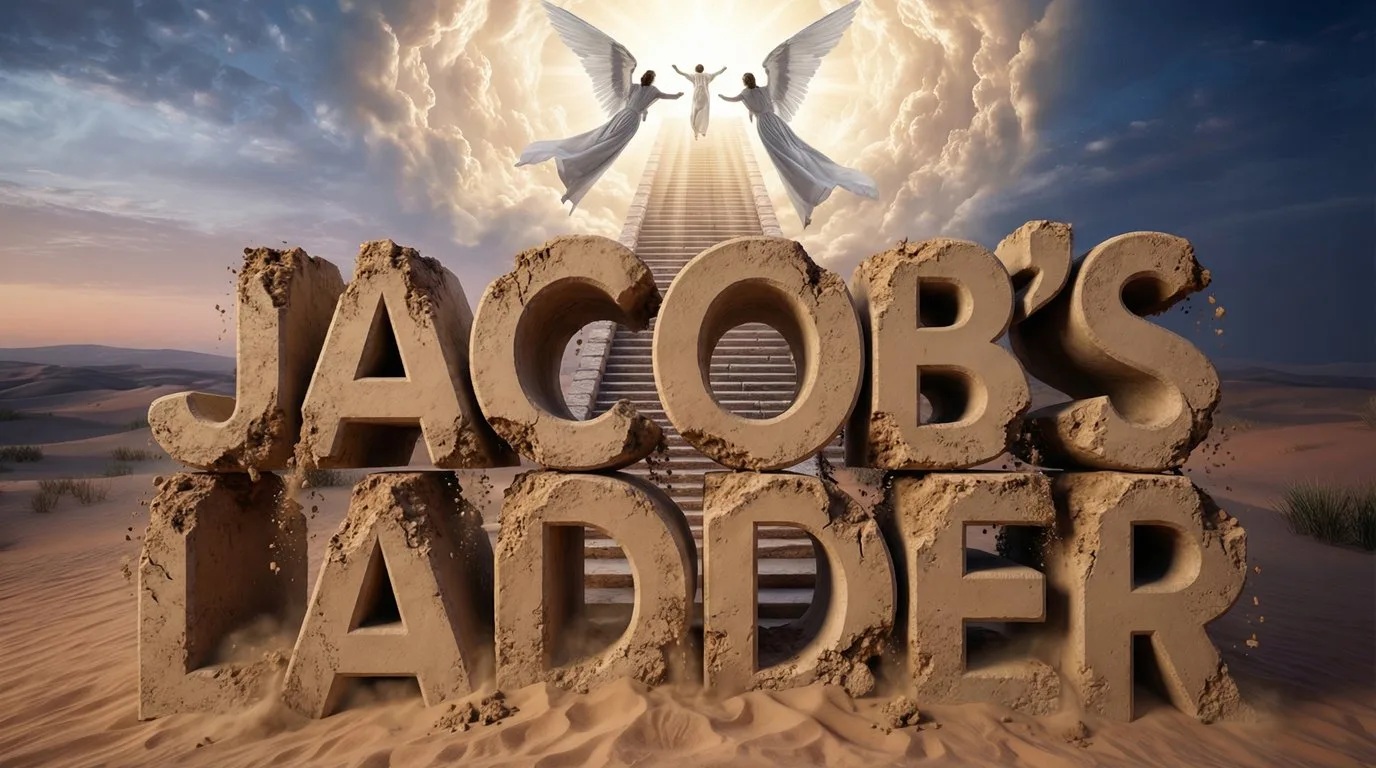
Jacob’s Ladder is a fascinating event recorded in Genesis 28:10-22, and it lands right in the middle of a messy family situation. Jacob is not on a victory lap. He is on the run, heading toward Haran, sleeping outside with a stone under his head. In that ordinary, uncomfortable place, God steps in and makes promises that shape the rest of Jacob’s life and, beyond Jacob, the whole line that leads to Jesus.
Jacob on the run
Genesis 28 comes after Jacob has taken Esau’s blessing by deception, and Esau has vowed to kill him. Isaac sends Jacob away toward Laban’s household, partly for safety and partly to find a wife from their extended family line. Jacob leaves home alone, and he is carrying consequences he helped create.
One detail is easy to miss on a first read: Jacob does not go looking for a holy place. He does not seek out a prophet. He does not build an altar and ask God for a sign. He stops because he has to. The sun goes down, and he beds down where he is.
So he came to a certain place and stayed there all night, because the sun had set. And he took one of the stones of that place and put it at his head, and he lay down in that place to sleep. Then he dreamed, and behold, a ladder was set up on the earth, and its top reached to heaven; and there the angels of God were ascending and descending on it. (Genesis 28:11-12)
The text calls it a certain place. That sounds like a throwaway line, but it sets up the surprise. Jacob thinks he is just finding a spot to sleep. God is choosing a meeting place. We tend to think God only meets people when they get everything lined up just right. Genesis 28 disagrees. God meets Jacob outside, tired, and exposed.
God starts it
Jacob’s dream is not a reward for spiritual maturity. It is mercy. God is the One who initiates, reveals, and speaks. That fits the pattern all through Scripture. When God makes Himself known, it is not because a person climbed high enough to find Him. God comes near, and then the person responds.
Jacob is going to be a long lesson in letting God change him instead of trying to run life by cleverness. He is a planner and a fixer. At Bethel, God makes it clear early on that this relationship will rest on God’s promise, not Jacob’s control.
A stone pillow
The stone under Jacob’s head is not a spiritual technique. It is a hard-pillow detail that underlines the situation. Jacob is not sleeping in Abraham’s tents with servants nearby. He is out in the open. God’s promises come to him when he has no leverage, no backup, and no protection except what God Himself gives.
God does not wait until Jacob has everything cleaned up. God meets him on the road and starts anchoring his future in a word from heaven. Jacob still has plenty to learn, but God does not start with a lecture. He starts with a promise.
The ladder and the Lord
Jacob sees what many English Bibles call a ladder. The Hebrew word used here is sullam. It only shows up this one time in the Old Testament. The word points to something like a stairway or ramp, not a flimsy rung-ladder. The point is not the engineering. The point is a fixed connection between earth and heaven that Jacob could never create for himself.
Then he dreamed, and behold, a ladder was set up on the earth, and its top reached to heaven; and there the angels of God were ascending and descending on it. (Genesis 28:12)
The ladder is set up on the earth, and its top reaches to heaven. Jacob does not build it. He does not climb it. He simply sees that there is a real link between the world he lives in and the realm he cannot see.
Angels on the move
Angels are ascending and descending. That tells you heaven is not quiet or empty. God is working. God’s purposes are being carried out. The vision does not explain where the angels are going or what each one is doing, and it does not invite guesses. It gives Jacob a strong impression: God’s work is ordered and active, even when Jacob’s life feels anything but ordered.
It is also worth noticing the wording: ascending and descending. Some have suggested this implies angels were already present on earth and then went up and came back down. Scripture does not spell that out, so we should not build a doctrine on it. But the order of the words does fit what Jacob says later: God was in that place and Jacob did not know it. Jacob learns that unseen reality is already there before he becomes aware of it.
This keeps our view of angels balanced. Angels are real and active, but they are not independent, and they are never the object of worship. The passage does not push Jacob toward angel-interest. It pushes him toward the Lord who speaks.
The Lord speaks
Then Jacob’s attention is drawn above the ladder to the Lord Himself. The ladder is not the center. Angels are not the center. God is the center. He speaks, identifies Himself, and repeats the covenant promises given earlier to Abraham and Isaac.
And behold, the LORD stood above it and said: "I am the LORD God of Abraham your father and the God of Isaac; the land on which you lie I will give to you and your descendants. Also your descendants shall be as the dust of the earth; you shall spread abroad to the west and the east, to the north and the south; and in you and in your seed all the families of the earth shall be blessed. Behold, I am with you and will keep you wherever you go, and will bring you back to this land; for I will not leave you until I have done what I have spoken to you." (Genesis 28:13-15)
God names Himself as the God of Abraham and Isaac. Jacob is being tied into a real history, a real family line, and a real set of promises God has been repeating on purpose. The promises include the land, a multiplied offspring, and blessing reaching all the families of the earth. Genesis has been circling those themes for chapters, and here they are handed directly to Jacob.
Then God gets personal. He promises His presence, His keeping, His guidance, and a return to the land. He also says He will not leave Jacob until He has done what He has spoken. That is not a vague spiritual feeling. It is God committing Himself to accomplish His own word.
This does not mean Jacob will have an easy road. Genesis will show plenty of hard consequences and hard lessons. But it does mean Jacob’s future will not be decided by Esau’s anger, Laban’s tricks, or Jacob’s own scheming. God’s promise will stand.
Keep the balance straight. God’s promise does not excuse Jacob’s sin, and it does not erase human responsibility. Jacob will reap what he has sown in many ways. Yet God is still able to move His plan forward through a man who is still rough around the edges.
Bethel and awe
When Jacob wakes up, he does not act casual. He is shaken in a healthy way. He realizes he has been in a place where God made Himself known.
Then Jacob awoke from his sleep and said, "Surely the LORD is in this place, and I did not know it." And he was afraid and said, "How awesome is this place! This is none other than the house of God, and this is the gate of heaven!" (Genesis 28:16-17)
Jacob says the Lord is in this place and he did not know it. Slow down there. Jacob is not saying God only just arrived. He is admitting his own blindness. God’s presence was real before Jacob recognized it. That is one of the big lessons of the chapter: God is not limited by our awareness, and God is not waiting around for us to become impressive.
Jacob’s fear here is not the kind that makes a man run away from God. It is the kind that makes a man take God seriously. This is the fear of the Lord in the plain Bible sense: awe, reverence, and a sober awareness that you are dealing with the living God.
House and gate
Jacob names the place Bethel, meaning house of God. He also calls it the gate of heaven. That does not mean Jacob found a permanent portal people can control or bottle up. It is figure-of-speech language, the way a man talks when he realizes God has opened his eyes to what is real. God made this ordinary patch of ground into a meeting place by speaking to him there.
Jacob sets up the stone as a pillar and pours oil on it. In the ancient world, a standing stone could mark a significant event or serve as a memorial. Here it is a simple way of saying, I do not want to forget what God said and did at this spot. Jacob is not worshiping the stone. He is marking the moment because he knows how easily a human heart forgets once life gets loud again.
Then Jacob rose early in the morning, and took the stone that he had put at his head, set it up as a pillar, and poured oil on top of it. And he called the name of that place Bethel; but the name of that city had been Luz previously. (Genesis 28:18-19)
There is also a sober detail many readers never connect: Bethel later becomes a place of idolatry in Israel’s history. Jeroboam sets up a rival worship site there with a golden calf. So the same location that was once connected with true revelation later becomes connected with counterfeit worship. The warning is not that places are evil. The warning is that people can keep religious language while refusing God’s Word, and a sacred memory can turn into a trap.
Jacob’s vow
Jacob makes a vow, and it can sound like bargaining if you read it too fast. God has already promised presence and protection. Jacob responds by voicing those same needs and committing himself to the Lord. There is faith here, but it is still young. Jacob is learning to relate to the Lord personally, not just as the God of his fathers.
Then Jacob made a vow, saying, "If God will be with me, and keep me in this way that I am going, and give me bread to eat and clothing to put on, so that I come back to my father's house in peace, then the LORD shall be my God. And this stone which I have set as a pillar shall be God's house, and of all that You give me I will surely give a tenth to You." (Genesis 28:20-22)
Jacob also promises a tenth. This is before the Law of Moses, so it is not the tithe system of Israel being set up here. It is a worship response. Jacob is not buying God’s favor. God has already spoken grace to him. Jacob is saying that if God brings him through, he will live as a man who belongs to the Lord, and he will honor the Lord with what the Lord provides.
Jesus the fulfillment
The New Testament points back to this moment in a striking way. Jesus tells Nathanael that he will see heaven opened and the angels of God ascending and descending on the Son of Man. Jesus takes the imagery of Genesis 28 and applies it to Himself. The connection between heaven and earth is not finally a place or a structure. It is a Person.
And He said to him, "Most assuredly, I say to you, hereafter you shall see heaven open, and the angels of God ascending and descending upon the Son of Man." (John 1:51)
That does not cancel the meaning of Genesis 28 in its own setting. God really did meet Jacob and really did confirm the Abrahamic promises to him. But it shows the fullest direction those promises were always moving. The blessing to all families of the earth comes through the line that leads to Christ. The true access to God is not a ladder we climb. God came down to us in His Son.
Jesus is the only Mediator between God and man. A mediator is the One who brings two sides together. Jesus can do that because He is fully God and fully man. He lived without sin, died for our sins, and rose again. Salvation is received by grace through faith in Him, not by works. Works matter, but they follow salvation as fruit. They do not cause it.
Jacob’s ladder also quietly exposes a problem. A holy God and sinful people do not naturally have open access. God must provide the way. In Jacob’s day, God gave promises and pointed forward. In the fullness of time, God gave His Son. Through Christ, we have real access to the Father.
Keeping Christ in view also keeps angels in their proper place. Angels are real servants of God, but they are never the focus of faith. Scripture never tells us to seek angels, pray to angels, or build our Christian life on angelic experiences. The foundation is God’s written Word and God’s Son.
My Final Thoughts
Genesis 28 shows God meeting a man who did not deserve it, in a place he did not plan, with promises he could not produce. The ladder is memorable, but the heart of the passage is the Lord speaking, committing Himself to His word, and teaching Jacob that heaven is not closed off.
If you belong to Jesus, you do not need to chase a Bethel moment to have access to God. You already have it in Christ. Still, Jacob’s night on the stone pillow is worth remembering. God is able to steady a fearful heart with a clear promise, and He is faithful to finish what He has said.


 Get the book that teaches you how to evangelize and disarm doctrines from every single major cult and religion.