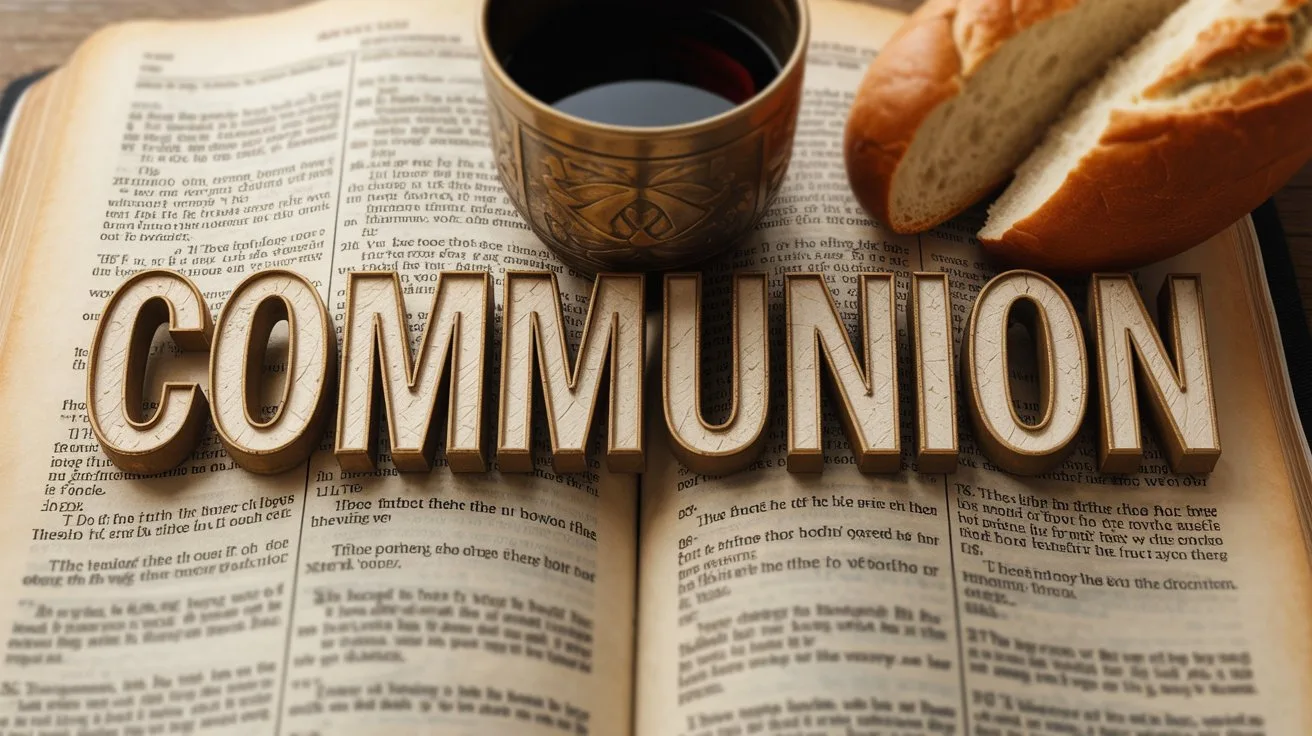
Communion, also called the Lord’s Supper, is one of those simple things Jesus gave His church that we can either handle with steady reverence or slowly turn into something it was never meant to be. Bread and a cup do not look like much, but Scripture ties them straight to the cross, to the unity of the church, and to the believer’s hope in Christ’s return. One place that helps set the stage is Genesis 14:18-20, where bread and wine show up early in a priestly setting, long before Jesus sat with His disciples in the upper room.
Bread and wine appear
Genesis 14 is not a communion service. It is a real historical moment after Abram rescues Lot and defeats a coalition of kings. Abram is coming back from battle, and two rulers come out to meet him: the king of Sodom and Melchizedek king of Salem. The king of Sodom tries to cut a deal. Melchizedek brings out bread and wine and blesses Abram in the name of God Most High. That contrast is easy to miss if you read fast, but Moses puts it right there on purpose.
Then Melchizedek king of Salem brought out bread and wine; he was the priest of God Most High. And he blessed him and said: "Blessed be Abram of God Most High, Possessor of heaven and earth; And blessed be God Most High, Who has delivered your enemies into your hand." And he gave him a tithe of all. (Genesis 14:18-20)
One more thing to notice: the center of the moment is not the bread and wine. It is the blessing, and even more, it is who gets the credit for the victory. Melchizedek blesses Abram, but he also blesses God Most High for delivering Abram. Abram is being honored, but God is being praised.
Melchizedek in context
Melchizedek is introduced without a backstory. He is called both king of Salem and priest of God Most High. That is unusual because, later in Israel’s life, the kingly line and the priestly line are kept separate. Kings come from Judah. Priests come from Levi. Here, long before the law of Moses, you have one man holding both roles, and Abram honors him by giving him a tenth of what he gained.
What does the bread and wine mean right there in Genesis 14? The text does not spell it out. At the simplest level, it fits a real need: Abram and his men have been fighting and traveling, and refreshment would make plain sense. At the same time, the scene is clearly more than hospitality because Melchizedek is acting as priest, pronouncing blessing in God’s name, and leading Abram into public praise of the true God. Scripture does not tell us to make the bread and wine into a sacrament here. It does show bread and wine in a priestly setting connected to blessing and worship.
A word and a title
Melchizedek is priest of God Most High. In Hebrew that is El Elyon, a title that stresses God’s greatness over every nation and ruler. Melchizedek is not speaking for a local city-god. He is blessing Abram in the name of the God who stands above all the kings Abram just beat.
Melchizedek also calls God the Possessor of heaven and earth. The Hebrew verb there carries the idea of owning by right, not grabbing by force. God owns everything because it is His. That lands right on Abram’s situation, because the king of Sodom is about to offer Abram wealth. Genesis is already teaching us: do not confuse God’s blessing with a king’s bribery.
A missed contrast
Right after Melchizedek blesses Abram, the king of Sodom speaks up and tries to negotiate (Genesis 14:21 and following). Melchizedek gives bread and wine and points Abram upward to God. Sodom offers goods and tries to pull Abram into obligation. That sets up Abram’s later refusal to be made rich by Sodom. The flow shows Abram receiving blessing from the priest of God Most High before he rejects the corrupt offer of Sodom. That order is part of the point.
Why Hebrews cares
The New Testament later points to Melchizedek, not because Melchizedek replaces Jesus, but because he points us to Jesus more clearly. Hebrews uses Melchizedek as a pattern to explain Christ’s priesthood. Jesus is not from Levi, yet He is still the true and final High Priest, and His priesthood does not end.
For this Melchizedek, king of Salem, priest of the Most High God, who met Abraham returning from the slaughter of the kings and blessed him, to whom also Abraham gave a tenth part of all, first being translated "king of righteousness," and then also king of Salem, meaning "king of peace," without father, without mother, without genealogy, having neither beginning of days nor end of life, but made like the Son of God, remains a priest continually. (Hebrews 7:1-3)
Hebrews says Melchizedek is made like the Son of God, not that the Son of God is made like Melchizedek. That direction is important. Melchizedek is the signpost. Jesus is the destination. So when bread and wine show up with Melchizedek, we do not force Genesis 14 into being the Lord’s Supper. But we can say something modest and solid: God placed bread and wine early in Scripture in a priestly context of blessing and praise, and later Jesus chose bread and the cup as His memorial of the sacrifice that saves.
Jesus sets the table
The Lord’s Supper does not come from church tradition. It comes straight from Jesus, in a very specific setting: the Passover meal. Passover was already a memorial of God’s rescue of Israel from slavery through the blood of a lamb. Jesus takes that memorial and shows its fulfillment in Himself.
And He took bread, gave thanks and broke it, and gave it to them, saying, "This is My body which is given for you; do this in remembrance of Me." Likewise He also took the cup after supper, saying, "This cup is the new covenant in My blood, which is shed for you. (Luke 22:19-20)
Passover to new covenant
In Luke’s account, Jesus ties the bread and the cup to His body given and His blood shed, and He commands His disciples to keep doing this in remembrance of Him. That command tells you what communion is supposed to be: an act of obedient remembrance for people who belong to Him. It is not a performance to earn favor with God, and it is not a ritual that gives salvation.
When Jesus speaks of the new covenant, He is saying His death will accomplish what the old sacrifices could never finish. Under the old covenant there were repeated sacrifices because the problem of sin was not fully settled. Jesus’ sacrifice is complete. Communion does not add to it. It keeps the church looking at it.
What remembrance is
Remembrance in the Bible is not just mental recall, like remembering a name. It is bringing something back to the center so it shapes how you think and how you respond. When believers take the bread and cup, we are deliberately putting the cross back in front of our eyes and saying again: our forgiveness cost the Son of God His suffering and His physical death, and we stand before God on the basis of Christ alone.
Here is something easy to miss: Jesus does not tell the disciples to do this to create a sacrifice. He tells them to do it to remember Him. The action is aimed at the disciples, and the focus is Jesus. Communion is meant to keep the church Christ-centered, not personality-centered, tradition-centered, or emotion-centered.
Plain figure of speech
When Jesus says the bread is His body and the cup is the new covenant in His blood, the wording is plain, but the setting shows how to read it. He is sitting there in His physical body holding actual bread and a cup. The disciples are not biting Him. They are eating bread while He gives a memorial meaning to the elements. Scripture uses this kind of language often. Jesus calls Himself a door and a vine in John’s Gospel, and no one thinks He is literal wood or literal plant life. The language is vivid because the reality behind it is weighty.
Once for all
Hebrews is direct that Christ’s offering was once for all. Old covenant priests stood daily because their work was never done. Jesus offered Himself and then sat down, because the payment for sin was finished. The posture change is part of the author’s argument. Standing signals ongoing duty. Sitting signals completion.
By that will we have been sanctified through the offering of the body of Jesus Christ once for all. (Hebrews 10:10)
Communion fits that truth. It points back to a finished sacrifice. It does not continue it. If someone starts treating the table like Christ must be offered again and again to keep forgiveness flowing, that person has drifted away from the whole message of Hebrews and away from how Jesus framed the meal.
Paul gives warnings
When you get to 1 Corinthians 11, you find a church that is doing the Lord’s Supper, but doing it in a way that denies what it proclaims. They were gathering with division, pride, and selfishness. Some were treating the meal like a social flex, and others were being shamed and left out. Paul does not treat that as a small problem because the Lord’s Supper preaches unity around one Savior.
Therefore whoever eats this bread or drinks this cup of the Lord in an unworthy manner will be guilty of the body and blood of the Lord. But let a man examine himself, and so let him eat of the bread and drink of the cup. For he who eats and drinks in an unworthy manner eats and drinks judgment to himself, not discerning the Lord's body. (1 Corinthians 11:27-29)
Unworthy manner
Paul warns about eating and drinking in an unworthy manner. Notice what he does not say. He does not say only sinless believers may partake. If sinlessness were the entry requirement, the table would be permanently empty. The issue is the manner, meaning the approach: irreverence, hypocrisy, selfishness, and refusal to take seriously what the meal is saying.
In Corinth, part of the unworthy manner was their disregard for fellow believers. They were sinning against the church while handling the ordinance that visibly proclaims that believers are one body in Christ. Paul tells them to examine themselves and to discern the Lord’s body. That includes recognizing the sacred meaning of the bread and cup, and it also includes recognizing the seriousness of how we treat Christ’s people.
Discipline and security
Paul says some were weak and sick, and some had died. That is sobering. But he also draws a line between the Lord’s discipline and the world’s condemnation. God corrects His children so they will not be condemned with the world. A true believer is secure in Christ, and at the same time God knows how to discipline His own when they treat holy things like they are common.
For this reason many are weak and sick among you, and many sleep. For if we would judge ourselves, we would not be judged. But when we are judged, we are chastened by the Lord, that we may not be condemned with the world. (1 Corinthians 11:30-32)
This discipline is not God losing control. It is a Father correcting His household. Communion is one place where the Lord trains His people to take sin seriously and to take grace seriously at the same time.
Confession helps
Self-examination is not meant to trap a believer in endless introspection. It is meant to bring honesty before God. When the Lord convicts us, we confess what is true, we turn from it, and we come to the table with clean hands and a clear conscience, not because we earned it, but because Christ paid for us.
If we confess our sins, He is faithful and just to forgive us our sins and to cleanse us from all unrighteousness. (1 John 1:9)
John 6 in place
Some people point to John 6 to argue that eating and drinking must be literal in communion. But John 6 is not set at the Lord’s Supper. It is a public teaching where Jesus confronts unbelief and calls people to come to Him. In that chapter, Jesus repeatedly ties eternal life to believing in Him, and He explains that His words are spiritual, not a command to chew on Him physically.
Most assuredly, I say to you, he who believes in Me has everlasting life. (John 6:47)
It is the Spirit who gives life; the flesh profits nothing. The words that I speak to you are spirit, and they are life. (John 6:63)
So when Jesus uses strong language about eating His flesh and drinking His blood, the chapter itself shows the meaning: receiving Him by faith, embracing His sacrifice as your only hope. That fits the rest of John, where Jesus uses everyday pictures to talk about spiritual realities. Communion belongs in that same lane. It is for believers who have already come to Christ by faith. It does not create saving faith. It proclaims what saving faith rests on.
This also protects the once-for-all nature of the cross. If the bread and cup were turned into a repeated offering of Christ, you would be teaching something that conflicts with the plain teaching of Hebrews. Communion is powerful, but its power is not that it repeats the sacrifice. Its power is that it faithfully remembers and proclaims the sacrifice that is already complete.
My Final Thoughts
Communion is a gift from the Lord Jesus to keep the gospel front and center in the church. Genesis 14:18-20 is not the Lord’s Supper, but it is an early scene where bread and wine appear with a priest who blesses God’s servant and praises the God who delivers. When Jesus later gives His church bread and the cup, He anchors them to His body given and His blood shed, and He tells them to remember Him.
Paul’s warnings keep us from treating the table lightly. The right response is not to stay away forever out of fear, but to examine ourselves honestly, confess sin, make things right as far as we can, and come with reverence and gratitude. Every time the church takes the bread and cup in a worthy manner, we are proclaiming the gospel: Christ died for our sins, His sacrifice is enough, and He is coming again.



 Get the book that teaches you how to evangelize and disarm doctrines from every single major cult and religion.