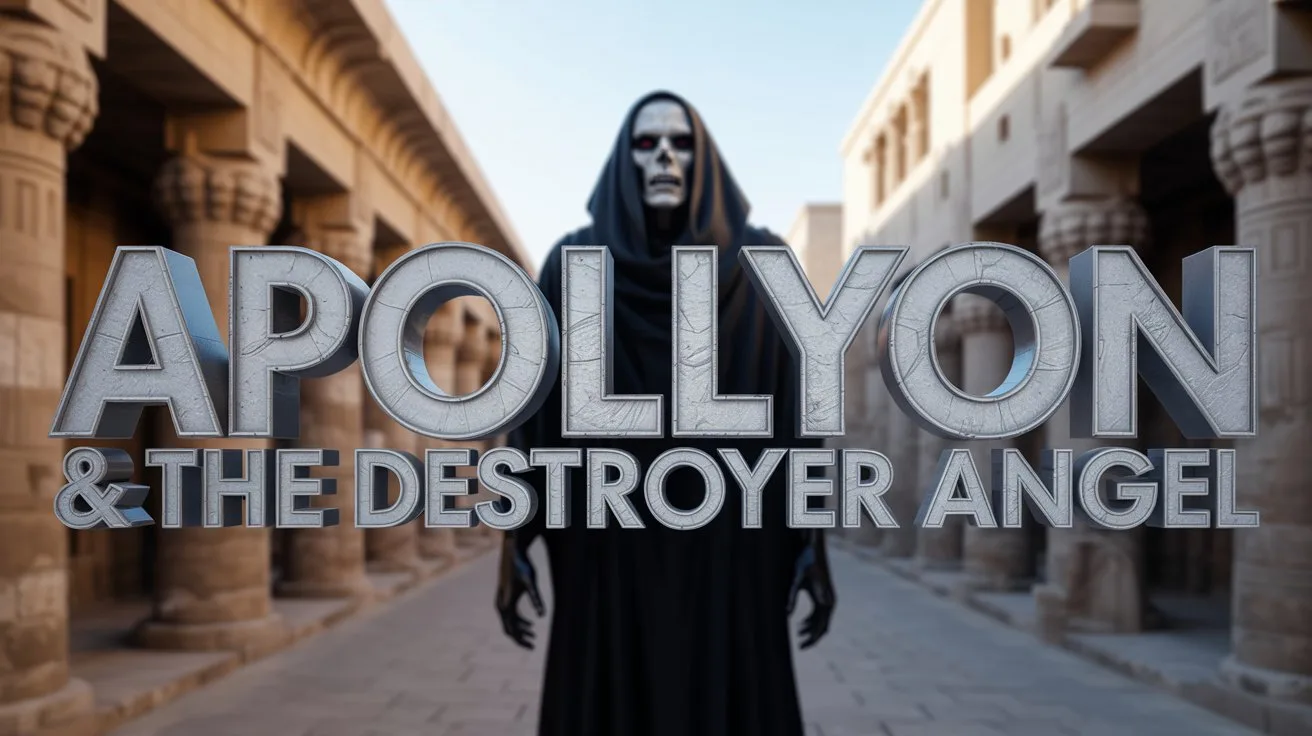
Revelation is not written to entertain us with strange creatures. It is written to show us how the Almighty brings history to its appointed end, and how He draws a clean line between those who belong to Him and those who harden themselves against Him. One of the most talked-about figures in that book is Apollyon, named in the middle of the fifth trumpet judgment, and the details in Revelation 9:1-2 set the tone for how we should read everything that follows.
The pit is opened
When the fifth trumpet sounds, John sees three things tied together: a fallen star, a key, and an opening. Those are not random props. They tell you this is a controlled release. Something is being unlocked on purpose, at a set time, under permission.
The key is given
John says the key to the bottomless pit is given to the one he sees. It is easy to skim past, but he does not take the key. He receives it. The action is allowed, timed, and bounded.
Then the fifth angel sounded: And I saw a star fallen from heaven to the earth. To him was given the key to the bottomless pit. And he opened the bottomless pit, and smoke arose out of the pit like the smoke of a great furnace. So the sun and the air were darkened because of the smoke of the pit. (Revelation 9:1-2)
In Scripture, a key pictures the right to open and shut, the right to grant access or keep something confined. Revelation uses that idea plainly. If the key is in someone’s hand, that person has authority to act within what God allows.
I am He who lives, and was dead, and behold, I am alive forevermore. Amen. And I have the keys of Hades and of Death. (Revelation 1:18)
So Revelation 9 is not saying the abyss bursts open because evil got loose and heaven could not stop it. The wording is careful. The key is given. The pit is opened. The scene is terrifying, but it is not out of control.
What is the abyss
The bottomless pit is also called the abyss. In Revelation it functions as a place of confinement, more like a prison than a symbol for normal life on earth. Certain beings can be held there, released for a purpose, and later shut up again.
When the pit is opened, smoke rises like smoke from a great furnace, and it darkens the sun and the air. John is describing more than an ugly fog. In the Bible, smoke often goes with judgment, and darkness often goes with dread and misery. There are clear echoes of plague language from the Old Testament, even though John is seeing something new and future in the Tribulation.
A detail people miss
Revelation does not treat the abyss as Satan’s headquarters. It treats it as a holding place that can be opened and shut by permission, and later as a place where Satan himself is imprisoned.
Then I saw an angel coming down from heaven, having the key to the bottomless pit and a great chain in his hand. He laid hold of the dragon, that serpent of old, who is the Devil and Satan, and bound him for a thousand years; and he cast him into the bottomless pit, and shut him up, and set a seal on him, so that he should deceive the nations no more till the thousand years were finished. But after these things he must be released for a little while. (Revelation 20:1-3)
That observation helps you keep your categories straight. Not every dark image equals Satan. Revelation is very willing to name Satan when it means Satan. When it does not name him, we should not rush to do it for John.
Apollyon is named
After the pit is opened and the locust-like beings come out, John gives you an anchoring line. They have a king. He is not unnamed. John gives his name in two languages so the meaning lands for more than one audience.
Abaddon and Apollyon
And they had as king over them the angel of the bottomless pit, whose name in Hebrew is Abaddon, but in Greek he has the name Apollyon. (Revelation 9:11)
John says their king is the angel of the bottomless pit. His name in Hebrew is Abaddon, and in Greek it is Apollyon. Both names point in the same direction: destruction.
The Greek name is not a random proper name. It is tied to a verb that means to destroy, ruin, or bring to destruction. The title fits the assignment. John is basically telling you, This angel is marked out by what he does in this judgment.
The Hebrew word Abaddon is used in the Old Testament for ruin and destruction, often in contexts that brush up against death and the grave.
Sheol is naked before Him, And Destruction has no covering. (Job 26:6)
John is not trying to impress you with bilingual trivia. He is making sure you hear the same idea whether you think in Hebrew categories from the Scriptures of Israel or you are a Greek-speaking reader in the Roman world. This is the destroyer.
Angel does not mean demon
John calls him an angel. That word simply means a messenger, and it can refer to faithful angels or fallen angels depending on context. So you cannot settle the question by saying, He is an angel so he must be good, or, He is tied to the pit so he must be evil. You have to follow the chapter and see what role he is playing.
What Revelation 9 does make clear is that he is a real personal being with real authority over the released horde. John gives him names. He ties him to the abyss. He calls him their king. This is not just a symbol for destruction in the abstract.
Not the key holder
There is also a careful distinction inside the chapter that many readers miss on a first read. Revelation 9:1-2 describes the one who opens the pit, but it does not name him as Apollyon. Apollyon is introduced later as the king over the beings that come out. The text never says Apollyon received the key, and it never says Apollyon opened the pit. If we merge those figures, we are supplying a detail John did not give.
That kind of restraint is important in Revelation. The book uses a lot of symbols, but it is still careful with its identifications. When it wants you to know who someone is, it tells you.
The destroyer pattern
Once you have Revelation 9 in front of you, the next question is fair: does Scripture speak elsewhere about a destroyer who carries out judgment under God’s direction? Yes. Those passages give you a pattern that helps you read Apollyon without forcing an ID the text does not make.
Passover restraint
In the Passover judgment in Egypt, the LORD brings judgment, and the text speaks of a destroyer who would strike. The key detail is not that the destroyer is a rival power. The key detail is that he is restrained by God’s command, and he cannot cross the line God sets.
For the LORD will pass through to strike the Egyptians; and when He sees the blood on the lintel and on the two doorposts, the LORD will pass over the door and not allow the destroyer to come into your houses to strike you. (Exodus 12:23)
That shows judgment with boundaries. It also shows protection by a sign God provided. On that night, the difference between being struck and being spared was not personality, courage, or background. It was whether a household was under the blood of the lamb, applied the way God said.
That is not salvation by works. The blood did not earn mercy. God provided the lamb and the covering. Faith receives what God provides, and faith acts on what God says.
Angels sent to judge
Psalm 78 looks back on the Exodus and speaks of angels of destruction. The emphasis is that God sent them. They are agents. They are not freelancing.
He cast on them the fierceness of His anger, Wrath, indignation, and trouble, By sending angels of destruction among them. (Psalm 78:49)
Revelation is full of angels doing hard things: sounding trumpets, announcing woes, pouring out bowls, and striking the earth as God directs. The Bible does not treat that as God losing His goodness. It treats it as God carrying out justice after long patience is refused.
Stopped by God
In David’s day, an angel brings judgment on Israel after David’s sinful census. The striking detail is that God stops the destruction at the moment He chooses and commands the angel to stop.
And when the angel stretched out His hand over Jerusalem to destroy it, the LORD relented from the destruction, and said to the angel who was destroying the people, "It is enough; now restrain your hand." And the angel of the LORD was by the threshing floor of Araunah the Jebusite. (2 Samuel 24:16)
The angel does not argue. He does not keep going. He restrains his hand because God says, enough. Again, judgment is real, personal, and severe, but it is supervised and limited.
Back to Revelation 9
Now come back to the fifth trumpet. The locust-like beings are terrifying, but the chapter is full of restraints. They are commanded not to harm certain things, and they are commanded to target only certain people.
They were commanded not to harm the grass of the earth, or any green thing, or any tree, but only those men who do not have the seal of God on their foreheads. And they were not given authority to kill them, but to torment them for five months. Their torment was like the torment of a scorpion when it strikes a man. (Revelation 9:4-5)
Notice how specific the limits are. There is a limit on what they can harm, a limit on who they can harm, a limit on what they can do, and a limit on how long they can do it. Revelation 9 is not chaos. Revelation 9 is controlled judgment.
There is also a wording detail here that is easy to miss. Revelation 9:4 uses the language of command. They are told what they may not do and what they may do. That fits the same pattern you saw in Exodus 12 and 2 Samuel 24: destructive activity under orders, not independent rebellion running wild.
If you want to connect Apollyon to the Old Testament destroyer passages, that is where the connection lives. Not in a verse that says, This is the same being as in Exodus, because Revelation never says that. The connection is in function: a destroyer figure operating inside strict boundaries during divine judgment.
So, is Apollyon the exact same individual as the destroyer in Exodus 12? Scripture does not say so, and we should not talk like it does. A reasonable inference is that Revelation is placing Apollyon into the same kind of biblical category: an angelic destroyer involved in judgment under God’s permission and limits.
This also guards you from another common mistake. Some people assume that because Apollyon is tied to the abyss and rules fearsome beings, he must be Satan. Revelation does not make that equation. Satan is identified with specific titles and is later bound and cast into the abyss.
He laid hold of the dragon, that serpent of old, who is the Devil and Satan, and bound him for a thousand years; (Revelation 20:2)
Apollyon is called the angel of the abyss. Satan is imprisoned in the abyss. Those are different roles. Revelation is careful. We should be careful too.
Judgment with limits
Revelation 9 does something else that helps your reading. It keeps showing you that even severe judgment is measured. The pit is opened by permission. The creatures operate under command. Their target is limited. Their time is limited.
That tells you something about God’s authority even in the darkest parts of Revelation. He is not reacting in panic. He is not improvising. He is carrying out what He has already decreed, in stages, with boundaries.
It also tells you something about human responsibility. Revelation 9 is part of the future Tribulation, a time when God’s wrath is poured out on an unbelieving world. From a pre-tribulation view, the church has already been caught up to be with Christ before this wrath begins.
Inside the judgment, God still knows exactly who belongs to Him. In Revelation 9 the protected group is described as those who have God’s seal. The point is not that believers are tougher or luckier. The point is that God can distinguish and protect His own even when judgment is falling.
That pushes you toward the gospel. Safety is not in being part of a religious crowd or knowing end-times terms. Safety is in belonging to Jesus Christ. Salvation is by grace through faith alone in Christ alone. When a person believes, God justifies him, meaning God counts him righteous on the basis of Christ. Real faith shows fruit over time, but works are not the cause of salvation.
And because salvation rests on Christ and His finished work, the believer is secure. The warning passages in Revelation are not written to make true believers panic about losing salvation. They are written to call the world to repent, and to steady believers to stay faithful and clear-minded.
My Final Thoughts
Apollyon shows up in a passage where judgment is released in measured stages, and Revelation 9:1-2 makes clear that what is released is released by permission. When Apollyon is named, his Hebrew and Greek names both point to destruction, and he is presented as a real angelic ruler over the beings that come out of the abyss. The text also keeps him distinct from the one who opens the pit, and distinct from Satan, who is clearly identified elsewhere and later imprisoned in the same abyss.
The Old Testament destroyer passages help you read Apollyon with a steady hand. Scripture already has a category for angelic agents who bring destruction under God’s direction and within God’s limits. Revelation 9 fits that pattern: clear commands, real boundaries, and a clear distinction between those marked out as God’s and those who are not. That is sobering, but it is clarifying. The right response is not obsession with scary details, but repentance, faith in Christ, and a life that takes God’s word seriously.

 Get the book that teaches you how to evangelize and disarm doctrines from every single major cult and religion.