
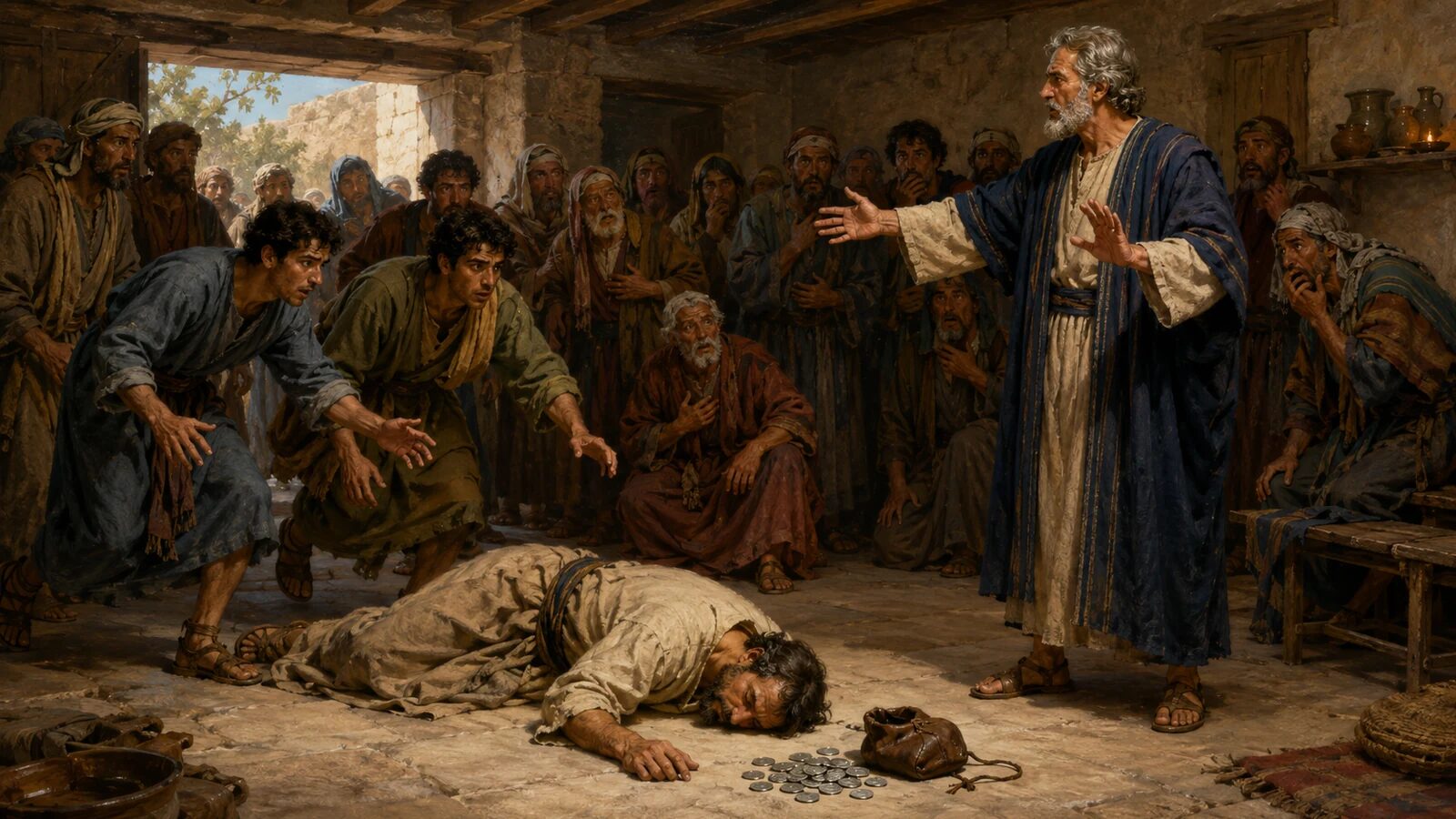
What unsettles me about Ananias and Sapphira is that their gift could have looked admirable to everyone watching. They brought money to the apostles while concealing a lie about how much they had kept. Acts 5 describes God judging that deception with death. Peter’s explanation does not allow us to turn their deaths into a threat against people who have not given enough.
Acts 5 Begins With Truth Before God
To understand their actions, we need to begin at the end of Acts 4. The believers were bearing witness to the risen Jesus, praying together, and using their possessions to help people in need. Luke describes the unity behind that generosity:
Now the multitude of those who believed were of one heart and one soul; neither did anyone say that any of the things he possessed was his own, but they had all things in common.
Their shared life under Christ affected what they were willing to do with their property. The apostles preached His resurrection with power, and grace was upon the believers. Selling land did not purchase salvation. Their giving was a response to the grace they had received, rather than a political scheme imposed upon them.
Luke then names Barnabas as an example of that willing generosity:
And Joses, who was also named Barnabas by the apostles (which is translated Son of Encouragement), a Levite of the country of Cyprus, having land, sold it, and brought the money and laid it at the apostles’ feet.
We do not have to make Barnabas flawless or demand that every believer copy his sale to recognize the honesty of his gift. Acts 5 begins with “But,” placing the couple’s deceit beside what Luke has just described. Their gift presented them as making a sacrifice they had not actually made.
The Sin Was Deceit, Not Keeping Money
Ananias and Sapphira sold property and kept part of the proceeds. Ananias brought the remainder to the apostles, with his wife’s knowledge:
But a certain man named Ananias, with Sapphira his wife, sold a possession. And he kept back part of the proceeds, his wife also being aware of it, and brought a certain part and laid it at the apostles’ feet.
Peter confronted Ananias about the deception and the one whose influence he had welcomed:
But Peter said, “Ananias, why has Satan filled your heart to lie to the Holy Spirit and keep back part of the price of the land for yourself?”
He then explained that Ananias had been free to decide what to do with the land and the money:
While it remained, was it not your own? And after it was sold, was it not in your own control? Why have you conceived this thing in your heart? You have not lied to men but to God.
The land belonged to Ananias, and selling it had not transferred control of every coin to the apostles. He could have kept the proceeds. He could also have given a portion and honestly said that was what he was giving. Instead, he claimed to have offered the whole price. Peter was confronting a lie, not demanding that Ananias increase his donation.
The Greek verb behind “kept back,” nosphizomai, can describe secretly retaining something for oneself or misappropriating it. The same word is used in Titus 2:10 for stealing. Here Peter’s explanation tells us how to understand the wrongdoing: Ananias had control of the money, but he was concealing the truth about what he gave. Luke was not condemning ordinary saving or continued ownership of property.
Lying to the Holy Spirit and the Fear of God
Peter named Satan’s involvement, but he also asked why Ananias had conceived the plan in his own heart. The devil’s influence did not make Ananias an innocent participant. He had chosen to carry out the deception. Jesus described the character of the one who encourages that rebellion:
When he speaks a lie, he speaks from his own resources, for he is a liar and the father of it.
A church that welcomes deceit is making room for the enemy of the Lord it claims to serve. Peter also identified the One Ananias had offended. In Acts 5:3, he called the act a lie to the Holy Spirit; in verse 4, he called it a lie to God. The Spirit is a divine Person, not a created messenger or an impersonal power. Ananias had tried to deceive people while dealing with God Himself.
That explains why the setting did not make the lie less serious. God’s Spirit is present among Christ’s people. We do not leave His sight when we give money or speak about our obedience, and a religious act cannot conceal dishonesty from Him. Luke records what happened when Ananias heard Peter’s words:
Then Ananias, hearing these words, fell down and breathed his last. So great fear came upon all those who heard these things.
Young men carried him out and buried him. About three hours later, Sapphira arrived without knowing her husband had died. Peter asked, “Tell me whether you sold the land for so much?” She had an opportunity to tell the truth, but she confirmed the false price.
Then Peter said to her, “How is it that you have agreed together to test the Spirit of the Lord? Look, the feet of those who have buried your husband are at the door, and they will carry you out.”
Sapphira also fell down and died, and the young men buried her beside her husband. Luke connects both deaths with their lie to God and their agreement to test His Spirit. He gives no medical cause for either death. The passage presents a severe judgment, not an unfortunate misunderstanding about a donation.
Peter called their agreement a test of the Spirit because they carried out the lie as though God would neither expose it nor respond. That presumption is very different from a struggling believer asking honest questions or admitting weak faith. The couple had colluded in a lie, and Sapphira repeated it when directly questioned.
Great fear came upon those who heard and upon the whole church. They had reason to revere the holy God who knew the truth, rather than regard Him as unpredictable. Acts does not tell believers to expect an immediate, visible judgment every time someone lies. It does show that living under grace gives us no permission to treat dishonesty casually.
The church continued bearing witness with this warning before it. Luke describes the apostles ministering and more people being added to the Lord. The severity of these deaths had not made it impossible to preach the grace of God honestly.
There is a comparison with Achan’s sin in Joshua 7, after Israel’s victory at Jericho. He took forbidden spoil and hid it in his tent, bringing trouble upon Israel. Achan had no right to keep those things, whereas Ananias had lied about money still under his own control. Their offenses and covenant settings were different, but in both accounts, concealing wrongdoing brought consequences beyond the person who committed it.
I can be dishonest about sacrifice without selling a field. If I embellish what my service has cost me so people will admire my devotion, the service does not make the exaggeration innocent. Teaching or volunteering can be worthwhile, but neither excuses lying about what I have done. I need to be willing to correct the impression I created, even if the truth is less flattering.
What Acts 5 Does and Does Not Authorize
A pastor who uses this passage to frighten someone into giving more is contradicting Peter’s explanation. Ananias owned the land and controlled the proceeds. The warning cannot honestly be turned into a demand that Christians surrender all their private property or make a public display of sacrifice.
Peter also had a unique role as an apostle and foundational witness of the risen Christ. Pastors and elders must confront sin when Scripture requires it, but they have no right to claim unchecked power by borrowing Peter’s place in this event. The man teaching the Word remains answerable to it. His position does not make every accusation true or every method of correction appropriate.
We need the whole of Scripture to understand confession, restoration, and church discipline. Some sin requires an immediate public response because it is already public and dangerous. Other failures call for private confrontation and patient shepherding. Telling the truth does not require broadcasting every person’s failure to the congregation, and Acts 5 gives no instruction to do that.
Some readers understand Ananias and Sapphira as believers under severe discipline; others see their hypocrisy as evidence of an empty profession of faith. Their deaths are recorded plainly, but Luke does not tell us whether they were born again.
Walking in the Light Together
Ananias and Sapphira did not need another religious act to offset the lie they were telling. They needed to tell the truth before God. John explains why fellowship with Him cannot be built on concealment:
If we say that we have fellowship with Him, and walk in darkness, we lie and do not practice the truth.
God is light, with no darkness in Him, but John does not tell believers to pretend that they live without sin. He warns in verse 8 that claiming to have no sin is self-deception. We can admit our failure because God has promised forgiveness and cleansing:
If we confess our sins, He is faithful and just to forgive us our sins and to cleanse us from all unrighteousness.
Proverbs also connects confession with turning from the wrongdoing:
He who covers his sins will not prosper, but whoever confesses and forsakes them will have mercy.
If my first concern is that someone might find out, I can spend more effort defending my reputation than dealing with the sin. Calling a false claim privacy or discretion does not make it truthful. I can keep appropriate personal matters private without inventing a false account of what I did. Confession requires me to name the wrong honestly and stop protecting it under a respectable description.
The gospel gives us reason to do that without despair. Jesus is the eternal Son, fully God and fully man, who lived without sin. Wicked men physically tortured and punished His innocent body. He willingly endured that real punishment for our sins, shedding His blood and dying. His saving work was completed through His blood and death before His bodily resurrection. The Father did not punish, curse, abandon, strike, bruise, or pour wrath on Jesus.
He was buried and rose bodily, having died for the sins of the whole world. God genuinely offers salvation to every person, though people can resist His grace and reject Him. Everyone who repents and trusts Christ is forgiven and born again, indwelt by the Spirit and sealed for redemption. Every genuine believer is eternally secure. That assurance gives us no permission to continue in lawlessness, and a shallow profession without new life does not establish genuine faith.
For a believer who has sinned, confession is a return to honest fellowship through Christ’s sufficient blood. We do not have to persuade a reluctant Savior to receive us or repair our public image before approaching Him. He already knows what we need to confess, and He has provided the cleansing we cannot supply for ourselves.
The church has responsibilities here too. If we reward impressive appearances while making it humiliating to admit a failure, we encourage people to hide what is wrong. Paul gives a reason for truthfulness that reaches beyond the individual:
Therefore, putting away lying, “Let each one of you speak truth with his neighbor,” for we are members of one another.
Believers depend on one another, and a lie damages that trust. Leaders need to refuse manipulation, while members need to stop embellishing their sacrifice or achievements. Correction should seek restoration and treat people with grace, but it cannot require the church to help someone maintain a false reputation.
Confessing a lie does not undo the harm it caused. If I obtained money dishonestly, I need to return it; that is restitution, giving back what I wrongfully took. False records need to be corrected, and people hurt by the deception deserve to hear the truth. My apology does not entitle me to insist that they ignore what happened or immediately trust me again.
Our giving should be willing, cheerful, and wise. We do not need to embellish a gift to make it acceptable, nor should a leader manipulate people into giving for the sake of appearances. If we tell people their gift will pay for a particular need, we ought to use it for that purpose and give an honest account of what happened.
I also take comfort in the fact that God knows what others never see. A private gift or unnoticed act of service does not escape His attention. He hears the trembling confession of a believer who wants to stop hiding the truth, even when no one else knows how hard that admission is. His knowledge should lead us to reverence, with confidence in the mercy Christ provides.
My Final Thoughts
Ananias and Sapphira were free to keep their money, but they were not free to lie to God about it. I need to hear that warning whenever protecting a reputation begins to seem more important than admitting the truth. Because Christ has provided cleansing for sinners, we can come to Him honestly, deal with the wrong we have done, and stop defending an appearance of devotion that He knows is false.