
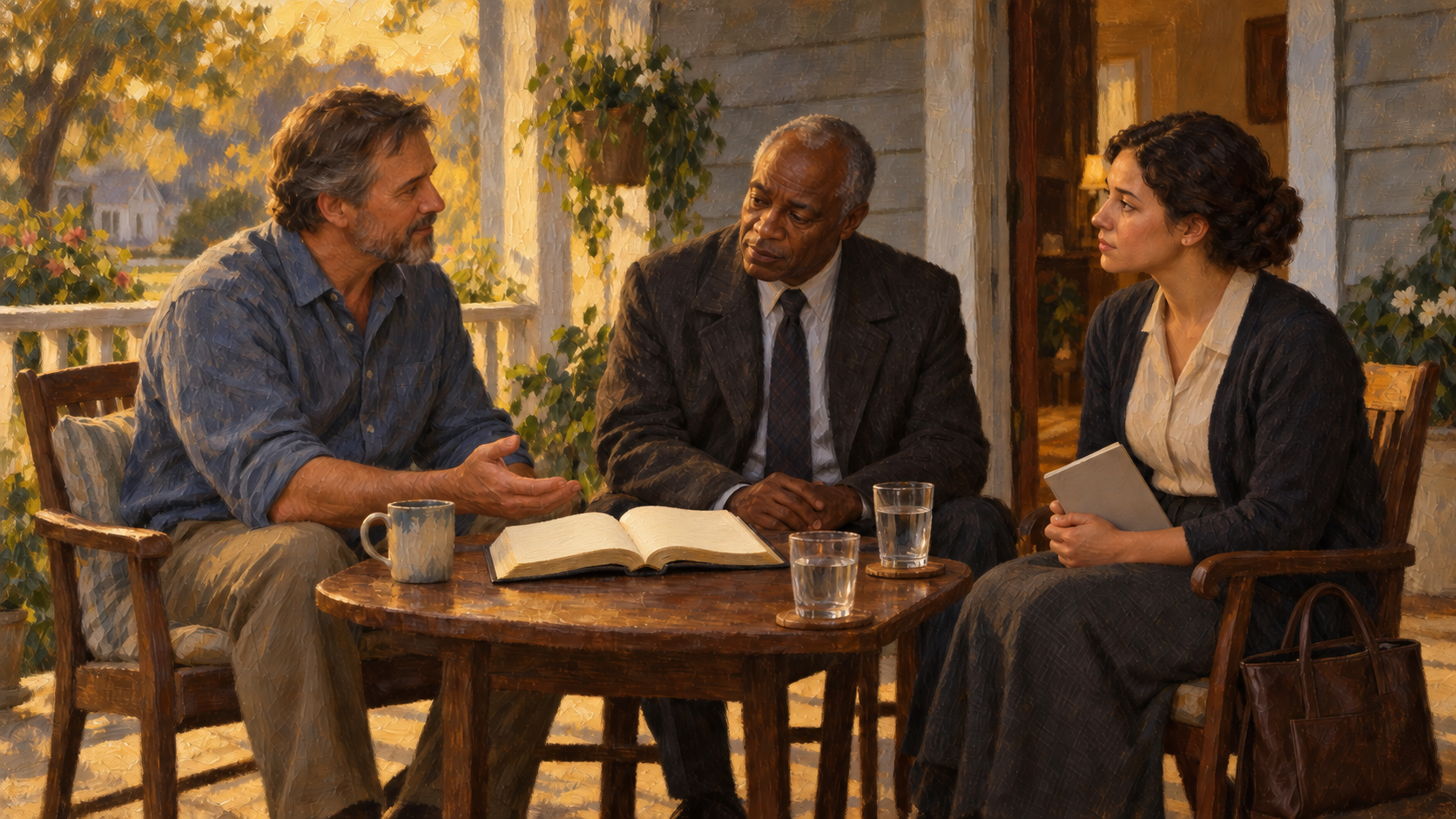
When I speak with a Jehovah’s Witness, I want to understand the person in front of me and explain Scripture clearly. A conversation can become intimidating when it moves quickly through Greek terms and a long chain of references. We do not have to follow that pace. Reading one passage carefully may accomplish more than trading twenty verses neither person has time to examine.
Kindness also requires honesty about the disagreement. Watchtower teaching places Jesus among created beings, denies His bodily resurrection, and describes the Holy Spirit as an impersonal force. Those claims alter the identity of the Savior and the gospel we are asking someone to believe. We should address them firmly without treating the person as an opponent to humiliate.
Walk in wisdom toward those who are outside, redeeming the time. Let your speech always be with grace, seasoned with salt, that you may know how you ought to answer each one.
Paul connects wise use of an opportunity with gracious speech toward each person, so listening belongs at the beginning of our witness. Ask how the person understands God and the Son, then take the same care with worship and resurrection. Gospel and salvation also need explanation. Familiar biblical words can conceal very different beliefs, and we may appear to agree simply because we have not explained our terms.
Start With Grace and the Bible
I would prepare by reading the organization’s own summary of its beliefs. It calls Jesus Son of God and Savior while denying His full deity and the Trinity. Its teaching separates 144,000 destined for heaven from other obedient people who hope to live in an earthly paradise. It dates Christ’s heavenly kingship to 1914. Although the summary says salvation cannot be earned, it also requires changed conduct and baptism to benefit from His ransom. The Governing Body directs the worldwide organization and its instruction. These claims help us prepare to discuss the beliefs a Witness may bring to the conversation.
Describing those claims accurately is part of truthful witness. The central disagreement is not the use of the name Jehovah, belief in a kingdom, or enthusiasm for evangelism. It concerns who God is, who Christ is, how He rose, and how sinners receive salvation. Ask whether the official statements describe the individual’s beliefs. He may understand them differently, know little about the technical arguments, or be considering questions he has been reluctant to raise. An institutional statement cannot answer on his behalf.
Then consider how both of you will use the Bible. You might ask, “If the text and an organization appear to disagree, which one is permitted to correct the other?” This is a question about authority, not an invitation to ridicule someone’s loyalty. If an official interpretation can never be corrected, appealing to the Bible as final authority becomes difficult to sustain.
2 Timothy 3:16-17 says Scripture is God-breathed and equips the man of God for every good work. Acts 17:11 commends the Bereans for receiving teaching eagerly while examining Scripture daily to test it. Teachers have a proper place, but every council and publication remains subject to the written Word, as does every tradition or governing body. I am asking the other person to accept a standard that applies equally to me. I should be willing to say, “If I have misunderstood the passage, Scripture must correct me.”
Agree to read whole paragraphs, identify the speaker and audience, and follow the surrounding argument. Compare passages without abandoning one as soon as it becomes uncomfortable. Clear statements should govern our treatment of figures of speech and disputed wording. This approach requires patience from both people, including the Christian who is accustomed to giving familiar answers without explaining them.
Who Is Jesus Christ?
I would usually begin with Jesus because the gospel depends on His identity. Replacing the eternal Son with a created angel changes the One in whom a person is being asked to trust. Before seeking agreement with the term Trinity, explain what it means. There is one God, and the Father, Son, and Holy Spirit are each fully God while remaining three distinct Persons. They are coequal and have always existed. Scripture does not describe three gods or one Person playing three roles. The study on the Trinity examines those passages together.
John’s opening paragraph is a good place to begin. The New World Translation renders the end of John 1:1 as “the Word was a god.” Read beyond that disputed rendering to John’s explanation of the Word’s relationship to creation.
In the beginning was the Word, and the Word was with God, and the Word was God. He was in the beginning with God. All things were made through Him, and without Him nothing was made that was made.
Greek has no indefinite article equivalent to the English word a, and the absence of a definite article before theos, God, does not automatically supply one. The clause describes what the Word is by nature. John distinguishes Him personally from the Father by saying He was “with God.”
Verse 3 lets us examine the issue without mastering Greek. Consider everything that came into existence, then consider the One through whom it came into existence. John says nothing in the first group was made apart from the Word. If the Word were Himself created, He would have had to bring Himself into existence. John therefore identifies Him as Creator, above everything He made.
John then says the Word became flesh and dwelt among us. The eternal divine Son took a genuine human nature without ceasing to be God or becoming the Father. That is the incarnation: the One who is fully God became truly man, rather than a created angel being promoted to a higher position.
Colossians 1 develops the same truth about the Son’s relationship to creation. Jehovah’s Witnesses often appeal to its description of Jesus as “the firstborn of all creation.” But firstborn can describe the one who holds the highest rank and receives the inheritance. Psalm 89:27 uses it for David’s royal heir, made higher than the kings of the earth. We need to follow Paul’s explanation in the rest of the paragraph to determine whether he means Christ was created or holds authority over creation.
Everything in heaven and earth, visible and invisible, was created through the Son and for Him. Paul includes thrones, dominions, principalities, and powers, leaving no heavenly order outside His work. He is before all things and holds them together. Colossians 1:19 says all fullness dwells in Him, and 2:9 says all the fullness of the Godhead, the divine nature, dwells bodily in Christ. A created spirit cannot account for that description.
The New World Translation repeatedly supplies other in the expression “all other things.” Its study note on Colossians 1:16 acknowledges that the literal Greek wording is “all things”. It defends the addition partly because the literal rendering could suggest that Jesus is Creator rather than created. The note appeals to other passages and argues that the context permits the addition. I disagree because Paul places every created order under the Son. Adding that word makes an exception for Christ that the Greek does not state.
Ask the person to read it without other. Who created the heavenly powers, who existed before them, and for whom do they exist? That allows him to consider the argument rather than merely hear an accusation that his Bible is wrong.
The organization’s identification of Jesus with Michael the archangel also needs to be tested. It reasons that both command angels and that the Lord descends with an archangel’s voice in 1 Thessalonians 4:16. Similar responsibilities do not establish that two persons are identical. That verse also mentions God’s trumpet; the accompanying voice and trumpet do not, by themselves, identify what kind of being the Lord is.
Daniel 10:13 calls Michael “one of the chief princes.” That places him among comparable heavenly princes. Jude 9 says he declined to bring a reviling accusation against the devil and appealed to the Lord’s rebuke. Jesus directly rebuked Satan and commanded demons by His own authority. Hebrews 1 gives us a sustained explanation of the Son’s position above angels, repeatedly asking which angel ever received the words addressed to Him.
But to the Son He says: "Your throne, O God, is forever and ever; A scepter of righteousness is the scepter of Your kingdom.
Paul, the author of Hebrews, describes angels as servants sent out by God, while the Son is addressed as God and occupies an everlasting throne. The chapter also identifies Him as the unchanging Lord who founded the earth and made the heavens. Read those descriptions together and consider the claim they make. The Son stands above the entire angelic order as its Creator, which rules out making Him its highest created member.
Answer the Main Objections in Context
A Witness may turn to John 14:28, where Jesus says, “My Father is greater than I.” We should receive His words and consider the work He came to do. The eternal Son humbled Himself by becoming truly man and taking the form of a servant. In that role He carried out the Father’s will. His place within that mission explains the comparison without denying the divine nature John has already affirmed. The Father and Son have an ordered relationship, but the Son’s service does not make Him a creature.
Revelation 3:14 calls Him “the Beginning of the creation of God.” The Greek term arche can refer to a beginning or origin and also carries the sense of rule. I understand Christ here as creation’s source and ruler because the direct statements in John and Colossians identify Him as the One through whom all created things came into existence.
The Watchtower also appeals to Proverbs 8 for a created Son, but we need to read the passage as poetry. Wisdom is personified, described as though she were a woman who calls publicly and dwells with prudence. That portrayal continues into Proverbs 9:1, where she builds a house. Proverbs 8 does not name Jesus or give a literal biography of a created Son. We cannot use that poetic language to overturn the direct teaching about Christ in John, Colossians, and Hebrews.
1 Corinthians 15:28 describes the Son’s subjection to the Father as His work in the mediatorial kingdom reaches completion. That is His work as Messiah, bringing His enemies under His feet and delivering the kingdom to the Father. Paul is explaining how Christ completes the work entrusted to Him. He is not dividing the divine nature into superior and inferior kinds of deity. The same Paul says all things are subjected under Christ and elsewhere identifies Him as their Creator and sustainer.
We should also ask what honor Jesus receives. The Watchtower says He should not be worshiped because He is not Almighty God. Yet John 5:23 requires all people to honor the Son just as they honor the Father. Thomas addressed the risen Jesus directly with a confession that a mere creature could not rightly accept.
And Thomas answered and said to Him, "My Lord and my God!"
Jesus responded to Thomas’s confession by recognizing his belief and blessing those who would believe without seeing. He did not rebuke Thomas for calling Him God. The words were addressed to Jesus, so this was no unrelated exclamation directed toward heaven. John explains that he recorded these signs so people would believe Jesus is the Christ, the Son of God, and have life in His name. In this Gospel, that title cannot mean a being beneath deity, because John has already identified the Son as the Word who is God.
Revelation 5 describes every creature offering praise to the One on the throne and the Lamb together. The Lamb receives divine honor while remaining personally distinct from the Father. He cannot simply be another member of the creation offering that praise.
Thomas’s encounter with Jesus also brings us to the question of His bodily resurrection. The organization’s account of Jesus’ resurrection appearances says He rose as a spirit creature and temporarily materialized different bodies, including one with wounds for Thomas. Compare that explanation with Jesus’ own words. In John 2, He promised to raise the temple His enemies would destroy, and John explicitly identifies that temple as His body. After rising, He invited the disciples to examine Him.
Behold My hands and My feet, that it is I Myself. Handle Me and see, for a spirit does not have flesh and bones as you see I have."
“I Myself” identifies the Person standing before them as the One who had been crucified. He showed His hands and feet and ate in their presence. Later, He invited Thomas to examine His wounds. His body was transformed and glorified, no longer subject to death, yet it was the body that had been crucified and buried. Jesus deliberately distinguished His flesh and bones from a spirit.
Read 1 Peter 3:18 alongside that testimony. Christ was put to death in the flesh and made alive by the Spirit. I understand Peter to describe His passage from suffering and death to resurrection life through the Spirit’s power. Peter does not require us to turn the risen Jesus into a spirit creature and dismiss the bodily evidence the Gospels emphasize. We should understand his words in agreement with the direct account of what Jesus showed His disciples.
The Holy Spirit and the Gospel
The Watchtower describes the Holy Spirit as God’s active force. Although the biblical words for spirit can refer to wind or breath, we need to ask which meaning fits the passage we are reading. The Holy Spirit teaches God’s people and guides them, speaking and hearing. He calls people to ministry and chooses how to distribute gifts. He also intercedes for believers and can be grieved. As we follow those passages, we are learning about Someone who knows us and acts according to His will.
In John 14-16, the Son promises to ask the Father to send another Helper. The Spirit will bring Christ’s words to the apostles’ remembrance and testify about Him. He will guide them into truth and glorify the Son. Those relationships distinguish the Father, Son, and Spirit personally. In Acts 5, Peter’s words to Ananias also show us that the Spirit is God.
But Peter said, "Ananias, why has Satan filled your heart to lie to the Holy Spirit and keep back part of the price of the land for yourself? While it remained, was it not your own? And after it was sold, was it not in your own control? Why have you conceived this thing in your heart? You have not lied to men but to God."
Peter identifies a lie to the Holy Spirit as a lie to God. The Spirit also speaks personally in Acts 13:2: “Separate to Me Barnabas and Saul for the work to which I have called them.” In 1 Corinthians 12:11, He distributes gifts as He wills, and Ephesians 4:30 warns believers not to grieve the One who seals them for redemption. Scripture does use personification, but I cannot explain these passages as occasional poetic descriptions of an impersonal force. Taken together, they show Someone who knows His people, exercises His will, and relates to the Father, Son, and church. He is fully divine and personally distinct. The study on the Person of the Holy Spirit develops that evidence.
With that understanding of who God is, ask what the person trusts for acceptance with Him. Official Watchtower material says salvation cannot be earned. Accusing a Witness of believing he can simply purchase it through effort would therefore misrepresent his stated position. Instead, ask how baptism and changed conduct relate to receiving salvation, and where endurance and organizational standing belong. Then read Paul’s explanation together.
For by grace you have been saved through faith, and that not of yourselves; it is the gift of God, not of works, lest anyone should boast.
Grace is God’s undeserved favor toward sinners, so faith receives Christ without offering God a wage. Works provide no grounds for boasting. Verse 10 gives them their proper place: believers are God’s workmanship, created in Christ Jesus to walk in good works. Baptism belongs after faith as well. When the Philippian jailer asked how to be saved, Paul answered, “Believe on the Lord Jesus Christ.” The jailer heard the Word, believed, and was baptized. His baptism publicly identified him with Christ. It did not cause regeneration, the genuine new birth, or add anything lacking in Christ’s saving work.
The Savior we are asking him to trust is the eternal Son, fully God and fully man, virgin-born and entirely sinless. He willingly gave Himself to be slain as the perfect sacrifice for our sins. Wicked men inflicted His bodily suffering and crucified Him, and He shed His blood and died. His saving sacrifice was complete through that blood and death before He was buried and rose bodily. The Father did not punish or curse His Son, and He never abandoned Him. Neither did He strike or bruise Jesus or pour wrath on Him. Father, Son, and Holy Spirit acted in unity for our salvation. God’s offer is genuine to the whole world. People can resist His grace, but everyone who repents and believes in Christ receives life.
The believer is forgiven and justified, declared righteous in Christ. He is also born again as a new creation, indwelt and sealed by the Holy Spirit. His eternal life rests securely in Christ, so neither institutional standing nor ministry reports maintain it. That assurance never excuses lawlessness or makes a shallow profession evidence of new birth. Genuine faith produces obedience, but those good works never earn or keep salvation. The study on soteriology, the study of salvation, explains that order more fully.
Keep the Conversation Focused
Questions about the 144,000 or 1914 may arise, along with objections concerning holidays, birthdays, and military service. Someone may also want to discuss blood transfusions, final judgment, or removal from the congregation. These subjects deserve accurate answers, especially when a family or medical decision is involved. Even so, I would keep returning to Christ’s identity and saving work, without expecting one doorstep conversation to settle every subject.
Revelation identifies the 144,000 as sealed servants from Israel’s tribes and later describes them as male virgins and firstfruits. It does not identify them as an organization’s exclusive heavenly class. Revelation 7 also presents an innumerable multitude before the throne and the Lamb. Read those descriptions together when examining the claim that only 144,000 people can be with Christ in heaven.
The organization’s 1914 calculation connects Daniel 4 with a proposed destruction of Jerusalem in 607 BC and a period of 2,520 years. Before following that chain, read the explanation Daniel actually gives: the tree represents Nebuchadnezzar. Where does the passage authorize turning the king’s seven times into a hidden date for Christ’s heavenly enthronement? The calculation depends on establishing that connection from Scripture. Getting caught up in the arithmetic before examining the interpretation can leave its central assumption untested.
Blood transfusions can raise urgent questions, so we need to describe the policy accurately. In its September 18, 2026 announcement, the Governing Body made accepting the four main blood components a matter of individual conscience. These are red cells, white cells, plasma, and platelets. Under the same announcement, each Witness may also decide whether to donate blood specifically to provide components or fractions. The policy continues to reject whole-blood transfusions. We should therefore avoid claiming that every use of blood components is forbidden. The biblical question remains whether commands about consuming blood prohibit a medical transfusion. Acts 15 addresses idolatry and sexual immorality, along with strangled animals and blood. It does not discuss transferring blood into the circulatory system. A person facing an actual treatment decision needs competent medical counsel about his individual risks and alternatives.
We also need to distinguish our beliefs about death. Watchtower teaching says people cease to exist at death and that God can restore them by resurrection. I reject eternal conscious torment for human beings, but I also reject soul sleep. The dead remain conscious in the intermediate state, the period between death and bodily resurrection, and believers are with Christ. Unbelievers will be raised and judged at the Great White Throne, and the Lake of Fire brings irreversible destruction of human body and soul. Revelation 20:10 specifies endless torment for the devil, beast, and false prophet. Our shared rejection of endless human torment does not mean we agree about what happens between death and resurrection.
You do not need to cover all those subjects in a first conversation. Ask what the person believes is the most important truth about Jesus, listen, and invite him to read a complete passage with you. If two Witnesses are present, give both the same respect. There is no reason to divide them or embarrass the less experienced person. Stay with the passage long enough for each person to explain what he sees and ask questions. This study is a resource for those discussions, not a script you must work through in order.
As the discussion draws to a close, I want the person to understand the gospel. He should be able to see that my concern is for him to know Christ, rather than simply to win an argument. Ask where his hope of forgiveness rests and consider Ephesians 2:8-10 together. An invitation to read the whole Gospel of John and meet again can give him time to examine Jesus beyond one disputed verse.
With a family member, ask when he is willing to talk and keep the discussion within the scope you promised. The relationship continues afterward, and careless words can be remembered for years. We should not turn every meal into a doctrinal ambush. Our love needs to be evident in the rest of the relationship, without making agreement the condition for receiving it.
For someone who fears losing close relationships, that steady care can be especially precious. The organization’s current public explanation says Witnesses do not socialize with a removed person, although he may attend meetings, be greeted there, and seek help from elders. It says marital relations and normal family dealings continue with a spouse and young children living in the same household. It also withholds even a greeting from those it regards as actively undermining the congregation or promoting wrongdoing. Each person’s circumstances need to be heard. Someone questioning the organization may fear losing close friends or family contact, and I should neither exploit that fear nor promise an easy outcome.
If someone begins questioning Watchtower teaching, give him time to explain what he is considering. Recognizing an error does not mean he can immediately explain every Christian doctrine. Help him distinguish God from the organization that claimed to speak for Him, and encourage him to read Scripture for himself. Leaving a tightly ordered community can involve grief, loneliness, fear, and practical difficulty. A healthy local church should offer steady friendship and sound teaching, along with help for ordinary needs. His vulnerability must never become an opportunity to manipulate him or make him dependent on another human leader.
Keep praying when the conversation develops slowly. A person may need time to reconsider convictions that have shaped years of his life. The Holy Spirit brings conviction through Scripture and can use repeated encounters with the Word and patient relationships. I am responsible to speak faithfully and treat the person well, but I cannot force him to believe. Our aim is that he come to know the trustworthy Savior and mature under Christ’s authority within a healthy church.
My Final Thoughts
I want a Jehovah’s Witness to hear an accurate explanation of Scripture from someone willing to listen and remain patient. John identifies Jesus as the eternal Word and Creator, Thomas confesses Him as Lord and God, and the risen Lord presents His own body to His disciples. Scripture also reveals the Holy Spirit as a divine Person and salvation as God’s gift through faith in Christ. Those truths deserve clear explanation. The person hearing them deserves honest friendship as he considers what they require him to believe.