
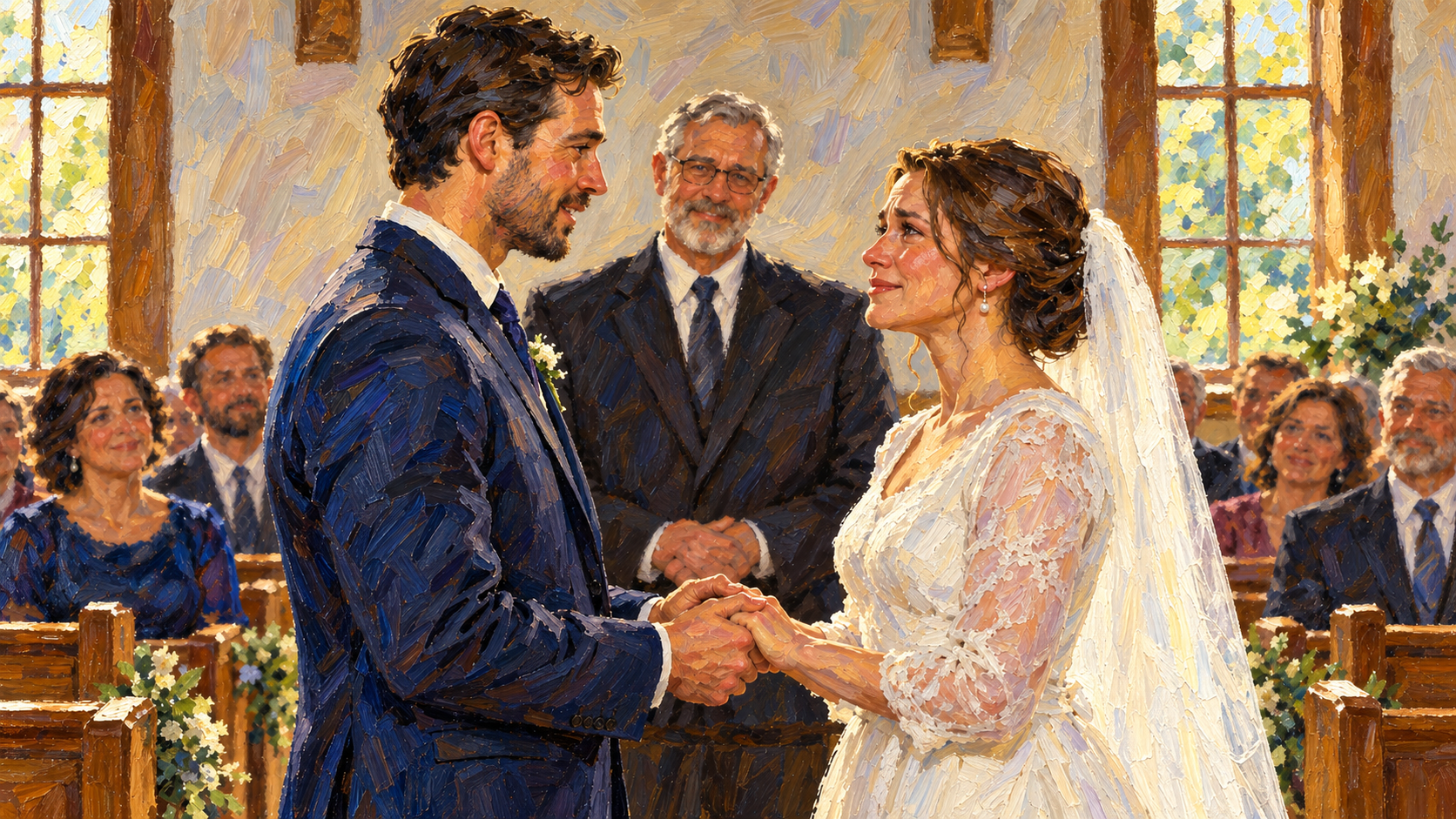
What makes a marriage a marriage according to Scripture? Genesis describes one man and one woman leaving their parents to join in covenant and share a one-flesh life under God. A ceremony or a private feeling does not explain all that commitment involves. I want us to understand how God’s design joins faithfulness with care for each spouse’s dignity and safety, and how the whole home depends on His grace.
God’s Design for Marriage
God established marriage when He created the first man and woman. It did not originate with a government or a church denomination, as an economic arrangement, or as a human attempt to regulate romance. He gave the man and woman equal dignity as His image-bearers and brought them into an ordered relationship. The man would leave his father and mother to be joined to his wife, and they would become one flesh.
That creation pattern is where I get the biblical definition of marriage: a public covenant union of one man and one woman. They enter it through a free and truthful commitment that is intended to be exclusive and permanent. Their covenant is lived out in a shared one-flesh life as they form a new household. Yet neither spouse stops being a distinct moral person who answers directly to God.
Marriage carries legal and social responsibilities, but it is more than a transaction for mutual advantage. Affection and companionship belong within it without giving feelings the power to create or dissolve the covenant. Sexual union belongs there too, yet intercourse alone does not turn fornication into marriage. And although children commonly follow, infertility does not make a couple’s marriage incomplete or invalid.
Scripture also honors singleness, so we should not make marriage the measure of adult worth or spiritual maturity. It is a good gift and a serious calling. A believer who is single or widowed remains a complete image-bearer and a full member of Christ’s body, as does a believer who has been abandoned or has no children.
Sin attacks this good gift in ways that reach beyond adultery. Lust violates sexual faithfulness, and selfishness or contempt erodes trust. Domination can damage a shared life, as can passivity and secrecy. That is why defending a definition of marriage is not enough. Biblical teaching must help spouses live truthfully under Christ, and it must never become a defense for coercion, abuse, or crime.
Then God said, "Let Us make man in Our image, according to Our likeness; let them have dominion over the fish of the sea, over the birds of the air, and over the cattle, over all the earth and over every creeping thing that creeps on the earth." So God created man in His own image; in the image of God He created him; male and female He created them. Then God blessed them, and God said to them, "Be fruitful and multiply; fill the earth and subdue it; have dominion over the fish of the sea, over the birds of the air, and over every living thing that moves on the earth." And God said, "See, I have given you every herb that yields seed which is on the face of all the earth, and every tree whose fruit yields seed; to you it shall be for food. Also, to every beast of the earth, to every bird of the air, and to everything that creeps on the earth, in which there is life, I have given every green herb for food"; and it was so. Then God saw everything that He had made, and indeed it was very good. So the evening and the morning were the sixth day.
God gave His image and blessing to both male and female. Neither is a lesser kind of human being. Both can reason and bear moral responsibility, and both have dignity in their embodied lives and stewardship for which they answer to their Creator. Every believing man and woman is saved through the same Christ and indwelt by the same Holy Spirit.
That equal dignity does not mean men and women are interchangeable. God created male and female bodies, and He later established their ordered responsibilities in marriage and the church. The difference belonged to His good creation before sin entered it. We don’t need to treat it as a defect in order to affirm the worth of both.
The command to be fruitful shows that marriage ordinarily provides the covenant setting for children and family life. But I would not make conception the test of whether a couple is truly married. Scripture recognizes barren couples without treating their unions as counterfeit. Parenthood is a gift to care for responsibly, not what makes the marriage valid.
Then the LORD God took the man and put him in the garden of Eden to tend and keep it. And the LORD God commanded the man, saying, "Of every tree of the garden you may freely eat; but of the tree of the knowledge of good and evil you shall not eat, for in the day that you eat of it you shall surely die." And the LORD God said, "It is not good that man should be alone; I will make him a helper comparable to him." Out of the ground the LORD God formed every beast of the field and every bird of the air, and brought them to Adam to see what he would call them. And whatever Adam called each living creature, that was its name. So Adam gave names to all cattle, to the birds of the air, and to every beast of the field. But for Adam there was not found a helper comparable to him. And the LORD God caused a deep sleep to fall on Adam, and he slept; and He took one of his ribs, and closed up the flesh in its place. Then the rib which the LORD God had taken from man He made into a woman, and He brought her to the man. And Adam said: "This is now bone of my bones And flesh of my flesh; She shall be called Woman, Because she was taken out of Man."
God formed Adam first, placed him in the garden, and gave him His command. None of the creatures was a helper comparable to him, so God caused him to fall into a deep sleep. He built the woman from Adam’s own bodily substance and brought her to him. Adam recognized that she shared his human nature, bone of his bones and flesh of his flesh.
The Hebrew expression ezer kenegdo describes a helper who corresponds to the man, suited to stand before him as his true counterpart. In that expression, Ezer means help or helper, and kenegdo conveys correspondence. The word tsela, traditionally rendered “rib,” can also mean “side.” Understanding those words helps us see how the passage describes the woman: she shared the man’s humanity and was suited to him, rather than belonging to a lower order of creature.
Scripture sometimes calls God a helper, so the word itself cannot mean a weak or worthless assistant. But I would not use that fact to make the woman divine or to settle every question about household order. Genesis gives us both correspondence and creation order. The apostles later identify the husband as head and command him to love his wife sacrificially.
I have heard the familiar saying that Eve was taken from Adam’s side rather than his head to rule or his feet to be trampled. It may serve as a sermon illustration, but it is not inspired interpretation. We have a better foundation in what Scripture actually tells us. God made the woman from the man’s own substance and personally brought her to him as the help he needed. They shared human nature within a covenant union that carried ordered responsibilities.
A wife’s place as a helper gives her an active part in their shared calling. Her help may come through wise work or a warning her husband needs to hear. She may take initiative or offer encouragement and correction, bringing her strength to their life together. A husband who dismisses truthful counsel from his wife rejects part of God’s good provision. At the same time, using her gifts to dominate or undermine him would depart from the order God established.
Covenant, Leaving, Joining, and One Flesh
Therefore a man shall leave his father and mother and be joined to his wife, and they shall become one flesh. And they were both naked, the man and his wife, and were not ashamed.
Genesis connects leaving father and mother with joining a wife and becoming one flesh. Leaving establishes a new primary human loyalty and responsibility for a household. It does not require a man to despise or abandon his parents, or even to live far from them. He must still honor them, but they no longer govern his marriage as though he had never left their home.
Being joined to a spouse means a lasting attachment, not merely living together for a time. The covenant binds each person to be faithful and present, to tell the truth and care for the other. They share responsibility for that life even when their feelings change, because the promise remains morally binding.
One flesh includes bodily sexual union, as 1 Corinthians 6 confirms, but it also reaches the rest of their shared life. Their home and time belong to both of them. How they handle money and work affects each other, as do family ties and decisions about health. They share suffering and the service they offer in hope. Neither loses a distinct personality or personal accountability, but they can no longer treat each other’s good as an unrelated concern.
Before the fall, being naked and unashamed described innocent marital intimacy. Sexuality was God’s creation, and bodily union within the covenant is honorable. Lust and exploitation corrupt that gift, as does secrecy. Fornication and adultery violate it, and so do pornography and coercion.
Have we not all one Father? Has not one God created us? Why do we deal treacherously with one another By profaning the covenant of the fathers? Judah has dealt treacherously, And an abomination has been committed in Israel and in Jerusalem, For Judah has profaned The LORD's holy institution which He loves: He has married the daughter of a foreign god. May the LORD cut off from the tents of Jacob The man who does this, being awake and aware, Yet who brings an offering to the LORD of hosts! And this is the second thing you do: You cover the altar of the LORD with tears, With weeping and crying; So He does not regard the offering anymore, Nor receive it with goodwill from your hands. Yet you say, "For what reason?" Because the LORD has been witness Between you and the wife of your youth, With whom you have dealt treacherously; Yet she is your companion And your wife by covenant. But did He not make them one, Having a remnant of the Spirit? And why one? He seeks godly offspring. Therefore take heed to your spirit, And let none deal treacherously with the wife of his youth. "For the LORD God of Israel says That He hates divorce, For it covers one's garment with violence," Says the LORD of hosts. "Therefore take heed to your spirit, That you do not deal treacherously."
Malachi confronted men of Judah who betrayed the wives of their youth while joining themselves to women identified with foreign gods. His rebuke was directed at idolatry, not ethnicity. Ruth, for example, was foreign-born and faithfully entered Israel’s covenant life. What Malachi condemned was disloyalty to God and betrayal of marriage vows.
Malachi calls the wife a companion and a wife by covenant. That is more than a private emotional arrangement. A covenant is a solemn, binding commitment before God that other people recognize too. It gives a spouse grounds to expect faithfulness and care, along with an honest public acknowledgment of the marriage.
I would be careful with the familiar contrast between a covenant and a contract. It can suggest that contracts carry no real obligation once they become inconvenient, when lawful contracts can impose serious moral duties. Marriage itself also has legal dimensions. The difference we need to explain is between covenant faithfulness and an arrangement someone intends to keep only while its benefits outweigh its costs.
The Hebrew syntax of Malachi 2:16 is difficult. The NKJV expresses the received Masoretic reading that the LORD hates divorce, but I would not claim more certainty about the syntax than the text allows. The chapter’s larger conclusion remains clear through those discussions: God condemns treachery and violence against the covenant wife, and He condemns treating her faithlessly. We cannot use His warning to protect an abuser or deny biblical grounds addressed elsewhere.
God brought Adam and Eve together before there were civil governments or church ceremonies. Later Scripture shows marriages known to families and communities, with betrothal and covenant testimony leading into celebration and legal obligation. A new household and consummation were part of that recognized union. We should not make any one modern detail its essence, whether a church building or minister, a ring or license, or a reception.
Nor can someone privately claim a marriage while refusing its public responsibilities. A man cannot tell a woman that sexual intimacy makes them married, then refuse legal protection or a faithful commitment. Neither may a couple hide an existing marriage or deceive their families. Religious language cannot justify evading laws that protect consent and accountability.
Where lawful civil recognition is available, it ordinarily gives public testimony and protects the couple’s responsibilities. Those protections touch property and inheritance, the care of children, medical decisions, and any later civil dissolution. A license does not give government authority to redefine marriage contrary to creation. It does give the couple a public and accountable way to state what they are entering.
That commitment cannot be truthful without real consent. Lying about identity or hiding an existing spouse attacks the truth on which the covenant rests. Threats and coercion do the same, and a person must have the capacity to consent. Families and churches can offer counsel and warning and stand as witnesses. They must not force either person into marriage.
One Man and One Woman, Faithful in Body and Life
The Pharisees also came to Him, testing Him, and saying to Him, "Is it lawful for a man to divorce his wife for just any reason?" And He answered and said to them, "Have you not read that He who made them at the beginning 'made them male and female,' and said, 'For this reason a man shall leave his father and mother and be joined to his wife, and the two shall become one flesh'? So then, they are no longer two but one flesh. Therefore what God has joined together, let not man separate." They said to Him, "Why then did Moses command to give a certificate of divorce, and to put her away?" He said to them, "Moses, because of the hardness of your hearts, permitted you to divorce your wives, but from the beginning it was not so. And I say to you, whoever divorces his wife, except for sexual immorality, and marries another, commits adultery; and whoever marries her who is divorced commits adultery." His disciples said to Him, "If such is the case of the man with his wife, it is better not to marry." But He said to them, "All cannot accept this saying, but only those to whom it has been given: For there are eunuchs who were born thus from their mother's womb, and there are eunuchs who were made eunuchs by men, and there are eunuchs who have made themselves eunuchs for the kingdom of heaven's sake. He who is able to accept it, let him accept it."
When the Pharisees questioned Him about divorce, Jesus took them back to creation. God made male and female, and the man was to leave his parents and join his wife in a one-flesh union. Jesus emphasized that they were no longer two but one flesh. People were not to separate what God had joined.
That male-and-female correspondence rules out same-sex marriage within the biblical design. Jesus’ reference to the two becoming one flesh also rules out polygamy as the creation pattern. Scripture records men who had multiple wives, but recording their conduct does not approve it. Again and again those accounts show rivalry and grief, along with divided inheritance and disorder in the home.
Scripture calls sexual activity outside marriage fornication, and sexual betrayal within marriage adultery. Civil terminology cannot make a same-sex union the marriage Genesis and Jesus describe. We should explain that conviction plainly without mocking people or treating them cruelly. Those outside God’s pattern are not beyond Christ’s mercy.
Jesus also honored those who remained unmarried for the kingdom of heaven. I don’t want to defend marriage in a way that overlooks His words about singleness. Both are good callings under God, with different responsibilities, and neither automatically makes someone mature.
Let brotherly love continue. Do not forget to entertain strangers, for by so doing some have unwittingly entertained angels. Remember the prisoners as if chained with them–those who are mistreated–since you yourselves are in the body also. Marriage is honorable among all, and the bed undefiled; but fornicators and adulterers God will judge. Let your conduct be without covetousness; be content with such things as you have. For He Himself has said, "I will never leave you nor forsake you." So we may boldly say: "The LORD is my helper; I will not fear. What can man do to me?"
Hebrews discusses marriage alongside hospitality and care for prisoners, including compassion for those who are mistreated. It also calls us to contentment and trust in God. I see sexual faithfulness here as part of a whole life of covenant love and care for our neighbors. God judges fornicators and adulterers because sexual sin violates bodies and vows, damages homes, and corrupts worship.
The marriage bed is honorable, so husband and wife can receive physical intimacy gratefully and show affection and tenderness in its privacy. It is neither dirty nor spiritually inferior. Genesis 2 and Hebrews 13 give us no reason to impose shame on lawful marital intimacy.
Faithfulness also concerns what we welcome outside the bedroom. Pornography directs desire toward people outside the covenant, while an emotional affair gives someone else secret intimacy. Flirtation and hidden messages can betray loyalty before physical adultery takes place. Paid sexual content and habitual comparisons with other people can do the same. It is wiser to establish boundaries early than to keep asking how near we can come to betrayal.
Purity is not only a wife’s responsibility. God commands a husband to rejoice with his own wife and flee sexual immorality, loving her without bitterness. Neither spouse can blame personal adultery on the other’s appearance or health. A difficult schedule or pregnancy is no excuse either, nor are disability and weakness.
When God said the man’s aloneness was not good, He identified the need for companionship and corresponding help. That helps me see marriage in the ordinary life a couple shares. They worship together and enjoy friendship and bodily affection while taking care of their home and providing for it. Hospitality belongs in that life too, as does care through sickness and faithfulness through aging. A spouse needs to be known as a person, not fitted into a role in someone else’s ideal life.
Children are a blessing and a common fruit of marriage, and both parents share authority and responsibility for them. Father and mother are to protect and provide for their children while teaching and disciplining them. Together they bear witness to the gospel at home. The father’s headship does not make discipleship his work alone. Scripture honors a mother’s teaching and calls children to obey both parents.
Some couples will never conceive, and some marry after their childbearing years. Infertility can bring real grief without taking anything away from the validity of their covenant. Their shared life can still be fruitful through hospitality or by discipling younger believers. They may care for relatives or consider adoption where it is wise and possible. Serving in the church and loving neighbors will not erase their sorrow, but being childless does not leave their marriage without ways to serve.
Living closely with another person can expose selfishness and give us daily opportunities to grow in holiness. Yet marriage does not make that growth automatic. Two sinners can reinforce each other’s pride or help conceal evil. We grow as we attend to Scripture and depend on the Holy Spirit, repenting and trusting Christ as we obey Him. Truthful fellowship belongs in that process within marriage.
Now concerning virgins: I have no commandment from the Lord; yet I give judgment as one whom the Lord in His mercy has made trustworthy. I suppose therefore that this is good because of the present distress–that it is good for a man to remain as he is: Are you bound to a wife? Do not seek to be loosed. Are you loosed from a wife? Do not seek a wife. But even if you do marry, you have not sinned; and if a virgin marries, she has not sinned. Nevertheless such will have trouble in the flesh, but I would spare you. But this I say, brethren, the time is short, so that from now on even those who have wives should be as though they had none, those who weep as though they did not weep, those who rejoice as though they did not rejoice, those who buy as though they did not possess, and those who use this world as not misusing it. For the form of this world is passing away. But I want you to be without care. He who is unmarried cares for the things of the Lord–how he may please the Lord. But he who is married cares about the things of the world–how he may please his wife. There is a difference between a wife and a virgin. The unmarried woman cares about the things of the Lord, that she may be holy both in body and in spirit. But she who is married cares about the things of the world–how she may please her husband. And this I say for your own profit, not that I may put a leash on you, but for what is proper, and that you may serve the Lord without distraction.
Paul wrote with a present distress in view and recognized the pressures married people faced. He was not calling marriage sinful or second-class. Marriage and singleness each carry responsibilities, with particular opportunities and limitations. An unmarried believer may serve the Lord with fewer household claims on his time, while a married believer is right to care for a spouse.
A church should never make unmarried adults feel they are waiting to become complete people or begin their real lives. Jesus was fully human and completely holy without marrying. Paul also served faithfully as an unmarried apostle. Someone may deeply desire marriage and grieve its absence without being deficient before God.
We should not present marriage as a cure for lust or homosexuality, or expect vows to end pornography use. Nor should we promise that marriage will cure loneliness, immaturity, or a lack of self-control. A spouse cannot be assigned the task of remedying another person’s unrepented sin, and living together may expose those problems more sharply. Honest discipleship and repentance need to begin before the vows.
Headship and Submission Under Christ
See then that you walk circumspectly, not as fools but as wise, redeeming the time, because the days are evil. Therefore do not be unwise, but understand what the will of the Lord is. And do not be drunk with wine, in which is dissipation; but be filled with the Spirit, speaking to one another in psalms and hymns and spiritual songs, singing and making melody in your heart to the Lord, giving thanks always for all things to God the Father in the name of our Lord Jesus Christ, submitting to one another in the fear of God. Wives, submit to your own husbands, as to the Lord. For the husband is head of the wife, as also Christ is head of the church; and He is the Savior of the body. Therefore, just as the church is subject to Christ, so let the wives be to their own husbands in everything. Husbands, love your wives, just as Christ also loved the church and gave Himself for her, that He might sanctify and cleanse her with the washing of water by the word, that He might present her to Himself a glorious church, not having spot or wrinkle or any such thing, but that she should be holy and without blemish. So husbands ought to love their own wives as their own bodies; he who loves his wife loves himself. For no one ever hated his own flesh, but nourishes and cherishes it, just as the Lord does the church. For we are members of His body, of His flesh and of His bones. "For this reason a man shall leave his father and mother and be joined to his wife, and the two shall become one flesh." This is a great mystery, but I speak concerning Christ and the church. Nevertheless let each one of you in particular so love his own wife as himself, and let the wife see that she respects her husband.
Before giving the marriage commands, Paul calls believers to walk wisely and understand the Lord’s will. They are to give thanks and be filled with the Spirit. The household instructions belong within that life under Christ, rather than serving as a technique for controlling someone else.
Paul calls the husband the head of the wife. The Greek kephale means head, and here it expresses an actual order of responsibility. But look at the example Paul gives: Christ loved the church and gave Himself for her. That rules out pagan domination as a model. A husband is repeatedly commanded to love his wife, nourishing and cherishing her as someone whose good is inseparable from his own.
The husband is not his wife’s lord or savior. Christ is her Savior and High Priest, and His Spirit dwells in her. Her husband cannot take God’s place or override her conscience. He can direct his own conduct and household according to Scripture, praying and teaching as he encourages holiness. Protection and provision are also his responsibilities. But he cannot give his wife new birth or absolve her sin, mediate grace to her, or control her relationship with God.
I cannot see how a husband could carry that responsibility wisely without listening to his wife. Her knowledge and skill may show him something he has missed, and her judgment and warnings deserve attention. He also needs to understand her burdens and health. Regularly deciding everything alone may seem efficient to him, but it often reveals how isolated he is from the wife he is called to care for.
A husband must not neglect necessary care or selfishly consume the family’s resources. Yet 1 Timothy 5:8 addresses care for dependent family broadly; it does not prescribe one economic arrangement for every home. Proverbs 31 also shows an industrious wife engaged in trade and property. Her work includes production and household management, and she uses what she has generously.
Paul speaks to wives as responsible disciples, commanding each to submit to her own husband as to the Lord. That means willingly supporting him with respect and cooperation within God’s order. It is not a command for women to submit to men generally. Nor does it make a wife less intelligent, require passivity, or take away her gifts and conscience.
“As to the Lord” explains both why a wife submits and where that submission is limited. She belongs first to Christ, so her husband cannot require her to lie or take part in sexual sin. He cannot demand that she abandon Christ, conceal abuse, or neglect a child. Nor may he require her to break the law or violate Scripture. His authority remains under God’s authority.
A wife’s help can include an appeal or disagreement, especially when she sees danger. She can ask questions and offer better information, or seek wise counsel. Abigail protected her household through wise intervention when Nabal acted foolishly. I would not call it virtuous submission for a wife to remain foolishly silent. Her husband should welcome truthful help rather than expect staged agreement.
Titus 2 treats faithfulness in the home as a serious calling without prescribing one work schedule or requiring every woman to be economically inactive. Both wife and husband should direct their labor toward the good of their covenant and household. Poverty and disability may affect those decisions, as may caregiving and children’s needs. Health and opportunity also call for wisdom, while the biblical priorities remain the same.
1 Peter calls husband and wife joint heirs of the grace of life. A wife’s spiritual standing does not flow through her husband. She has direct access to the Father through Jesus Christ and is indwelt by the Holy Spirit.
Therefore, as the elect of God, holy and beloved, put on tender mercies, kindness, humility, meekness, longsuffering; bearing with one another, and forgiving one another, if anyone has a complaint against another; even as Christ forgave you, so you also must do. But above all these things put on love, which is the bond of perfection. And let the peace of God rule in your hearts, to which also you were called in one body; and be thankful. Let the word of Christ dwell in you richly in all wisdom, teaching and admonishing one another in psalms and hymns and spiritual songs, singing with grace in your hearts to the Lord. And whatever you do in word or deed, do all in the name of the Lord Jesus, giving thanks to God the Father through Him. Wives, submit to your own husbands, as is fitting in the Lord. Husbands, love your wives and do not be bitter toward them.
These household commands follow Paul’s description of Christlike character. Compassion and kindness should be joined by humility and meekness, with patience toward one another. As the Word of Christ fills the home, forgiveness and love should shape its life. Peace and gratitude belong there too. Headship cannot excuse a husband’s bitterness, and a husband’s failures do not release his wife from conduct fitting in the Lord.
Sharing a life means being truthful about money and work, including debt and giving. Family responsibilities and housing concern them both, as do health care and church life. They also need to consider hospitality and rest as they plan for the future. Secret accounts or purchases undermine that shared stewardship, as does undisclosed debt. Using money to punish a spouse violates it too. Both should know the resources they actually have and the obligations they have taken on.
Amos 3:3 is often brought into this discussion, but I would not use it as a direct statement about marriage. Amos asks a series of questions about cause and effect to explain covenant judgment and prophetic warning. Agreement is a worthy goal for spouses because they share one life and need to live truthfully and peacefully. We can teach that without turning Amos’s words into a wedding slogan.
Disagreement calls for enough patience to understand the facts and each other’s motives. Spouses should consider the risks and what Scripture says before deciding. The husband remains responsible to lead under Christ, ordinarily seeking agreement. He must never declare a false emergency to shut down counsel. His wife should speak honestly and support lawful decisions without contempt or sabotage.
Intimacy, an Unbelieving Spouse, and Patient Repair
Now concerning the things of which you wrote to me: It is good for a man not to touch a woman. Nevertheless, because of sexual immorality, let each man have his own wife, and let each woman have her own husband. Let the husband render to his wife the affection due her, and likewise also the wife to her husband. The wife does not have authority over her own body, but the husband does. And likewise the husband does not have authority over his own body, but the wife does. Do not deprive one another except with consent for a time, that you may give yourselves to fasting and prayer; and come together again so that Satan does not tempt you because of your lack of self-control. But I say this as a concession, not as a commandment. For I wish that all men were even as I myself. But each one has his own gift from God, one in this manner and another in that. But I say to the unmarried and to the widows: It is good for them if they remain even as I am; but if they cannot exercise self-control, let them marry. For it is better to marry than to burn with passion.
Paul had to address both sexual disorder in Corinth and a rejection of intimacy in reaction to it. He directed each man to his own wife and each woman to her own husband. I notice that he deliberately speaks of bodily authority in both directions. Neither spouse gets to claim sexual privilege while treating the other’s body as irrelevant.
That shared bodily responsibility gives neither spouse permission to use force. Paul describes love as patient and kind, refusing selfishness and wrongdoing. Sexual assault and intimidation violate that love, as do threats and deliberate pain. Manipulation and retaliation also violate the covenant. Being married does not permit someone to ignore a spouse’s refusal or fear, or disregard illness, trauma, and bodily safety.
Paul warns spouses against depriving one another, while allowing them to agree to abstain for a limited time devoted to fasting and prayer. They are then to come together again, taking temptation and human weakness seriously. Applying that instruction requires communication and consent, with attention to health and tender care for each other.
Differences in desire call for patience, not shame. Pregnancy and recovery after birth can affect intimacy, as can disability or medication. Age and illness may bring changes too, while exhaustion, past abuse, and emotional injury can also affect a couple’s closeness. Spouses should speak honestly and seek appropriate medical, pastoral, or professional help. Private details should never be exposed for entertainment or used to control a spouse.
Do not be unequally yoked together with unbelievers. For what fellowship has righteousness with lawlessness? And what communion has light with darkness? And what accord has Christ with Belial? Or what part has a believer with an unbeliever? And what agreement has the temple of God with idols? For you are the temple of the living God. As God has said: "I will dwell in them And walk among them. I will be their God, And they shall be My people." Therefore "Come out from among them And be separate, says the Lord. Do not touch what is unclean, And I will receive you." "I will be a Father to you, And you shall be My sons and daughters, Says the LORD Almighty."
2 Corinthians warns against binding ourselves to unbelief and participating in idolatry and darkness. Marriage is the deepest voluntary human yoke, so a believer should enter it with someone who genuinely belongs to Christ. Attraction and shared interests cannot provide that unity. Even respect for a person’s morals does not replace agreement about the Lord who will govern the home.
The passage is broader than marriage, and it should not be used as though every business contract or conversation creates the same bond. Its marriage application is strongest before a covenant is made: a Christian should not knowingly join his or her life to an unbeliever and hope the vows will produce conversion.
Now to the married I command, yet not I but the Lord: A wife is not to depart from her husband. But even if she does depart, let her remain unmarried or be reconciled to her husband. And a husband is not to divorce his wife. But to the rest I, not the Lord, say: If any brother has a wife who does not believe, and she is willing to live with him, let him not divorce her. And a woman who has a husband who does not believe, if he is willing to live with her, let her not divorce him. For the unbelieving husband is sanctified by the wife, and the unbelieving wife is sanctified by the husband; otherwise your children would be unclean, but now they are holy. But if the unbeliever departs, let him depart; a brother or a sister is not under bondage in such cases. But God has called us to peace. For how do you know, O wife, whether you will save your husband? Or how do you know, O husband, whether you will save your wife?
The situation is different when someone becomes a believer after marrying. If the unbelieving spouse is willing to remain, the apostolic command is not to initiate divorce merely over their spiritual difference. The believer’s presence sets the household apart for gospel witness and lawful family life. It does not automatically save the other spouse or give the children new birth.
Peter likewise explains how a wife’s chaste conduct may commend the Word to a disobedient husband. Neither apostle promises that the spouse will be converted or makes one adult responsible for another’s rejection. The believer is to pray and speak truth, living purely and using words appropriately. Faithful witness also means refusing to participate in sin.
Paul also says that if the unbeliever departs, the brother or sister is not under bondage in such cases. God has called believers to peace. We should not leave that instruction out when teaching the permanence of marriage, even though a complete discussion of abandonment, divorce, and remarriage belongs in the dedicated study.
Two people who marry still need to grow in holiness. A disagreement does not prove that their covenant was a mistake. It may expose pride or fear, or reveal poor communication and conflicting expectations. Exhaustion and financial pressure can also contribute, as can interference from family. Sometimes there is unconfessed sin to address; at other times they face a genuine question of wisdom.
Confession needs to name the wrong without turning an explanation into an excuse. Saying “I was harsh because you disrespected me” puts the blame on the person harmed. An honest confession sounds different: “I spoke with contempt. That was sin. I harmed you, and I need to change.” The injured spouse should not then be pressed to comfort the offender or declare that trust has instantly returned.
Forgiveness refuses personal vengeance and releases the debt to God, but restoring trust and reconciliation may require more than a declaration. Harmful behavior must stop, and there may need to be truthful disclosure and restitution. Accountability and counseling may be needed, along with church discipline and consistent evidence of change over time. Denying the wrong does not produce the peace Scripture calls for.
It is better to seek help before secrecy becomes entrenched. A mature pastor or qualified counselor serves a different need from a physician or financial professional, and some situations require civil authorities. Whoever offers counsel must not demand concealment or automatic reconciliation. Loyalty to a ministry must never be placed above truth and safety.
Safety, Permanence, and the Gospel Marriage Pictures
Wives, likewise, be submissive to your own husbands, that even if some do not obey the word, they, without a word, may be won by the conduct of their wives, when they observe your chaste conduct accompanied by fear. Do not let your adornment be merely outward–arranging the hair, wearing gold, or putting on fine apparel– rather let it be the hidden person of the heart, with the incorruptible beauty of a gentle and quiet spirit, which is very precious in the sight of God. For in this manner, in former times, the holy women who trusted in God also adorned themselves, being submissive to their own husbands, as Sarah obeyed Abraham, calling him lord, whose daughters you are if you do good and are not afraid with any terror. Husbands, likewise, dwell with them with understanding, giving honor to the wife, as to the weaker vessel, and as being heirs together of the grace of life, that your prayers may not be hindered.
Peter tells wives to hope in God and live chastely even when their husbands do not obey the Word. The wife’s faithfulness does not make her responsible for her husband’s unbelief. Nor do Peter’s words require her to conceal a crime or remain physically accessible to violence.
Peter also commands husbands to understand and honor their wives, recognizing vulnerability and their standing as joint heirs. A man who uses greater physical strength to frighten or injure his wife is violating that instruction. His dishonoring conduct can hinder his prayers. Religious activity will not cover the cruelty he practices at home.
Violence and sexual coercion have no place in biblical headship. Stalking and credible threats are abuse, as are child abuse and strangulation. Forced isolation and financial captivity do not become rightful authority within marriage, nor does destroying someone’s necessary medicine or means of communication. A spouse and children may move to safety and call emergency services. They may also report crimes and seek protective orders, with help from trustworthy church leaders and qualified care.
Separation for safety does not itself settle every later question about divorce or remarriage. It recognizes that immediate protection and later decisions about the covenant are not the same question. Churches should never make the endangered spouse wait for a committee before escaping present harm.
False accusations can destroy lives too, which is why churches and authorities need to examine evidence carefully and impartially. That does not mean beginning with disbelief. It means seeking the truth in a way that protects vulnerable people and the accused, as well as the congregation.
Jesus’ words, “What God has joined together, let not man separate,” make permanence the norm. Boredom or disappointment cannot make divorce an ordinary escape, nor can aging or financial strain. Neither should someone use it to avoid repentance. Covenant love remains a responsibility even when it becomes emotionally costly.
But we must read all of Jesus’ teaching in Matthew 19, including what He says about sexual immorality. We also have to account for the departing unbeliever in 1 Corinthians 7 and Malachi’s condemnation of covenant treachery. One slogan cannot be allowed to silence those other passages.
A permanent covenant does not make abuse righteous or entitle an offender to continued access to a spouse he is harming. Separation for safety may be necessary. Crimes may call for civil action, and church discipline may also be required.
Many troubled marriages can be helped through confession and patient counsel rather than ended. Boundaries and changed behavior may take time to bear fruit. Yet we cannot declare reconciliation where truth and repentance are absent. Each situation needs to be considered in light of biblical grounds and each person’s responsibility, including any danger or abandonment. Timing and evidence matter, along with how each person is behaving now.
A fuller study of divorce and reconciliation is the place to work through remarriage and desertion, sexual immorality and difficult cases. It should also address civil process and church discipline, including restoration. Here I want to keep the central conclusion clear: marriage is a lifelong covenant. Biblical exceptions must neither become excuses for casually discarding it nor be suppressed to protect treachery.
Paul describes the one-flesh passage as a great mystery concerning Christ and the church. Marriage began at creation, and it serves as a living sign of covenant fidelity and sacrificial love. Its order should lead a couple to nourish each other in unity and enduring care. Their life together should help someone understand Christ’s faithfulness rather than make it harder to believe.
I need to keep the limits of that comparison in view. Jesus is the eternal Son, fully God and fully man. He was born of a virgin and is completely sinless, while a husband is a sinful creature who needs grace. Christ is both Head and Savior of the church, sanctifying and cleansing her with perfect wisdom and authority. No husband has those divine rights or saving power over his wife.
Wicked men physically tortured and punished Jesus, then killed Him. He willingly bore that real punishment for our sins in His innocent body. He shed His blood and died, was buried, and rose bodily. The Father did not punish or curse Him, nor did He abandon Him. He did not strike or bruise Jesus or pour wrath upon Him. A husband’s sacrifices can reflect self-giving love, but they can never repeat or share in Christ’s atoning work.
The church submits to Christ, whose character and authority are perfect. A wife’s submission to a human husband remains under Christ’s superior command. The analogy therefore cannot be used to sanctify sin, demand unquestioning obedience, or treat a husband’s preference as divine revelation.
Marrying a Christian does not make someone a Christian. Neither does following household roles or remaining sexually pure, nor even staying married through hardship. Marriage cannot forgive sin or give new birth. Each husband and wife must respond personally to Jesus Christ, and their children need to respond to Him too.
Christ died for the whole world, and God’s offer is genuine even though people can resist and reject Him. Everyone who repents and believes is forgiven and justified, born again as a new creation. The Holy Spirit indwells and seals those believers, and they are eternally secure.
That security does not make adultery or cruelty acceptable. Manipulation and coercion remain sinful, as do neglect and abandonment. Nor does eternal security prove that a superficial profession of faith was genuine. Grace teaches believers to confess sin and flee sexual immorality. It calls us to speak truth and accept discipline as we learn to love the people actually in our care.
A single person needs Christ more than a spouse, just as a married person needs Him more than a restored public reputation. We cannot convert an unbelieving spouse by controlling that person or performing perfectly ourselves. We can pray and speak truth, removing needless stumbling blocks while living faithfully. Seeking help and entrusting the outcome to God belong with that witness.
God created male and female with equal dignity and brought the first man and woman into an ordered union. Marriage joins one man and one woman through truthful covenant commitment, public responsibility, sexual exclusivity, and shared household life. It is intended to endure until death and to honor the Creator who joined them.
The husband leads under Christ by knowing his wife well and loving her sacrificially. He is to nourish and honor her, protecting her and remaining faithful in his care. The wife gives support and submission under Christ as a strong, responsible helper and joint heir. Neither calling permits sin or coercion, or allows one spouse to disregard the other’s personhood or cause harm. Both answer directly to God and need His grace in Jesus Christ.
Marriage is a gift rather than a savior. Christ alone forgives, gives new life, and forms holiness through the Holy Spirit. A healthy marriage can display His covenant faithfulness, but even the strongest marriage must remain beneath His authority and depend upon His truth.
For a fuller treatment of the distinct callings within the covenant, continue with A Complete Bible Study on Being a Biblical Husband and Father and A Bible Study on Being a Biblical Wife and Mother. The creation pattern is developed in A Complete Bible Study on Adam and Eve. Biblical intimacy and covenant love are considered further in A Complete Bible Study on the Song of Solomon and A Complete Bible Study on What True Love Is.
My Final Thoughts
I see marriage as a covenant that places one man and one woman under God’s authority, rather than giving either private power over the other. Their equal dignity belongs alongside ordered responsibility: he leads through sacrificial care, and she gives willing help and submission under her higher loyalty to Christ. Sharing one life requires truth and sexual faithfulness, but it also reaches how they use what God has entrusted to them and how patiently they repent and care for each other’s good. Permanence cannot excuse abuse or remove the need for safety, accountability, and lawful help. A marriage can show Christ’s covenant faithfulness, but it cannot forgive anyone’s sin or give new birth. Whether married or single, we need the crucified and risen Christ more than a role, a reputation, or an ideal household.