
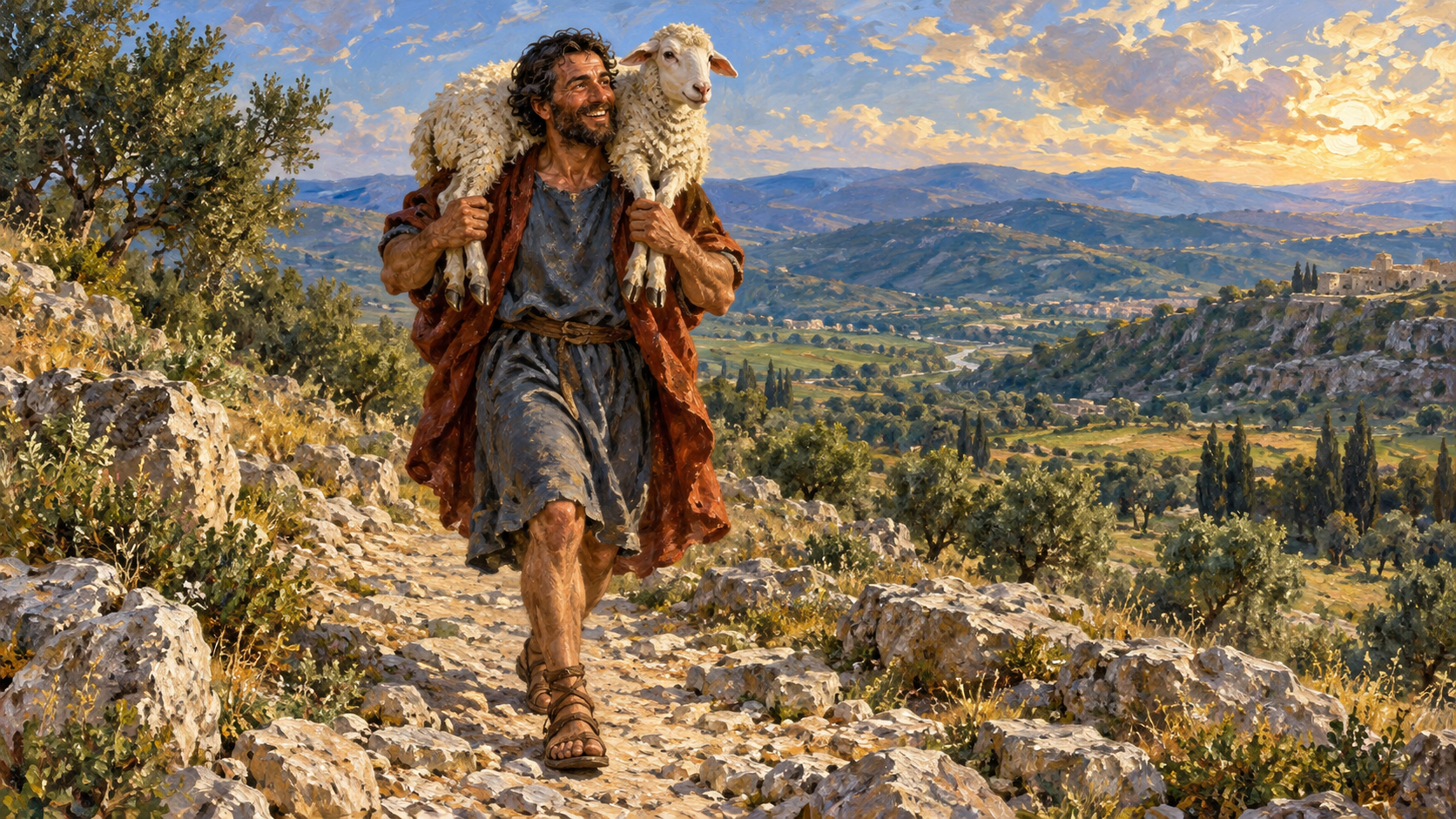
Jesus told the parable of the lost sheep to people who needed to reconsider how they treated someone else. In Luke, religious leaders resented His welcome of sinners. In Matthew, the disciples needed to stop competing for greatness and learn the Father’s care for little ones. I want to hear what Jesus says in both settings, because it is possible to admire the shepherd’s search while still neglecting the people He tells us to seek.
Why Jesus Told the Parable in Luke 15
Then all the tax collectors and the sinners drew near to Him to hear Him. And the Pharisees and scribes complained, saying, “This Man receives sinners and eats with them.” So He spoke this parable to them, saying: “What man of you, having a hundred sheep, if he loses one of them, does not leave the ninety-nine in the wilderness, and go after the one which is lost until he finds it? And when he has found it, he lays it on his shoulders, rejoicing. And when he comes home, he calls together his friends and neighbors, saying to them, ‘Rejoice with me, for I have found my sheep which was lost!’ I say to you that likewise there will be more joy in heaven over one sinner who repents than over ninety-nine just persons who need no repentance. “Or what woman, having ten silver coins, if she loses one coin, does not light a lamp, sweep the house, and search carefully until she finds it? And when she has found it, she calls her friends and neighbors together, saying, ‘Rejoice with me, for I have found the piece which I lost!’ Likewise, I say to you, there is joy in the presence of the angels of God over one sinner who repents.”
Tax collectors and people publicly known as sinners were coming to hear Jesus. Tax collectors gathered revenue within the Roman world and were widely despised, especially where their work involved extortion. The Pharisees were an influential religious movement concerned with strict observance, and the scribes were trained interpreters and teachers of the Law. These men complained that Jesus received sinners and ate with them.
Eating together expressed welcome and fellowship. The complaint was therefore directed at more than His willingness to speak within earshot of disreputable people. He received them personally. But Luke also tells us why they were drawing near: they came to hear Him. Jesus had not begun telling people that sin was harmless, and His own explanation of the parable would repeatedly identify repentance as the reason for heaven’s joy.
He answered with three connected parables: a lost sheep, a lost coin, and a father with two sons. The younger son’s open rebellion brought him to ruin before he returned, while the older son’s anger kept him outside the celebration of his brother’s recovery. In each illustration, the recovery of what was lost brought joy. The grumbling leaders needed to consider why they were so reluctant to share it. The study on the Prodigal Son follows the final parable in that sequence.
The shepherd had a hundred sheep, but one was missing. The Greek verb translated “lost” comes from apollymi, which can describe loss, ruin, or destruction depending on its setting. Here the sheep was alive and needed to be found. Its separation from the flock placed it in danger, and Jesus used that condition to describe a sinner who needed to repent.
The shepherd did not decide that ninety-nine were enough and the missing animal could be written off. He went after it because it was his sheep, and he continued until he found it. Being lost had not made it worthless.
Luke says the shepherd left the ninety-nine in the wilderness, or open country. Jesus does not say they were in a secure pen or guarded by a second shepherd. Such arrangements are possible, but the parable does not tell us which, if any, were made. It is not a complete set of instructions for managing a flock, and it does not authorize a church leader to abandon everyone else whenever one person needs help. The search illustrates the deliberate care given to recovering one who is lost.
When the shepherd found the sheep, he laid it on his shoulders and carried it home rejoicing. He draws our attention to the shepherd doing the work of recovery and delighting in having found his sheep. Once home, he called his friends and neighbors to rejoice with him.
The woman who found her lost coin made the same invitation. Jesus then explained the celebration twice: heaven rejoices over one sinner who repents. The leaders who objected to His welcome were out of step with that joy. Mercy had not become too generous because it reached someone they disliked.
Jesus compares heaven’s joy with that over ninety-nine just persons who need no repentance. He cannot mean ninety-nine sinless human beings, because all have sinned. Some understand these as people already walking faithfully, with no need for the particular return pictured by the lost sheep. That reading does not diminish the value of those who remain with the flock.
I also hear irony directed at the Pharisees and scribes, who considered themselves righteous while refusing mercy to others. In Luke 5, Jesus said He came to call sinners to repentance rather than the righteous. A person satisfied with his own respectability may see no need to return, yet the complaint itself can expose sin he refuses to acknowledge. These leaders needed repentance as surely as the people they despised.
The sheep in the illustration neither makes a confession nor walks home under its own strength. Jesus nevertheless says the recovery represents a sinner who repents. We must use His explanation rather than make an animal’s behavior settle every question about a human response to God.
Repentance means turning from rebellion to God, agreeing with Him about sin and trusting Jesus Christ. It involves more than regretting embarrassment or fearing consequences. Tears may accompany it, but tears alone do not establish it, and moral repair does not purchase forgiveness. The study on repentance explains that response more fully.
The Shepherd’s initiative and the sinner’s response both belong in Jesus’ explanation. Calvinists who teach irresistible grace generally mean that God renews the person’s will so that he comes willingly, as Westminster Confession 10 states. I disagree that God’s saving call guarantees the response of a selected group while withholding that effective grace from everyone else. His offer is genuine for every person and can be resisted. The sheep’s being carried cannot by itself prove otherwise, nor does a sinner’s repentance earn the Shepherd’s care.
I need to examine my own resentment when someone whose wrongdoing is publicly known begins to turn to Christ. A church should exercise discernment, and rebuilding trust after serious wrongdoing can take time. But I should not be disappointed that God has shown mercy or make a repentant person keep paying socially for sins Christ forgives. Welcoming someone into Christian fellowship does not require immediately placing that person in leadership or ignoring necessary safeguards.
The Warning in Matthew 18
Matthew places the illustration in teaching addressed to disciples who asked about greatness. Jesus brought a little child among them before warning against contempt and the harm they could cause to others.
At that time the disciples came to Jesus, saying, “Who then is greatest in the kingdom of heaven?” Then Jesus called a little child to Him, set him in the midst of them, and said, “Assuredly, I say to you, unless you are converted and become as little children, you will by no means enter the kingdom of heaven. Therefore whoever humbles himself as this little child is the greatest in the kingdom of heaven. Whoever receives one little child like this in My name receives Me. “But whoever causes one of these little ones who believe in Me to sin, it would be better for him if a millstone were hung around his neck, and he were drowned in the depth of the sea. Woe to the world because of offenses! For offenses must come, but woe to that man by whom the offense comes! “If your hand or foot causes you to sin, cut it off and cast it from you. It is better for you to enter into life lame or maimed, rather than having two hands or two feet, to be cast into the everlasting fire. And if your eye causes you to sin, pluck it out and cast it from you. It is better for you to enter into life with one eye, rather than having two eyes, to be cast into hell fire. “Take heed that you do not despise one of these little ones, for I say to you that in heaven their angels always see the face of My Father who is in heaven. For the Son of Man has come to save that which was lost. “What do you think? If a man has a hundred sheep, and one of them goes astray, does he not leave the ninety-nine and go to the mountains to seek the one that is straying? And if he should find it, assuredly, I say to you, he rejoices more over that sheep than over the ninety-nine that did not go astray. Even so it is not the will of your Father who is in heaven that one of these little ones should perish.
The disciples were asking who was greatest in the kingdom of heaven. Jesus told them that unless they turned and became as little children, they would not enter it. They needed humility instead of a claim to superior rank. Receiving such a child in His name was a way of receiving Him.
As the teaching develops, Jesus speaks of “these little ones who believe in Me.” His concern includes vulnerable believers who can be despised, mistreated, or led into sin. The child standing among the disciples gives His warning a concrete setting: they could not pursue greatness while treating those of low standing as expendable.
The warning about a millstone and drowning makes the danger of causing another to stumble unmistakable. Jesus also speaks of cutting off a hand or foot and removing an eye when it causes sin. This severe language calls for a decisive break with sin, not self-mutilation as a cure for an evil heart. I cannot keep protecting what leads me into wrongdoing while telling myself that its harm to others is insignificant.
Jesus tells the disciples not to despise even one of them, and says their angels always see His Father’s face in heaven. Some understand this as an individual guardian angel assigned to each person. Others understand the angels collectively as serving these little ones before God. Jesus does not describe those assignments in detail. He does make clear that people treated as unimportant on earth are not disregarded in heaven.
A church can favor the wealthy, the talented, or those who make its work look successful, while neglecting someone whose needs are less convenient. Poverty, disability, youth, or immaturity must not make a believer beneath our notice. If I am impatient with someone who needs repeated instruction or practical help, Jesus’ command reaches beyond courteous words to the value I place on that person.
Matthew’s shepherd goes to the mountains to seek the sheep that has strayed. The verb associated with planomai describes wandering or being led astray. Luke says the search continues “until he finds it,” whereas Matthew says, “if he should find it.” Luke emphasizes the successful recovery that pictures a sinner’s repentance; Matthew teaches the disciples to pursue the wanderer without promising them control over the outcome.
When the shepherd finds that one, he rejoices over its recovery. Jesus concludes that the Father does not will that one of these little ones should perish. His concern reaches the individual, so the disciples cannot excuse neglect on the ground that most of the group seems to be doing well.
The Father’s genuine desire for people’s good does not establish that everyone will ultimately be saved or that His grace cannot be resisted. Scripture also describes people rejecting Christ and perishing. Neither does this warning overturn Christ’s promise to keep everyone genuinely born again. Wandering can still bring serious harm, invite discipline, and injure others. Eternal security gives us no reason to shrug at a believer’s danger.
We should therefore seek restoration with prayer, truthful conversation, gentle correction, and practical help. Removing a temptation or an obstacle may be part of that care. Defending an abusive leader, pressuring someone into an unsafe meeting, or treating recovery as entirely someone else’s job would disregard the person the Father tells us to value.
The received text quoted here includes Matthew 18:11: “For the Son of Man has come to save that which was lost.” Some translations omit the verse from their main text because of differences among the Greek manuscripts; the NET textual note explains that decision. The same purpose is plainly stated in Luke 19:10. The Father’s care for little ones is also explicit in the surrounding commands and the parable’s conclusion.
Luke and Matthew thus develop closely related teaching in different situations. Luke confronts resentment when sinners repent; Matthew calls disciples to humility, protection, and recovery of vulnerable people. Jesus may have used the illustration on different occasions, or the two Gospels may preserve forms of His teaching suited to their settings. Either way, inspiration does not require us to erase the differences in audience and emphasis.
The Shepherd God Promised
Jesus’ hearers already had Scripture describing God as a shepherd and condemning leaders who failed to care for His people. Through Ezekiel, the LORD charged Israel’s shepherds with enriching themselves at the flock’s expense.
And the word of the LORD came to me, saying, “Son of man, prophesy against the shepherds of Israel, prophesy and say to them, ‘Thus says the Lord GOD to the shepherds: “Woe to the shepherds of Israel who feed themselves! Should not the shepherds feed the flocks? You eat the fat and clothe yourselves with the wool; you slaughter the fatlings, but you do not feed the flock. The weak you have not strengthened, nor have you healed those who were sick, nor bound up the broken, nor brought back what was driven away, nor sought what was lost; but with force and cruelty you have ruled them. So they were scattered because there was no shepherd; and they became food for all the beasts of the field when they were scattered. My sheep wandered through all the mountains, and on every high hill; yes, My flock was scattered over the whole face of the earth, and no one was seeking or searching for them.” ‘Therefore, you shepherds, hear the word of the LORD: “As I live,” says the Lord GOD, “surely because My flock became a prey, and My flock became food for every beast of the field, because there was no shepherd, nor did My shepherds search for My flock, but the shepherds fed themselves and did not feed My flock”– therefore, O shepherds, hear the word of the LORD! Thus says the Lord GOD: “Behold, I am against the shepherds, and I will require My flock at their hand; I will cause them to cease feeding the sheep, and the shepherds shall feed themselves no more; for I will deliver My flock from their mouths, that they may no longer be food for them.” ‘For thus says the Lord GOD: “Indeed I Myself will search for My sheep and seek them out. As a shepherd seeks out his flock on the day he is among his scattered sheep, so will I seek out My sheep and deliver them from all the places where they were scattered on a cloudy and dark day. And I will bring them out from the peoples and gather them from the countries, and will bring them to their own land; I will feed them on the mountains of Israel, in the valleys and in all the inhabited places of the country. I will feed them in good pasture, and their fold shall be on the high mountains of Israel. There they shall lie down in a good fold and feed in rich pasture on the mountains of Israel. I will feed My flock, and I will make them lie down,” says the Lord GOD. “I will seek what was lost and bring back what was driven away, bind up the broken and strengthen what was sick; but I will destroy the fat and the strong, and feed them in judgment.”
These leaders took the fat and wool while leaving the weak without strength, the sick without care, and the broken without help. They failed to bring back those driven away or search for those lost. Their force and cruelty scattered the people, exposing them to further harm. God held the shepherds accountable for that neglect and declared that He would rescue His flock from them.
He then promised to search for His sheep Himself, gather them from the countries, and bring them into their own land. He would feed them on Israel’s mountains, give them rest, and strengthen the sick. His care included judgment against the fat and strong who harmed the flock. The promise was not permission for the powerful to keep exploiting the vulnerable under a comforting religious image.
Later in Ezekiel 34, God promises one shepherd over them, “My servant David.” I understand this as the Davidic Messiah. Jesus’ claim to be the Good Shepherd and His work of seeking the lost fulfill divine and Messianic work. He is doing what God promised, rather than merely comparing Himself to a kind livestock owner. God’s announced gathering of Israel also retains its national and land promises; Christian applications do not cancel those terms.
David’s description of the LORD’s care in Psalm 23 shows what it means personally to belong to that Shepherd.
The LORD is my shepherd; I shall not want. He makes me to lie down in green pastures; He leads me beside the still waters. He restores my soul; He leads me in the paths of righteousness For His name’s sake. Yea, though I walk through the valley of the shadow of death, I will fear no evil; For You are with me; Your rod and Your staff, they comfort me. You prepare a table before me in the presence of my enemies; You anoint my head with oil; My cup runs over. Surely goodness and mercy shall follow me All the days of my life; And I will dwell in the house of the LORD Forever.
The LORD provides pasture and water, restores the psalmist’s soul, and leads him in righteous paths for His name’s sake. His provision is joined to guidance. I would not call it faithful shepherding to comfort someone while refusing to warn him about a path that is taking him into danger.
The valley of death’s shadow does not mean the Shepherd has left. His presence, rod, and staff give comfort through it. The psalm also pictures His generous hospitality: a prepared table, anointing with oil, and an overflowing cup, even with enemies present. Goodness and mercy follow the psalmist as he looks ahead to dwelling in the LORD’s house. This is ongoing care through life’s threats, not simply an isolated rescue.
Isaiah likewise joins the Lord’s power to His gentle treatment of the flock.
O Zion, You who bring good tidings, Get up into the high mountain; O Jerusalem, You who bring good tidings, Lift up your voice with strength, Lift it up, be not afraid; Say to the cities of Judah, “Behold your God!” Behold, the Lord GOD shall come with a strong hand, And His arm shall rule for Him; Behold, His reward is with Him, And His work before Him. He will feed His flock like a shepherd; He will gather the lambs with His arm, And carry them in His bosom, And gently lead those who are with young.
The Lord GOD comes with a strong hand and an arm that rules, yet He uses that arm to gather lambs and carry them close. He gently leads those with young. His strength serves those who need protection. That rebukes any leader who mistakes harshness for proof of spiritual authority.
Isaiah later describes why all of us need more than kindly guidance. We have wandered in sin, and the Servant bears what is necessary for our peace.
Surely He has borne our griefs And carried our sorrows; Yet we esteemed Him stricken, Smitten by God, and afflicted. But He was wounded for our transgressions, He was bruised for our iniquities; The chastisement for our peace was upon Him, And by His stripes we are healed. All we like sheep have gone astray; We have turned, every one, to his own way; And the LORD has laid on Him the iniquity of us all.
Each sheep has turned to its own way. Outwardly, one person’s rebellion may look scandalous and another’s respectable, but neither is obedience to God. Religious self-direction cannot become righteous merely because it attracts less public criticism.
The Servant bears griefs, sorrows, and iniquity. Isaiah says that people regarded Him as stricken by God; that judgment of Him must not be confused with the passage’s explanation of His innocent suffering for us. The LORD appointed Him to bear our sins. Wicked people inflicted the bodily wounds and punishment that Jesus willingly endured, and their violence did not make the Father the torturer or punisher of His Son.
The “all” who went astray are the people whose iniquity He bears. His giving Himself provides salvation for the whole world, genuinely offered to every person. Everyone needs that mercy, including the religious observer who resents its being extended to someone else.
Jesus Seeks, Saves, and Keeps His Sheep
Luke later records Jesus seeking a chief tax collector in Jericho. The crowd’s complaint resembles the objection that prompted the lost-sheep parable.
Then Jesus entered and passed through Jericho. Now behold, there was a man named Zacchaeus who was a chief tax collector, and he was rich. And he sought to see who Jesus was, but could not because of the crowd, for he was of short stature. So he ran ahead and climbed up into a sycamore tree to see Him, for He was going to pass that way. And when Jesus came to the place, He looked up and saw him, and said to him, “Zacchaeus, make haste and come down, for today I must stay at your house.” So he made haste and came down, and received Him joyfully. But when they saw it, they all complained, saying, “He has gone to be a guest with a man who is a sinner.” Then Zacchaeus stood and said to the Lord, “Look, Lord, I give half of my goods to the poor; and if I have taken anything from anyone by false accusation, I restore fourfold.” And Jesus said to him, “Today salvation has come to this house, because he also is a son of Abraham; for the Son of Man has come to seek and to save that which was lost.”
Zacchaeus was rich, but his position did not make him welcome among those around him. Unable to see over the crowd, he climbed a sycamore tree. Jesus saw him, called him down by name, and said He must stay at his house that day. Zacchaeus received Him joyfully while the onlookers complained that Jesus had gone to be a sinner’s guest.
Zacchaeus then declared that he would give half his possessions to the poor and repay fourfold anything taken by false accusation. His response addressed the way a tax collector could abuse people, rather than offering a vague claim that he wanted to improve. Generosity and restitution gave concrete evidence of repentance; they did not buy salvation.
Jesus announced that salvation had come to the house and called Zacchaeus a son of Abraham. His ancestry had not made his sins harmless. Now he was receiving the Savior whose purpose was to seek and save the lost. Jesus did not wait for the crowd’s approval before showing mercy, and Zacchaeus’ response gave them reason to rejoice instead of complain.
John 10 explains more fully who this Shepherd is and what He gives to those who enter through Him.
“Most assuredly, I say to you, he who does not enter the sheepfold by the door, but climbs up some other way, the same is a thief and a robber. But he who enters by the door is the shepherd of the sheep. To him the doorkeeper opens, and the sheep hear his voice; and he calls his own sheep by name and leads them out. And when he brings out his own sheep, he goes before them; and the sheep follow him, for they know his voice. Yet they will by no means follow a stranger, but will flee from him, for they do not know the voice of strangers.” Jesus used this illustration, but they did not understand the things which He spoke to them. Then Jesus said to them again, “Most assuredly, I say to you, I am the door of the sheep. All who ever came before Me are thieves and robbers, but the sheep did not hear them. I am the door. If anyone enters by Me, he will be saved, and will go in and out and find pasture. The thief does not come except to steal, and to kill, and to destroy. I have come that they may have life, and that they may have it more abundantly. “I am the good shepherd. The good shepherd gives His life for the sheep. But a hireling, he who is not the shepherd, one who does not own the sheep, sees the wolf coming and leaves the sheep and flees; and the wolf catches the sheep and scatters them. The hireling flees because he is a hireling and does not care about the sheep. I am the good shepherd; and I know My sheep, and am known by My own. As the Father knows Me, even so I know the Father; and I lay down My life for the sheep. And other sheep I have which are not of this fold; them also I must bring, and they will hear My voice; and there will be one flock and one shepherd. “Therefore My Father loves Me, because I lay down My life that I may take it again. No one takes it from Me, but I lay it down of Myself. I have power to lay it down, and I have power to take it again. This command I have received from My Father.”
Jesus calls Himself both the door of the sheep and the Good Shepherd. Those who enter through Him receive salvation and life. He knows His sheep personally, calls them by name, and leads them. His reference to thieves and robbers exposes false claimants who exploit the flock; it does not condemn the prophets and other faithful servants God sent before Him.
The hireling runs when the wolf comes because he does not care for the sheep. Jesus gives His life for them. The illustration of a shepherd facing danger leads to His express declaration that He lays down His life and has authority to take it again. He is speaking of His actual death and bodily resurrection, not merely the influence of a devoted teacher.
Wicked men killed Jesus and remained guilty for what they did, but they could not make His death an unwilling defeat outside God’s foreknown purpose. He gave Himself freely. The risen Shepherd continues to lead His people, and His written word governs how we understand His voice. A private impression has no authority to contradict what He has revealed in Scripture.
He also promises to bring sheep who are not of the present fold, gathering one flock under one Shepherd. I understand this to include Gentiles brought into saving fellowship with believing Jews through the gospel. Their unity in Christ does not turn Gentiles into ethnic Israelites or transfer Israel’s land promises to the church. The study on Jesus as the Good Shepherd considers His care and identity more fully.
His laying down His life for the sheep does not say that He died only for them. Other passages identify His provision with the whole world. I therefore cannot restrict His death to a predetermined elect group, even while affirming the particular relationship He describes with His sheep. All are genuinely offered salvation; those who receive Him have life in Him.
Later in John 10, opponents demanded that He say plainly whether He was the Christ. His answer points to the testimony He had already given and the security of those who belong to Him.
Then the Jews surrounded Him and said to Him, “How long do You keep us in doubt? If You are the Christ, tell us plainly.” Jesus answered them, “I told you, and you do not believe. The works that I do in My Father’s name, they bear witness of Me. But you do not believe, because you are not of My sheep, as I said to you. My sheep hear My voice, and I know them, and they follow Me. And I give them eternal life, and they shall never perish; neither shall anyone snatch them out of My hand. My Father, who has given them to Me, is greater than all; and no one is able to snatch them out of My Father’s hand. I and My Father are one.”
Jesus had spoken and performed works in His Father’s name, yet these opponents did not believe. He identified them as outside His flock, while His sheep hear His voice, are known by Him, and follow Him. A religious position or demand for further proof could not substitute for receiving the testimony already before them.
He gives His sheep eternal life and says they will never perish. No one can snatch them out of His hand or His Father’s hand. Their security rests in the power and faithfulness of the Father and Son, not in their ability to maintain a flawless record of obedience.
That promise belongs to people genuinely born again, rather than everyone who adopts a Christian label. The Holy Spirit indwells and seals every genuine believer, who will never become eternally lost again. New life produces a changed direction, so we should look for evidence in conduct without demanding sinless perfection. Following Christ is the fruit of salvation, not the price of obtaining or keeping it.
How the Church Should Care for Wanderers
Being secure in Christ does not make a believer’s wandering harmless. James closes his letter by calling the church to help someone who departs from the truth.
Brethren, if anyone among you wanders from the truth, and someone turns him back, let him know that he who turns a sinner from the error of his way will save a soul from death and cover a multitude of sins.
James describes someone among the church who wanders and another person who turns him back. Departure can involve false teaching, sinful conduct, or both. The people around the wanderer must care enough to speak rather than assume that correction is always unloving or that the person has ceased to be their concern.
Readers differ over the reference to saving a soul from death. Some understand physical death under God’s discipline, a real possibility for a sinning believer as 1 Corinthians 11:30 shows. Others understand rescue from final death for someone associated with the church whose profession had not been genuine. Steven Cole explains both readings, favoring the latter. Neither requires us to say a genuinely born-again person loses eternal life. In either case, the danger of sin is serious and turning the sinner back is an act of mercy.
Covering a multitude of sins concerns the forgiveness connected with that return, not concealing wrongdoing so that an offender can avoid accountability. The person helping does not become a second savior or earn forgiveness for himself by recovering someone else. God uses truthful correction to bring the wanderer back to what is right.
Qualified male elders have a particular responsibility to shepherd the church, but the rest of us should not wait for an official assignment before offering a needed warning or encouragement. We can pray, teach patiently, ask honest questions, provide practical help, and welcome genuine repentance. Someone beginning to stray may need a direct conversation rather than a public accusation or silence disguised as kindness.
We must also listen carefully enough to understand what has happened. A person who leaves a congregation because of abuse is not necessarily wandering from Christ. Seeking restoration never authorizes threats, repeated unwanted contact, or demands that a harmed person return to an unsafe setting. Human shepherds serve under Christ. They can teach and plead, but they cannot control another person’s heart or ignore lawful boundaries.
The ninety-nine still need care, and seeking one wanderer does not justify exposing others to danger. A church can rejoice over repentance while retaining safeguards, reporting crime, and declining to restore an offender to a former position. Joy over forgiveness must not be used to silence those who were harmed. Jesus’ concern for little ones requires their protection throughout any attempt at recovery.
Peter brings our attention back to the Shepherd whose suffering both saves us and teaches us how to respond when we are wronged.
For to this you were called, because Christ also suffered for us, leaving us an example, that you should follow His steps: “Who committed no sin, Nor was deceit found in His mouth”; who, when He was reviled, did not revile in return; when He suffered, He did not threaten, but committed Himself to Him who judges righteously; who Himself bore our sins in His own body on the tree, that we, having died to sins, might live for righteousness–by whose stripes you were healed. For you were like sheep going astray, but have now returned to the Shepherd and Overseer of your souls.
Christ committed no sin and spoke no deceit. When reviled, He did not revile in return; when suffering, He entrusted Himself to the One who judges rightly. He bore our sins in His body so that we might live for righteousness. Peter describes people who had strayed like sheep and returned to the Shepherd and Overseer of their souls. An overseer exercises watchful care and authority; Christ has not merely noticed their need from a distance.
Jesus is the eternal Son, fully God and fully man, born of a virgin and completely sinless. Wicked men physically tortured, punished, and killed Him. He willingly bore that bodily punishment for our sins, shed His innocent blood, and died. His saving work through His blood and death was complete before His burial and bodily resurrection. The Father did not punish, curse, abandon, strike, bruise, or pour wrath on Jesus.
Christ died for the whole world, and His invitation is genuine for every person, even though His grace can be resisted. In his second letter, Peter explains God’s patience while answering scoffers who question the promise of Christ’s coming.
But, beloved, do not forget this one thing, that with the Lord one day is as a thousand years, and a thousand years as one day. The Lord is not slack concerning His promise, as some count slackness, but is longsuffering toward us, not willing that any should perish but that all should come to repentance.
The Lord has not forgotten His promise or become unable to act. He is patient, desiring repentance rather than people’s destruction. His patience does not mean judgment has been canceled, and it gives us no reason to postpone responding to Him.
Everyone who turns to Jesus in repentance and faith receives forgiveness and justification, God’s declaration that the believer is righteous before Him. God gives new birth, and the Holy Spirit dwells within and seals that person. This salvation is eternally secure without giving permission for lawlessness. We should receive the Shepherd’s mercy and share His concern for others, rather than defend our own rebellion or resent someone else’s welcome.
My Final Thoughts
I need to listen to Jesus as someone who needs His mercy, not stand with the grumbling observers who decide who deserves to receive it. Luke calls me to rejoice when a sinner repents, and Matthew requires me to value and protect a vulnerable believer. The Shepherd gave His life and keeps those who are genuinely His. Our care for wanderers should therefore be truthful, patient, and willing to do the work of restoration, while respecting the people and boundaries that work is meant to protect.