
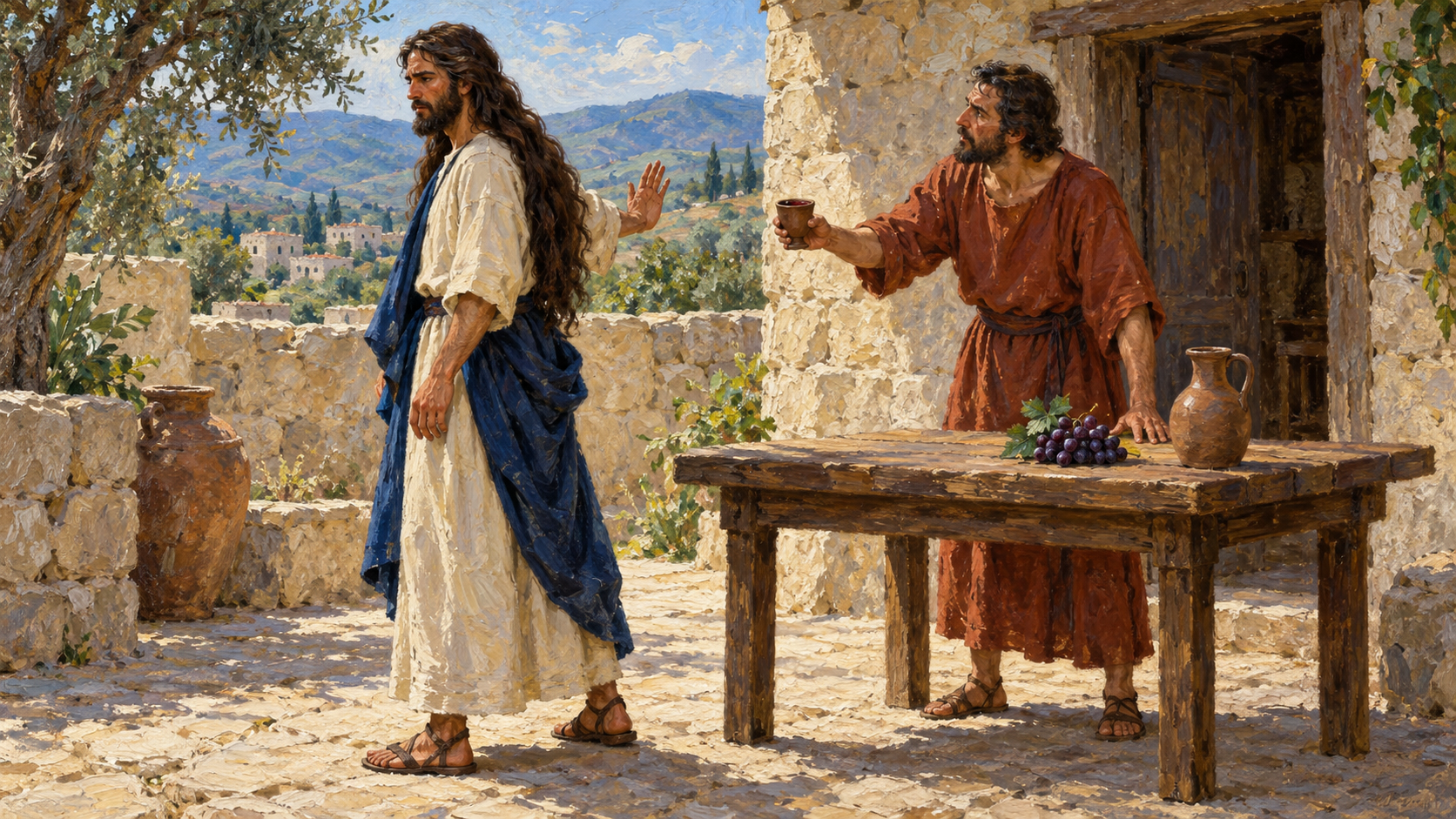
The Nazirite vow was a particular way for an Israelite to be set apart to the Lord. It involved more than growing long hair or deciding to avoid alcohol. Numbers 6 regulated what the person consumed, the hair on the head, contact with death, and the offerings required when the period of separation ended.
I want to understand that whole arrangement before applying it to Christians. God gave Israel a defined act of consecration, meaning dedication to His service. We can learn from it without assuming that Christian devotion requires us to reproduce a vow that belonged to Israel’s covenant worship.
What Numbers 6 Required
Then the LORD spoke to Moses, saying, "Speak to the children of Israel, and say to them: 'When either a man or woman consecrates an offering to take the vow of a Nazirite, to separate himself to the LORD, he shall separate himself from wine and similar drink; he shall drink neither vinegar made from wine nor vinegar made from similar drink; neither shall he drink any grape juice, nor eat fresh grapes or raisins. All the days of his separation he shall eat nothing that is produced by the grapevine, from seed to skin. 'All the days of the vow of his separation no razor shall come upon his head; until the days are fulfilled for which he separated himself to the LORD, he shall be holy. Then he shall let the locks of the hair of his head grow. All the days that he separates himself to the LORD he shall not go near a dead body. He shall not make himself unclean even for his father or his mother, for his brother or his sister, when they die, because his separation to God is on his head. All the days of his separation he shall be holy to the LORD. 'And if anyone dies very suddenly beside him, and he defiles his consecrated head, then he shall shave his head on the day of his cleansing; on the seventh day he shall shave it. Then on the eighth day he shall bring two turtledoves or two young pigeons to the priest, to the door of the tabernacle of meeting; and the priest shall offer one as a sin offering and the other as a burnt offering, and make atonement for him, because he sinned in regard to the corpse; and he shall sanctify his head that same day. He shall consecrate to the LORD the days of his separation, and bring a male lamb in its first year as a trespass offering; but the former days shall be lost, because his separation was defiled. 'Now this is the law of the Nazirite: When the days of his separation are fulfilled, he shall be brought to the door of the tabernacle of meeting. And he shall present his offering to the LORD: one male lamb in its first year without blemish as a burnt offering, one ewe lamb in its first year without blemish as a sin offering, one ram without blemish as a peace offering, a basket of unleavened bread, cakes of fine flour mixed with oil, unleavened wafers anointed with oil, and their grain offering with their drink offerings. 'Then the priest shall bring them before the LORD and offer his sin offering and his burnt offering; and he shall offer the ram as a sacrifice of a peace offering to the LORD, with the basket of unleavened bread; the priest shall also offer its grain offering and its drink offering. Then the Nazirite shall shave his consecrated head at the door of the tabernacle of meeting, and shall take the hair from his consecrated head and put it on the fire which is under the sacrifice of the peace offering. 'And the priest shall take the boiled shoulder of the ram, one unleavened cake from the basket, and one unleavened wafer, and put them upon the hands of the Nazirite after he has shaved his consecrated hair, and the priest shall wave them as a wave offering before the LORD; they are holy for the priest, together with the breast of the wave offering and the thigh of the heave offering. After that the Nazirite may drink wine.' "This is the law of the Nazirite who vows to the LORD the offering for his separation, and besides that, whatever else his hand is able to provide; according to the vow which he takes, so he must do according to the law of his separation."
The Lord gave these instructions through Moses while Israel was learning to live and worship around the tabernacle. Either a man or a woman could take the vow. It did not confer the office of priest, prophet, or ruler, and it did not make someone a Levite. The person voluntarily undertook a period of special dedication, then had to observe what God prescribed throughout that time.
An ordinary vow had a period to fulfill, although Numbers 6 does not specify a universal minimum number of days. Samson’s lifelong calling, considered below, was an exceptional appointment before birth. Numbers 30 also regulated vows within a household. A father could disallow the vow of a young daughter living in his house, and a husband could disallow his wife’s vow; the response had to be made when he first heard it. A widow or divorced woman was responsible for her own vow. Those provisions did not erase the express invitation to both men and women in Numbers 6.
The first restriction covered wine and similar drink, vinegar made from them, and everything produced by the grapevine. Grape juice, fresh grapes, raisins, seeds, and skins were all included. A person could not claim to be keeping the rule merely because what he consumed was not intoxicating. God had set a wider boundary for this particular consecration.
That does not make grapes or wine inherently sinful. The chapter itself permits the Nazirite to drink wine after completing the vow.
The second restriction was that no razor should come upon the head during the vow. The growing hair made the separation visible, but its significance depended on God’s command and the commitment it represented. This was not an opportunity to display a distinctive appearance while disregarding the rest of what God required.
The Hebrew word nazir refers to a person set apart. The related word nezer describes consecration and can also refer to a crown. Here the uncut hair marked dedication to God upon the person’s head. These words help explain the sign; they do not suggest that hair itself contains supernatural power.
The third restriction concerned death. A Nazirite was not to go near a dead body, even that of a parent or sibling. Those examples show how demanding the separation could be. Ceremonial uncleanness affected participation in Israel’s sacred worship; it was not a declaration that every person who cared for a body had committed a moral evil. Death belonged to the fallen condition from which God would ultimately deliver His people, and this consecration required a particular separation from it.
Numbers also addresses a sudden death beside the Nazirite. The person might have done nothing deliberately to cause the defilement, yet the consecration had been interrupted. The prescribed cleansing included shaving on the seventh day, bringing two birds on the eighth, and the priest offering one as a sin offering and the other as a burnt offering. A male lamb was also required as a trespass offering. The earlier days no longer counted, and the period of separation had to begin again.
The sacrificial language does not mean the Nazirite caused the death or knowingly defied God. The Mosaic offerings also dealt with ceremonial defilement and restored access to holy service. An interruption did not leave the person permanently excluded; God provided a way to be cleansed and begin again. At the same time, good intentions did not allow the person to disregard the cleansing He required.
Completion was equally specific. The Nazirite came to the sanctuary with the required burnt, sin, and peace offerings, together with bread, grain offerings, and drink offerings. After the priest presented the sacrifices, the person shaved the consecrated head and placed the hair on the fire beneath the peace offering. The priest then presented the designated portions as a wave offering. Only after that could the Nazirite drink wine. Additional generosity according to one’s means did not replace these prescribed requirements.
I cannot detach the hair and dietary rules from that priesthood, sanctuary, and sacrificial procedure and claim to have reproduced Numbers 6. Nor could an Israelite use the vow to excuse dishonesty, neglect of dependents, or failure to make restitution. Special dedication remained subject to God’s other commands.
Christians may choose to abstain from alcohol for conscience, health, recovery from addiction, or concern for another person. I respect those reasons, but the choice does not make someone a Nazirite or authorize him to condemn every believer who responsibly receives what Scripture permits. The study on Christians and alcohol considers that question more fully.
The corpse restriction is not a Christian prohibition on attending funerals, caring for a dying relative, or preparing a body for burial. We should not make grieving families feel guilty by placing them under a covenant requirement God has not given to the church.
Samson, the Explicit Lifelong Nazirite
Samson’s calling began with God’s announcement to his mother, not a voluntary decision he made as an adult. Israel was under Philistine domination when the Angel of the Lord appeared.
Again the children of Israel did evil in the sight of the LORD, and the LORD delivered them into the hand of the Philistines for forty years. Now there was a certain man from Zorah, of the family of the Danites, whose name was Manoah; and his wife was barren and had no children. And the Angel of the LORD appeared to the woman and said to her, "Indeed now, you are barren and have borne no children, but you shall conceive and bear a son. Now therefore, please be careful not to drink wine or similar drink, and not to eat anything unclean. For behold, you shall conceive and bear a son. And no razor shall come upon his head, for the child shall be a Nazirite to God from the womb; and he shall begin to deliver Israel out of the hand of the Philistines." So the woman came and told her husband, saying, "A Man of God came to me, and His countenance was like the countenance of the Angel of God, very awesome; but I did not ask Him where He was from, and He did not tell me His name. And He said to me, 'Behold, you shall conceive and bear a son. Now drink no wine or similar drink, nor eat anything unclean, for the child shall be a Nazirite to God from the womb to the day of his death.'" Then Manoah prayed to the LORD, and said, "O my Lord, please let the Man of God whom You sent come to us again and teach us what we shall do for the child who will be born." And God listened to the voice of Manoah, and the Angel of God came to the woman again as she was sitting in the field; but Manoah her husband was not with her. Then the woman ran in haste and told her husband, and said to him, "Look, the Man who came to me the other day has just now appeared to me!" So Manoah arose and followed his wife. When he came to the Man, he said to Him, "Are You the Man who spoke to this woman?" And He said, "I am." Manoah said, "Now let Your words come to pass! What will be the boy's rule of life, and his work?" So the Angel of the LORD said to Manoah, "Of all that I said to the woman let her be careful. She may not eat anything that comes from the vine, nor may she drink wine or similar drink, nor eat anything unclean. All that I commanded her let her observe." Then Manoah said to the Angel of the LORD, "Please let us detain You, and we will prepare a young goat for You." And the Angel of the LORD said to Manoah, "Though you detain Me, I will not eat your food. But if you offer a burnt offering, you must offer it to the LORD." (For Manoah did not know He was the Angel of the LORD.) Then Manoah said to the Angel of the LORD, "What is Your name, that when Your words come to pass we may honor You?" And the Angel of the LORD said to him, "Why do you ask My name, seeing it is wonderful?" So Manoah took the young goat with the grain offering, and offered it upon the rock to the LORD. And He did a wondrous thing while Manoah and his wife looked on– it happened as the flame went up toward heaven from the altar–the Angel of the LORD ascended in the flame of the altar! When Manoah and his wife saw this, they fell on their faces to the ground. When the Angel of the LORD appeared no more to Manoah and his wife, then Manoah knew that He was the Angel of the LORD. And Manoah said to his wife, "We shall surely die, because we have seen God!" But his wife said to him, "If the LORD had desired to kill us, He would not have accepted a burnt offering and a grain offering from our hands, nor would He have shown us all these things, nor would He have told us such things as these at this time." So the woman bore a son and called his name Samson; and the child grew, and the LORD blessed him. And the Spirit of the LORD began to move upon him at Mahaneh Dan between Zorah and Eshtaol.
The Messenger promised a son and instructed the mother concerning wine, grape products, and unclean food. No razor was to touch the child’s head, and his consecration would last from the womb to his death. God appointed him to begin delivering Israel from the Philistines. This differs from the ordinary temporary vow described in Numbers 6.
I understand the Angel of the Lord here as a Christophany, an appearance of Christ before He became man. The Messenger’s wondrous action, His ascent in the flame, and Manoah’s response to having seen God belong to that identification. Manoah’s wife also reasoned from what they had been told and what the Lord had accepted: the promise of a child was not an announcement that He intended to kill them.
The Lord blessed Samson, and His Spirit began to move upon him. His hair marked the consecration; God supplied the strength. As the following chapters unfold, however, Samson’s choices repeatedly disregard the holiness his calling required.
Now Samson went down to Timnah, and saw a woman in Timnah of the daughters of the Philistines. So he went up and told his father and mother, saying, "I have seen a woman in Timnah of the daughters of the Philistines; now therefore, get her for me as a wife." Then his father and mother said to him, "Is there no woman among the daughters of your brethren, or among all my people, that you must go and get a wife from the uncircumcised Philistines?" And Samson said to his father, "Get her for me, for she pleases me well." But his father and mother did not know that it was of the LORD–that He was seeking an occasion to move against the Philistines. For at that time the Philistines had dominion over Israel. So Samson went down to Timnah with his father and mother, and came to the vineyards of Timnah. Now to his surprise, a young lion came roaring against him. And the Spirit of the LORD came mightily upon him, and he tore the lion apart as one would have torn apart a young goat, though he had nothing in his hand. But he did not tell his father or his mother what he had done. Then he went down and talked with the woman; and she pleased Samson well. After some time, when he returned to get her, he turned aside to see the carcass of the lion. And behold, a swarm of bees and honey were in the carcass of the lion. He took some of it in his hands and went along, eating. When he came to his father and mother, he gave some to them, and they also ate. But he did not tell them that he had taken the honey out of the carcass of the lion. So his father went down to the woman. And Samson gave a feast there, for young men used to do so. And it happened, when they saw him, that they brought thirty companions to be with him. Then Samson said to them, "Let me pose a riddle to you. If you can correctly solve and explain it to me within the seven days of the feast, then I will give you thirty linen garments and thirty changes of clothing. But if you cannot explain it to me, then you shall give me thirty linen garments and thirty changes of clothing." And they said to him, "Pose your riddle, that we may hear it." So he said to them: "Out of the eater came something to eat, And out of the strong came something sweet." Now for three days they could not explain the riddle. But it came to pass on the seventh day that they said to Samson's wife, "Entice your husband, that he may explain the riddle to us, or else we will burn you and your father's house with fire. Have you invited us in order to take what is ours? Is that not so?" Then Samson's wife wept on him, and said, "You only hate me! You do not love me! You have posed a riddle to the sons of my people, but you have not explained it to me." And he said to her, "Look, I have not explained it to my father or my mother; so should I explain it to you?" Now she had wept on him the seven days while their feast lasted. And it happened on the seventh day that he told her, because she pressed him so much. Then she explained the riddle to the sons of her people. So the men of the city said to him on the seventh day before the sun went down: "What is sweeter than honey? And what is stronger than a lion?" And he said to them: "If you had not plowed with my heifer, You would not have solved my riddle!" Then the Spirit of the LORD came upon him mightily, and he went down to Ashkelon and killed thirty of their men, took their apparel, and gave the changes of clothing to those who had explained the riddle. So his anger was aroused, and he went back up to his father's house. And Samson's wife was given to his companion, who had been his best man.
Samson demanded the Philistine woman because she pleased him, despite his parents’ objection. Judges says that the Lord was seeking an occasion against the Philistines through these events. God’s purpose did not make every impulse Samson followed wise or righteous. The Spirit empowered him to kill the lion, but Samson later returned to its carcass, took honey from it, and shared the honey without telling his parents where it came from.
The wedding companions threatened his wife and her family to obtain the riddle’s answer. After she disclosed it, the Spirit came upon Samson, and he killed thirty men at Ashkelon and paid the wager with their clothes. He returned angrily to his father’s house, and his wife was then given to his companion.
His earlier contact with the lion’s carcass also needs careful explanation. Numbers 6 names dead family members, and interpreters differ about whether its special corpse restriction extends to animals. The NET translation notes take the broader view, whereas the UBS translation handbook emphasizes dead humans in this context. Leviticus 11:27–28 nevertheless treats the carcass of such an animal as unclean. I read Samson’s taking food from it as disregard for the cleanness his consecration called for, without claiming that Judges records a formal restarting of his vow.
Judges 16 first records Samson visiting a prostitute in Gaza. Later he loved Delilah, whom the Philistine rulers offered money to discover how they could overpower him. She repeatedly tested the answers he gave, yet he remained with her and finally disclosed the consecration marked by his uncut hair. She then arranged for a man to shave him while he slept.
Now Samson went to Gaza and saw a harlot there, and went in to her. When the Gazites were told, "Samson has come here!" they surrounded the place and lay in wait for him all night at the gate of the city. They were quiet all night, saying, "In the morning, when it is daylight, we will kill him." And Samson lay low till midnight; then he arose at midnight, took hold of the doors of the gate of the city and the two gateposts, pulled them up, bar and all, put them on his shoulders, and carried them to the top of the hill that faces Hebron. Afterward it happened that he loved a woman in the Valley of Sorek, whose name was Delilah. And the lords of the Philistines came up to her and said to her, "Entice him, and find out where his great strength lies, and by what means we may overpower him, that we may bind him to afflict him; and every one of us will give you eleven hundred pieces of silver." So Delilah said to Samson, "Please tell me where your great strength lies, and with what you may be bound to afflict you." And Samson said to her, "If they bind me with seven fresh bowstrings, not yet dried, then I shall become weak, and be like any other man." So the lords of the Philistines brought up to her seven fresh bowstrings, not yet dried, and she bound him with them. Now men were lying in wait, staying with her in the room. And she said to him, "The Philistines are upon you, Samson!" But he broke the bowstrings as a strand of yarn breaks when it touches fire. So the secret of his strength was not known. Then Delilah said to Samson, "Look, you have mocked me and told me lies. Now, please tell me what you may be bound with." So he said to her, "If they bind me securely with new ropes that have never been used, then I shall become weak, and be like any other man." Therefore Delilah took new ropes and bound him with them, and said to him, "The Philistines are upon you, Samson!" And men were lying in wait, staying in the room. But he broke them off his arms like a thread. Delilah said to Samson, "Until now you have mocked me and told me lies. Tell me what you may be bound with." And he said to her, "If you weave the seven locks of my head into the web of the loom"– So she wove it tightly with the batten of the loom, and said to him, "The Philistines are upon you, Samson!" But he awoke from his sleep, and pulled out the batten and the web from the loom. Then she said to him, "How can you say, 'I love you,' when your heart is not with me? You have mocked me these three times, and have not told me where your great strength lies." And it came to pass, when she pestered him daily with her words and pressed him, so that his soul was vexed to death, that he told her all his heart, and said to her, "No razor has ever come upon my head, for I have been a Nazirite to God from my mother's womb. If I am shaven, then my strength will leave me, and I shall become weak, and be like any other man." When Delilah saw that he had told her all his heart, she sent and called for the lords of the Philistines, saying, "Come up once more, for he has told me all his heart." So the lords of the Philistines came up to her and brought the money in their hand. Then she lulled him to sleep on her knees, and called for a man and had him shave off the seven locks of his head. Then she began to torment him, and his strength left him. And she said, "The Philistines are upon you, Samson!" So he awoke from his sleep, and said, "I will go out as before, at other times, and shake myself free!" But he did not know that the LORD had departed from him. Then the Philistines took him and put out his eyes, and brought him down to Gaza. They bound him with bronze fetters, and he became a grinder in the prison. However, the hair of his head began to grow again after it had been shaven. Now the lords of the Philistines gathered together to offer a great sacrifice to Dagon their god, and to rejoice. And they said: "Our god has delivered into our hands Samson our enemy!" When the people saw him, they praised their god; for they said: "Our god has delivered into our hands our enemy, The destroyer of our land, And the one who multiplied our dead." So it happened, when their hearts were merry, that they said, "Call for Samson, that he may perform for us." So they called for Samson from the prison, and he performed for them. And they stationed him between the pillars. Then Samson said to the lad who held him by the hand, "Let me feel the pillars which support the temple, so that I can lean on them." Now the temple was full of men and women. All the lords of the Philistines were there–about three thousand men and women on the roof watching while Samson performed. Then Samson called to the LORD, saying, "O Lord GOD, remember me, I pray! Strengthen me, I pray, just this once, O God, that I may with one blow take vengeance on the Philistines for my two eyes!" And Samson took hold of the two middle pillars which supported the temple, and he braced himself against them, one on his right and the other on his left. Then Samson said, "Let me die with the Philistines!" And he pushed with all his might, and the temple fell on the lords and all the people who were in it. So the dead that he killed at his death were more than he had killed in his life. And his brothers and all his father's household came down and took him, and brought him up and buried him between Zorah and Eshtaol in the tomb of his father Manoah. He had judged Israel twenty years.
When Samson awoke, he expected to escape as before, but he did not know that the Lord had departed from him. His enemies seized him, put out his eyes, and imprisoned him. The passage concerns the special strength entrusted to him as Israel’s judge. It does not describe magical energy leaving his hair, and I would not use it to teach that every failure means a believer has lost salvation.
His hair began growing again, but the final act also required him to ask the Lord for strength. The Philistines had brought him into Dagon’s temple to entertain them and celebrate their god’s supposed victory. Samson prayed, pushed against the supporting pillars, and died when the building fell upon the gathered people. God answered him in judgment against Israel’s oppressors, though the consequences of Samson’s compromise remained tragic.
His commission as an Old Covenant judge does not give us permission for private vengeance, terrorism, or taking our own lives. We cannot assume that calling because we are angry or despairing. The warning for me is that Samson retained an outward mark of dedication while repeatedly choosing disobedience. A visible religious practice cannot establish that the rest of my conduct is faithful. The study on the life of Samson follows his wider ministry and failures.
Samuel, the Nazirites in Amos, John, and Jesus
Other passages have to be considered on their own terms. Hannah promised lifelong dedication and uncut hair for the son she asked God to give her.
Now there was a certain man of Ramathaim Zophim, of the mountains of Ephraim, and his name was Elkanah the son of Jeroham, the son of Elihu, the son of Tohu, the son of Zuph, an Ephraimite. And he had two wives: the name of one was Hannah, and the name of the other Peninnah. Peninnah had children, but Hannah had no children. This man went up from his city yearly to worship and sacrifice to the LORD of hosts in Shiloh. Also the two sons of Eli, Hophni and Phinehas, the priests of the LORD, were there. And whenever the time came for Elkanah to make an offering, he would give portions to Peninnah his wife and to all her sons and daughters. But to Hannah he would give a double portion, for he loved Hannah, although the LORD had closed her womb. And her rival also provoked her severely, to make her miserable, because the LORD had closed her womb. So it was, year by year, when she went up to the house of the LORD, that she provoked her; therefore she wept and did not eat. Then Elkanah her husband said to her, "Hannah, why do you weep? Why do you not eat? And why is your heart grieved? Am I not better to you than ten sons?" So Hannah arose after they had finished eating and drinking in Shiloh. Now Eli the priest was sitting on the seat by the doorpost of the tabernacle of the LORD. And she was in bitterness of soul, and prayed to the LORD and wept in anguish. Then she made a vow and said, "O LORD of hosts, if You will indeed look on the affliction of Your maidservant and remember me, and not forget Your maidservant, but will give Your maidservant a male child, then I will give him to the LORD all the days of his life, and no razor shall come upon his head." And it happened, as she continued praying before the LORD, that Eli watched her mouth. Now Hannah spoke in her heart; only her lips moved, but her voice was not heard. Therefore Eli thought she was drunk. So Eli said to her, "How long will you be drunk? Put your wine away from you!" But Hannah answered and said, "No, my lord, I am a woman of sorrowful spirit. I have drunk neither wine nor intoxicating drink, but have poured out my soul before the LORD. Do not consider your maidservant a wicked woman, for out of the abundance of my complaint and grief I have spoken until now." Then Eli answered and said, "Go in peace, and the God of Israel grant your petition which you have asked of Him." And she said, "Let your maidservant find favor in your sight." So the woman went her way and ate, and her face was no longer sad. Then they rose early in the morning and worshiped before the LORD, and returned and came to their house at Ramah. And Elkanah knew Hannah his wife, and the LORD remembered her. So it came to pass in the process of time that Hannah conceived and bore a son, and called his name Samuel, saying, "Because I have asked for him from the LORD." Now the man Elkanah and all his house went up to offer to the LORD the yearly sacrifice and his vow. But Hannah did not go up, for she said to her husband, "Not until the child is weaned; then I will take him, that he may appear before the LORD and remain there forever." So Elkanah her husband said to her, "Do what seems best to you; wait until you have weaned him. Only let the LORD establish His word." Then the woman stayed and nursed her son until she had weaned him. Now when she had weaned him, she took him up with her, with three bulls, one ephah of flour, and a skin of wine, and brought him to the house of the LORD in Shiloh. And the child was young. Then they slaughtered a bull, and brought the child to Eli. And she said, "O my lord! As your soul lives, my lord, I am the woman who stood by you here, praying to the LORD. For this child I prayed, and the LORD has granted me my petition which I asked of Him. Therefore I also have lent him to the LORD; as long as he lives he shall be lent to the LORD." So they worshiped the LORD there.
Hannah fulfilled her promise after Samuel was weaned, bringing him to serve the Lord at Shiloh. Lifelong dedication and the restriction on his hair strongly resemble Nazirite consecration. The Masoretic Hebrew text represented by the quotation above does not call him a Nazirite or specify all the restrictions of Numbers 6. Another Hebrew manuscript, found at Qumran, expressly includes a Nazirite designation in 1 Samuel 1:22, as the translation handbook explains. That textual difference explains why some Bibles state the connection more directly. In the wording quoted here, I recognize the resemblance while distinguishing it from an express identification.
Amos leaves no uncertainty about the name. The Lord explicitly calls the men Nazirites while rebuking Israel for undermining their consecration.
Thus says the LORD: "For three transgressions of Israel, and for four, I will not turn away its punishment, Because they sell the righteous for silver, And the poor for a pair of sandals. They pant after the dust of the earth which is on the head of the poor, And pervert the way of the humble. A man and his father go in to the same girl, To defile My holy name. They lie down by every altar on clothes taken in pledge, And drink the wine of the condemned in the house of their god. "Yet it was I who destroyed the Amorite before them, Whose height was like the height of the cedars, And he was as strong as the oaks; Yet I destroyed his fruit above And his roots beneath. Also it was I who brought you up from the land of Egypt, And led you forty years through the wilderness, To possess the land of the Amorite. I raised up some of your sons as prophets, And some of your young men as Nazirites. Is it not so, O you children of Israel?" Says the LORD. "But you gave the Nazirites wine to drink, And commanded the prophets saying, 'Do not prophesy!' "Behold, I am weighed down by you, As a cart full of sheaves is weighed down. Therefore flight shall perish from the swift, The strong shall not strengthen his power, Nor shall the mighty deliver himself; He shall not stand who handles the bow, The swift of foot shall not escape, Nor shall he who rides a horse deliver himself. The most courageous men of might Shall flee naked in that day," Says the LORD.
God places the Nazirites beside the prophets as people He raised up for Israel’s benefit. Yet Israelites gave the Nazirites wine and ordered the prophets not to prophesy. They were pressuring others to break their commitments and trying to silence the revelation that exposed their sin. That rebellion belonged with the exploitation and injustice Amos condemned; religious activity had not made the people willing to hear God. The Lord warned that neither speed nor military strength would enable them to escape His judgment.
I should take care not to mock another believer’s lawful abstinence or entice him to violate his conscience. Christian liberty does not give me the right to pressure someone into doing what he believes would be unfaithful to God. That application does not make every personal commitment a Nazirite vow, but it does expose the cruelty of deliberately trying to corrupt another person’s obedience.
John the Baptist is another case often associated with the vow. Gabriel’s announcement to Zacharias establishes a specific restriction without naming John a Nazirite.
There was in the days of Herod, the king of Judea, a certain priest named Zacharias, of the division of Abijah. His wife was of the daughters of Aaron, and her name was Elizabeth. And they were both righteous before God, walking in all the commandments and ordinances of the Lord blameless. But they had no child, because Elizabeth was barren, and they were both well advanced in years. So it was, that while he was serving as priest before God in the order of his division, according to the custom of the priesthood, his lot fell to burn incense when he went into the temple of the Lord. And the whole multitude of the people was praying outside at the hour of incense. Then an angel of the Lord appeared to him, standing on the right side of the altar of incense. And when Zacharias saw him, he was troubled, and fear fell upon him. But the angel said to him, "Do not be afraid, Zacharias, for your prayer is heard; and your wife Elizabeth will bear you a son, and you shall call his name John. And you will have joy and gladness, and many will rejoice at his birth. For he will be great in the sight of the Lord, and shall drink neither wine nor strong drink. He will also be filled with the Holy Spirit, even from his mother's womb. And he will turn many of the children of Israel to the Lord their God. He will also go before Him in the spirit and power of Elijah, 'to turn the hearts of the fathers to the children,' and the disobedient to the wisdom of the just, to make ready a people prepared for the Lord." And Zacharias said to the angel, "How shall I know this? For I am an old man, and my wife is well advanced in years." And the angel answered and said to him, "I am Gabriel, who stands in the presence of God, and was sent to speak to you and bring you these glad tidings. But behold, you will be mute and not able to speak until the day these things take place, because you did not believe my words which will be fulfilled in their own time." And the people waited for Zacharias, and marveled that he lingered so long in the temple. But when he came out, he could not speak to them; and they perceived that he had seen a vision in the temple, for he beckoned to them and remained speechless. So it was, as soon as the days of his service were completed, that he departed to his own house. Now after those days his wife Elizabeth conceived; and she hid herself five months, saying, "Thus the Lord has dealt with me, in the days when He looked on me, to take away my reproach among people."
John would drink neither wine nor strong drink, be filled with the Holy Spirit from his mother’s womb, and prepare people for the Lord. Luke does not prescribe uncut hair or the avoidance of corpses, nor does he mention all grape products. John’s prophetic calling has some features resembling Nazirite dedication, but the passage does not identify the complete Numbers 6 vow. We should not supply the missing requirements merely because we recognize one similarity.
Jesus Himself contrasted John’s manner of life with His own. Their critics rejected both, rather than responding honestly to what God was doing through either ministry.
As they departed, Jesus began to say to the multitudes concerning John: "What did you go out into the wilderness to see? A reed shaken by the wind? But what did you go out to see? A man clothed in soft garments? Indeed, those who wear soft clothing are in kings' houses. But what did you go out to see? A prophet? Yes, I say to you, and more than a prophet. For this is he of whom it is written: 'Behold, I send My messenger before Your face, Who will prepare Your way before You.' "Assuredly, I say to you, among those born of women there has not risen one greater than John the Baptist; but he who is least in the kingdom of heaven is greater than he. And from the days of John the Baptist until now the kingdom of heaven suffers violence, and the violent take it by force. For all the prophets and the law prophesied until John. And if you are willing to receive it, he is Elijah who is to come. He who has ears to hear, let him hear! "But to what shall I liken this generation? It is like children sitting in the marketplaces and calling to their companions, and saying: 'We played the flute for you, And you did not dance; We mourned to you, And you did not lament.' For John came neither eating nor drinking, and they say, 'He has a demon.' The Son of Man came eating and drinking, and they say, 'Look, a glutton and a winebibber, a friend of tax collectors and sinners!' But wisdom is justified by her children."
Jesus came eating and drinking, received the fruit of the vine, and touched dead people when He raised them. Those actions do not fit the restrictions of Numbers 6. Calling Him a Nazarene identifies His association with Nazareth; it does not mean He took a Nazirite vow. He was perfectly holy without undertaking every voluntary practice the Law permitted. His complete obedience to the Father cannot be reduced to one temporary form of consecration.
What the Vows in Acts Do and Do Not Prove
The references to vows in Acts require similar care. They describe Jewish practices during the apostolic period, without commanding the church to adopt them.
So Paul still remained a good while. Then he took leave of the brethren and sailed for Syria, and Priscilla and Aquila were with him. He had his hair cut off at Cenchrea, for he had taken a vow. And he came to Ephesus, and left them there; but he himself entered the synagogue and reasoned with the Jews. When they asked him to stay a longer time with them, he did not consent, but took leave of them, saying, "I must by all means keep this coming feast in Jerusalem; but I will return again to you, God willing." And he sailed from Ephesus. And when he had landed at Caesarea, and gone up and greeted the church, he went down to Antioch. After he had spent some time there, he departed and went over the region of Galatia and Phrygia in order, strengthening all the disciples.
Acts connects Paul’s haircut at Cenchrea with a vow but does not name that vow, state its length, or describe its requirements. The involvement of hair suggests a possible Nazirite connection. Luke does not clearly identify this haircut as the vow’s completion. Numbers 6 required completion at the sanctuary with its offerings, whereas Cenchrea was outside Jerusalem. The possible connection is worth recognizing without presenting it as an explicit identification.
Later in Jerusalem, four men were nearing the completion of vows involving shaved heads and offerings. James and the elders asked Paul to assist them in response to a damaging report about his teaching.
And when we had come to Jerusalem, the brethren received us gladly. On the following day Paul went in with us to James, and all the elders were present. When he had greeted them, he told in detail those things which God had done among the Gentiles through his ministry. And when they heard it, they glorified the Lord. And they said to him, "You see, brother, how many myriads of Jews there are who have believed, and they are all zealous for the law; but they have been informed about you that you teach all the Jews who are among the Gentiles to forsake Moses, saying that they ought not to circumcise their children nor to walk according to the customs. What then? The assembly must certainly meet, for they will hear that you have come. Therefore do what we tell you: We have four men who have taken a vow. Take them and be purified with them, and pay their expenses so that they may shave their heads, and that all may know that those things of which they were informed concerning you are nothing, but that you yourself also walk orderly and keep the law. But concerning the Gentiles who believe, we have written and decided that they should observe no such thing, except that they should keep themselves from things offered to idols, from blood, from things strangled, and from sexual immorality." Then Paul took the men, and the next day, having been purified with them, entered the temple to announce the expiration of the days of purification, at which time an offering should be made for each one of them. Now when the seven days were almost ended, the Jews from Asia, seeing him in the temple, stirred up the whole crowd and laid hands on him, crying out, "Men of Israel, help! This is the man who teaches all men everywhere against the people, the law, and this place; and furthermore he also brought Greeks into the temple and has defiled this holy place." (For they had previously seen Trophimus the Ephesian with him in the city, whom they supposed that Paul had brought into the temple.) And all the city was disturbed; and the people ran together, seized Paul, and dragged him out of the temple; and immediately the doors were shut. Now as they were seeking to kill him, news came to the commander of the garrison that all Jerusalem was in an uproar. He immediately took soldiers and centurions, and ran down to them. And when they saw the commander and the soldiers, they stopped beating Paul. Then the commander came near and took him, and commanded him to be bound with two chains; and he asked who he was and what he had done. And some among the multitude cried one thing and some another. So when he could not ascertain the truth because of the tumult, he commanded him to be taken into the barracks. When he reached the stairs, he had to be carried by the soldiers because of the violence of the mob. For the multitude of the people followed after, crying out, "Away with him!"
The accusation was that Paul taught Jews living among the Gentiles to abandon Moses, circumcision, and their customs. The proposed public response was for him to join the men’s purification and pay their expenses. Paul agreed and entered the temple to announce when the purification would be complete and the offerings presented.
James and the elders also restated the decision concerning Gentile believers: they were not being placed under these Jewish practices. Paul was addressing a serious accusation while the temple still stood, rather than buying forgiveness or adding ritual works to the gospel. The plan did not prevent another accusation. Jews from Asia assumed he had brought Trophimus into the temple because they had seen them together in the city. That unsupported conclusion helped provoke a mob that beat Paul until Roman soldiers intervened.
The account resembles Nazirite completion more closely than the brief notice in Acts 18, though it describes four men under vows rather than explicitly saying Paul took a new Nazirite vow himself. This passage records a difficult moment in the spread of the gospel among Jews and Gentiles. It does not establish a universal Christian ordinance. We should not use Paul’s participation to demand ritual vows from believers, or imagine that an attempt to answer a false report guarantees that hostile people will respond reasonably.
Consecration Under the New Covenant
The Numbers 6 vow required an Aaronic priest, sanctuary worship, and animal offerings. The church’s dedication to God rests on Christ’s completed sacrifice. We cannot recreate the Mosaic vow merely by adopting its visible marks, and no vow can supply what His blood has accomplished.
Jesus is the eternal Son, fully God, who became fully man through the virgin birth and lived without sin. Wicked men tortured Him and put Him to death, but He willingly bore that bodily punishment for our sins and shed His innocent blood. The Father did not punish, curse, abandon, strike, bruise, or pour wrath on Jesus. His saving work through His blood and death was complete before His burial and bodily resurrection. His sacrifice will never need to be repeated.
He died for the whole world, and God’s offer of salvation is genuine for every person, although people can resist and reject it. Whoever repents and believes is forgiven and born again, with the Holy Spirit indwelling and sealing the believer, who is eternally secure. A religious profession alone does not establish that someone has received this new life. The evidence should appear in conduct, while obedience neither earns salvation nor keeps us saved. We must not turn assurance into permission for lawlessness.
Paul describes the response to God’s mercy in Romans 12. His call involves our bodies, our minds, our work within the church, and our treatment of other people.
I beseech you therefore, brethren, by the mercies of God, that you present your bodies a living sacrifice, holy, acceptable to God, which is your reasonable service. And do not be conformed to this world, but be transformed by the renewing of your mind, that you may prove what is that good and acceptable and perfect will of God. For I say, through the grace given to me, to everyone who is among you, not to think of himself more highly than he ought to think, but to think soberly, as God has dealt to each one a measure of faith. For as we have many members in one body, but all the members do not have the same function, so we, being many, are one body in Christ, and individually members of one another. Having then gifts differing according to the grace that is given to us, let us use them: if prophecy, let us prophesy in proportion to our faith; or ministry, let us use it in our ministering; he who teaches, in teaching; he who exhorts, in exhortation; he who gives, with liberality; he who leads, with diligence; he who shows mercy, with cheerfulness. Let love be without hypocrisy. Abhor what is evil. Cling to what is good. Be kindly affectionate to one another with brotherly love, in honor giving preference to one another; not lagging in diligence, fervent in spirit, serving the Lord; rejoicing in hope, patient in tribulation, continuing steadfastly in prayer; distributing to the needs of the saints, given to hospitality. Bless those who persecute you; bless and do not curse. Rejoice with those who rejoice, and weep with those who weep. Be of the same mind toward one another. Do not set your mind on high things, but associate with the humble. Do not be wise in your own opinion. Repay no one evil for evil. Have regard for good things in the sight of all men. If it is possible, as much as depends on you, live peaceably with all men. Beloved, do not avenge yourselves, but rather give place to wrath; for it is written, "Vengeance is Mine, I will repay," says the Lord. Therefore "If your enemy is hungry, feed him; If he is thirsty, give him a drink; For in so doing you will heap coals of fire on his head." Do not be overcome by evil, but overcome evil with good.
Presenting our bodies to God as a living sacrifice includes far more than a chosen restriction on food or appearance. Paul calls believers to use their gifts humbly, love sincerely, share with people in need, practice hospitality, endure trouble, and refuse personal revenge. The mind being renewed by God’s truth is to direct the way the body acts. A person cannot make cruelty or dishonesty acceptable by maintaining an impressive discipline.
I also do not want to suggest that Old Testament devotion concerned only the outside while New Testament devotion concerns only the heart. God required the heart under the Old Covenant, and He still requires bodily obedience under the New. The change in covenant order does not mean He has surrendered His claim on any part of our lives. Peter connects that holy conduct with Christ’s redeeming blood and the new birth.
Therefore gird up the loins of your mind, be sober, and rest your hope fully upon the grace that is to be brought to you at the revelation of Jesus Christ; as obedient children, not conforming yourselves to the former lusts, as in your ignorance; but as He who called you is holy, you also be holy in all your conduct, because it is written, "Be holy, for I am holy." And if you call on the Father, who without partiality judges according to each one's work, conduct yourselves throughout the time of your stay here in fear; knowing that you were not redeemed with corruptible things, like silver or gold, from your aimless conduct received by tradition from your fathers, but with the precious blood of Christ, as of a lamb without blemish and without spot. He indeed was foreordained before the foundation of the world, but was manifest in these last times for you who through Him believe in God, who raised Him from the dead and gave Him glory, so that your faith and hope are in God. Since you have purified your souls in obeying the truth through the Spirit in sincere love of the brethren, love one another fervently with a pure heart, having been born again, not of corruptible seed but incorruptible, through the word of God which lives and abides forever, because "All flesh is as grass, And all the glory of man as the flower of the grass. The grass withers, And its flower falls away, But the word of the LORD endures forever." Now this is the word which by the gospel was preached to you.
Peter calls believers to be holy because the God who called them is holy. They were redeemed by Christ’s precious blood, rather than by silver or gold, and born again through God’s enduring word. Sincere love for other believers belongs to the life they have received. Holiness grows from that saving work; imitating the outward marks of Numbers 6 cannot take its place. The study on sanctification explains this growth in a believer’s conduct.
Voluntary disciplines can still help us obey. Someone may abstain from alcohol, fast for a time, limit media, or simplify spending to give more careful attention to prayer and service. Those choices should address an actual need in our lives. They do not purchase God’s favor or establish a superior spiritual class, and my chosen discipline must not become a private law imposed on everyone else.
Any such discipline must also remain subject to the responsibilities God has already given. I cannot neglect dependents to maintain a public reputation for devotion, or insist on a discipline that damages health. If a promise was foolish or requires wrongdoing, we should seek wise counsel and address it truthfully; we do not fulfill a sinful promise by committing the sin. Lawful commitments deserve honesty and faithfulness, rather than an invented ritual that supposedly releases us from responsibility.
Before taking on another practice, I need to examine the obedience I may already be avoiding. Long hair did not make Samson’s visit to a prostitute holy. Abstaining from alcohol cannot justify cheating a customer, intimidating a spouse, or concealing a lie. God claims our sexuality, money, work, speech, and treatment of our families along with our worship. A discipline is useful when it helps us obey Him in those actual relationships, rather than giving us something conspicuous to point to while we refuse His commands.
My Final Thoughts
I do not believe Christians are called to reproduce Numbers 6 while leaving out the priesthood, sanctuary, and sacrifices God required. The vow was a serious dedication within Israel’s covenant life, and its outward signs never excused disobedience. Christ has established the New Covenant through His blood, so my hope rests in His finished work. We should offer Him our whole lives and use voluntary disciplines where they help us obey, without treating them as payment for grace or a reason to burden another believer.