
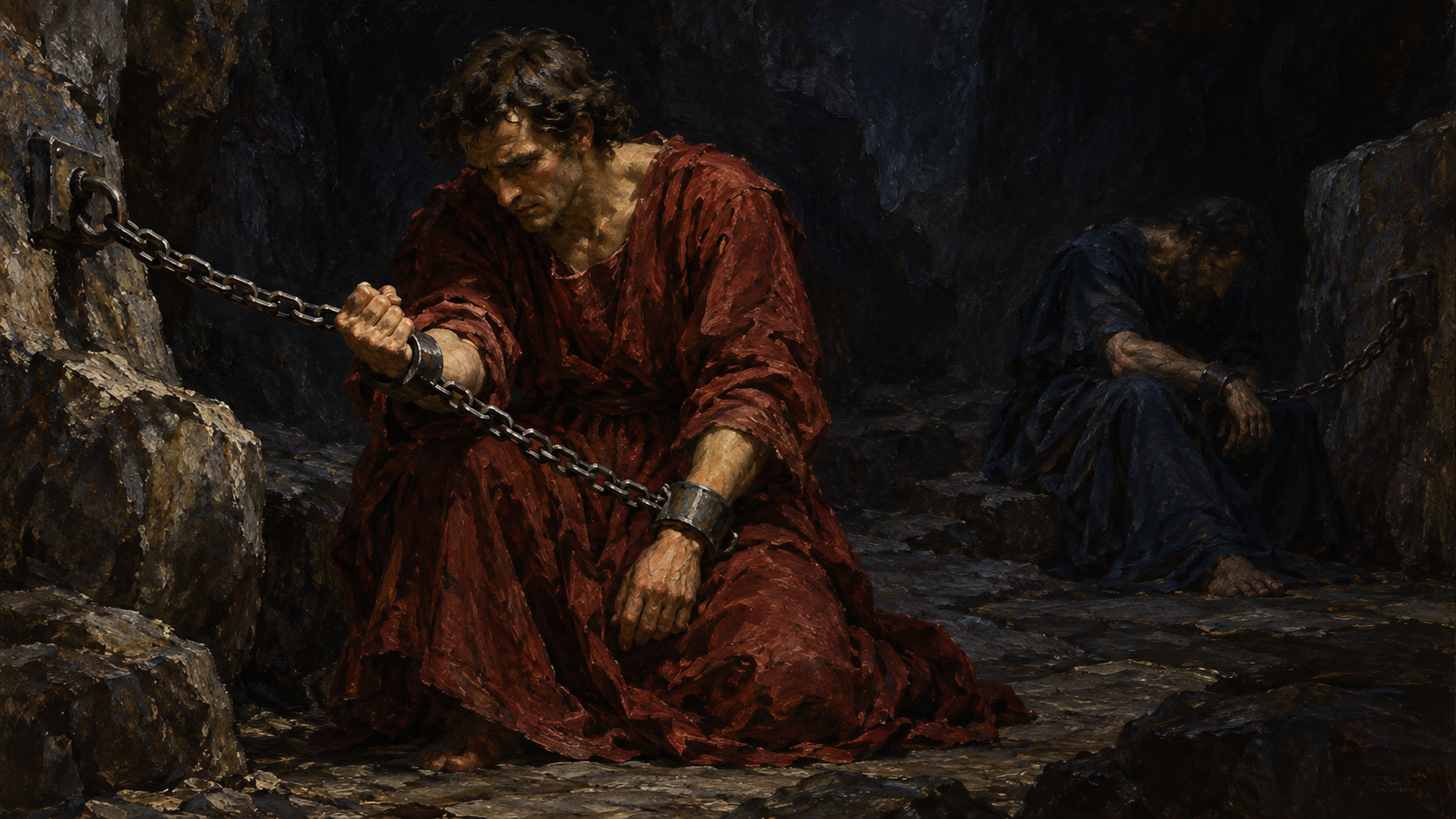
Jude describes angels who abandoned the place God had given them and are now held in darkness for judgment. I understand their rebellion in light of Genesis 6, but Jude’s purpose reaches beyond identifying an ancient event. He is warning the church about people who reject the Lord’s authority while claiming the freedom of His grace.
The Angels Who Left Their Proper Domain
False teachers had entered among believers, turning grace into permission for sensuality and denying the authority of the only Lord God and our Lord Jesus Christ. Jude answered their claims with examples of judgment. He first recalled Israel’s unbelief, then the rebellion of angels, and then the wickedness of Sodom and Gomorrah:
And the angels who did not keep their proper domain, but left their own abode, He has reserved in everlasting chains under darkness for the judgment of the great day; as Sodom and Gomorrah, and the cities around them in a similar manner to these, having given themselves over to sexual immorality and gone after strange flesh, are set forth as an example, suffering the vengeance of eternal fire.
Jude describes their rebellion as failing to keep their proper domain and leaving their own abode. God then confined them in everlasting chains under darkness, awaiting the judgment of the great day. Their present condition is already one of restraint, though the appointed judgment is still ahead. This is more specific than a general reference to Satan’s original fall or the existence of evil angels.
The word translated “proper domain” is archē. It can refer to a beginning or to rule and authority, depending on context. Here it concerns the station entrusted to these angels. Their position came from God, and they had no right to abandon His order simply because they desired something outside it.
“Own abode” translates oikētērion, a dwelling place or habitation. Paul uses the same word in 2 Corinthians 5:2 for the believer’s future heavenly dwelling. That shared word does not explain the physical nature of angels or how these angels crossed their appointed boundary. Jude tells us that they left the habitation proper to them and were held accountable for doing so. The study on angels considers their place as created servants of God.
Jude’s warning would lose its force if we treated their rank as protection from judgment. They were answerable to their Creator, and teachers in the church are answerable to Him too. Influence, spiritual language, and claims of freedom cannot give someone authority to disregard what God has commanded.
Genesis 6 Gives the Best Biblical Background
I find the strongest biblical background for these angels in the events before the flood. Genesis describes humanity multiplying, followed by the sons of God taking wives from among the daughters of men:
Now it came to pass, when men began to multiply on the face of the earth, and daughters were born to them, that the sons of God saw the daughters of men, that they were beautiful; and they took wives for themselves of all whom they chose.
The expression “sons of God” refers to heavenly beings in Job 1:6, 2:1, and 38:7. A phrase must still be understood in its own setting, but that use helps explain the contrast in Genesis between the sons of God and the daughters of men. Read beside Jude’s description of angels leaving their habitation, it supports the understanding that heavenly beings crossed into a relationship God had not appointed for them.
Genesis 6:4 places the Nephilim in this setting, when the sons of God came in to the daughters of men and children were born. The NKJV uses “giants” and describes mighty men of old, men of renown. The passage gives us that connection without explaining every question about their nature or the later presence of giants. The related study on Nephilim tribes examines those references more fully.
Some interpreters identify the sons of God as men descended from Seth who married women descended from Cain. On that reading, Genesis warns about the corruption of the godly line through ungodly marriages. Scripture certainly condemns corrupt alliances, but Genesis 6 does not name Seth’s and Cain’s descendants as the two groups. More significantly, that explanation leaves the connections with Jude’s angels and Peter’s imprisoned rebels unresolved. I do not think it accounts adequately for the passages read together.
Jude’s comparison with Sodom strengthens the angelic reading. He says the cities acted “in a similar manner to these,” giving themselves to sexual immorality and pursuing strange flesh. I understand “these” to refer back to the angels. The phrase sarkos heteras means different or strange flesh. In this comparison, desire reached beyond the boundary God had established.
The sins of Sodom were not confined to one wrong. Ezekiel 16:49–50 names pride, abundant provision without care for the poor, and abomination. Genesis also describes violence and sexual perversion. Jude focuses on the sexual rebellion because it serves his comparison with the angels. He does not identify the people of Sodom as angels or make their acts identical. Both groups pursued what the Creator had not permitted them to take.
The angelic interpretation of Genesis 6 has ancient Jewish and Christian precedents. The Jewish work 1 Enoch and Justin’s Second Apology, chapter 5, both describe angels transgressing through desire for women. Such writings help us understand what earlier readers believed. Their age does not make their details biblical teaching.
Jude records Enoch’s prophecy of coming judgment, but I do not take that as grounds for receiving the whole work known as 1 Enoch as Scripture. The study on the Book of Enoch considers that question. Our doctrine must be governed by Scripture. We can affirm the angels’ real transgression and judgment without accepting additional names, schemes, or explanations that the Bible does not supply.
Peter Confirms Their Sin and Restraint
In 2 Peter 2, Peter warns that false teachers will not escape judgment. He supports that warning by beginning with angels who sinned:
For if God did not spare the angels who sinned, but cast them down to hell and delivered them into chains of darkness, to be reserved for judgment;
The verb translated “cast them down to hell” is tartaroō, meaning to cast into Tartarus. Peter uses this word rather than the other terms often rendered hell, such as Hades and Gehenna. His description concerns confinement in darkness while judgment is awaited. We should keep that setting in view instead of assuming that every use of the English word hell describes the same condition. The study on hell examines the terms and passages more fully.
Peter next describes the flood upon the ancient world and God’s preservation of Noah, then the destruction of Sodom and Gomorrah and the deliverance of Lot. The sequence connects sinning angels, Noah’s generation, and Sodom. Alongside Jude, that gives me good reason to associate these imprisoned angels with Genesis 6, rather than make the passage a description of every fallen angel.
Both writers are showing that God can restrain rebels and bring them to judgment. In 2 Peter 2:9, Peter also explains the Lord’s care for the godly. God knew how to preserve Noah and deliver Lot without overlooking the wickedness around them. His people had reason to trust Him even when evil appeared firmly established.
Another passage in 1 Peter connects imprisoned spirits with Noah’s day. After speaking of Christ’s suffering for sins and His being made alive by the Spirit, Peter writes:
by whom also He went and preached to the spirits in prison, who formerly were disobedient, when once the Divine longsuffering waited in the days of Noah, while the ark was being prepared, in which a few, that is, eight souls, were saved through water.
I understand these spirits as rebellious supernatural beings associated with Noah’s time. The reference to Noah is explicit; identifying the spirits as these angelic rebels is my conclusion from reading this passage alongside Jude and 2 Peter. The wider paragraph ends with the risen Christ at God’s right hand, with angels, authorities, and powers subject to Him (1 Peter 3:22).
On that reading, Christ’s proclamation declares His triumph over the rebels. Peter does not say they repented, were released, or received salvation. This passage does not establish universal salvation, a second opportunity after death, or soul sleep, the belief that the dead are unconscious. Its difficult details should be considered within Peter’s explanation of Christ’s suffering, resurrection, and authority.
Isaiah also describes the Lord’s judgment reaching both heavenly rebels and earthly rulers:
It shall come to pass in that day That the LORD will punish on high the host of exalted ones, And on the earth the kings of the earth. They will be gathered together, As prisoners are gathered in the pit, And will be shut up in the prison; After many days they will be punished.
Isaiah’s prophecy is broader than Jude’s description of this particular group, but it distinguishes confinement from a later punishment. Neither exalted beings nor earthly kings can escape God’s authority. A delay before the appointed judgment does not mean He has forgotten what they did.
These Bound Angels Are Not the Demons Still Active
Jude’s angels are held in chains under darkness. The demons described elsewhere in Scripture remain active, so we should not treat these imprisoned angels as though they are roaming the earth. Jude identifies a particular rebellion and restraint; he is not giving one description that fits every evil spirit.
Mark 5 gives a clear example of demons still acting in the world. They tormented a man, recognized Jesus, and had to ask His permission before entering the swine. They could neither dismiss His command nor dictate the outcome. Their activity was real, but so was His authority over them.
That is how I need to approach spiritual warfare. We depend on Christ, pray, receive the truth of His Word, and put on the armor God provides. Secret names or elaborate diagrams of demonic ranks cannot supply what He gives. Spiritual evil should make us attentive to His commands, rather than absorbed in claims of hidden knowledge or afraid that an unseen power can overrule our Lord.
Jude’s Warning Is for the Church
Jude gave these examples because believers needed to recognize the danger of teachers who excused sin and rejected the Lord’s authority. Their influence might impress people, but it could not protect them from God. The angels had not been allowed to redefine their place in His creation, and a teacher cannot redefine obedience by calling rebellion freedom.
If I admire someone’s gifts enough to excuse his contempt for God’s commands, I am disregarding the warning Jude gave. Religious language does not make sensuality holy, and cultural approval does not give us authority to overturn the Creator’s boundaries. We need to examine what a teacher is encouraging us to believe and do, rather than assume that confidence or popularity establishes his faithfulness.
Jude also teaches us patience when judgment has not yet come. Some evil is already restrained, while other evil remains active within God’s limits. The appointed judgment is certain even when we do not know its date. I can trust the Judge without possessing a timetable for every rebel.
That confidence must include humility about our own need. Israel fell in unbelief, angels rejected their appointed place, and Sodom pursued wickedness. Knowing the details of their rebellion cannot deliver me from my own sin and its judgment. I need the salvation God gives through Jesus Christ.
Jesus is the eternal Son, fully God and fully man, born of a virgin and completely sinless. On the cross He physically bore the punishment for our sins in His innocent body. Wicked men inflicted the real torture and crucifixion He willingly endured. He shed His blood and completed His saving work through His death, was buried, and rose bodily from the dead.
The Father did not punish, curse, abandon, strike, bruise, or pour wrath on Jesus. Christ died for the sins of the whole world, and God’s offer of salvation is genuine for every person, though people may resist His grace and reject Him. Everyone who repents and believes is forgiven and born again, indwelt and sealed by the Holy Spirit, and eternally secure.
That assurance gives us no permission to continue in the lawlessness Jude condemns. Christ’s people are called to walk in truth under the Lord who conquered through His death and resurrection. We do not need to fear that imprisoned angels or active demons can take us out of His care. His authority extends over both the unseen world and the world we see, and every enemy will finally be put under His feet.
Jude calls us to contend for the faith once for all delivered to the saints. We should defend that faith without becoming harsh, paranoid, or hungry for secret knowledge. The Lord who judges rebellion also keeps His people, and Jude ends by praising His ability to keep them from stumbling and present them faultless before His glory with exceeding joy. We should receive the warning about sin with the same seriousness as that assurance of His care.
My Final Thoughts
I believe Genesis 6 gives the best explanation of Jude’s angels, especially when we read his words alongside Peter’s references to Noah and imprisoned spirits. Those connections do not answer every question about the unseen world, but they do explain why rebellion is a foolish claim to freedom. These angels left the place God gave them and found themselves confined for judgment. I want their example to make us careful about the teaching we receive and confident in Christ, whose authority no rebel can overthrow.