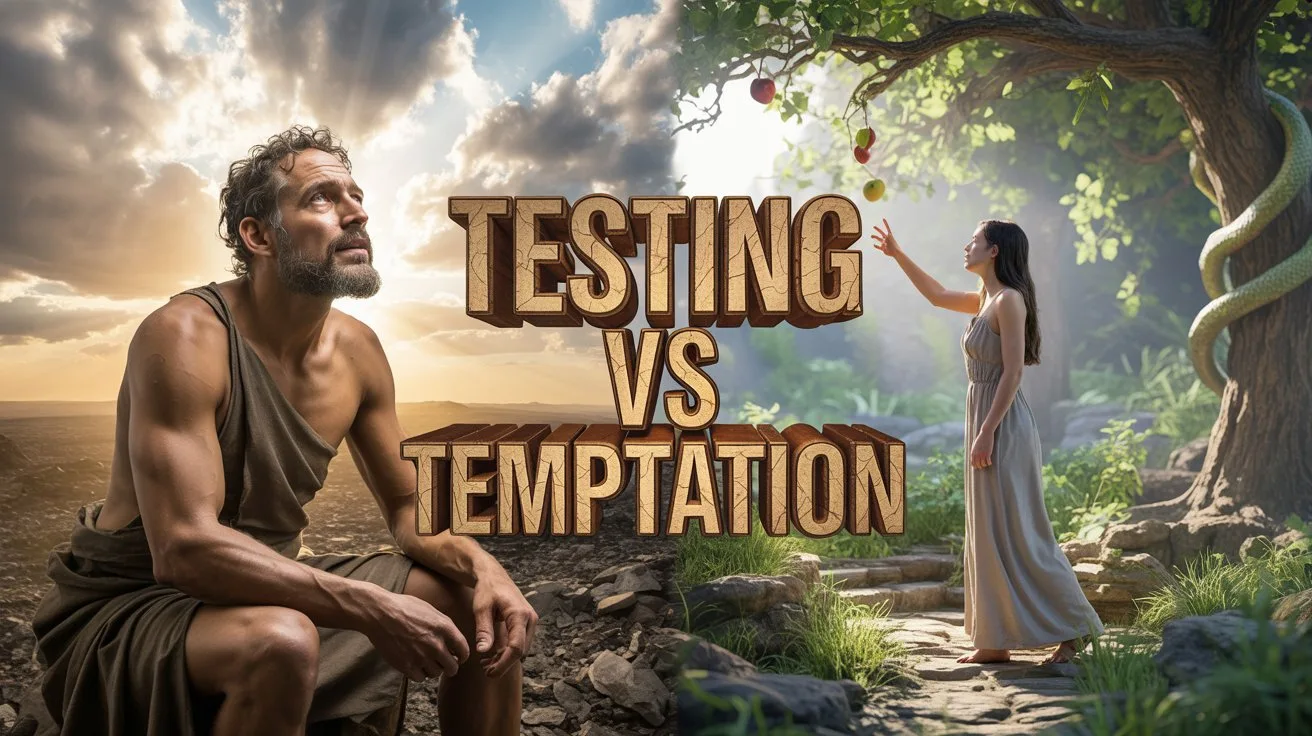
When you are under pressure, it helps to know what kind of pressure it is. The Bible draws a clear line between the Lord testing His people and Satan tempting them, and mixing those up can lead to blame, confusion, or excuses. Ephesians 6:12 reminds us there is a real spiritual battle behind the scenes, but it also keeps us from treating every hard day like it has the same source or the same purpose.
What we face
If you start in Ephesians, keep an eye on the flow. Paul has been teaching believers who they are in Christ and how that plays out in everyday life: how we walk, how we talk, how we handle our homes, and how we live under the Lord’s authority. Then he closes the letter with a call to be strong in the Lord and to put on God’s armor. That is the setting for Ephesians 6:12. This is not an invitation to be spooky or paranoid. It is a call to think straight and stand firm.
For we do not wrestle against flesh and blood, but against principalities, against powers, against the rulers of the darkness of this age, against spiritual hosts of wickedness in the heavenly places. (Ephesians 6:12)
Paul says our struggle is not mainly against people. People can sin against you. People can cheat you, slander you, abandon you, and abuse you. None of that is small. Still, Paul says there is something deeper than human conflict going on.
He uses a word for struggle that points to close combat, the kind of fight that feels up close and personal. That fits real life. The enemy aims for your mind, your conscience, your faith, your relationships, your witness, your joy, and your staying power.
One detail that is easy to miss: in this whole armor section, Paul keeps aiming at one main outcome, that you would stand. He is not telling you to go hunting for demons or trying to win the war by your own cleverness. Christ has already won. Your part is to stand your ground in what God has provided. That is why it is God’s armor, not yours.
Flesh and blood
When Paul says not against flesh and blood, he is not saying human choices do not matter. He is saying people are not the deepest enemy. If you make people the real enemy, you will start using the wrong weapons. You will reach for anger, slander, manipulation, and fear. Those tools never produce the righteousness God wants in His people.
This is where the difference between testing and temptation gets practical. A trial can come through people. A temptation can come through a conversation, a conflict, or a disappointment. But the battle is not solved by winning the argument or getting the last word. The armor Paul lists in the surrounding verses is about truth, righteousness, faith, salvation, the Word of God, and prayer. Those are not debate tactics. They are ways of staying faithful.
Rulers and powers
Paul describes organized evil, not random trouble. He is not giving us a demon chart, and he is not asking you to guess which spirit is behind which problem. He is simply saying evil is real, active, and intentional. Darkness works through lies, accusations, and pressure. You see that pattern all through Scripture. The enemy deceives, then he condemns, then he tries to push you away from trusting the Lord.
At the same time, this verse does not mean every flat tire is a demon. Some hardship is just life in a fallen world. Some hardship is the consequence of our own choices. Some hardship is persecution. Some hardship is the Lord training His people. The point is discernment. You do not want to blame God for what Satan is doing, and you do not want to waste what God is doing by treating it like meaningless pain.
How temptation works
James is one of the clearest places in the Bible on temptation. He shuts the door on a common excuse: blaming God for the pull toward sin. God is good, and God is holy. He does not bait His children into evil.
Let no one say when he is tempted, "I am tempted by God"; for God cannot be tempted by evil, nor does He Himself tempt anyone. But each one is tempted when he is drawn away by his own desires and enticed. Then, when desire has conceived, it gives birth to sin; and sin, when it is full-grown, brings forth death. (James 1:13-15)
James teaches two truths at once. First, God does not tempt anyone. Second, temptation has an inside connection point. Even if Satan brings outside pressure, temptation hooks into real desires, real fears, real pride, real anger, real impatience. That is why temptation can feel like it is coming from inside you, even when something outside you is pressing.
James describes a progression. Desire pulls, then it lures, then it grows into sin, and sin grows into death. The wording is plain: temptation is not neutral. It is not just an unpleasant thought floating through your mind. It is a pull toward disobedience that, if welcomed, grows. You do not play with it like it is harmless. You treat it like what it is.
A word that matters
The Greek word family James uses can mean either tempted or tested, depending on context. That is not a contradiction. It is one word family describing pressure, and the context tells you what kind of pressure it is. In James 1:13-15 the direction is toward sin and death, so it is temptation. In James 1:2-4 the direction is toward endurance and maturity, so it is testing. If you ignore context, you will get lost fast.
That word note also explains why believers sometimes feel confused in the middle of a hard season. You can be under real testing, and in the middle of that same season, temptation is trying to get you to respond in a sinful way. The pressure feels like one big mess, but Scripture separates the sources and the goals.
Eden and distortion
Genesis shows temptation doing what it does best: taking God’s word and bending it. The serpent does not start with a blunt command to rebel. He starts with a question that aims to loosen confidence in what God said.
Now the serpent was more cunning than any beast of the field which the LORD God had made. And he said to the woman, "Has God indeed said, "You shall not eat of every tree of the garden'?" And the woman said to the serpent, "We may eat the fruit of the trees of the garden; but of the fruit of the tree which is in the midst of the garden, God has said, "You shall not eat it, nor shall you touch it, lest you die."' Then the serpent said to the woman, "You will not surely die. (Genesis 3:1-4)
The movement is steady. First, doubt God’s word. Then, doubt God’s goodness. Then, doubt the consequences. Then, take control for yourself. Temptation usually does not show up wearing a name tag. It shows up sounding reasonable. It presents sin as small and obedience as extreme. It makes waiting on God feel foolish.
There is also a quiet detail in that exchange. Eve repeats God’s command, but she changes it. She adds something God did not say. That is a small shift, but it is how things start sliding. When God’s word gets blurred, whether by taking away from it or adding to it, the heart becomes easier to steer. We do not handle temptation well when we are fuzzy on what God actually said.
Jesus in the wilderness
Matthew shows temptation aimed straight at Jesus at a physically weak point, after fasting. The push is to meet a real need in a wrong way, outside the Father’s will.
Now when the tempter came to Him, he said, "If You are the Son of God, command that these stones become bread." But He answered and said, "It is written, "Man shall not live by bread alone, but by every word that proceeds from the mouth of God."' (Matthew 4:3-4)
Jesus answers with Scripture. He does not negotiate. He does not treat the suggestion as harmless. He treats it as an attack and responds as the obedient Son who trusts the Father’s Word more than immediate relief. He is not only giving us an example. He is also showing what faithful sonship looks like under pressure.
Another detail people miss: later in that same scene, Satan is willing to use Scripture too. He is not allergic to religious language. He will gladly use Bible words if he can twist them. So you cannot measure temptation by how spiritual it sounds. You measure it by where it leads. Does it lead you into simple obedience, or does it lead you into compromise and self-rule?
Temptation is always trying to produce sin. And when sin is embraced, the enemy often shifts tactics and starts accusing. He wants you either proud in sin or crushed by shame. Either way, you stop walking in the light. You stop praying plainly. You start hiding instead of dealing honestly with God.
How testing works
The Lord does test His people, but His tests are not traps. They are not meant to make you fall. They are meant to strengthen faith, produce endurance, and bring maturity that does not grow in easy seasons. James talks about this right in the same chapter where he talks about temptation.
My brethren, count it all joy when you fall into various trials, knowing that the testing of your faith produces patience. But let patience have its perfect work, that you may be perfect and complete, lacking nothing. (James 1:2-4)
James does not pretend trials feel good. He says to count it joy because you know what God produces through them. The endurance James describes is the ability to stay under a load without quitting. That is not stubbornness or denial. It is faith that holds steady because it is anchored in the Lord.
Testing often exposes what is already there. Not because God needs information, but because we do. Pressure brings the truth to the surface. Comfort can hide weak spots for a long time. Heat brings them out.
Abraham on Moriah
Genesis is direct about Abraham. It says God tested him. The command is hard, and you should not treat it like a cold puzzle. Abraham is being pressed right where promise and love meet.
Now it came to pass after these things that God tested Abraham, and said to him, "Abraham!" And he said, "Here I am." Then He said, "Take now your son, your only son Isaac, whom you love, and go to the land of Moriah, and offer him there as a burnt offering on one of the mountains of which I shall tell you." (Genesis 22:1-2)
God is not tempting Abraham to murder his son. Murder would violate God’s character. The test is whether Abraham will trust God’s promise when he cannot see how the promise will stand. Later Scripture fills in what Genesis does not spell out in detail. Abraham believed God could raise Isaac if necessary.
By faith Abraham, when he was tested, offered up Isaac, and he who had received the promises offered up his only begotten son, of whom it was said, "In Isaac your seed shall be called," concluding that God was able to raise him up, even from the dead, from which he also received him in a figurative sense. (Hebrews 11:17-19)
Then God stops Abraham and provides the substitute. That teaches something about testing: the Lord does not demand obedience and then leave you empty-handed. He provides what He requires. Abraham learns the Lord as Provider in a deeper way than he could have learned in a calm season.
And when God says now I know, that is not God learning facts He did not know. It is a common Bible way of speaking about something being proved and shown in real life. The test demonstrated Abraham’s faith, and Abraham himself learned what trusting God looks like when it costs him.
Israel in the wilderness
Deuteronomy looks back and tells Israel why the wilderness went the way it did. God led them, humbled them, and tested them so what was in their heart would be brought into the open.
And you shall remember that the LORD your God led you all the way these forty years in the wilderness, to humble you and test you, to know what was in your heart, whether you would keep His commandments or not. (Deuteronomy 8:2)
Again, that phrase about knowing what was in the heart does not mean God lacked knowledge. It means the season proved it. The wilderness exposed unbelief and complaint, but it also trained daily dependence. God provided in ways that forced Israel to look to Him day by day, not just talk big when things were easy.
Deuteronomy also ties testing to God’s Word. The Lord fed them in a way that taught them they needed more than food. Later, Jesus uses that same passage when He answers Satan. Israel’s training ground becomes Jesus’ battleground, and He succeeds where they failed. Scripture learned in testing becomes strength in temptation. That connection is not accidental.
Job and limits
Job’s suffering shows another angle. Satan is the attacker, but he is not free to do whatever he wants. God permits and limits. Job does not get all the reasons, and neither do we, but the book makes one thing clear: Satan’s aim is destruction and accusation, while God’s purpose is proving and refining.
Then Job arose, tore his robe, and shaved his head; and he fell to the ground and worshiped. And he said: "Naked I came from my mother's womb, And naked shall I return there. The LORD gave, and the LORD has taken away; Blessed be the name of the LORD." In all this Job did not sin nor charge God with wrong. (Job 1:20-22)
Job grieves, and Scripture does not treat his grief as unbelief. He worships, and Scripture does not treat his worship as denial. He refuses to charge God with wrong. Some believers act like faith means pretending you are not hurting. The Bible never teaches that. Faith tells the truth about the pain while holding to the truth about God.
Job also corrects a shallow idea that still hangs around. Job’s friends assume intense suffering must always be direct punishment for personal sin. The book of Job shows that is not true. Sin has consequences, yes, but not every trial is a penalty. Sometimes suffering is a test. Sometimes the reason is not revealed in the moment. Scripture guards you from false guilt and from bitter accusations at the same time.
Putting these together helps you sort life out. Testing presses you toward God. Temptation pulls you away from God. A trial can become the setting where temptation shows up, but the directions are not the same. Financial pressure can be a test of trust and contentment while also becoming a temptation to lie or cheat. Sickness can be a test of endurance while also becoming a temptation to despair or turn bitter. The trial is not the sin. The temptation is the invitation to respond to the trial in unbelief or disobedience.
God also tells believers they can endure temptation without giving in. He does not promise you will never be tempted. He promises there is a real way of escape, meaning a real path of obedience in the moment.
No temptation has overtaken you except such as is common to man; but God is faithful, who will not allow you to be tempted beyond what you are able, but with the temptation will also make the way of escape, that you may be able to bear it. (1 Corinthians 10:13)
That promise removes two excuses. You cannot say nobody has ever felt this kind of pressure. Scripture says temptation is common to man. You also cannot say you had no choice. Scripture says God provides a way to endure it. Sometimes the escape is leaving the room. Sometimes it is shutting off the screen. Sometimes it is confessing early, before sin has time to grow. Sometimes it is calling a mature believer instead of trusting your own willpower.
When the pressure is a test, the need is wisdom. James says to ask God for wisdom, and God gives generously. Wisdom does not always mean God explains every why. Often it means He shows you the next faithful step.
If any of you lacks wisdom, let him ask of God, who gives to all liberally and without reproach, and it will be given to him. (James 1:5)
And when temptation and testing both feel heavy, you do not face either one alone. Jesus understands temptation without sinning, and He gives mercy and grace to help at the right time.
For we do not have a High Priest who cannot sympathize with our weaknesses, but was in all points tempted as we are, yet without sin. Let us therefore come boldly to the throne of grace, that we may obtain mercy and find grace to help in time of need. (Hebrews 4:15-16)
If you are truly saved, you are saved by grace through faith in Christ, not by your performance. Works are fruit, not the cause. When you fail, you confess it and come back into the light. When you are being tested, you keep trusting and obeying. In both cases, you keep coming to Christ, because He is not only the example. He is the Savior and the help.
My Final Thoughts
If you can remember one simple difference, keep this one: temptation is trying to get you to disobey God, and testing is pressing you to obey God. They can show up in the same season, but they do not come from the same hand and they are not headed to the same destination.
So ask honest questions when pressure hits. Where is this pulling me: toward secrecy, bitterness, and compromise, or toward prayer, endurance, and obedience? Then do the next clear thing God has already told you to do in His Word. Take the way of escape when it is temptation. Endure in faith when it is testing. Keep coming to Christ for mercy and help, because He gives it.




 Get the book that teaches you how to evangelize and disarm doctrines from every single major cult and religion.