
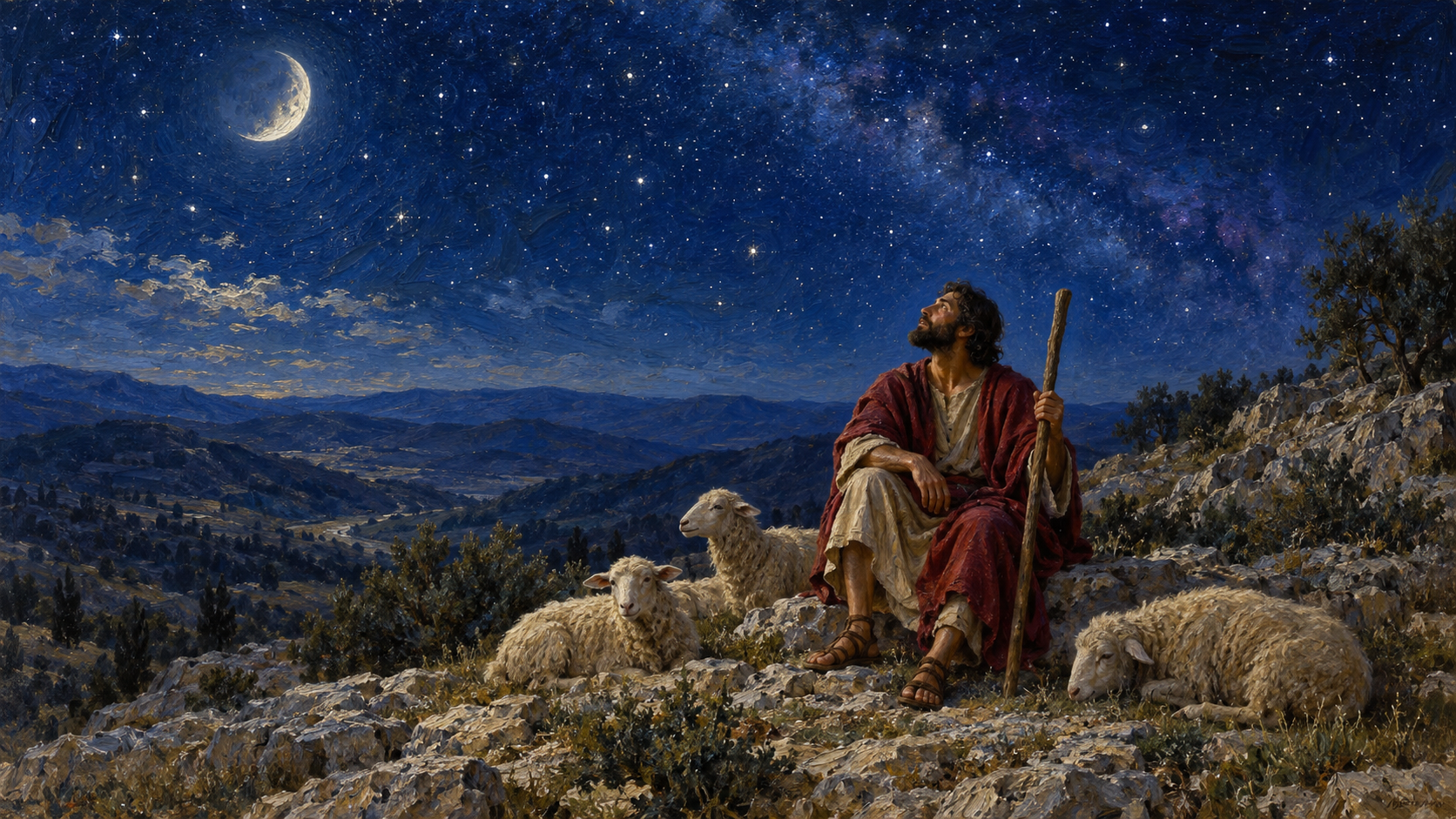
David looks at the heavens in Psalm 8 and asks why God would pay attention to people as small as we are. Yet the same psalm describes mankind crowned with glory and honor and entrusted with responsibility over God’s creation. I want to keep those thoughts together. David does not diminish the honor God gave us, but he never lets us forget who gave it. When Paul takes up this psalm in Hebrews, he also explains why its fullest answer is found in Jesus Christ.
The LORD’s Majesty Frames the Whole Psalm
The superscription, the heading printed before the psalm, reads, “To the Chief Musician. On the instrument of Gath. A Psalm of David.” It identifies David as the author and directs the psalm toward public worship. The musical instruction associated with Gath may refer to an instrument, a tune, or a style; its exact meaning remains uncertain. That uncertainty concerns how the psalm was to be performed, not whom David was praising.
David’s earlier work as a shepherd helps us understand his familiarity with the heavens. He had cared for flocks in the fields, but the psalm does not tell us when he composed it. He may have written it during those years or later, remembering what he had seen. We know that he considered the night sky and praised God; we do not know the particular night or stage of his life. The Life of King David follows his years as shepherd and king in the wider biblical account.
We often remember Psalm 8 through its question, “What is man?” David, however, begins by addressing the LORD. His attention to mankind grows out of his worship of the God whose glory is above the heavens.
O LORD, our Lord, How excellent is Your name in all the earth, Who have set Your glory above the heavens!
The opening identifies the One David is praising. The first “LORD” represents YHWH, God’s covenant name. David is addressing the God who revealed Himself to Israel and delivered His people, not a nameless force behind the universe. In the words “our Lord”, he uses a form of adon, meaning lord, master, or ruler. The God who made Himself known to His people has authority over all the earth.
God’s name means more here than a word by which we address Him. It represents who He is and the authority and glory He makes known. The earth belongs to Him, and the heavens display His greatness without containing Him. David closes the psalm with the same praise in verse 9, so everything he says about human honor belongs within that confession. Any reading that makes us independent of our Creator has missed where David began and ended.
God Uses Weak Voices to Silence Pride
Out of the mouth of babes and nursing infants You have ordained strength, Because of Your enemies, That You may silence the enemy and the avenger.
David first draws attention to people whose weakness is obvious. Infants cannot command an army, argue a case in court, or defend themselves against an avenger. Yet God establishes strength through their mouths to silence opposition. He does not need an impressive human instrument before He can answer His enemies.
Jesus applied this verse in Matthew 21 after cleansing the temple and healing the blind and lame. Children were crying out, “Hosanna to the Son of David!” The chief priests and scribes were indignant and asked whether He heard what they were saying. Jesus answered by asking whether they had read, “Out of the mouth of babes and nursing infants You have perfected praise.”
The wording about perfected praise follows the ancient Greek translation of the psalm. Jesus used it to defend the praise the leaders wanted stopped. The children had no religious office, but they were honoring the Son of David standing before them. The men who had studied Scripture were resisting Him. Their learning and position did not give them the right to silence truthful praise.
I do not take this as a reason to treat children as infallible teachers or to despise careful learning. God can receive true praise from a child while a knowledgeable adult refuses Him. Jesus did not rebuke the children for honoring Him as Messiah. He received their praise and defended it with a psalm addressed to the LORD. We should pay attention to both His acceptance of that praise and the leaders’ refusal to recognize the One their Scriptures revealed.
The Heavens Lead David to Wonder About Man
When I consider Your heavens, the work of Your fingers, The moon and the stars, which You have ordained, What is man that You are mindful of him, And the son of man that You visit him?
David calls them “Your heavens.” The moon and stars belong to God because He made them and established their order. They are not gods to be worshiped or independent powers directing our lives. Their greatness gives us reason to honor their Creator.
The expression “the work of Your fingers” describes that greatness without suggesting God was overwhelmed by the task. What is immense to us is the work of His hands. David looks from those heavens to mankind and asks why their Maker would remember and attend to us at all.
The Hebrew zakar can mean to remember or be mindful, while paqad can describe visiting, attending to, or intervening for someone. David is considering God’s purposeful attention to human beings. The One above the heavens does more than notice that we exist; He gives us life, cares for us, and assigns us responsibility within what He has made.
That is why I cannot read David’s question as a declaration that people are worthless. Our smallness is real, but so is God’s care. We did not create ourselves or give ourselves breath, yet He chose to honor us. Recognizing how much we have received should humble us without making us despise the life God gave.
Made from Dust and Crowned with Honor
Genesis supplies the creation foundation for this honor. God made man and woman in His image and appointed them to rule over the creatures.
Then God said, “Let Us make man in Our image, according to Our likeness; let them have dominion over the fish of the sea, over the birds of the air, and over the cattle, over all the earth and over every creeping thing that creeps on the earth.”
Being made in God’s image does not mean God is a larger human being with a body shaped like ours. God is Spirit. He made us to represent Him and to resemble Him in ways appropriate to creatures: as personal beings who can reason, speak, relate to others, and worship Him. Scripture does not describe the animals as bearing His image. Human dignity comes from our Creator, and a government or society can neither invent it nor rightfully take it away.
Genesis 2 also says that God formed man from dust and breathed life into him. The person honored with responsibility over creation remains a creature whose existence depends on God. I cannot claim to be self-made when even my breath has been received, and I cannot treat someone else as meaningless when God made that person in His image. The study on Imago Dei: Made in God’s Image develops that creation foundation.
For You have made him a little lower than the angels, And You have crowned him with glory and honor.
The NKJV gives the comparison as “angels.” The Hebrew word is elohim, which often refers to God but can also refer to heavenly beings; its use must be considered in context. That is why some translations read God and others heavenly beings here. Hebrews 2 follows the ancient Greek wording, “angels,” when it quotes this verse. I follow that reading in explaining the psalm, while acknowledging why readers encounter different English translations. The NET translation notes on Psalm 8:5 discuss the alternatives.
Whichever of those renderings a reader encounters, David has not made mankind divine. We receive glory and honor from God and remain accountable to Him. Our position over the creatures never places us above the Creator or makes us independent of His care.
The fall corrupted our thinking, desires, and conduct, including the way we exercise authority, but it did not erase God’s image. A child in the womb, an elderly person, a stranger, and even an enemy still possess human dignity. That dignity does not depend on whether they are useful to us or able to display every human ability. We should protect the weak and treat people according to what God has made them, rather than deciding their worth by their strength or our preferences.
Created dignity must also be distinguished from salvation. Bearing God’s image does not remove our guilt for sin or reconcile us to Him. We were made to represent Him, but we have sinned against Him and need forgiveness and new birth. I should not answer human pride by saying people have no value, or answer human guilt by pretending that being valuable means we have no need of a Savior.
Dominion Is Stewardship Under God
You have made him to have dominion over the works of Your hands; You have put all things under his feet, All sheep and oxen, Even the beasts of the field, The birds of the air, And the fish of the sea That pass through the paths of the seas.
David echoes the calling God gave the man and woman in Genesis 1:28: fill the earth and exercise dominion over its creatures. Dominion means real authority to rule, but it is authority received from God over “the works of Your hands.” Mankind is responsible for what the Creator made and continues to own. We are stewards, people entrusted with the care of another’s property.
The sheep and oxen include animals kept within ordinary human work, while the beasts of the field live beyond the household. Birds occupy the air, and fish travel through the seas. David’s list shows the reach of that responsibility rather than offering a technical classification of animals. The creatures we handle, the land we cultivate, and the world we study all belong to the LORD.
I cannot justify cruelty or reckless destruction by saying mankind has dominion. Greater strength does not release me from answering to God for its use. But neglect and passivity do not fulfill the calling either. He gave people work to do, including cultivating, protecting, learning, and building. Sin has made labor painful and can corrupt its purpose, but it has not made useful work beneath our dignity.
Care for a home, responsible treatment of animals, tending land, and building something useful can all be offered to God. None of that work saves us, but neither should it be dismissed as spiritually unimportant because it happens outside a church gathering. The question is whether we carry out the work faithfully, with care for what He has entrusted to us.
Our other responsibilities remain accountable to Him too. Authority in a home, workplace, or church does not give anyone permission to treat people as property. The people affected by our decisions bear God’s image just as we do. Psalm 8’s commission concerns rule over creation under God; it cannot excuse a ruler who forgets either God’s ownership or another person’s dignity.
We Do Not Yet See All Things, but We See Jesus
The psalm describes a magnificent calling, but the world around us does not display mankind exercising it without failure. Creation is abused, human authority is corrupted, and those appointed to rule are themselves subject to death. Paul addresses that difficulty when he uses Psalm 8 in Hebrews.
For in that He put all in subjection under him, He left nothing that is not put under him. But now we do not yet see all things put under him. But we see Jesus, who was made a little lower than the angels, for the suffering of death crowned with glory and honor, that He, by the grace of God, might taste death for everyone.
Paul takes seriously the breadth of what God put under mankind. He also states what we can observe: “We do not yet see all things put under him.” Sin, disorder, and death have not disappeared through human achievement. Psalm 8 cannot be fulfilled simply by congratulating ourselves on our abilities or predicting that our progress will eventually put everything right.
His answer is, “But we see Jesus.” The eternal Son became truly man without ceasing to be fully God. He entered our human life without sin and took the lowly place described in the psalm so that He could suffer death for us. Hebrews is directing us to the Savior who fulfills mankind’s calling, not merely presenting a more impressive example of human potential.
Wicked men physically tortured and punished Jesus, and He willingly bore the punishment for our sins in His innocent body. He shed His blood and died; His saving work through that blood and death was completed before His bodily resurrection. The Father did not punish, curse, abandon, strike, bruise, or pour wrath on Jesus. He was buried and rose bodily, and He is now crowned with glory and honor. A Bible Study on Psalm 22 considers another psalm pointing to Christ, including His suffering.
Jesus is the last Adam and the victorious Son of Man. First Corinthians 15 uses the same “under His feet” language as Paul explains that Christ must reign until every enemy has been subjected to Him. Death is the last enemy to be destroyed. God’s purpose for mankind has not been abandoned; the sinless Son of Man fulfills it perfectly and will bring all things into their proper order.
The “not yet” keeps us from mistaking present conditions for the completed promise. Christ is already crowned, but we still await the removal of every enemy. We do not have to deny corruption, suffering, or death to trust His victory, and we should not make hope depend on what mankind can achieve without Him. The risen Lord’s reign will bring the completion our own rule has failed to produce.
The crowned Savior is also the One Hebrews says tasted death for “everyone”. I take that word to mean what it says: His death made a genuine and sufficient provision for the whole world. God’s offer of salvation is real for every person, including those who resist His grace and reject Him. We should not restrict Christ’s provision so that a sinner invited to trust Him is actually excluded from the saving work being offered.
Nor does “everyone” mean that all people are automatically saved. We receive salvation through repentance and faith. Those who truly believe are born again, indwelt and sealed by the Holy Spirit, and eternally secure in Christ. This is more than adopting a Christian label. New birth brings new life, and obedience is evidence of that life rather than a way to earn or maintain salvation. Our security gives us reason to trust and obey Him, not permission to excuse lawlessness.
My Final Thoughts
David ends where he began, praising the LORD’s excellent name. I want my response to the psalm to follow that direction. Being small beneath the heavens does not make my life pointless, because God made us in His image and entrusted us with real work. Being honored does not give me a reason for pride or an excuse to mistreat people and creation that belong to Him. Sin has exposed how badly we need redemption, but Jesus has suffered death for us and is now crowned with glory and honor. I need to carry out the work He gives me faithfully while trusting Christ to complete what human rule cannot.