
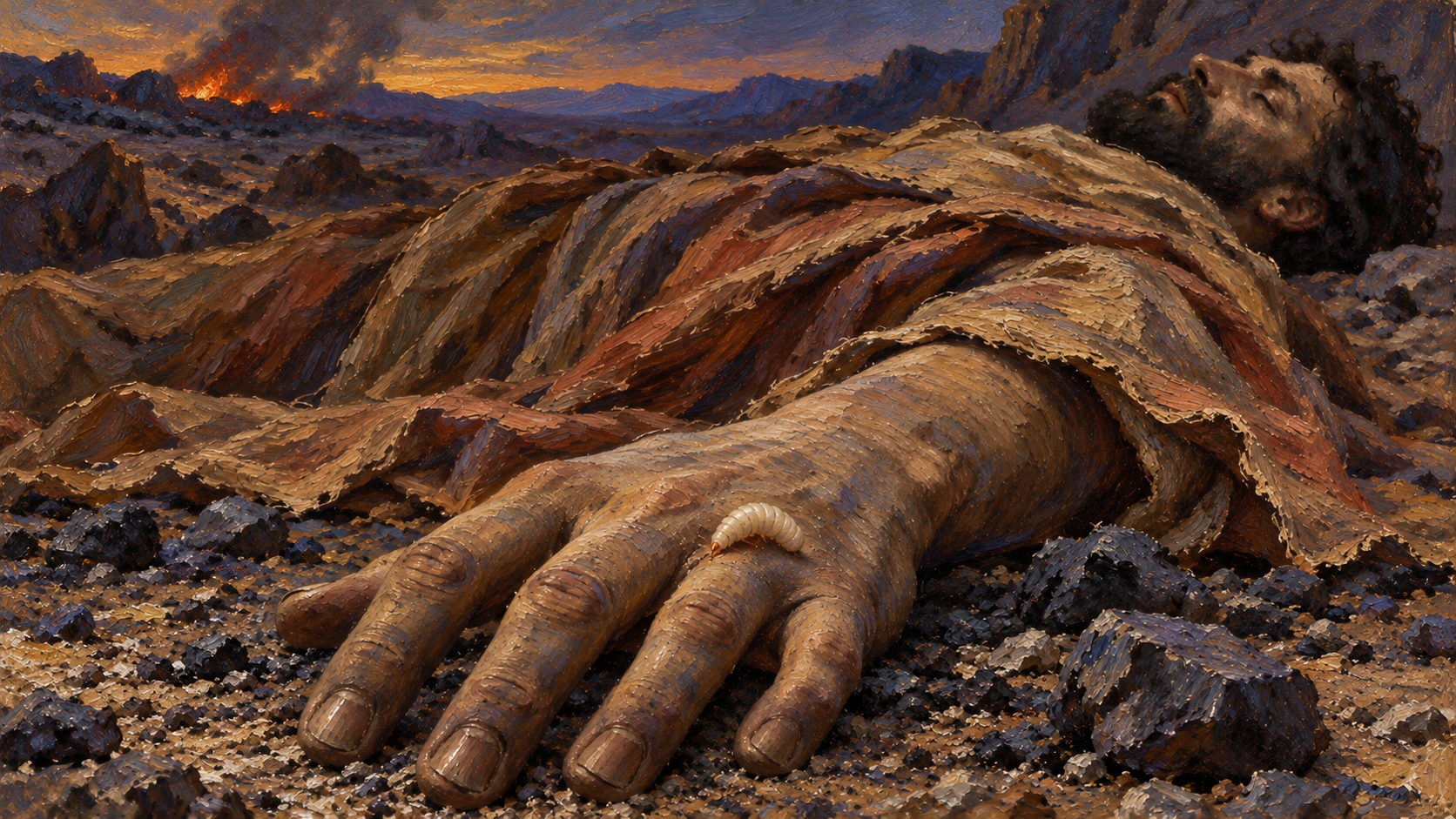
What did Jesus mean when He spoke of a worm that does not die and a fire that is not quenched? I don’t want to soften that warning, but I do want to understand the passage in Isaiah that He was quoting. It gives us the setting for His words about Gehenna and destruction, including how we understand the second death that follows resurrection.
Mark 9 and the Passage Jesus Quotes
In Mark 9, Jesus warned His disciples about causing little ones who believed in Him to stumble. He also confronted them with the danger of their own sin and of Gehenna. When He said it was better to lose a hand, a foot, or an eye than to be cast into hell, He deliberately chose language they could not easily dismiss. He was not commanding bodily mutilation as a way to become righteous. He was calling them to take sin seriously and repent decisively.
Jesus was teaching His disciples how to live, so I don’t want to read this warning as an invitation to detached speculation about the afterlife. He places entering life beside being cast into Gehenna. No cherished sin or present advantage is worth losing life itself. We need to hear the full force of that warning from the Judge who knows where unrepentant rebellion ends.
Then Mark 9:48 repeats the words, “where their worm does not die and the fire is not quenched.” Jesus did not invent that picture for this occasion. He drew it directly from the final verse of Isaiah, and I believe that prophetic setting must control how we understand His warning.
Isaiah 66 looks beyond judgment and restoration to the future glory of the Lord. God gathers the nations and establishes worship that will endure. The worshipers then go out and look upon the corpses of those who transgressed against Him. Their worm does not die and their fire is not quenched. These rebels are an abhorrence to all flesh.
The word I keep coming back to is corpses. Isaiah is describing the dead bodies of rebels after divine judgment, not using a general Hebrew term for living souls who remain conscious while they suffer. Beside those bodies he places worshipers who endure before God. That contrast helps us understand the picture: one group lives with God while the other is displayed under His completed judgment.
Jesus carries that warning into His own teaching about Gehenna without setting Isaiah’s meaning aside. The final judgment will be terrible and publicly visible, and its outcome cannot be reversed. Isaiah shows the shameful end of rebellion after God has defeated it. He does not describe rebels passing through purification and then returning to life.
These people had rejected their Creator, and Isaiah leaves no suggestion that they are being honored or secretly preserved. Their corpses are an abhorrence to all flesh. An unburied body signified disgrace and defeat in the ancient world, so the horror of that image would have been familiar. Isaiah uses it to announce God’s final victory over sin.
I cannot regard that outcome as less serious simply because it is death rather than eternal conscious torment. The second death means ruin and irreversible loss: the final destruction of human body and soul with no possibility of recovery. Scripture repeatedly sets life against death and salvation against perishing. We should let those words carry their ordinary force instead of treating death as a mild consequence.
The Worm and the Unquenchable Fire
I understand the worm in Isaiah 66 and Mark 9 as the maggot that consumes a dead body. Other Old Testament descriptions of death and humiliation use similar imagery. The body in Isaiah remains a corpse, which is why I do not read this as an immortal human soul being eaten alive forever.
When the passage says that the worm “does not die,” the point is that its consuming work will not be interrupted or prevented. It does not mean that one individual worm lives eternally. Once judgment begins, these rebels will not be rescued or restored. They will not receive an honorable burial either. That disgrace reaches its appointed end.
Jesus gives us no reason to be complacent about sin. Outward religion cannot deal with its consequences, and anyone who clings to rebellion should fear the Judge who can destroy both soul and body in Gehenna. I hear compassion in that warning because He tells us the truth while there is still time to repent.
We can understand unquenchable fire in much the same way. In Jeremiah 17, God warned that He would kindle a fire in Jerusalem’s gates that would devour its palaces and would not be quenched. Those ancient palaces are not still burning. The point is that no human being could put the fire out before it completed God’s judgment.
Jeremiah 7 also connects the Valley of Hinnom with slaughter and judgment. Ezekiel describes a fire that devours every green tree and dry tree in the south. In both passages, we are being shown the certainty of God’s judgment. No human power can stop it from reaching its target.
That prophetic language helps me understand the fire in Mark 9. Jesus is not making an empty threat or describing a temporary fire from which the unrepentant will eventually emerge. Yet “not quenched” does not require human beings to remain alive in that fire forever. Isaiah’s corpses, together with Scripture’s repeated language of destruction, point to an outcome that cannot be undone.
Isaiah gives us a prophetic picture, but its imagery still has meaning. A corpse is a dead body, and the abhorrence it provokes is horror and rejection. I would not try to extract a timetable for every physical detail of final judgment from that picture. Neither can I fairly make it teach that condemned human beings are immortal and remain consciously alive forever.
Gehenna and the Destruction of Body and Soul
Gehenna is the Greek form of the Hebrew name for the Valley of Hinnom near Jerusalem. That valley was marked by Israel’s terrible idolatry, including child sacrifice. Jeremiah announced that it would become the Valley of Slaughter because of God’s judgment against those abominations.
With that history behind it, Gehenna conveyed defilement and death under God’s wrath. Jesus used its name to warn about the final consequence of rebellion. His words belong within Israel’s Scriptures and their account of God judging sin. He was not borrowing the Greek idea that every human soul is naturally immortal.
You may have heard Gehenna described as a municipal garbage dump that burned continually in Jesus’ day. The evidence for that particular explanation is limited and debated, so I would not build an understanding of Christ’s words on it. We have enough context in Isaiah and Jeremiah, along with Jesus’ own teaching, to understand Gehenna as devastating and final judgment.
In Matthew 10:28, Jesus tells us to fear God, who is able to destroy both soul and body in Gehenna. I notice that He includes the whole person. That leaves no basis here for treating the soul as inherently immortal while only the body can be destroyed. Everlasting life is God’s gift in Christ; final judgment destroys both body and soul.
Understanding the Greek word translated “destroy” helps us read Jesus’ words accurately, but it has a range of uses. A dictionary definition alone cannot decide what He means here. We need to notice that He names both body and soul and places their destruction in Gehenna, the place of God’s final judgment. In that setting, destruction cannot be reduced to temporary correction or turned into God’s endless preservation of the whole person in conscious torment.
Paul describes death as the wages of sin and eternal life in Christ Jesus as God’s gift. John likewise contrasts perishing with everlasting life, while 2 Thessalonians 1:9 speaks of everlasting destruction. Read together, these statements describe a permanent judgment that ends in irreversible loss of life.
This does not mean the wicked are never raised. Jesus teaches that all who are in the graves will hear His voice and come forth, some to the resurrection of life and others to the resurrection of condemnation. The unbelieving dead will stand before God to answer for their deeds and receive His righteous sentence. I want to keep that order clear: resurrection and judgment come before the second death.
We therefore need to take everlasting seriously. Final destruction is not a temporary sentence or a period of probation. Scripture gives no promise that a condemned human being will be restored after the second death. The outcome cannot be reversed, so God’s final warning will not prove empty.
Answering the Main Objections
What, then, about Matthew 25:46, where Jesus contrasts everlasting punishment with eternal life? I understand the punishment as everlasting because its judgment and outcome never end. That does not require the person to remain alive forever while being punished. Scripture can describe a completed work by the result that continues, and that helps us understand the distinction here.
Hebrews gives us an example when it speaks of eternal redemption. Christ is not continually performing the act of redemption, but what He secured remains effective forever. In the same way, eternal judgment and everlasting destruction describe a verdict whose consequence will never be undone.
Some understand destruction to mean continuing ruin rather than the end of life. To decide between those readings, I need to consider what the passages actually describe. Psalm 37 says the wicked perish and vanish like smoke, while Malachi says they will be stubble with neither root nor branch left. Jesus speaks of destroying body and soul. Together, those passages convince me that the outcome is final loss of life, not an indestructible human soul kept endlessly in misery.
That conclusion rules out universalism just as firmly as it rules out eternal conscious torment for human beings. The Lake of Fire is the second death, not a process that restores the condemned. Those who finally refuse Christ have no further opportunity after judgment. I see no reason to make Jesus’ warning less urgent when the loss He describes is irreversible.
I also need to listen to the Lord who gave this warning, not simply decide what a phrase means. Winning an argument would do me little good if I remained indifferent to my own sin or to people who have not trusted Him. The finality of judgment should deepen our gratitude for Christ and move us to pray earnestly for others. There is no place for coldness in the way we speak about their need for Him.
Revelation 20 and a Necessary Distinction
Revelation 20:10 explicitly says that the devil, the beast, and the false prophet will be tormented day and night forever and ever. I cannot set that language aside simply because I understand the final fate of human beings differently. Scripture states endless torment for these three beings, and we need to receive that statement as it stands.
The chapter then turns to the dead who appear before the Great White Throne. Death and Hades are cast into the Lake of Fire, which is the second death, and anyone not found in the Book of Life is cast there too. We need to keep the descriptions where Scripture places them. It states endless torment for the devil, beast, and false prophet, while it states final destruction for human body and soul.
I would rather take the care needed to understand that distinction than flatten it to fit a familiar theological formula. God judges every creature righteously, and His verdicts are perfectly holy. Our responsibility is to receive His words as He gave them.
The Warning Calls Us to Repent and Live
Jesus warned about Gehenna so that people would repent and live. He came first as Savior so that the world through Him might be saved, not to condemn it. At the cross He bore the punishment for sin in His innocent body and shed His blood. He died and then rose bodily from the grave.
Everyone who trusts Christ receives forgiveness and eternal life. The believer has passed from death into life and will not face the second death. This security rests in Christ’s finished sacrifice and the sealing work of the Holy Spirit, not in human perfection.
If you are still resisting Him, His invitation remains open, but the warning calls for a response now. Don’t spend the time you have arguing with the warning while refusing the Savior. Come to Jesus by faith, knowing that He is merciful and His blood is sufficient. You can trust His promise of life.
In Mark, this warning follows Jesus’ words about the hand, foot, and eye. He is not describing separate routes into different judgments. Each picture presses us to deal honestly with sin because entering life is worth more than anything rebellion offers now. His repeated warning about Gehenna calls for that response, rather than detached guesses about how much pain a condemned person experiences.
Jesus closes this part of His teaching by calling His disciples to salt, peace, and humble care for one another. His warning against sin belongs with that call to live faithfully together. We should speak plainly about Christ’s judgment and help one another turn from sin, holding fast to the Savior who gives life.
Remembering that Christ alone knows every heart should keep me humble when I speak about another person’s standing before God. He will judge with perfect righteousness. His warning leaves no room for presumption about ourselves or for taking His place as Judge over someone else. We are responsible to proclaim all that God has told us: sin brings death, while Christ offers salvation freely. Every person must answer to Him.
Readers who want to keep tracing these passages can continue with The Great White Throne, which examines the Book of Life and the second death. The study Eternal Conscious Torment works through the biblical case for final destruction, while Hell and Gehenna follows judgment language across Scripture. For the good news Christ offers in place of death, see the study on Salvation.
My Final Thoughts
Reading Mark 9 alongside Isaiah 66, I hear a warning that is severe and merciful. The worm and unquenchable fire show that no one can stop or reverse God’s final sentence. Isaiah’s corpses and Christ’s words about destroying body and soul lead me to understand its outcome as the final loss of human life, rather than endless conscious torment. The second death remains everlasting in its result, with no later restoration, so this gives no comfort to universalism. We should respond by turning from sin and trusting the Savior who shed His blood and rose again. I want to speak His warning with the urgency and compassion He showed.