
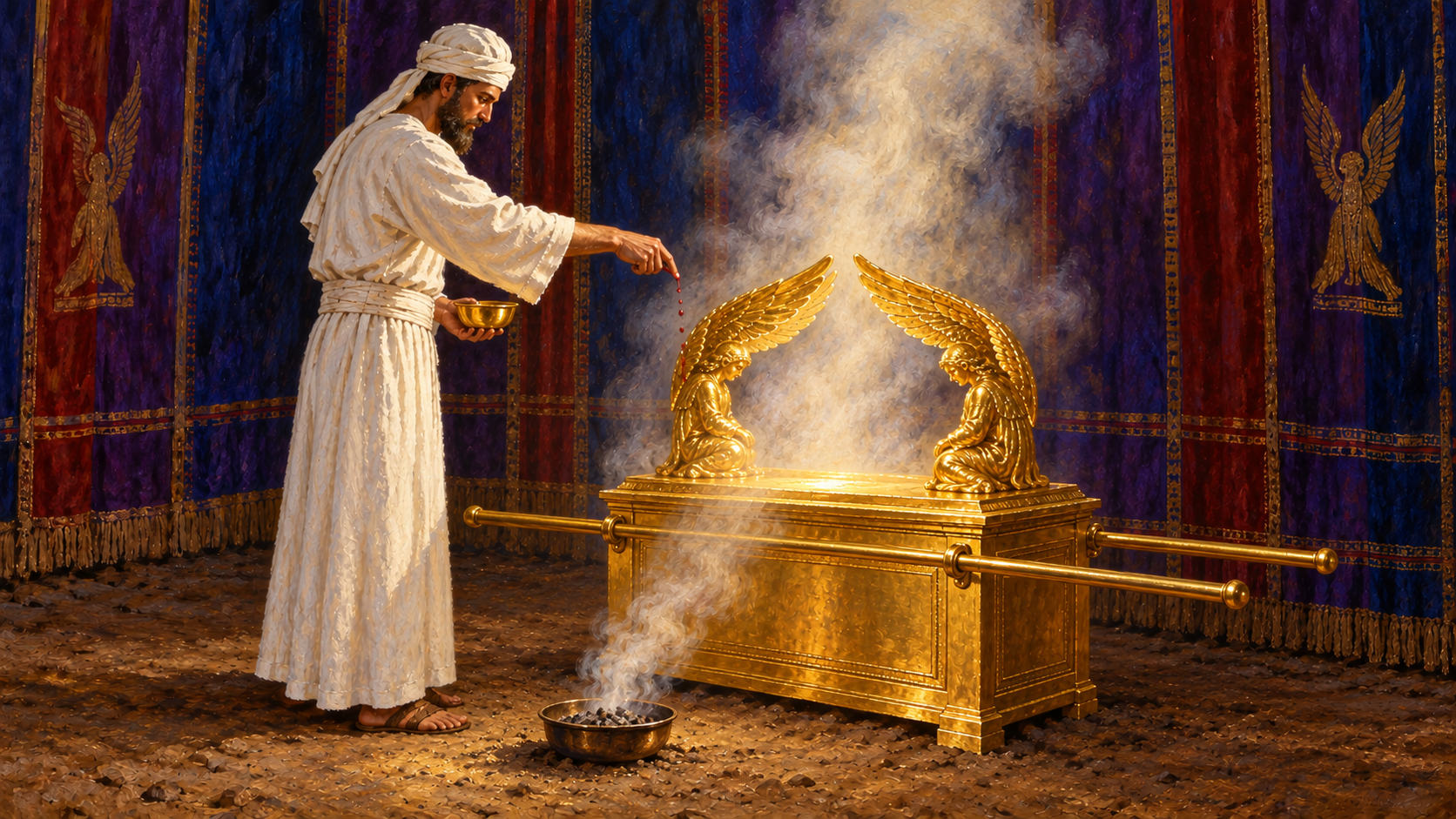
The mercy seat was the cover of the ark, but that description alone does not explain why it had such an important place in Israel’s worship. Why did God appoint a place where blood would be sprinkled and He would meet with His people? I want to understand how that provision on the Day of Atonement points us to Jesus’ sacrifice and priesthood, and what it means for us to come to God through Him now.
The Ark and the Place Where God Met Israel
God told Moses to make the ark from acacia wood and overlay it with pure gold. It stood in the Most Holy Place, the innermost room of the tabernacle. The stone tablets of the covenant were placed inside it. Hebrews also connects the ark with the golden pot of manna and Aaron’s rod that budded, so the contents bore witness to both God’s faithfulness and Israel’s history with Him.
The covenant recorded on the tablets was good, holy, and just. Yet those tablets also testified against people who had not kept it perfectly. Aaron’s rod recalled Israel’s challenge to the leadership God appointed, while the manna recalled His wilderness provision and the people’s repeated doubts. I cannot look at those reminders only as signs of God’s faithfulness. They also show how His people rebelled against the faithful God who dwelt among them.
God called the ark’s cover the mercy seat and commanded that it be made of pure gold. There was a cherub at each end, with their wings spread above the cover. The Hebrew word kapporet is related to kaphar, the language of atonement, which helps us understand the purpose of this cover. It stood over the covenant testimony as God’s provision for people whose guilt the law exposed. The law was not a mistake to be hidden; the people needed God’s mercy because they had broken it.
In Exodus 25:21-22, God said He would meet Moses and speak with him from above the mercy seat, between the cherubim. Psalm 99 describes the Lord as reigning and dwelling between the cherubim. We should not picture Him confined to the ark as though He were a local god. Heaven is His throne and earth His footstool. He chose the earthly sanctuary as a sign of His presence and rule among His covenant people.
Israel could not control God by possessing the ark. When the nation treated it as a weapon or talisman in battle, the Lord allowed it to be captured. That should keep me from confusing a religious object with authority over His presence. The God who graciously provided a way to meet with Him remained the holy King who determined how people could approach.
When Isaiah saw the Lord high and lifted up, he immediately confessed his uncleanness. I find comfort in God’s presence, but I cannot forget that His holiness is dangerous to an unclean sinner. The mercy seat did not make Him less holy or make our guilt less serious. It showed that God Himself would provide mercy so guilty people could be cleansed rather than consumed by the judgment they deserved.
The Day of Atonement and the Cost of Access
Leviticus 16 places the mercy seat at the center of the annual Day of Atonement. Aaron washed and put on the garments God prescribed, then offered a sacrifice for his own sin before offering for the people. Every part of the service had to follow the Lord’s instructions. Being high priest did not make Aaron fit to enter God’s presence on his own. He needed cleansing and blood just as the people did.
Aaron then offered the goat of the sin offering for Israel and carried its blood inside the veil. He sprinkled it on and before the mercy seat to make atonement for the holy place because of Israel’s uncleanness and transgressions. No one but the high priest could enter that room, and even he could come only at the appointed time with blood.
Leviticus also describes the live goat over which Israel’s sins were confessed before it was sent away. The slain goat showed that sin required a death God accepted, while the live goat pictured guilt being carried away from the people for whom atonement was made. I see both the cost of dealing with sin and the removal of guilt in that service. Yet it had to be repeated every year because it could not provide the final cleansing Christ would later accomplish.
God explains the place of blood in Leviticus 17:11. The life of the flesh is in the blood, and He gave it on the altar to make atonement for souls. We should understand the blood in connection with the life poured out through the death of the sacrifice He appointed. It had no independent power as a ritual substance apart from that death.
That helps me understand why Scripture speaks so often about Christ’s blood. Jesus truly suffered and shed His blood in death, bearing in His innocent body the punishment our sins deserved. Our redemption cost the sinless Son His life on the cross. I do not want language about sacrifice to become so familiar that I lose sight of what He actually endured.
Carrying out the animal sacrifices did not automatically save a person. They showed believing Israel the need for a perfect Redeemer and directed them toward God’s promise. Their blood pictured cleansing, but Christ’s blood truly cleanses the conscience. Through Him we receive eternal redemption and a right standing before God.
The priest’s preparation shows me why approaching God cannot rest on personal merit. Religious excitement could not open the way, and the right family connection was not enough. Moral effort could not erase guilt either. Access was costly, but it remained God’s gift because He made the provision and determined how His people could come.
Christ Fulfills What the Mercy Seat Foreshadowed
Jesus fulfilled the sanctuary pattern through His own person and work. He is the sinless Lamb who gave Himself for sin, and He is also the High Priest who represents His people before God. As Mediator of the new covenant, He brings them to God. His death answers the judgment of sin, while His resurrection and ascension establish His living priestly ministry. We are looking to Him as the fulfillment, not to another earthly mercy seat made of gold.
Romans 3 begins by showing that Jews and Gentiles are both under sin and that no one is justified by works of the law. Paul then explains how God’s righteousness is revealed apart from the law through faith in Jesus Christ. God set Christ forth by His blood, showing that He does not overlook sin or excuse it out of sentiment. He remains just while declaring the person who has faith in Jesus righteous. That is why I can receive His mercy without treating my guilt as something He simply ignored.
In Romans 3:25, Paul uses the Greek word hilasterion. It can refer to propitiation, the sacrifice that answers righteous judgment, and it has a strong connection with mercy-seat language in the Greek Old Testament. Understanding that word helps us recognize the connection Paul is making. I do not take it to mean that every detail of the gold covering must describe Jesus exactly. The saving provision pictured at the mercy seat becomes reality in the sacrifice God provided through His Son.
The Father and Son were united in providing that sacrifice. The Father loved the world and sent His Son, who loved us and willingly gave Himself. The Holy Spirit unites believers to Christ. So when we speak of propitiation, we are speaking of God’s united work to answer righteous judgment and extend mercy to guilty people, not a quarrel within the Godhead.
Through His once-for-all sacrifice, Christ truly deals with guilt instead of hiding sin for a time. Those who trust Him are forgiven and justified, meaning that God declares them righteous. They are reconciled to God and welcomed into fellowship with Him. Jesus can bring God and humanity together because He is fully God and fully man, and He alone is our Mediator.
The law beneath the mercy seat and the blood above it help me see why God’s mercy does not set righteousness aside. The law exposed guilt, and God provided atonement rather than treating sin as harmless. Christ fulfilled the law and bore sin’s penalty, and He gives His righteousness to those who believe. His mercy answers the guilt truth exposes without compromising His holiness.
The Better High Priest and the Open Way
Hebrews describes the tabernacle as a copy and shadow of the greater reality in Christ’s priesthood. While that earthly order remained, the way into the holiest had not yet been openly displayed. Every year’s sacrifices reminded worshipers that the work was unfinished. Those repeated services could not give them a perfected conscience.
Aaron had to offer a sacrifice for himself before serving on behalf of others. Jesus never needed to do that because He is holy and completely without sin. His righteous life made Him the perfect High Priest, and His shed blood was the sufficient sacrifice. That difference gives me confidence in the One who represents us before God.
Christ entered the heavenly reality through His own blood and obtained eternal redemption. Hebrews says He appeared once to put away sin by the sacrifice of Himself, so He does not return year after year to offer Himself again. When we take communion, we remember His body and blood and proclaim what He accomplished. We do not repeat the sacrifice He completed at the cross.
The One who offered that sacrifice also lives forever to intercede for those who come to God through Him. Jesus is not merely an example we preserve in a ceremony. His continuing life and priesthood are why Hebrews says He can save to the uttermost. I can rest in a living High Priest whose ministry will never end.
When Jesus died, the temple veil was torn from top to bottom. That was an actual event, and Hebrews helps us understand what it means for believers. Through Christ’s flesh and blood, we can now enter the holiest with boldness and draw near to God.
The torn veil does not mean holiness disappeared or every spiritual path became acceptable. It means Christ has dealt with the sin that kept us from God, in the one way God provided. Jesus is the way, the truth, and the life. No one comes to the Father except through Him.
Because Christ is our sufficient High Priest, I can pray directly to the Father through Him. I do not need a human priest to offer another sacrifice or stand between me and God, and that access belongs to every believer. We can confess sin and seek the Lord’s help as we worship Him without another earthly mediator. Nor do we need to recreate the mercy seat in a church building or at home. The sanctuary pattern has reached its fulfillment in Christ Himself.
Coming to the Throne of Grace
Hebrews 4:16 invites believers to come boldly to the throne of grace to receive mercy and find grace to help in time of need. We can come because Jesus is our great High Priest. He understands human weakness and sympathizes with us, yet He never sinned. Our need does not put us beyond His care.
I need to remember why that invitation gives me confidence. Christ’s blood opened the way; my need did not make me worthy. God still rules from His throne, and the grace He gives remains a gift. We can therefore come boldly without becoming careless or arrogant. Even when guilt makes a believer want to hide, Christ gives us reason to confess plainly and come to the Father for cleansing and help.
We can draw near in weakness and temptation because our High Priest understands weakness without ever having surrendered to sin. The throne of grace gives us no excuse for disobedience. God meets us there with mercy when we fail and strength to keep walking with Him.
The mercy seat should help us understand holiness and mercy together. Nadab and Abihu offered unauthorized fire, and Uzzah treated the ark irreverently when he touched it. Their actions and the warnings surrounding the sanctuary show that God’s presence must never be treated as common. Knowing that history should teach me reverence. Being familiar with religious things is not the same as knowing God rightly.
Our security in Christ never gives us permission to neglect holiness. The God who provided Israel’s atonement also called His people to obey His covenant. Under the new covenant, grace changes the heart so that obedience becomes a grateful response to mercy. It does not release us into lawlessness.
1 Peter connects holy living with redemption by Christ’s precious blood, like that of a lamb without blemish and without spot. The blood that brings us near to God also identifies us as His people. Because I have been bought with that price, His truth should govern what I say and how honestly I deal with others. Our bodies belong to the Lord, so we turn from sexual sin. Having received His mercy, we should also learn to forgive and treat our neighbors with love.
When we fail, we can come again to the God who has already made provision in Christ. We do not need to return to fear or try to atone for ourselves. Instead of defending our sin, we confess it and receive His cleansing so we can continue in obedience. I see no reason for despair or presumption when the mercy God offers in His Son is both holy and sufficient.
Christ’s provision should shape how we worship together. We gather joyfully because He opened the way to God, and we come humbly because opening that way required His blood. Since His sacrifice is complete, that humility can be accompanied by confidence. We need neither another sacrifice nor another mediator to approach God, and access does not depend on a hidden holy room. The risen Christ is enough.
Related Studies
The Atonement of Jesus Christ: This study explains Christ’s substitutionary sacrifice and shed blood.
The Tabernacle: This study traces the sanctuary’s structure and its testimony to Christ.
The High Priest: This study examines Christ’s enduring priesthood and intercession.
Hebrews: This study explores the better covenant and Christ’s once-for-all sacrifice.
My Final Thoughts
The mercy seat shows me how the holy God made a way for guilty people to approach Him. He desired to be with His people, but they could approach only through the provision He gave. That gold cover in Israel’s tabernacle pointed forward to what Jesus accomplished through His shed blood and living priesthood. Because Christ fulfilled the pattern, I do not need to hide from God or invent another way to reach Him. I can come through Jesus with reverence and confidence, receiving mercy in my need and responding to His grace with grateful obedience.