
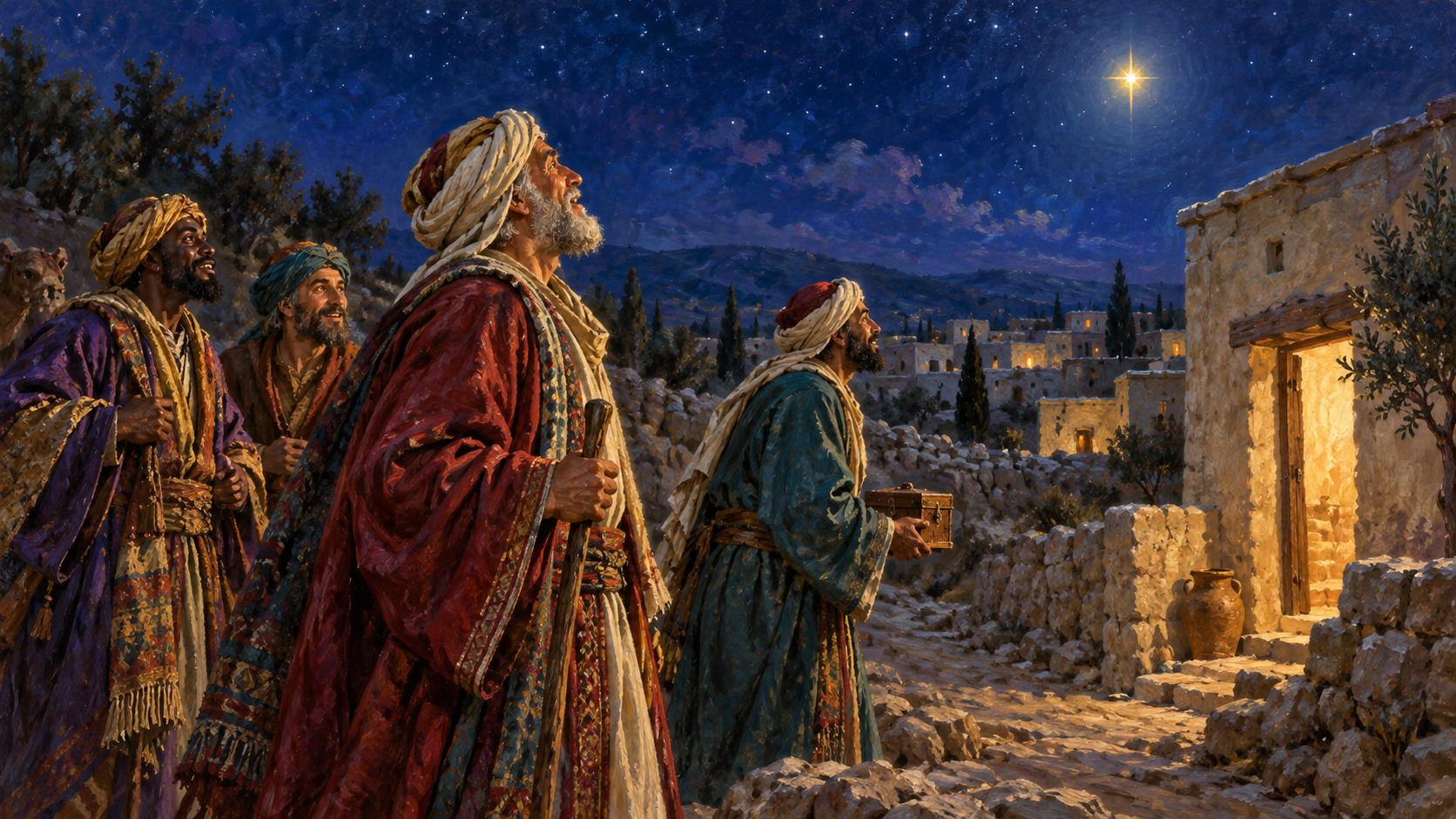
What was the star that led the Magi to Jesus? I can follow what Matthew says it did, but he never tells us what kind of object or light it was. That leaves room to consider several possibilities, provided we don’t lose sight of the King God was leading these men to worship.
Matthew’s Account of the Magi
Matthew is the only Gospel writer who records the visit of the Magi. After Jesus was born in Bethlehem of Judea during the reign of Herod, these men came from the East to Jerusalem. They asked, “Where is He who has been born King of the Jews? For we have seen His star in the East and have come to worship Him” (Matthew 2:1-2). Their question troubled Herod, and the rest of Jerusalem was disturbed with him.
Herod gathered the chief priests and scribes to ask where the Christ would be born, and they identified Bethlehem from Micah 5:2. He then met with the Magi in secret to learn when the star had appeared. He sent them toward Bethlehem while pretending that he also wanted to worship the child (Matthew 2:3-8).
After they left Herod, the Magi saw the star again. Matthew says that it went before them until it stood over the place where the young Child was. Filled with joy, they entered the house and saw Jesus with Mary His mother. They fell down before Him in worship and opened their treasures to give Him gold, frankincense, and myrrh (Matthew 2:9-11).
The word translated Magi broadly refers to learned men from the East who were associated with royal courts and the search for wisdom. Their work could include interpreting dreams and observing the heavens. Matthew does not name their homeland, though they may have come from a region connected with Babylon, Persia, or Arabia. Israel’s long exile had made Jewish Scripture and hope known in the East, and Daniel’s ministry had been public in imperial courts. That background interests me, but it doesn’t tell me exactly what these men knew. Matthew leaves unexplained both their earlier knowledge and how they understood the star.
Scripture never gives their number or names either. The familiar picture of three kings comes from tradition and the three gifts, but Matthew does not call them kings or say there were three men. I don’t want those familiar details to obscure what we do know: God brought Gentile seekers to worship His Son.
Their visit introduces a theme that runs through Matthew. Jesus is Israel’s Messiah, yet His kingdom reaches the nations, as we see again in the command at the end of the Gospel to make disciples of all nations. The Magi’s worship gives us an early glimpse of that blessing. The nations receive it through Israel’s Messiah without taking Israel’s place.
Isaiah 60:1-6 looks ahead to the nations coming to Israel’s light and bringing gold and incense. When I read that promise, I can see why Gentile worshipers bringing costly gifts belong in the hope the prophets describe. Matthew does not quote Isaiah here, so I wouldn’t assign a direct fulfillment to every detail as though he had done so. The larger promise still helps us understand their visit: God’s light through Israel would draw the nations to Him.
What the Star Did and What We Cannot Know
Matthew calls the light “His star.” The Magi first saw it in the East and connected it with the birth of the King of the Jews. After leaving Jerusalem, they saw it again as it went before them and stood over the place where Jesus was. Before trying to name the star, I need to account for that guidance.
How would the ordinary movement of a distant star mark one house for travelers on the ground? That is the difficulty I see with explaining the final part of the journey as an ordinary astronomical event. God could have used a heavenly body, an extraordinary light, or some other providential means. Matthew leaves those questions open while showing us that God directed the Magi to His Son.
Proposed explanations range from a conjunction of planets to a comet or the sudden brightness of a nova or supernova. Others understand the star as an angelic appearance or a wholly miraculous light. We can consider those historical questions honestly without being afraid of them. God created everything in the heavens and rules it all.
None of those proposals can be proved from Scripture. A conjunction might explain why observers noticed something unusual, but I still have to ask how it would mark one house. Comets and novas leave that same question unanswered. A special miraculous sign fits the directed guidance, though Matthew gives no technical description that would let us say how it worked.
Some Christians connect the star with the visible glory of the LORD in the Old Testament or with the glory that shone around the shepherds in Luke 2. I can see the connection they are considering, but Matthew does not identify the star that way. Luke explicitly connects the light around the shepherds to an angelic announcement on the night of Jesus’ birth, while Matthew gives a separate account of the Magi and the star. They share a theme of divine light. Identifying the lights as the same remains a possibility rather than something Matthew tells us.
I’m content to leave the star’s exact nature unanswered where Scripture leaves it unanswered. The Bible gives us enough to worship Christ without settling every modern reconstruction. Nor does this account authorize astrology or the reading of omens. Israel was forbidden to seek guidance from the host of heaven, so we shouldn’t build doctrine on astronomical calculations or look to horoscopes and secret signs for direction. The God who made the stars guides His people through His Word and providence.
Bethlehem and the Fulfillment of Israel’s Story
When Herod asked where the Christ would be born, the scribes quoted Micah 5:2. Bethlehem was small among Judah’s clans, yet the promised Ruler of Israel would come from there, and His goings forth were from everlasting. The town’s smallness could easily draw my attention away from what Micah says about its promised Ruler. He came from David’s town as the promised Davidic King, whose greatness did not depend on Bethlehem’s prominence.
God had named Bethlehem in His promise and used Jesus’ birth there to reveal His identity. The fulfillment does not give the town itself saving power. Nor was it something Mary and Joseph manufactured. God directed history through the census and David’s family line, bringing about the circumstances of Jesus’ birth in keeping with His word.
Numbers 24:17 speaks of a star coming from Jacob and a scepter rising from Israel. In its immediate setting, Balaam’s oracle looks to a ruler who will defeat Israel’s enemies, and Christians rightly see that royal hope reaching its final fulfillment in Christ. I would distinguish that fulfillment from a claim about the light the Magi followed. Matthew does not quote Numbers 24 or directly identify its star with the Bethlehem star. The shared royal imagery helps us recognize the King without settling the physical nature of the sign.
Matthew continues to show how Jesus fulfills what God had been revealing through Israel’s history. The flight to Egypt recalls Hosea 11:1: “Out of Egypt I called My Son.” Hosea first looked back to Israel’s exodus, but Matthew shows Jesus, the true Son, entering Israel’s history and obeying where the nation failed. Herod’s slaughter recalls Jeremiah’s picture of Rachel weeping for her children, and the return to Nazareth completes the chapter’s pattern of fulfillment.
I don’t read these as detached predictions that Matthew could attach to any event he chose. Jesus is the promised King and faithful Son at the center of God’s unfolding work through Israel. His coming brings the promised blessing to the nations as God keeps His word to Israel and opens the way for Gentiles to worship Israel’s Messiah.
Herod’s Hostility and the Magi’s Worship
Herod claimed that he wanted to worship Jesus, but he intended to kill Him. He saw the newborn King as a threat to his own rule. When the Magi did not return, Herod ordered the death of the boys in Bethlehem and the surrounding area who were two years old and younger. He based that range on the time he had learned from the Magi (Matthew 2:16).
Herod’s age limit doesn’t tell us that Jesus was two years old when the Magi arrived. He may have widened his order because he was uncertain and wanted to eliminate every possible rival. I also notice that Matthew calls Jesus a young Child and places the visitors in a house. He isn’t describing the stable on the night of Jesus’ birth, though he doesn’t give us the exact interval between the birth and their arrival.
Herod’s violence fulfilled Jeremiah’s lament without making his evil good. God can foretell and overrule human sin without being its author. We see that distinction here as Herod opposes the true King and God carefully preserves His Son. The fulfillment gives me confidence in God’s providence, not a reason to excuse Herod’s sin.
The Magi rejoiced when the star led them onward and then fell down to worship Jesus. Their response was very different from Herod’s. Scripture’s fuller witness helps us understand why this Child was worthy of the worship that belongs to God: He is the eternal Son, fully God and fully man. Born of a virgin, He was far more than a gifted child who would grow into a great teacher.
That contrast doesn’t mean every Gentile received Jesus or every Jew rejected Him. I only have to look at Mary and Joseph to see Jews who trusted God’s promise. The shepherds did too, as did Simeon, Anna, and the first disciples. Matthew shows the significance of the King of the Jews for the nations from the beginning without denying the faith of these Jewish believers.
The gifts honored Jesus and His family. Gold was precious and suited to a king, while frankincense and myrrh were costly resins used in incense and perfume. Myrrh also had a place in burial preparations. Christians have often connected these gifts with who Jesus is and what He came to do. In that symbolic reading, gold points to kingship and frankincense to deity or priesthood, while myrrh points to suffering and death. I can appreciate those devotional reflections because Scripture elsewhere presents Christ as King and High Priest as well as the suffering Savior. Matthew himself does not assign those meanings to the gifts, so I wouldn’t present the later symbolism as his stated interpretation.
We don’t have to assign a meaning to each gift to see the Magi’s generosity as they opened their treasures before the King. Their worship makes me think about what I do with my own resources. A gift cannot purchase salvation because only Christ’s blood saves, but receiving Him gives us reason to respond with gratitude and use what we have for His purposes.
God’s Guidance and the Response of Faith
God warned the Magi in a dream not to return to Herod, so they went home another way. An angel also appeared to Joseph in a dream and told him to take the young Child and His mother to Egypt because Herod would seek His life. Joseph obeyed, and the family remained there until Herod died (Matthew 2:12-15).
God gave these particular dreams to guide the Magi and Joseph during the incarnation. That doesn’t make every dream a message from Him. If I believe a dream or personal impression is directing me, I must test that claim by Scripture. God still works through providence, but His written Word remains our final authority and no spiritual claim can contradict it.
The religious leaders in Jerusalem could point Herod to the passage naming the Messiah’s birthplace, yet Matthew never describes them traveling the short distance to Bethlehem. The Magi came from far away with limited information and acted on what they learned. I notice the difference between being able to give the right answer and responding to it.
That leaves me with something to examine in my own response to Scripture. Knowing what it says is precious, but knowledge by itself isn’t the same as trusting and obeying Jesus. A person can discuss prophecy or attend church while still refusing the King the Bible points to. Herod even used religious information to serve his murderous ambition, while the Magi acted on what they had received and sought the King. The star could guide them to Jesus, but responding in worship was something they had to do themselves.
Jesus Christ Is the True Light
Throughout Scripture, light helps us understand God’s revelation and saving work. John says that life was in the Word and that life was the light of men, shining in the darkness (John 1:4-5). Jesus later says, “I am the light of the world” (John 8:12). With those words in mind, I don’t want my interest in the star to overshadow the One it pointed to. The sign directed attention to Jesus, who is the center of the message.
Jesus reveals the Father and exposes our sin. He also offers forgiveness and gives eternal life. He physically bore the punishment for our sins in His innocent body at the cross, where He was tortured and shed His blood. He died and was buried, then rose bodily from the grave on the third day. Everyone who repents and believes receives life through Him.
Revelation describes the final city as needing neither sun nor moon because God’s glory illuminates it and the Lamb is its light (Revelation 21:22-24). That promise won’t tell me the exact nature of the Bethlehem star, but it gives me far more to look forward to than an answer to that question. The Lamb will dwell with His redeemed people in glory that never fades. The Bible’s theme of light leads us to that lasting hope.
The related studies on the birth of Jesus, the Gospel of Matthew, the deity of Jesus, and Jesus Christ develop those truths in greater depth.
My Final Thoughts
I cannot name the star’s physical nature with certainty, but I can see whom God used it to reveal. He brought Gentile Magi to Israel’s promised King, with the Scripture they heard in Jerusalem directing them onward to Bethlehem. They worshiped Him while Herod tried to protect his rule by destroying Him, and Matthew records no similar response from the leaders who knew the prophecy. I don’t want to become so absorbed in the sign that I fail to respond to Jesus myself. We should refuse superstition and receive Christ by faith, allowing what we know about Him to lead us into genuine worship.