
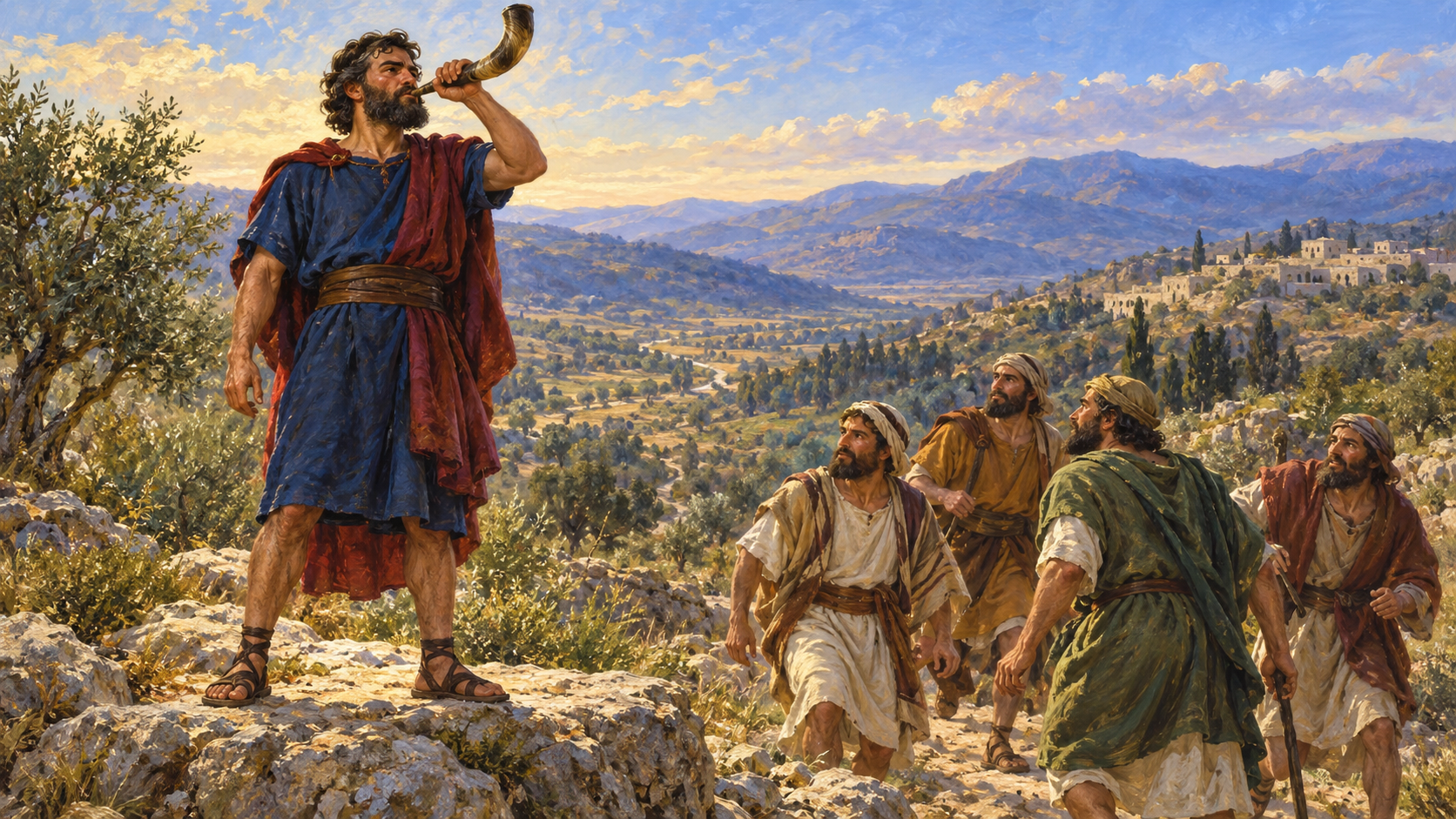
God raised Ehud, a left-handed Benjamite, to deliver Israel from Moab. Ehud killed the king who oppressed them and then led the Israelites in defeating the Moabite forces. The violence is difficult to read, but it belongs within a definite account of Israel’s rebellion, God’s judgment, and His mercy. I want to understand that setting before drawing conclusions about what Christians should do today.
Israel’s Sin and Moab’s Oppression
Judges repeatedly describes people turning from the LORD, coming under oppression, and crying out for help. God raised deliverers, but the relief did not produce lasting faithfulness. After a judge died, Israel returned to corruption, often becoming worse than before. Judges 2 traces that pattern to a generation that did not know the LORD or remember what He had done for Israel (Judges 2:10–19). Religious identity did not keep their hearts from following other gods.
After the earlier deliverance under Othniel, Israel again did evil in the LORD’s sight. God strengthened Eglon king of Moab against them. Eglon gathered the Ammonites and Amalekites, defeated Israel, and occupied the City of Palms, Jericho. Israel served him for eighteen years (Judges 3:12–14). The tribute Israel sent was a concrete expression of that subjection: the conquered people were supplying the ruler who held power over them.
The passage tells us why God permitted this oppression. Deuteronomy had warned that persistent covenant rebellion would bring defeat and bondage in the land (Deuteronomy 28). Israel had received His commands and rejected them, so Eglon’s success did not mean Moab’s gods were stronger than the LORD. God was disciplining His own people. His use of an oppressive ruler did not make that ruler’s oppression righteous.
When the Israelites cried out, the LORD raised Ehud son of Gera, a Benjamite, as their deliverer (Judges 3:15). God’s action comes before the account of Ehud’s strategy. He heard their cry and provided the man through whom He would rescue them. The book of Judges follows this recurring pattern of judgment and mercy.
Ehud, His Left Hand, and the Hidden Dagger
The Hebrew phrase describing Ehud is usually translated “left-handed.” It can also be understood as “restricted in his right hand,” and interpreters differ over whether it implies a physical limitation or simply describes his use of the left hand. The Hebrew expression concerns his right hand being restricted, but it does not establish a medical diagnosis. We know that he used his left hand effectively; we are not told why.
Benjamin means son of the right hand, so a left-handed Benjamite is a memorable description. But the passage does not turn that contrast into a secret symbol. Ehud made a double-edged dagger, described in the NKJV as a cubit long, and fastened it under his clothing on his right thigh (Judges 3:16). His left hand would reach that concealed weapon when the opportunity came.
Israel sent him to deliver tribute to Eglon. After presenting it, Ehud sent the carriers away and began the return journey. At the carved images near Gilgal, he turned back and told the king he had a secret message. Eglon ordered those attending him to leave and received Ehud in his private upper room (Judges 3:17–20).
Ehud said he had a message from God, and Eglon rose from his seat. Ehud reached with his left hand, drew the dagger from his right thigh, and killed him. The weapon remained in the king’s body. Ehud went out, shut the doors of the upper room behind him, and locked them (Judges 3:20–23).
When the servants returned, they found the doors locked and assumed Eglon was relieving himself. They waited until the delay became embarrassing, then opened the room with a key and found him dead. While they waited, Ehud had escaped past the carved images and reached Seirah (Judges 3:24–26). Their mistaken explanation of the locked room gave him time to get away.
The LORD Delivered Israel and Gave Rest
The king’s death did not by itself free Israel from Moab’s forces. Ehud sounded the trumpet in the mountains of Ephraim and led the Israelites down, telling them to follow because the LORD had delivered their enemies into their hand. They seized the Jordan fords leading toward Moab and prevented the Moabites from crossing. Israel killed about ten thousand Moabite fighting men, and none of that force escaped (Judges 3:27–29).
Moab was subdued, and the land had rest for eighty years (Judges 3:30), the longest period of rest recorded in Judges. The people who had supplied tribute for eighteen years now had relief from their oppressors. Ehud had planned, taken a grave risk, and led the battle, but his own announcement credited the LORD with the deliverance. The victory was no proof that his ingenuity made him independent of God.
The eighty years of relief were a real mercy, but outward peace could not make Israel’s heart faithful. The next cycle begins with renewed evil after Ehud’s death (Judges 4:1). A generation can enjoy the benefits of deliverance and still turn away from the God who gave them. Peace in a nation, church, or household should produce gratitude, not the assumption that there is nothing left to examine.
Ehud’s work also teaches us to hold courage and dependence on God together. Ehud did not remain passive when God raised him to serve, and his careful preparation was part of what happened. Yet his ability did not make him the source of Israel’s salvation. When God gives me an opportunity or an ability to serve, I have reason for gratitude rather than a claim to greatness.
We must also keep the explanation of Israel’s oppression within the limits Scripture gives. God explicitly connects this particular defeat to Israel’s sin. That does not authorize me to identify a hidden sin behind someone else’s illness, financial loss, or grief. Job’s friends wrongly treated suffering as proof of guilt. Christians can suffer while remaining faithful, and a hard season alone does not disclose God’s reason for allowing it. We can ask Him for relief without assuming He has promised to end a hardship immediately.
I want to thank God when He answers prayer, provides a wise leader, or brings relief from hardship. But a political victory or a settled period is not the kingdom of God in its fullness. Jesus gives rest to those who come to Him, and Paul writes in Hebrews about the rest that remains for God’s people. We continue in faith while looking to the risen King, whose final victory will remove every enemy, including death.
What Ehud’s Deliverance Does Not Tell Christians to Do
Ehud’s concealment, deception, and killing raise ethical questions the chapter does not pause to discuss in detail. We should neither turn the physical details into entertainment nor detach his actions from Israel’s national conflict. Scripture presents him as the deliverer God raised for covenant Israel in that period. It does not commission modern Christians to deceive officials, assassinate rulers, or appoint themselves agents of divine judgment.
The church is not ancient Israel occupying the land under that covenant arrangement. Christians are not instructed to spread the gospel by weapons or punish people for refusing the faith. Jesus told Peter to put his sword back in its place, and Paul tells believers to leave vengeance with God and overcome evil with good (Matthew 26:52; Romans 12:17–21). A person’s claim to have a divine mission cannot override those instructions.
Civil government has a responsibility to restrain wrongdoing, and that responsibility differs from private vengeance or coercing faith. We can pray for rulers, speak truthfully, and support righteous justice. If an order requires us to disobey God, we must refuse it, but that refusal gives us no authority to carry out our own violent judgment. The study on the justice of God examines His judgment and our accountability.
We should also resist assigning symbolic identities the passage does not provide. Hebrews 4:12 describes God’s Word as sharper than a two-edged sword, but that does not make Ehud’s dagger a code for the Bible. Nor does a secret meeting with Eglon establish a rule that private spirituality guarantees public success. Jesus calls us to pray in secret because our Father sees there (Matthew 6:6). We can obey that command without demanding a visible result on our own schedule.
Ordinary Servants and the Church’s Spiritual Warfare
Ehud’s left hand served his task, but the account gives us no promise that every limitation will become a tactical advantage. I would not tell someone with a disability that faithfulness requires turning it into a conspicuous achievement. A person’s worth comes from being made in God’s image, rather than from being publicly impressive or useful. God gives different people different gifts and responsibilities.
Other servants also needed to learn dependence on Him. Moses feared his inadequacy, Gideon spoke of his weak clan, David was the youngest son, and Paul learned that God’s power was made perfect in weakness. Their circumstances were different, but none could claim that personal strength supplied everything necessary for serving God. We need His help whether our weakness is obvious to others or carefully hidden.
The church should value faithful service that draws little attention. A believer who cares patiently for someone, opens a home, teaches the truth, or does an honest day’s work is not doing inferior service because nobody applauds. Prayer and a timely word of encouragement may help someone endure a difficulty we do not see. We should not overlook such work while admiring a more visible leader.
These same believers are called to stand against spiritual evil, and the New Testament gives them weapons for that struggle. Ephesians 6:10–18 tells believers to stand in the Lord’s strength, clothed with truth, righteousness, readiness in the gospel of peace, faith, salvation, and the Word of God, the sword of the Spirit. Prayer accompanies that whole dependence on Him. We resist the devil by trusting Christ and obeying His Word, not by copying Ehud’s attack.
The devil is real, but a hardship does not automatically prove that a demon caused it. Neither can we invent commands or theatrical declarations and assume Christ’s name authorizes them. Every spiritual claim must be tested by Scripture. The study on spiritual warfare considers that dependence on the Lord and the weapons He actually gives His people.
Paul says our weapons are not carnal, or merely human, but are used to overthrow arguments and proud ideas raised against the knowledge of God (2 Corinthians 10:3–5). The apostolic witness confronted falsehood and unbelief through the truth of Christ. Believers preached, prayed, endured suffering, and loved sacrificially. They did not force people to confess faith at sword point.
We therefore oppose evil by telling the truth, naming sin as God does, praying for those caught in deception, and caring for those harmed. As we carry them out, we follow the Lord who was crucified and rose again, even if that obedience attracts less attention than displays of worldly power.
Jesus Christ, the Greater Deliverer
Ehud freed Israel from Moab but could not remove sin or give the nation an eternal kingdom. Political relief cannot clear a guilty conscience, and a religious ritual cannot create a new heart. The repeated failures in Judges expose our need for a Deliverer who can deal with the bondage within us, as well as judge evil outside us.
Jesus Christ is the eternal Son, fully God and fully man, born of a virgin and entirely without sin. He came to seek and save the lost. Wicked men tortured and crucified Him, and He willingly bore the punishment for our sins in His innocent body. He shed His blood and died, completing His saving sacrifice before His burial. The Father did not punish, curse, abandon, strike, bruise, or pour wrath on Jesus. The Father, Son, and Holy Spirit were united in the work of salvation. On the third day He rose bodily from the grave.
Because Christ died for the whole world, His invitation to repent and believe is genuine for every person. People can resist His grace, but those who trust Him are forgiven and born again. Every true believer becomes a new creation, indwelt and sealed by the Holy Spirit and eternally secure in Christ. Obedience is the fruit of that new life, rather than a means of earning or keeping salvation; security gives no permission for lawlessness.
Jesus will return bodily to judge evil, deliver Israel, and reign in righteousness. The temporary peace Israel enjoyed after Ehud’s victory could not bring the lasting justice and rest His kingdom will establish. We can receive present mercies with gratitude while awaiting the Deliverer whose work reaches beyond another cycle of national relief.
My Final Thoughts
Ehud acted courageously, but the LORD heard Israel’s cry and provided their deliverance. I need to remember both God’s righteous discipline and His mercy, without turning this account into permission for private vengeance or a promise that my own strategy will always succeed. Christians are called to truth, prayer, and faithful service under Christ’s authority. The rest Ehud brought was temporary; Jesus saves sinners and will reign in a kingdom that does not end. That greater deliverance gives us reason to serve humbly now and trust Him when obedience attracts little notice.