
Abimelech ruled over Israel, yet he never delivered Israel from anyone. That makes me ask why his life appears in Judges alongside men God raised up to rescue His people. Judges 9 follows a man who seized power for himself and shows how the violence he used eventually turned against him.
Gideon’s House and a Son Who Wanted a Throne
In Judges, Israel often turned from the LORD and fell under an enemy’s power. When the people cried out, God raised up a judge to deliver them. Abimelech’s conduct was very different. He took advantage of Israel’s spiritual decline to make himself king, without rescuing the nation or leading the people back to the LORD. He was one of the darkest figures in the book.
Abimelech is sometimes discussed with the judges because his life is recorded in Judges and because Judges 9:22 says he ruled over Israel for three years. But I cannot take his inclusion in the book as God’s approval. Scripture presents him as a usurper, someone who seized power, rather than a righteous deliverer. He gained his throne through idolatrous funding and murder. The compromised men who crowned him could give him power for a time, but they could not keep him from God’s final judgment.
I believe the last two verses of the chapter tell us how to understand everything that came before them:
“Thus God repaid the wickedness of Abimelech, which he had done to his father by killing his seventy brothers.”
“And all the evil of the men of Shechem God returned on their own heads, and on them came the curse of Jotham the son of Jerubbaal.”
God saw Shechem’s treachery and the bloodshed, and He remembered Jotham’s warning. Abimelech had gained a crown through violence, but becoming king did not put him beyond the LORD’s judgment. Those closing verses keep me from measuring his success by how much power he managed to acquire.
To understand how Abimelech came to power, we need to go back to his father Gideon, who was also called Jerubbaal. God had used Gideon to deliver Israel from Midian. After that victory, the men of Israel asked him to rule over them, with his son and grandson succeeding him. Gideon rightly answered that the LORD should rule:
“I will not rule over you, nor shall my son rule over you; the LORD shall rule over you.”
Gideon’s later conduct did not always reflect that answer. He made an ephod from gold, which Israel turned into an object of spiritual unfaithfulness. Judges says it became a snare to Gideon and his household. He had many wives and seventy sons, and his concubine in Shechem bore another son named Abimelech. We can follow the victory God gave him, along with his failures and the account of his household, in the study of Gideon.
“Gideon had seventy sons who were his own offspring, for he had many wives. And his concubine who was in Shechem also bore him a son, whose name he called Abimelech.”
The name Abimelech means “my father is king.” I notice the tension between that name and Gideon’s refusal to become king, although Scripture does not explain every reason for choosing it. I would not claim to know more than we are told. As Judges 8 leads into Judges 9, the name takes on an ominous significance: the father had said the LORD should rule, but the son acted as though kingship belonged to him.
After Gideon died, Israel turned again to the Baals and made Baal-Berith their god. The people forgot the LORD who had delivered them, and they showed no kindness to Gideon’s house for the good he had done. That spiritual collapse created the setting in which Abimelech could rise. His self-made rule also provides a dark backdrop for the later kings of Israel and the need for kingship to remain under God.
Shechem Crowned a Murderer
Abimelech went to Shechem, the city of his mother, and spoke to her brothers and the rest of her family. His argument was designed to create fear. He asked whether Shechem would rather have seventy sons of Jerubbaal rule or only one man who was their own relative.
“Please speak in the hearing of all the men of Shechem: ‘Which is better for you, that all seventy of the sons of Jerubbaal reign over you, or that one reign over you?’ Remember that I am your own flesh and bone.”
Scripture never says that Gideon’s seventy sons were campaigning to rule Shechem. Abimelech invented an urgent threat for the city to fear and then offered himself as the simple answer. He also appealed to their family relationship: “I am your own flesh and bone.” I see a man asking people to trust his kinship while he pursued power for himself.
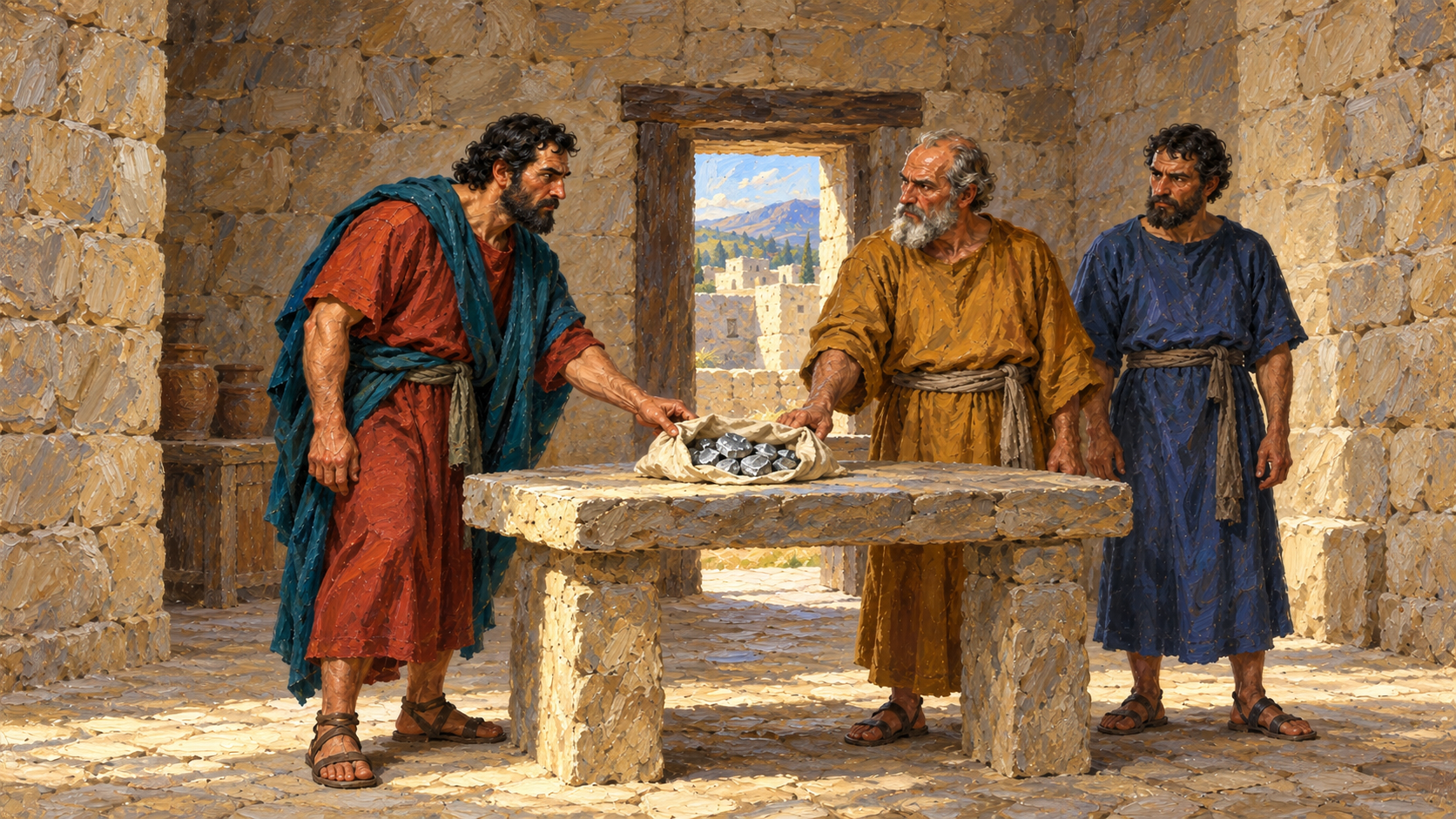
The men of Shechem accepted his argument because they considered him their brother. They supplied seventy shekels of silver from the temple of Baal-Berith, so his bid for kingship began with money from an idolatrous treasury. Baal-Berith means “lord of covenant,” or “Baal of the covenant.” Even the language of covenant had been turned toward Baal worship. Abimelech drew on that corruption to establish his rule, and we can examine its spiritual background further in the study of Baal.
| Abimelech’s method | What he used | What it revealed |
|---|---|---|
| Fear | He warned Shechem about seventy possible rulers. | He created urgency around his own ambition. |
| Family loyalty | He emphasized his mother’s kinship ties. | He turned blood relationship into leverage. |
| Idolatrous funding | He received silver from Baal-Berith. | His rule was tied to spiritual compromise from the start. |
| Violence | He hired reckless men and murdered his brothers. | His throne was built on bloodshed rather than righteousness. |
With that silver, Abimelech hired worthless and reckless men to follow him. He then went to his father’s house at Ophrah and murdered his brothers on one stone. Jotham, the youngest, survived only because he hid.
“Then he went to his father’s house at Ophrah and killed his brothers, the seventy sons of Jerubbaal, on one stone. But Jotham the youngest son of Jerubbaal was left, because he hid himself.”
Abimelech slaughtered his own brothers to remove anyone he considered a rival. These were sons of the man through whom God had delivered Israel, and their deaths served neither battlefield necessity nor justice. After the murders, the men of Shechem and Beth Millo gathered by the terebinth tree at the pillar in Shechem and made him king.
Shechem was a place where Israel should have remembered its covenant with the LORD. Near that region, God had appeared to Abram and promised the land to his descendants. Much later, Joshua gathered Israel there and called them to serve the LORD sincerely and in truth. Yet idolatrous men now gathered in that setting to crown a murderer. Knowing what had happened there before makes the betrayal more painful to consider.
I cannot judge faithfulness simply by the language people use or the family they belong to. Abimelech’s name spoke of kingship, and Shechem’s covenant memories should have called the city back to the LORD. But even the name Baal-Berith used covenant language for an idol. Sin had stripped those sacred words and family loyalties of righteousness, and none of them produced faithfulness. Their chosen course began with murder and continued through treachery until it ended in fire.
Jotham’s Bramble Warning
Jotham climbed Mount Gerizim and cried out to the men of Shechem. Gerizim was the mountain of blessing in the covenant ceremony recorded in Deuteronomy and Joshua. From that place, the son who had escaped Abimelech’s slaughter told a parable that exposed both Shechem and Abimelech. The covenant geography behind his speech is explored more fully in the study of Mount Ebal and Mount Gerizim.
“The trees once went forth to anoint a king over them. And they said to the olive tree, ‘Reign over us!’”
The olive tree refused to abandon the oil by which God and men were honored, just as the fig tree would not give up its sweetness and good fruit. The vine also refused to stop producing wine that cheers God and men. Each fruitful tree had useful work to continue instead of leaving it merely to wave over the others. After those refusals, the trees turned to the bramble.
“Then all the trees said to the bramble, ‘You come and reign over us!’”
“And the bramble said to the trees, ‘If in truth you anoint me as king over you, Then come and take shelter in my shade; But if not, let fire come out of the bramble And devour the cedars of Lebanon!’”
A low, thorny bramble with no useful fruit could not provide the shelter it promised. Yet it threatened anyone who would not trust it, which makes it a fitting picture of Abimelech. I do not understand Jotham to be condemning leadership itself. The fruitful trees continued their useful service, while the bramble sought authority and endangered the very trees it offered to shelter. The parable exposes that corrupt kind of kingship.
Jotham applied the parable to Shechem’s treatment of Gideon’s house. If they had acted with truth and sincerity, they could rejoice in Abimelech. If they had not, fire would come from Abimelech to consume Shechem, and fire from Shechem would consume him. As the chapter continues, we see that warning unfold in the destruction of both sides.
The Alliance Turned on Itself
Abimelech’s rule lasted three years, but Judges never describes that time as deliverance or peace under God’s blessing. Instead, the account explains why his alliance with Shechem began to collapse:
“God sent a spirit of ill will between Abimelech and the men of Shechem; and the men of Shechem dealt treacherously with Abimelech.”
God is holy and does not commit moral evil, so I need to keep that truth in view when I read about the spirit of ill will. He remains holy while ruling over human hearts and the consequences of sin. Abimelech and Shechem had joined in a selfish alliance financed by idolatry and secured through murder. God judged them by causing that partnership to turn against itself through the treachery already present on both sides. He would answer the bloodshed of Gideon’s sons.
The men of Shechem set ambushes for Abimelech. Gaal the son of Ebed arrived with his brothers and soon won the city’s confidence. He began mocking Abimelech and stirred Shechem toward rebellion. Zebul, the ruler of the city and an ally of Abimelech, secretly warned Abimelech and urged him to ambush Gaal.
The betrayal now spread through the alliance itself. Abimelech had betrayed his brothers, and Shechem had betrayed Gideon’s house. Shechem then turned against Abimelech, while Gaal challenged his rule and Zebul deceived Gaal to serve Abimelech. I see ambition destroying relationships throughout this account, as people turned against one another to pursue power. Judges 9 gives a vivid example of the biblical principle examined in the study of reaping and sowing.
Abimelech rose during the night and set four companies in ambush around Shechem. When Gaal saw men coming down from the mountains, Zebul mocked him until the attack could no longer be denied. Abimelech defeated Gaal, and Zebul drove Gaal and his brothers from the city.
Abimelech was not satisfied with defeating Gaal. The next day he attacked the people of Shechem as they went into the field. After capturing the city and killing its people, he demolished it and sowed the ground with salt as a sign of desolation. The people who had financed his first violence were now suffering from the power they had helped him gain.
The leaders of Shechem’s tower fled into the stronghold of the temple of the god Berith. Abimelech and his men brought branches they had cut from the trees and set the stronghold on fire. About a thousand men and women died as fire from Abimelech consumed Shechem, fulfilling Jotham’s warning. The temple that had supplied the silver for his rise could not protect the city from the man it had helped bring to power.
Abimelech Fell at Thebez
Abimelech next captured Thebez, but its people fled into a strong tower. He approached the door intending to burn it, just as he had burned the stronghold at Shechem. This time his attempt ended very differently, as God brought him down through a woman’s unexpected action:
“But a certain woman dropped an upper millstone on Abimelech’s head and crushed his skull.”
As Abimelech lay dying, he quickly ordered his armor-bearer to draw a sword and kill him so people would not say a woman had killed him. That last concern reveals how firmly pride still held him. He had murdered his brothers and destroyed cities where people were burned alive, yet his final recorded concern was the effect of his death on his reputation. I find that chilling because even then he was trying to control how others would remember him.
The armor-bearer killed Abimelech, and the men of Israel left when they saw he was dead. His fall ended the campaign of violence. The throne he wanted had brought him to a crushed skull and a shameful memory, while Shechem’s choice of a convenient relative as ruler had brought fire upon the city. Neither side escaped the judgment Jotham had pronounced.
Abimelech’s life makes me examine ambition that has no fear of God. The desire to serve or lead is not itself wrong. God raises up leaders and calls men to shepherd churches, just as He gives fathers responsibility in their homes and uses rulers to preserve civil order. The question is whether I am willing to sacrifice righteousness in order to gain control. That is where ambition departs from faithful service.
“Pride goes before destruction, And a haughty spirit before a fall.”
Shechem chose Abimelech because he seemed convenient and justified that choice by appealing to family loyalty. But the agreement depended on money from an idol’s temple and was sealed by murder. Their partnership warns me that shared sin cannot provide a trustworthy basis for agreement. The evil that serves people’s purposes for a time can eventually turn against the relationship they built on it.
Abimelech had a king’s title without ever shepherding or delivering the people. He had funding and influence, with strong local support, but none of that made his rule righteous or proved God’s approval. I need to judge leadership by more than its title or the size of its following. Scripture’s wider warning about such self-exaltation is developed in the study of human pride.
Three years of Abimelech’s rule may have seemed a long time to someone who knew what he had done. But the delay did not mean God had forgotten the blood of Gideon’s sons or Shechem’s treachery. His judgment returned evil precisely to those who had chosen it. That helps me distinguish God’s timing from indifference: He repays evil even when He allows it to continue for a time.
Jotham’s bramble also makes me consider where I look for protection. People still put their trust in manipulative leaders and promises when they want quick safety or an advantage. Those sinful systems cannot provide the shelter they offer. The parable brings that false promise into view, while Scripture calls us to take refuge in the LORD.
The True King Is Nothing Like Abimelech
Abimelech shed his brothers’ blood to gain the rule he wanted. Jesus, though fully God, humbled Himself and came as a servant who gave His own blood to save sinners. Where Abimelech took lives to secure a throne, Jesus gave His own. That contrast helps me see how far Abimelech’s rule was from righteous kingship. Abimelech built his kingdom with idolatrous money and reckless followers, while Jesus obeyed the Father in perfect holiness. Abimelech’s reign ended in shame, but Jesus rose bodily and is exalted above every name.
“And being found in appearance as a man, He humbled Himself and became obedient to the point of death, even the death of the cross.”
Jesus is the eternal Son of God, fully God and fully man. As the Son of David and Lord of glory, He is the rightful King. Wicked men subjected Him to physical torture and punishment and killed Him, yet He willingly bore real punishment for our sins in His innocent body. That suffering involved bloodshed and death, followed by His burial and bodily resurrection. Our salvation rests in His blood. Human power cannot provide it, nor can a family name or personal ambition, and religious performance cannot earn it.
I should not read about Abimelech’s violence as though the desire to exalt myself has nothing to do with me. A person can be ruled by envy or bitterness without ever murdering brothers or burning cities. Pride wants to be noticed, and the flesh wants control without surrendering to God. Christ calls sinners to repent and believe so they receive more than an improvement of their old life. He gives them new birth and makes them new creations.
Recognizing Abimelech’s wicked ambition should not make us withdraw from serving. Believers should serve faithfully wherever God calls them, and a leader should protect vulnerable people while refusing every compromise that buys influence at the price of truth. I want that distinction to guide the way I serve: humble obedience to Christ, the rightful King, rather than a scramble to become a king myself.
My Final Thoughts
Abimelech inherited the memory of Gideon’s deliverance without sharing his father’s faith in the LORD. He turned every advantage toward exalting himself, and the shelter promised by Jotham’s bramble quickly became a fire that consumed both the ruler and those who crowned him. What stays with me is that God saw the hidden ambition throughout the time He allowed their violent partnership to continue. He never forgot the innocent blood. That gives me reason to fear God and to be cautious about leaders who trade truth for influence. My confidence belongs in Jesus, the true King who humbled Himself to save rather than destroying others to secure His throne.