
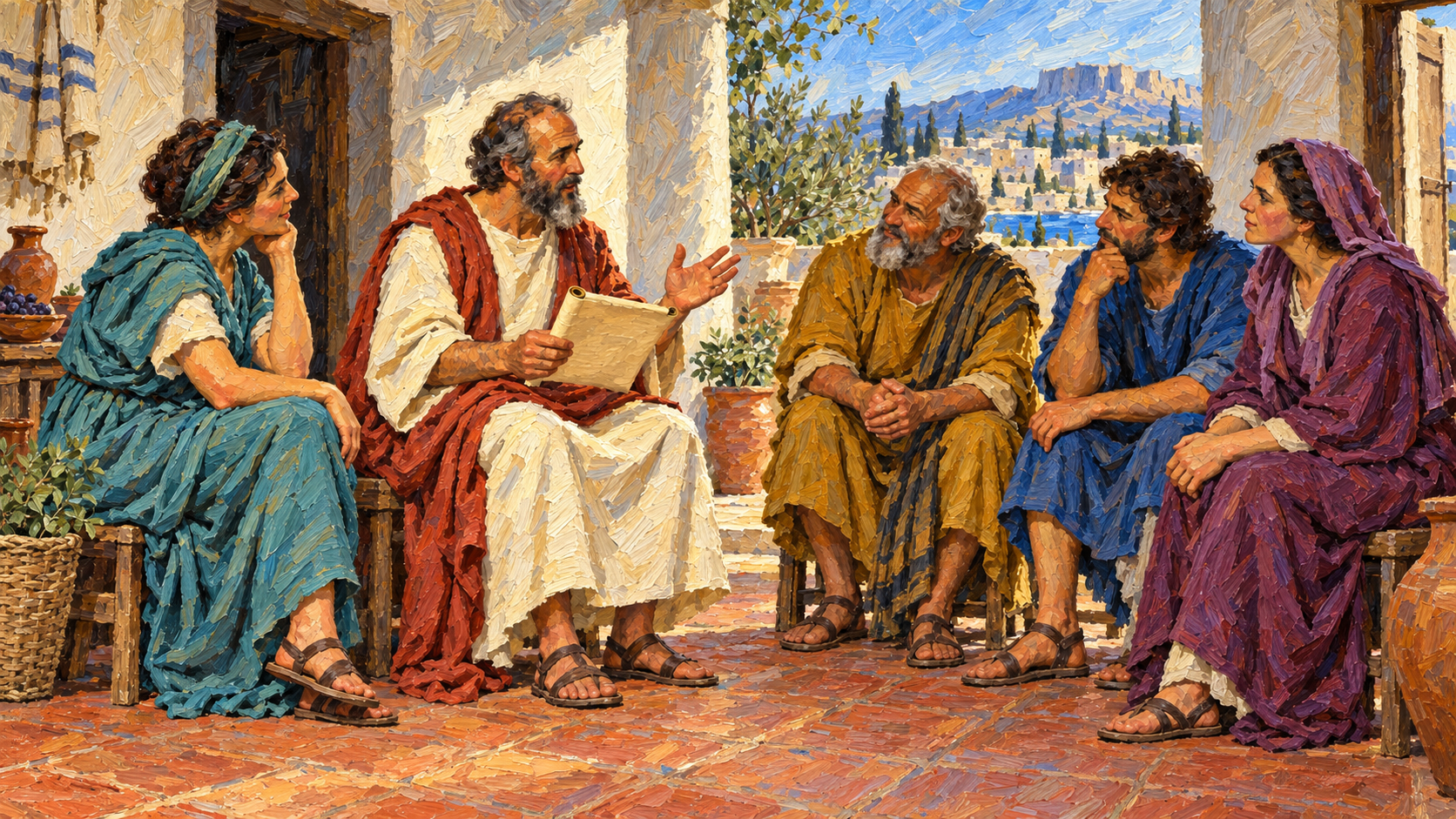
Paul’s words about God’s hidden wisdom raise a question I want to understand carefully. How could the rulers who opposed Jesus know enough to hate Him, yet fail to understand what God was accomplishing through the cross? Paul starts with his preaching in Corinth, then takes us through prophecy and the Spirit’s work before turning our eyes toward Christ’s return.
Christ Crucified in Corinth
1 Corinthians 2 pulls back the curtain on the way God saves. Paul does not present the gospel as one religious idea among many or as a human philosophy that happens to persuade more people. His message in Corinth centered on Jesus Christ and Him crucified. That center was deliberate because the cross is where God’s wisdom overturns the pride of this age.
To human wisdom, the crucifixion looked like shame and weakness. The rulers who condemned Jesus thought they had removed a political and religious threat. The powers of darkness could see that the promised Seed was being bruised. Yet Scripture tells us that God was accomplishing the victory He had planned before the ages through the real suffering of His Son, His shed blood, His death and burial, and His bodily resurrection.
Corinth was an important city where trade and social ambition existed alongside idolatry and moral confusion. Public speech and status carried weight there. Acts 18 records Paul reasoning in the synagogue and testifying that Jesus is the Christ. When opposition came, the Lord encouraged him to keep speaking because God had many people in that city.
The Corinthian believers lived in a culture that admired polished speech and public skill. Paul was not opposed to clear reasoning. He reasoned from Scripture, wrote carefully, and corrected error with precision. What he refused was the kind of display that makes the messenger look impressive while pushing the cross into the background.
And I, brethren, when I came to you, did not come with excellence of speech or of wisdom declaring to you the testimony of God.
The warning reaches every generation of the church. We should explain the gospel clearly and carefully, but we must never speak as though the cross needs the world’s approval before it can save. Human skill may draw attention, yet it cannot raise the spiritually dead. Paul wanted the Corinthians’ faith anchored in God Himself.
His next statement gives us one of the clearest descriptions of gospel-centered ministry in the New Testament. Paul did not mean that he ignored every other doctrine. This same apostle taught about creation and resurrection. When a church faced disorder, he addressed its discipline and communion. He wrote about marriage and spiritual gifts, then went on to teach prophecy and the return of Christ. Everything found its center in the person and work of Jesus, especially His crucifixion.
For I determined not to know anything among you except Jesus Christ and Him crucified.
The cross is not an introduction that the church eventually outgrows. In 1 Corinthians 1:18, Paul says its message is foolishness to those who are perishing, but to those who are being saved it is the power of God. Christ crucified is a stumbling block to the Jews and foolishness to the Greeks. To those who are called, however, He is the power and wisdom of God (1 Corinthians 1:23-24).
This keeps Christian teaching from becoming a platform for religious cleverness. The eternal Son became truly man and lived without sin. He went willingly to the cross. Wicked men physically tortured, punished, and killed Him. He willingly bore that real punishment for our sins in His innocent body, shed His blood, died, was buried, and rose bodily. Through that finished work, He secured salvation for all who believe. The cross is not an embarrassing part of the Christian message. It is the saving center.
Paul describes his own arrival in Corinth with striking weakness. He does not present himself as a polished religious celebrity. He came in fear and much trembling because he knew the task was beyond the strength of any man.
I was with you in weakness, in fear, and in much trembling. And my speech and my preaching were not with persuasive words of human wisdom, but in demonstration of the Spirit and of power, that your faith should not be in the wisdom of men but in the power of God.
Paul did not despise words. He preached and taught, and he reasoned with people. The issue was where his confidence rested. A persuasive technique may move someone’s emotions for a moment, but the Holy Spirit gives life. He convicts of sin and opens blind eyes. He glorifies Christ and seals those who truly believe. Faith built on human wisdom will shift when a stronger personality appears. Faith resting in God’s power stands because God Himself has brought the sinner to Christ.
Wisdom Ordained Before the Ages
Christianity is not without wisdom. Paul says believers speak wisdom, but it is not the wisdom of this age. Fallen human wisdom exalts whatever people think they can control or celebrate as their own achievement. God’s wisdom humbles us and puts Christ in the place of glory.
However, we speak wisdom among those who are mature, yet not the wisdom of this age, nor of the rulers of this age, who are coming to nothing. But we speak the wisdom of God in a mystery, the hidden wisdom which God ordained before the ages for our glory.
The Greek word translated “mystery” is mysterion. In Paul’s letters, it commonly refers to truth that God once kept hidden and then revealed at the time He chose. It is not a secret teaching reserved for a higher class of Christians. Here the mystery is tied directly to God’s ordained wisdom in Christ crucified.
The cross was not Plan B after Israel rejected her King. It was not God’s desperate response to Satan’s success. Paul says this wisdom was ordained before the ages. Long before human rulers gathered against Jesus, God knew exactly what He would accomplish through His Son.
That does not make those rulers innocent. Scripture can hold God’s purpose and human guilt together without confusion. Acts 2:23 says Jesus was delivered by the determined purpose and foreknowledge of God, yet lawless hands took and crucified Him. Acts 4:27-28 names Herod and Pontius Pilate. It also names the Gentiles and the people of Israel who gathered against Christ. They did what God’s hand and purpose had determined, but they acted from their own rebellion and remained responsible. God’s sovereignty never excuses sin, and human rebellion never threatens His purpose.
Paul adds that the hidden wisdom was ordained “for our glory.” He is not promising worldly fame. The glory is the blessing God gives in Christ. He declares believers righteous and brings them into His family. He gives resurrection hope and is conforming them to His Son. Everlasting life with Christ completes that promise. Romans 8:29-30 and 1 Peter 5:10 help us hear Paul’s words in this way: God saves sinners and brings them into the life and glory found in Christ.
What the Rulers of This Age Missed
Verse 8 brings us to the heart of the question. Paul says none of the rulers of this age knew God’s hidden wisdom. If they had understood it, they would not have crucified the Lord of glory.
which none of the rulers of this age knew; for had they known, they would not have crucified the Lord of glory.
The phrase certainly includes the earthly rulers involved in the crucifixion. Herod and Pilate acted according to their own will and were truly guilty. The rulers in Jerusalem were not innocent merely because prophecy was being fulfilled, and Pilate was not a puppet without responsibility.
At the same time, I do not think Paul’s language should be limited to visible authorities. His reference to this age and its rulers fits the larger New Testament teaching about spiritual powers behind the present evil world system. Ephesians 6:12 speaks of principalities and powers, including rulers of the darkness of this age and spiritual hosts of wickedness. 2 Corinthians 4:4 calls Satan the god of this age and says he blinds unbelieving minds. Satan and his forces are real. They deceive people and oppose Christ.
We must still be careful not to give Satan attributes that belong only to God. Scripture never says he is omniscient or that he can read minds. He observes people and tempts them. He also accuses and deceives, using his forces to coordinate opposition, but he remains a creature under God’s rule. Satan knew the promise of Genesis 3:15 and the blessing promised through Abraham’s Seed. He knew a ruler would come from Judah and that God had promised David a Son. He understood enough to oppose Jesus, but he did not grasp the full wisdom God was carrying out through the cross.
When I keep those limits on Satan clearly in view, the strong language about Christ’s victory in Hebrews and Colossians becomes even more striking. Hebrews 2:14-15 says that through death Jesus destroyed the one who had the power of death, that is, the devil. He also released those who had lived in bondage through fear of death. Colossians says God wiped out the handwriting of requirements that stood against us and nailed it to the cross. In doing so, He disarmed the powers that opposed Christ.
Having disarmed principalities and powers, He made a public spectacle of them, triumphing over them in it.
The rulers saw the crucifixion as a way to silence Jesus. God made it the place where sin was answered and death was broken. The enemy’s accusations lost their claim over those who are in Christ. The very act meant to defeat the promised Seed became the setting of His victory. This is the hidden wisdom that the rulers did not know.
Prophecy Became Clear in the Risen Christ
The Old Testament did not leave Israel without a witness to the Messiah. God gave real promises and solid reasons to hope. Yet the Messiah’s suffering and glory were woven together in a way that was true before the cross and became fully clear after the resurrection.
Genesis 3:15 promised the Seed of the woman, who would crush the serpent while being bruised. Genesis 22:18 promised blessing to every nation through Abraham’s Seed, while Genesis 49:10 pointed to the ruler from Judah. In 2 Samuel 7, God promised David a Son whose throne would be established. Micah 5:2 named Bethlehem, and Zechariah 9:9 showed the King arriving humbly on a donkey. Psalm 22 and Isaiah 53 spoke plainly about suffering. Daniel 7 showed the Son of Man receiving dominion and a kingdom.
These prophecies do not contradict one another; they are remarkable threads that meet in Christ. The same Messiah would suffer and reign. He would be rejected before He was exalted, and He would die and rise, coming first in humility and later in visible glory.
Ought not the Christ to have suffered these things and to enter into His glory?
After His resurrection, Jesus opened the Scriptures to His disciples. Luke says He began with Moses and all the Prophets, then explained the things concerning Himself throughout the Scriptures. The Old Testament had not been false or useless before that moment. The risen Christ showed them the full pattern that had always been there.
Peter tells us that the prophets searched carefully. They wanted to know the time and circumstances the Spirit of Christ was indicating when He spoke beforehand of Christ’s sufferings and the glories that would follow. They possessed true revelation, yet they still longed to understand how its parts would unfold. This is often the shape of prophecy. God gives enough light for faith and obedience while keeping the complete timing and arrangement under His authority.
I think this prophetic background is important for reading 1 Corinthians 2:9 correctly. The verse is often quoted as though Paul were saying that God’s prepared blessings remain hidden from believers. His next sentence says the opposite: God has revealed them through His Spirit.
But as it is written: “Eye has not seen, nor ear heard, Nor have entered into the heart of man The things which God has prepared for those who love Him.” But God has revealed them to us through His Spirit. For the Spirit searches all things, yes, the deep things of God.
This is not an invitation to chase hidden codes or private revelations. Paul is explaining why the gospel must be revealed through the Spirit’s work. Human senses could never discover God’s saving plan, and human pride will not willingly bow to a crucified Messiah. The Holy Spirit makes known what God has freely given.
The Spirit Gives the Mind of Christ
The Holy Spirit is not an impersonal force. He searches the deep things of God and knows what belongs to God. He teaches the words God gave and enables believers to receive what the natural person rejects. The same Spirit who inspired Scripture also illumines believers as they read it. Illumination means He opens our eyes to understand and obey the Word already given; it does not place a second Bible inside the heart.
Paul distinguishes the natural man from the spiritual person. The natural man is not merely someone with little education. He is a person without the Spirit. He may be brilliant by the world’s standards and still refuse the things of God because they seem foolish to him.
But the natural man does not receive the things of the Spirit of God, for they are foolishness to him; nor can he know them, because they are spiritually discerned.
This gracious work of the Spirit explains why two people can hear the same message so differently. One hears about Christ crucified and sees weakness, while another hears the same gospel and bows before the wisdom and power of God. The difference is not that the second person was clever enough to solve a religious riddle; it is that the Spirit has opened the heart to receive God’s truth.
Paul ends the chapter by saying, “But we have the mind of Christ.” Believers do not become omniscient or infallible. The Spirit teaches us to understand truth from Christ’s point of view, with the cross shaping how we think. Philippians 2 shows the shape of that mind. Christ humbled Himself and obeyed the Father. He served and willingly suffered, and God exalted Him. The mind of Christ is not pride dressed in religious language. It is a Spirit-formed way of thinking that bows before Christ and follows Him.
The word translated “discerned” in 1 Corinthians 2 describes Spirit-enabled understanding. It is not a personality trait or something earned through an academic degree. Nor is it a passing emotional mood. Spiritual discernment is receiving God’s truth because the Spirit teaches us through His Word. When verse 13 speaks of comparing spiritual things with spiritual, it does not give us permission to force unrelated verses together. Scripture interprets Scripture, but we must still honor each passage’s context. Careful reading belongs with humble prayer, and both should lead to obedience.
This truth shapes Christian ministry. A church can stay busy with many good subjects and still move away from its center. We must keep Christ crucified before the people because every doctrine finds its proper place around Him. Preaching and teaching should be done well. Music and writing also deserve care, and a Christian should answer objections thoughtfully. None of that can replace the Spirit’s power. Our goal is for people to trust God rather than admire the messenger.
We should also expect the gospel to be misunderstood. The natural man calls the things of the Spirit foolish, but that should make us neither ashamed nor harsh. We speak plainly and pray earnestly, asking God to shine the knowledge of His glory in the face of Jesus Christ.
Christ’s Return Calls Us to Watch
The pattern of hidden and revealed wisdom also helps us think about Christ’s return, but I believe we need to handle the connection with restraint. Scripture gives genuine revelation about the future. Jesus will return bodily, and the church is commanded to watch. I understand the Bible to teach a pre-Tribulation gathering of the church, followed by a literal seven-year Tribulation. Christ will then return visibly in glory and establish a literal thousand-year reign. These conclusions do not come from guessing about current events. They come from reading Scripture in its normal grammatical and historical sense.
At the same time, Jesus did not give His people the day or hour. The apostles were not authorized to publish a date, and neither are we. Watchfulness is not date-setting with Bible words attached.
But of that day and hour no one knows, not even the angels of heaven, but My Father only.
Jesus told His disciples to watch and be ready. Acts 1 says that the same Jesus who went up into heaven will return in the same way the disciples saw Him leave. Revelation 1:7 says every eye will see Him. 2 Thessalonians 2 describes developments that must be understood soberly. We should neither panic nor pretend that every news headline fulfills a verse.
The proper response to prophecy is faithful living. God has revealed enough to give us hope and endurance. His warnings prepare us to obey, and His promises lead us to worship. He has not revealed the timing so people can boast about predictions. As with Christ’s first coming, God has kept the exact sequence and timing under His own authority. The Lord will come exactly on time.
Watchfulness should reach ordinary life. We keep working and praying because the Lord may return. We make the gospel known and forgive one another. When suffering comes, we endure with our eyes on Christ. The Lord’s return is not a hobby built on fear or speculation; it is a purifying hope.
Readers who want to explore these truths further can begin with The Gospel and The Messiah in the Bible. The Person of the Holy Spirit develops His work in Scripture and in believers. The Pre-Tribulation Rapture explains the gathering of the church and watchfulness without date-setting. The Serpent’s Head Crushed follows Genesis 3:15 through Christ’s victory and the enemy’s final judgment.
My Final Thoughts
After working through 1 Corinthians 2, I do not see the cross as a tragedy that God somehow turned into a rescue plan. It was the saving wisdom He ordained before the ages, even though human rulers and spiritual powers opposed Christ without understanding what their actions would accomplish. The Holy Spirit now teaches believers this truth through Scripture and forms the mind of Christ in us. That gives me confidence to keep the cross central, read prophecy humbly, and watch for the Lord without trying to force God’s plan into my own timetable.