
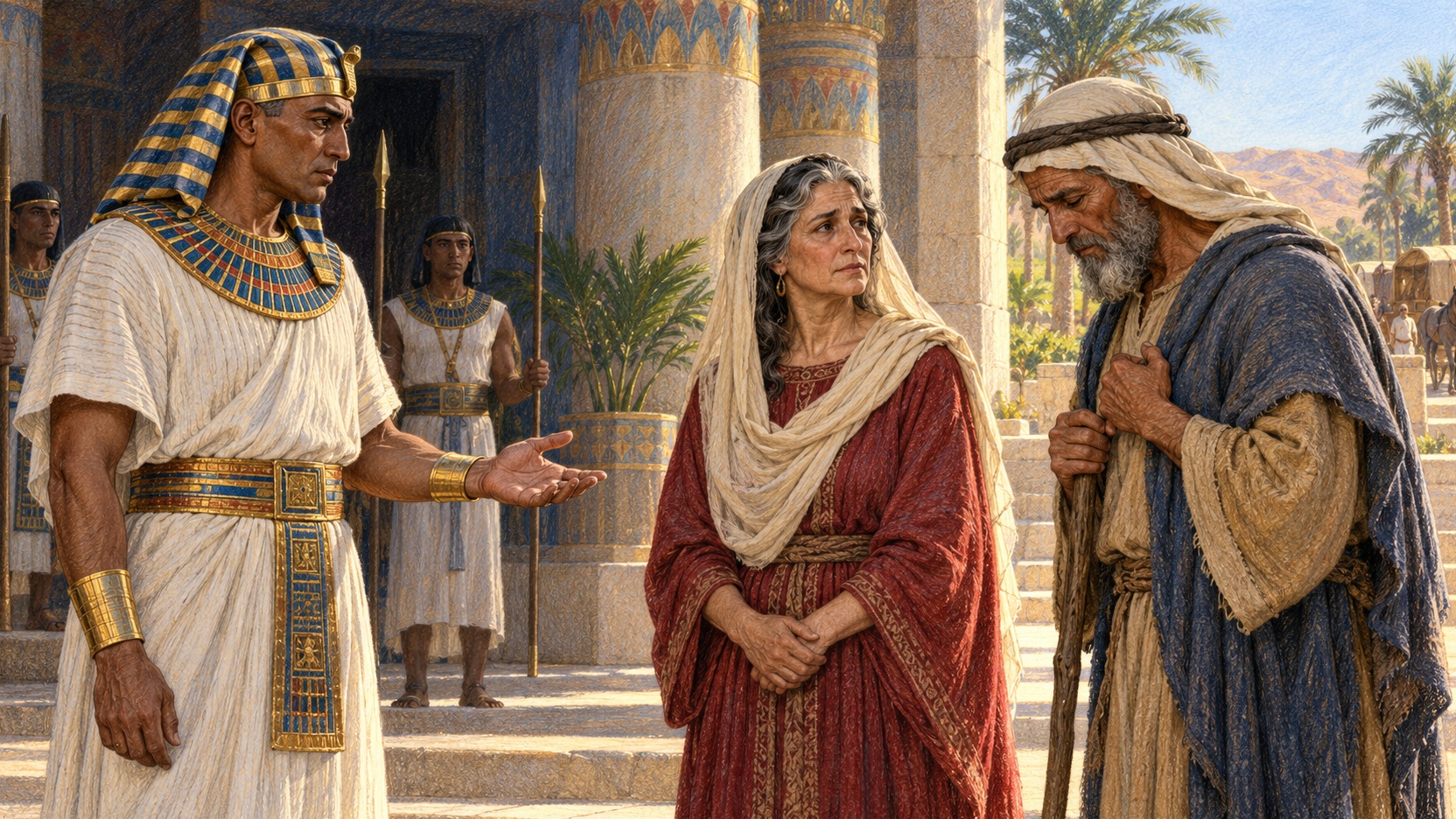
Abraham was afraid that someone would kill him in order to take Sarah, his wife. He asked her to identify him as her brother, hoping that people would let him live if they did not know they were married. Sarah really was his half-sister, but Abraham used that part of their relationship to hide the fact that she was also his wife.
I think we can understand why he was afraid without defending what he did with that fear. His plan placed Sarah in danger, and Genesis records him using it twice. Let’s look at what happened in Egypt first, because by the time Abraham repeated the deception in Gerar, he had already seen the harm it could cause.
God’s Promise and Abraham’s Fear in Egypt
At this point in Genesis, Abraham is still called Abram and Sarah is still called Sarai. God changed their names later, so the different names refer to the same husband and wife. Sarai had no children when the LORD called Abram to leave his country and go to the land He would show him (Genesis 11:30–12:1). The promise God gave him reached far beyond anything he could see in his household:
Now the LORD had said to Abram: “Get out of your country, From your family And from your father’s house, To a land that I will show you. I will make you a great nation; I will bless you And make your name great; And you shall be a blessing. I will bless those who bless you, And I will curse him who curses you; And in you all the families of the earth shall be blessed.”
Abram obeyed and went to Canaan. When he arrived, the LORD appeared to him and told him that He would give that land to his descendants. Abram built an altar there, and later he built another altar and called on the name of the LORD near Bethel (Genesis 12:4–8). He had left what was familiar because he believed the God who had called him.
There was still a great deal he could not bring about for himself. A great nation was supposed to come from a man who did not yet have a son, and blessing was supposed to reach all the families of the earth through him. God had made the promise, and Abram needed to depend on Him to fulfill it. Leaving his country was an act of faith, but there would be other decisions in which that trust needed to govern him.
Then a severe famine struck the land, and Abram went down to Egypt to stay for a time. A famine meant a serious shortage of food, so this was a practical threat to his household. Genesis does not record God forbidding this journey, and it does not identify the move itself as Abram’s sin. I do not want to add an accusation the passage has not made when it gives us such a clear account of the deception that followed.
As they approached Egypt, Abram began speaking to Sarai about what he thought would happen when the Egyptians saw her:
And it came to pass, when he was close to entering Egypt, that he said to Sarai his wife, “Indeed I know that you are a woman of beautiful countenance. Therefore it will happen, when the Egyptians see you, that they will say, ‘This is his wife’; and they will kill me, but they will let you live. Please say you are my sister, that it may be well with me for your sake, and that I may live because of you.”
Abram knew his wife was beautiful, and he expected that men who wanted her would kill him if they knew he was her husband. The passage records that as his prediction. It does not tell us that an Egyptian had already threatened to do it. His concern was about a danger he anticipated, and he built his plan around keeping himself alive.
Notice what Sarai was being asked to do. By calling herself his sister and concealing their marriage, she would allow others to think she was available to marry. Abram hoped that this would cause people to treat him well. The protection he sought for himself depended on leaving his wife exposed to the very people he feared.
I find that difficult to read alongside God’s promise. The LORD had told Abram that a nation would come from him, yet Abram was acting as though he needed this deception to preserve his future. He had good reason to care about his life, but he also had a responsibility to the woman who was his wife. His fear did not make her safety something he could trade for his own.
When they entered Egypt, the princes of Pharaoh noticed Sarai and praised her to the king. Pharaoh, the ruler of Egypt, then took her into his house. He also treated Abram well for her sake, and Abram received livestock and male and female servants (Genesis 12:14–16). Part of what Abram wanted had happened: he was being treated favorably. But his wife was now in another man’s household.
If we only looked at the increase in Abram’s possessions, we could misunderstand the entire event. Material gain did not make the deception right. Sarai had been taken because her marriage was hidden, and the next thing Genesis records is the LORD striking Pharaoh and his house with great plagues because of her. The passage identifies her as Abram’s wife even while she is in Pharaoh’s house (Genesis 12:17).
Pharaoh called Abram and demanded to know why he had not told him Sarai was his wife. The king recognized that the concealed marriage had exposed him to wrongdoing. He returned her, ordered Abram to leave, and instructed his men to send the couple away with everything Abram had (Genesis 12:18–20). Abram’s plan had not brought his wife safely through the danger. The LORD intervened, and Pharaoh released her.
There are details about that intervention that Genesis does not give us. Pharaoh is not identified by a personal name, and we are not told how he learned why the plagues had come. I cannot supply a particular Egyptian king or an unrecorded confession to fill those gaps. We do know that he confronted Abram over the deception and returned Sarai.
We should be just as careful about what happened to her in Pharaoh’s house. Being taken there placed her in serious danger, but the text does not say that Pharaoh had sexual relations with her. I would not turn that danger into an assertion that adultery or assault occurred. Sarai’s beauty did not make her responsible for the choices others made about her, and it did not relieve Abram of his responsibility to deal truthfully concerning their marriage.
The Same Deception in Gerar
After leaving Egypt, Abram returned with Sarai to Canaan and again called on the name of the LORD at the place where he had built an altar (Genesis 13:1–4). Years passed before the second incident. During those years, God told Abram that his heir would be his own son and that his descendants would be as numerous as the stars he could not count (Genesis 15:1–6). To understand Abraham’s later question about that promise, we first need to know who Ishmael was.
While Sarai still had no child, she gave her Egyptian maidservant Hagar to Abram as a wife, hoping to obtain children through her. Hagar conceived and bore Abram a son named Ishmael (Genesis 16:1–16). By Genesis 17, Ishmael was thirteen years old. Abram therefore already had a son when God told him that his wife Sarai herself would bear a child.
In that same chapter, God changed Abram’s name to Abraham and Sarai’s name to Sarah. He said that Sarah would become a mother of nations and that kings would come from her. Abraham fell on his face and laughed as he considered a child being born to a man of a hundred and a woman of ninety. He asked God about Ishmael, the son he already knew:
Then Abraham fell on his face and laughed, and said in his heart, “Shall a child be born to a man who is one hundred years old? And shall Sarah, who is ninety years old, bear a child?” And Abraham said to God, “Oh, that Ishmael might live before You!” Then God said: “No, Sarah your wife shall bear you a son, and you shall call his name Isaac; I will establish My covenant with him for an everlasting covenant, and with his descendants after him. And as for Ishmael, I have heard you. Behold, I have blessed him, and will make him fruitful, and will multiply him exceedingly. He shall beget twelve princes, and I will make him a great nation. But My covenant I will establish with Isaac, whom Sarah shall bear to you at this set time next year.”
God did not ignore Abraham’s concern for Ishmael. He promised that Ishmael would become a great nation and have twelve princes among his descendants. But He also made clear that the covenant would continue through Isaac, the son Sarah would bear. A covenant is a solemn commitment, and here God was committing Himself to a continuing relationship with Abraham’s family through that particular son.
Sarah was therefore not someone Abraham could set aside while still expecting the promise to proceed through any child he happened to have. God named her as Isaac’s mother, named the child, and appointed the time of his birth. Their age made the prospect seem beyond ordinary human possibility, but the Lord had said what He would do.
Abraham had heard that specific promise when he later stayed in Gerar, a place ruled by a king named Abimelech. There Abraham again identified Sarah as his sister. Abimelech sent for her and took her, and the account once more places Abraham’s wife in another man’s household. This time Genesis tells us about the warning God gave the king in a dream:
But God came to Abimelech in a dream by night, and said to him, “Indeed you are a dead man because of the woman whom you have taken, for she is a man’s wife.” But Abimelech had not come near her; and he said, “Lord, will You slay a righteous nation also? Did he not say to me, ‘She is my sister’? And she, even she herself said, ‘He is my brother.’ In the integrity of my heart and innocence of my hands I have done this.” And God said to him in a dream, “Yes, I know that you did this in the integrity of your heart. For I also withheld you from sinning against Me; therefore I did not let you touch her. Now therefore, restore the man’s wife; for he is a prophet, and he will pray for you and you shall live. But if you do not restore her, know that you shall surely die, you and all who are yours.”
The passage expressly says that Abimelech had not come near Sarah. God also told him that He had withheld him from sinning and had not allowed him to touch her. We do not have to guess about whether the marriage had been violated sexually in this incident. God had prevented it, and He commanded the king to return her.
Abimelech explained that Abraham had called Sarah his sister and that Sarah had also called Abraham her brother. He had acted without knowing they were married. God acknowledged the integrity of his heart in that action, which tells us that the deception had actually misled him. It does not mean God was declaring every part of Abimelech’s life sinless.
Once the king knew the truth, however, he had to respond to it. He could no longer appeal to his earlier ignorance as a reason to keep Sarah. God said that touching her would be sin against Him, and He still identified her as Abraham’s wife. A king’s power did not give him the right to another man’s wife, and Abraham’s concealment had not dissolved their marriage.
God also called Abraham a prophet and said that he would pray for the king. A prophet is someone who receives and communicates God’s word. That description of Abraham can seem surprising here, because we have just watched him bring another household into danger. Yet the Lord acknowledged his calling while requiring the wrong to be put right. Being God’s servant did not make Abraham’s deception acceptable.
Abimelech rose early the next morning and told his servants what God had said. They were very much afraid. He then called Abraham and wanted to know why Abraham had brought this danger upon his household. The king asked what he had done to provoke such treatment, and he told Abraham that his conduct was wrong. Abraham answered by explaining both his fear and the arrangement he had made with Sarah:
And Abraham said, “Because I thought, surely the fear of God is not in this place; and they will kill me on account of my wife. But indeed she is truly my sister. She is the daughter of my father, but not the daughter of my mother; and she became my wife. And it came to pass, when God caused me to wander from my father’s house, that I said to her, ‘This is your kindness that you should do for me: in every place, wherever we go, say of me, “He is my brother.”‘” Then Abimelech took sheep, oxen, and male and female servants, and gave them to Abraham; and he restored Sarah his wife to him. And Abimelech said, “See, my land is before you; dwell where it pleases you.” Then to Sarah he said, “Behold, I have given your brother a thousand pieces of silver; indeed this vindicates you before all who are with you and before everybody.” Thus she was rebuked.
Abraham had assumed there was no fear of God in Gerar. Now the men of that place were afraid after hearing God’s warning, and their king was confronting Abraham over conduct that threatened his household. Abraham’s assumption about other people’s wickedness had not justified his own dishonesty.
He then explained the family relationship behind his claim. Sarah was the daughter of his father but not of his mother, so she was his half-sister. She had also become his wife. The first statement was true, but it was being used to hide the second statement, which was the very fact Abimelech needed to know.
I think that gives us a more searching way to examine dishonesty than merely asking whether each word can be defended. Abraham intended the king to come away with a false understanding. If I tell someone a true detail for the purpose of concealing the truth that would change his decision, the accuracy of that detail does not make my conduct honest.
Abraham’s explanation also tells us that this was a standing arrangement. When he left his father’s house, he asked Sarah to call him her brother wherever they went. He described it as a kindness she could do for him. What happened in Gerar therefore came from a plan he had kept in place even after the trouble in Egypt. He was not simply improvising a new response in a moment of panic.
Sarah participated by saying that Abraham was her brother, and I do not want to erase her part in misleading Abimelech. Abraham, however, acknowledged that he had devised the arrangement and asked her to do it. The kindness he wanted for himself placed her in danger. Both had responsibility for what they said, while his own explanation makes clear who initiated the plan.
Abimelech returned Sarah and gave Abraham livestock and servants. He also offered him a place to live in his land. When he addressed Sarah, he spoke of a thousand pieces of silver that he had given to her brother and of her standing before the people around her. The wording of Genesis 20:16 is difficult, as the translation note explains. The NKJV describes her vindication, the clearing of her standing before others, and it also says that she was rebuked. I would not turn the difficult wording into a more detailed ceremony or custom than the passage establishes.
The timing of the gifts helps us distinguish the two accounts. Pharaoh treated Abram well while he still did not know Sarai was his wife. Abimelech gave his gifts after learning the truth and confronting Abraham. Both kings returned her, and both households had suffered because the marriage was concealed. Whatever possessions Abraham received, the harm and rebukes give us no reason to teach deception as a way of obtaining God’s blessing.
Abraham then prayed to God for Abimelech. Genesis says God healed the king, his wife, and his female servants, and the women bore children. The LORD had closed the wombs of Abimelech’s household because of Sarah, Abraham’s wife (Genesis 20:17–18). The account ends with God removing that affliction in response to the prayer He had said Abraham would offer.
I see mercy in the way Abraham was still given a responsibility toward the people he had endangered. He had to pray for the very household his deception had harmed. That continued service did not cancel Abimelech’s rebuke or prove that Abraham had acted wisely. A spiritual calling does not place someone beyond correction, especially when another person has been hurt by his conduct.
Genesis then records Sarah giving birth. God had named her as the mother of the promised son, and He did for her what He had said He would do:
And the LORD visited Sarah as He had said, and the LORD did for Sarah as He had spoken. For Sarah conceived and bore Abraham a son in his old age, at the set time of which God had spoken to him. And Abraham called the name of his son who was born to him–whom Sarah bore to him–Isaac.
Isaac’s birth is credited to the LORD’s faithfulness. The deception had contributed nothing that God needed in order to fulfill His word. He preserved Sarah through the danger and brought the promised child into the world at the appointed time.
I also do not want to speak about Sarah as though her only value were the child she would bear. She was a person made in God’s image, and she was Abraham’s wife (Genesis 1:27; 20:7). God protected her in that danger, and His protection also preserved the family through whom He had promised blessing. We can be grateful for His mercy while still acknowledging the wrong that made His intervention necessary.
Isaac Repeated the Family Pattern
Isaac eventually grew up and married a woman named Rebekah. During a later famine, he went to Gerar, and the LORD told him to remain in the land rather than go down to Egypt. God also reaffirmed to him the promise He had made to Abraham about the land and the blessing that would reach the nations through his descendants (Genesis 26:1–5).
This is the occasion on which God explicitly forbade a journey to Egypt. The instruction was given to Isaac in his circumstances. I would not take it backward through the account and treat it as a command his father had received before the earlier famine. In Isaac’s case, he obeyed the instruction about where to stay, but he then repeated his father’s deception about his marriage:
So Isaac dwelt in Gerar. And the men of the place asked about his wife. And he said, “She is my sister”; for he was afraid to say, “She is my wife,” because he thought, “lest the men of the place kill me for Rebekah, because she is beautiful to behold.” Now it came to pass, when he had been there a long time, that Abimelech king of the Philistines looked through a window, and saw, and there was Isaac, showing endearment to Rebekah his wife. Then Abimelech called Isaac and said, “Quite obviously she is your wife; so how could you say, ‘She is my sister’?” Isaac said to him, “Because I said, ‘Lest I die on account of her.'” And Abimelech said, “What is this you have done to us? One of the people might soon have lain with your wife, and you would have brought guilt on us.” So Abimelech charged all his people, saying, “He who touches this man or his wife shall surely be put to death.”
Isaac gave the same reason Abraham had given: he thought men might kill him because his wife was beautiful. He was willing to call Rebekah his sister rather than acknowledge that she was his wife. Genesis does not tell us that Abraham taught him to do this, so I cannot describe an unrecorded lesson from father to son. We can see the resemblance, and we can also see that Isaac made his own decision.
This time the king discovered the truth by looking through a window and seeing Isaac showing affection to Rebekah. What he saw made it clear to him that they were husband and wife. He called Isaac and demanded an explanation, then pointed out that someone could have had relations with Rebekah and brought guilt upon the people. By concealing their marriage, Isaac had kept people from knowing the very fact that should have warned them away from her.
Abimelech then commanded that anyone who touched Isaac or Rebekah would be put to death. The ruler whose people Isaac feared became the one who publicly protected the couple. As with Abraham, the husband had to receive correction from the foreign king rather than claim that his fear had made the deception necessary.
The name Abimelech appears in both generations, but the shared name does not by itself tell us that this was the same man Abraham had known. It may have been a name borne by more than one ruler or a royal designation. I would leave the ruler’s precise identity open rather than build the explanation on a certainty Genesis does not give us. His response to Isaac is recorded plainly enough: he exposed the lie and ordered protection for both husband and wife.
Real Faith Can Still Need Growth
After reading these failures, we might wonder how the New Testament can speak so warmly about Abraham and Sarah’s faith. Hebrews does not ask us to forget what Genesis recorded. It directs our attention to the trust they placed in God and to the things they did because they believed Him.
The passage looks back to Abraham leaving his country and living as a foreigner in the land God had promised. It also mentions Isaac and Jacob, Abraham’s son and grandson, who inherited that same promise. Then it describes Sarah receiving strength to bear the child the Lord had named:
By faith Abraham obeyed when he was called to go out to the place which he would receive as an inheritance. And he went out, not knowing where he was going. By faith he dwelt in the land of promise as in a foreign country, dwelling in tents with Isaac and Jacob, the heirs with him of the same promise; for he waited for the city which has foundations, whose builder and maker is God. By faith Sarah herself also received strength to conceive seed, and she bore a child when she was past the age, because she judged Him faithful who had promised.
I understand Paul to be the author of Hebrews, and here he commends actual acts of faith. Abraham went when God called him, even though he did not know where he was going. Sarah came to regard the One who promised as faithful, despite her age. Neither commendation says that they had never sinned or that every choice they made expressed the same confidence in God.
The order of events keeps me from treating faith as though it can be judged by one isolated failure. Abraham obeyed the call before entering Egypt. Later he heard the specific promise concerning Sarah, and he still repeated the deception in Gerar. God corrected him, continued to use him, and eventually tested him in a way that required him to entrust even Isaac to the Lord.
In Genesis 22, God told Abraham to offer Isaac, the son through whom He had said the promise would continue. Abraham took him to the appointed place, prepared an altar, and bound him upon it. When he took the knife, the Angel of the LORD called to him from heaven and told him not to harm the boy. Abraham then offered a ram in Isaac’s place (Genesis 22:1–19).
Hebrews explains the reasoning behind Abraham’s obedience: he considered that God could raise Isaac from the dead (Hebrews 11:17–19). He trusted God to fulfill His word even when he could not see how the command and the promise would come together. That later obedience gives us reason to recognize growth in his faith. It does not require us to rename the earlier deception as something good.
Paul’s letter to the Romans also looks at Abraham’s confidence, but its focus is the righteousness he received through faith. Paul is explaining why a sinner’s acceptance before God rests on believing Him rather than earning a favorable verdict by works. He describes Abraham considering the birth God had promised when he and Sarah were already old:
And not being weak in faith, he did not consider his own body, already dead (since he was about a hundred years old), and the deadness of Sarah’s womb. He did not waver at the promise of God through unbelief, but was strengthened in faith, giving glory to God, and being fully convinced that what He had promised He was also able to perform. And therefore “it was accounted to him for righteousness.”
The description of Abraham’s body as already dead concerns his ability to father the promised child in those circumstances. Paul is not saying Abraham had literally died. He places Abraham’s old age alongside Sarah’s inability to bear children and then directs our attention to God’s ability to do what He had promised. Abraham’s confidence rested on that ability.
I understand Paul’s commendation in relation to the promise he is discussing. Abraham became convinced that God could give him this son. Paul is not rewriting Genesis to say that Abraham never acted fearfully in another situation. We should allow both passages to speak: his faith in God’s promise was real, and his deception concerning Sarah was wrong.
Justification means that God declares the believer righteous before Him. Romans 4 explains that this righteousness is credited through faith. Abraham did not receive it because his good decisions eventually outnumbered his bad ones, and his later obedience did not turn God’s gift into wages. His failures show why he needed grace, the favor God gives rather than something a person has earned.
Fear itself is something we can bring to the Lord. David, who became Israel’s king, wrote Psalm 56 while facing enemies who opposed him and watched for an opportunity to take his life. The psalm describes that hostility before giving us these words:
Whenever I am afraid, I will trust in You. In God (I will praise His word), In God I have put my trust; I will not fear. What can flesh do to me?
David acknowledges that he is afraid, and then he directs his trust toward God. He does not need to pretend that hostile people are harmless in order to rely on the Lord. I can take danger seriously, seek wise help, and still refuse to let fear become my permission to deceive someone or expose another person to harm.
Nor should we turn Sarah’s rescue into a promise that every believer will be delivered from danger in the same way. God had made a particular promise concerning her son, and He preserved that promise. Elsewhere, Hebrews honors people who trusted Him and still suffered torture or death (Hebrews 11:35–40). Their suffering did not prove that their faith was inadequate. Faith rests on what God has actually said, rather than on an assumption that every faithful person must receive the same earthly outcome.
Truth and Protection in Marriage
Abraham’s explanation makes the cost to Sarah difficult to overlook. He wanted to stay alive and be treated well, but his plan required her to carry the danger created by hiding their marriage. Isaac later made the same kind of choice about Rebekah. When I consider a solution to my own fear, I need to ask what that solution will do to the person who is trusting me to seek her good.
Scripture’s teaching about a husband’s leadership gives him no defense for this kind of conduct. In Ephesians 5:25–29, Paul tells husbands to love their wives as Christ loved the church and gave Himself for her. He also tells them to nourish and cherish their wives as they care for their own bodies. Biblical headship places that responsibility upon the husband. It does not authorize him to recruit his wife into sin so that he can protect his own interests.
Sarah’s respect for Abraham is commended in 1 Peter 3:1–6. Peter is describing women who trusted God and whose conduct expressed that trust. He is not declaring every request Abraham ever made to be righteous. I can honor the respect Peter commends while recognizing that Sarah’s participation in this deception was wrong.
A wife’s submission remains under her obedience to God. The same Lord who instructs her to respect her husband also requires truthfulness, so I cannot use one instruction to cancel the other. Peter also tells husbands to live with understanding and give honor to their wives as people who share in the grace of life (1 Peter 3:7). Abraham’s arrangement should be examined under those responsibilities, not used to excuse a husband who endangers his wife.
Planning for safety is still appropriate. A couple may need to leave a threatening situation or seek protection and help from others. Nothing in this account requires them to remain exposed to danger in order to prove their faith. The wrong we have examined is the decision to conceal the marriage and obtain one person’s advantage at the other person’s expense.
The resemblance between Abraham’s and Isaac’s decisions also makes me consider the example parents provide. Genesis has not told us how Isaac came to think of this deception, but children can learn from the way their parents respond to pressure. If I teach trust in God and then routinely compromise when I am afraid, my conduct can undermine the very instruction I want a child to receive. The same concern belongs to anyone whose example influences other people.
Where I have already misled someone, repentance needs to deal with what I actually did. Blaming the pressure leaves the false impression in place. I need to acknowledge the deception, correct what the other person was led to believe, and address the harm as far as I can. Proper consequences should not be treated as an injustice simply because I have admitted the wrong.
Abraham’s standing arrangement gives me another practical point to examine. If I have kept a plan that makes the same deception easy to repeat, that plan needs to end. A claim to be sorry does not make a dangerous practice safe while I continue it. Forgiveness is real, but rebuilding trust involves giving the other person reason to believe that I will now deal honestly.
God Preserved the Promise Through Sarah
Sarah’s protection and Isaac’s birth belong within a promise that reaches beyond their household. God had told Abraham that all the families of the earth would be blessed through him. Isaac became the father of Jacob, and the nation of Israel came through Jacob’s descendants. From that family line, in time, came Jesus Christ. Matthew begins his account of Jesus’ ancestry with Abraham and Isaac, and Paul identifies Christ as the promised Seed through whom the blessing reaches the nations (Matthew 1:1–17; Galatians 3:8, 16).
I understand the preservation of Sarah in that setting as part of God’s faithfulness to His word. Abraham’s deception put people in danger, but it could not supply or secure the Savior God had promised. The blessing came because God fulfilled His commitment, even while correcting the man to whom He had made it.
Jesus is the eternal, uncreated Son who became fully human without ceasing to be fully God. He was born of a virgin and lived without sin. The New Testament therefore presents a Savior who could give Himself as the perfect sacrifice for our sins, rather than a man who needed forgiveness for sins of His own (John 1:1–18; Luke 1:26–35; Hebrews 4:15).
His atonement, the sacrifice through which our sins are dealt with and we are reconciled to God, rests on His perfection and His willing death. Wicked men tortured and crucified Him, and He shed His innocent blood and died. I do not believe the Father punished, cursed, abandoned, struck, bruised, or poured wrath upon His Son. Father and Son remained united in the work of redemption. Jesus said before His arrest that His disciples would leave Him, but that the Father would be with Him (John 16:32).
His saving sacrifice through His blood and death was complete before His burial, and He rose bodily from the dead. The salvation He accomplished is offered to the whole world. Paul says He gave Himself as a ransom for all, and John says His atoning sacrifice is for the sins of the whole world (1 Timothy 2:5–6; 1 John 2:2). The blessing promised through Abraham’s family is therefore not confined to people who can trace their ancestry to him.
God’s offer is genuine for every person, even though people can resist His grace and reject Him. Whoever turns to Jesus in repentance and faith receives forgiveness and is declared righteous. Repentance means agreeing with God about our sin and turning toward Him; faith means depending on Christ to save us. As Romans explains through Abraham’s example, that righteousness is received through faith rather than earned through a flawless record.
God also gives the believer new birth, real spiritual life, and the Holy Spirit comes to dwell in that person. Having believed, the believer is sealed with the Spirit as God’s guarantee of the promised inheritance (Ephesians 1:13–14). I believe the person who has truly been born again is eternally secure in Christ. That security rests on God’s faithfulness and does not become a permission to continue in rebellion.
The life God gives should find expression in the way we live. Ephesians 2:8–10 places both truths together: salvation is a gift received through faith, and those who are saved are created in Christ for good works. Obedience does not earn or maintain salvation, but an empty profession that has no reality behind it should not be confused with genuine faith. Nor should we make sinless behavior the test of whether someone’s faith is genuine. Abraham needed correction and growth, and God’s mercy gave him reason to respond.
My Final Thoughts
Abraham called Sarah his sister because he was afraid for his life, and he used a real family relationship to hide their marriage. The consequences in Egypt and Gerar show why that explanation cannot excuse him. Sarah was placed in danger, other households suffered, and Abraham had to be corrected. God preserved Sarah and fulfilled His promise, but Abraham’s deception deserves none of the credit for that fulfillment.
I come away from these passages wanting to be more honest about what fear can persuade me to justify. It is not enough to defend a detail in what I said if I intended someone to believe something false. I need to tell the truth, consider the harm my plans could cause, and accept correction when I have done wrong. The Lord who kept His word concerning Sarah has also provided the Savior through whom I can receive forgiveness. His mercy gives me reason to abandon the deception and trust Him with what comes next.