
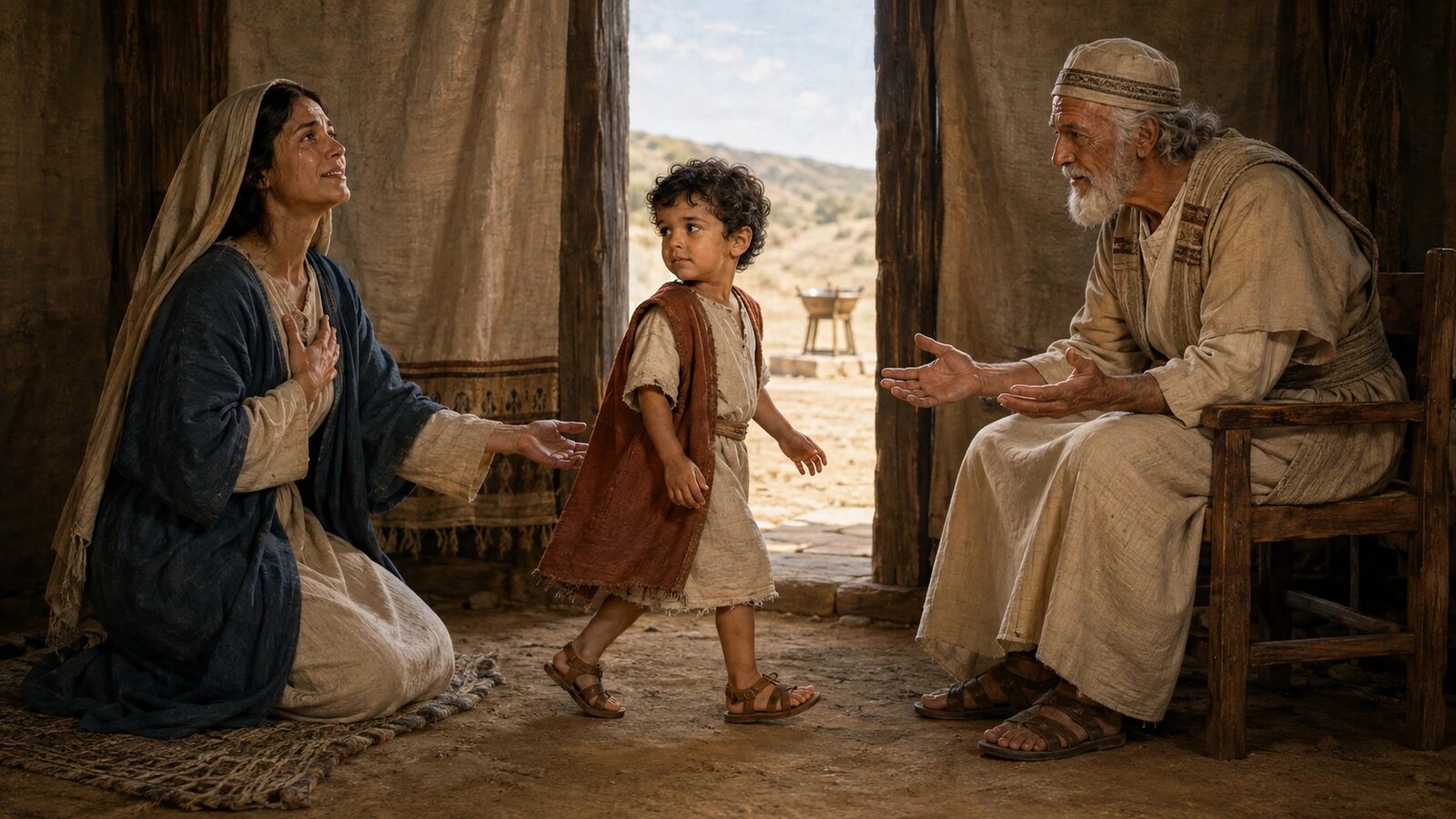
Hannah’s story begins with a grief she could not fix, and Peninnah would not let her forget it. I want to look closely at what Hannah did with that pain and what followed when the LORD answered her. Her story reaches beyond the birth of Samuel into prayer, surrender, and a song about God’s Anointed King.
Hannah Carried Her Grief into Worship
1 Samuel opens with Elkanah, a man from Ramathaim Zophim in the mountains of Ephraim. The story places his household in Ephraimite territory, while genealogical material in 1 Chronicles connects Samuel’s family line with Levi. We should let both details stand instead of making the regional description prove more than it does.
Elkanah had two wives, Hannah and Peninnah. Scripture does not stop here to give an abstract lesson on polygamy, but this divided household shows some of the sorrow it produces. Peninnah had children, while Hannah had none. Elkanah loved Hannah and gave her a double portion when the family worshiped at Shiloh. His affection was real, but it could not remove her pain or stop Peninnah’s cruelty.
The family went to Shiloh each year to worship and sacrifice to the LORD of hosts. Hannah therefore carried her grief into the place where Israel gathered before God. I do not think we should rush past that detail. A person can remain faithful in worship and still hurt deeply. Faith does not require us to pretend that grief is small.
Hannah’s name is commonly connected with grace or favor. The story does not build its argument on the meaning of her name, so we should not force it to do so. Still, her life does show that favor comes from the LORD’s mercy rather than from a person’s standing in the eyes of others.
And her rival also provoked her severely, to make her miserable, because the LORD had closed her womb. So it was, year by year, when she went up to the house of the LORD, that she provoked her; therefore she wept and did not eat.
The text says plainly that the LORD had closed Hannah’s womb in this inspired account. The same passage also shows Peninnah sinning by turning Hannah’s sorrow into a weapon. We must not confuse Peninnah’s cruelty with God’s character.
Nor should we turn Hannah’s particular story into a universal explanation for infertility. In the ancient world, barrenness often brought social shame and could make the future feel uncertain. The personal grief was deep, and some people used it as a reason to look down on a woman. Scripture shows God working through the barrenness of Sarah and Rebekah, then Rachel and Hannah. Elizabeth’s story later follows the same pattern. None of their accounts gives anyone permission to treat a woman without children as rejected by God.
Hannah’s story honors motherhood without making childbirth the measure of a woman’s worth. Scripture first shows Hannah as a worshiper who is loved by her husband and known by the LORD. Her tears are real, and the passage does not scold her for feeling them. Instead, it shows where she finally takes the pain: she brings it to God.
Hannah Poured Out Her Soul Before the LORD
And she was in bitterness of soul, and prayed to the LORD and wept in anguish.
Hannah’s prayer begins in bitterness of soul and anguish. This is not a polished address meant for an audience. It is the prayer of a broken woman before God. The passage gives us room to bring sorrow to the LORD in truthful words and even through tears when words are hard to find.
Prayer was not a way for Hannah to avoid reality. She knew what Peninnah had done, and she knew the ache of her empty arms. She also knew that Elkanah’s love could not give what she longed for. Yet she believed the LORD was the One to whom she must speak. She brought her grief into prayer instead of letting it close the door of faith.
I think Hannah’s prayer helps us see that honesty and reverence are not enemies. She tells God the truth about her affliction, but she does not command Him. By calling herself His maidservant, she places herself humbly before Him. She asks the LORD to see her sorrow and remember her by giving her a son.
Then she made a vow and said, “O LORD of hosts, if You will indeed look on the affliction of Your maidservant and remember me, and not forget Your maidservant, but will give Your maidservant a male child, then I will give him to the LORD all the days of his life, and no razor shall come upon his head.”
Her vow was solemn. Hannah asked for a male child and promised to give him to the LORD for his whole life. Her statement that no razor would touch his head recalls the Nazirite consecration described in Numbers 6. In that chapter, uncut hair was one mark that a person had been specially separated to the LORD. Yet 1 Samuel does not list every Nazirite detail here, so we should not claim more than the passage says. Its main point is clear: Hannah wanted a son whom she intended to set apart for God.
Her desire for a child was real, but she did not treat the child merely as a possession that would improve her place in the household. From the beginning, her hope of motherhood was joined to surrender. She asked the LORD for a gift that she was willing to entrust to His purpose.
That does not turn Hannah’s vow into a prayer technique. Scripture never invites grieving people to manipulate God by offering an increasingly costly promise. Vows are serious, and Ecclesiastes warns us not to speak rashly before Him. Hannah’s vow belongs to her story. The lasting principle is surrendered prayer, not bargaining with God.
Eli Misjudged Hannah, but God Gave Her Peace
Now Hannah spoke in her heart; only her lips moved, but her voice was not heard. Therefore Eli thought she was drunk.
Eli watched Hannah’s lips move without hearing her voice and assumed that she was drunk. The priest who should have recognized anguish mistook it for sin. That must have been painful, but Hannah answered him with dignity. She had not been drinking. She was a woman of sorrowful spirit who had poured out her soul before the LORD.
That description of prayer is hard to forget. Hannah was not performing for Eli or trying to impress anyone at the sanctuary. She was opening the whole burden of her heart before God. Even when Eli misunderstood her, the LORD knew exactly what she was doing.
After hearing her answer, Eli told her to go in peace and asked the God of Israel to grant her petition. Hannah received his blessing and left. She ate, and her face was no longer sad. Samuel had not yet been conceived, so her peace did not come from seeing the answer. She had placed the matter before God and was able to rise from prayer before her circumstances had changed.
We should be careful here too. The text does not promise that every burden will lift at the same moment or that peace will come to every person in exactly the same way. It simply tells us what happened to Hannah. Her story shows that honest prayer can end in trust even while the answer is still unseen.
The LORD Remembered Hannah, and She Kept Her Word
Then they rose early in the morning and worshiped before the LORD, and returned and came to their house at Ramah. And Elkanah knew Hannah his wife, and the LORD remembered her. So it came to pass in the process of time that Hannah conceived and bore a son, and called his name Samuel, saying, “Because I have asked for him from the LORD.”
When the Bible says that the LORD remembered Hannah, it does not mean that He had forgotten who she was and suddenly recovered the memory. In Scripture, God’s remembering often means that He turns His covenant attention into action. The One who had seen Hannah’s affliction now gave the child in His time.
Hannah called her son Samuel and explained, “Because I have asked for him from the LORD.” The name is often connected with hearing or with the name of God, but the explanation Scripture itself gives emphasizes Hannah’s asking. There is wordplay here with the Hebrew verb sha’al, which means to ask. We do not need to force one simple dictionary definition onto Samuel’s name. The inspired explanation keeps his identity tied to prayer and to God’s answer.
Samuel’s birth was mercy, not magic. Hannah did not earn a child through the strength of her grief or unlock a result by praying more intensely than someone else. The LORD gave Samuel. Answered prayer should therefore lead us to worship, not to pride in our method.
Hannah remained at home while Samuel was very young and told Elkanah that she would take him to Shiloh after he was weaned. Then he would appear before the LORD and remain there. She was not avoiding her vow. She was caring for the child until the time came to fulfill it.
“For this child I prayed, and the LORD has granted me my petition which I asked of Him. Therefore I also have lent him to the LORD; as long as he lives he shall be lent to the LORD.” So they worshiped the LORD there.
When Samuel had been weaned, Hannah brought him to the house of the LORD with a sacrifice. She identified herself to Eli as the woman who had stood nearby praying. Then she joined the prayer to its fulfillment with the words, “For this child I prayed.”
Hannah did not receive the answer and quietly forget what she had promised. Keeping her word was costly. She had longed for Samuel and cared for him through his earliest years, yet she brought him to Shiloh because he belonged to the LORD.
The word translated “lent” may sound temporary to modern readers. The verse explains its meaning: “as long as he lives he shall be lent to the LORD.” Hannah was not arranging a short-term loan. She was giving Samuel into lifelong service.
The scene closes with worship. Her surrender was not cold resignation, as though God had stolen something from her. She recognized that Samuel remained the LORD’s gift and trusted His purpose for the child’s life. Her obedience was deeply costly, but it was also genuine worship.
Hannah’s Song Looks Far Beyond Her Own Household
And Hannah prayed and said: “My heart rejoices in the LORD; My horn is exalted in the LORD. I smile at my enemies, Because I rejoice in Your salvation. No one is holy like the LORD, For there is none besides You, Nor is there any rock like our God.”
Hannah’s song begins with joy in the LORD and in His salvation. She confesses that no one is holy like Him, then calls Him the Rock on whom she rests. Her answered prayer has not made the song chiefly about Hannah. It has taught her more about God.
She then warns proud people to stop speaking arrogantly because the LORD is the God of knowledge and weighs every action. That warning reaches farther than Peninnah. A strong or wealthy person may assume that success proves superiority. Someone else may use social standing or the size of a family as evidence that God favors one person over another. People display what they think makes them important, but God knows the truth and weighs their deeds.
The song moves through reversals under God’s rule. The bows of mighty warriors are broken, while those who stumbled receive strength. People who were full must work for bread, while the hungry cease to hunger. The barren woman bears seven, and the woman with many children becomes feeble. Hannah is not promising that every painful condition reverses immediately in this life. She is declaring that human boasting is never secure because the LORD rules over both strength and weakness. Fullness and hunger are under His authority, as are life and death.
Hannah goes even further: “The LORD kills and makes alive; He brings down to the grave and brings up.” The child she received did not come through luck, rivalry, or human control. Life belongs to the LORD. He raises the poor from the dust and lifts the beggar from the ash heap. He guards the feet of His saints, while the wicked are silenced in darkness. No one prevails by human strength alone.
The final line of Hannah’s song catches my attention because she speaks of the LORD giving strength to His king and exalting the horn of His anointed, even though Israel has not yet received a king in the narrative. Her prayer looks ahead to the monarchy that Samuel will later help begin. In the full witness of Scripture, the promised king and anointed one lead us to Jesus Christ, the final Son of David and the true Anointed King.
Hannah’s song also prepares us to hear Mary’s praise in Luke 1:46-55. Mary magnifies the Lord and rejoices in God her Savior. Like Hannah, she speaks as a lowly maidservant. She praises the God who brings down the mighty and exalts the lowly, who fills the hungry and remembers mercy.
We do not need to claim that Mary copied Hannah one line at a time. Both women speak from the same biblical understanding of God. He sees the lowly and resists the proud. He remembers mercy and advances His saving purpose through children whose births display His initiative.
At the same time, we should not overlook the profound difference between the two sons. Samuel was a prophet and judge given in answer to Hannah’s prayer. Jesus is the eternal Son of God who became fully man in the womb of the virgin Mary. Samuel faithfully served the LORD, but Jesus is the sinless Savior. Hannah’s song pointed ahead to the LORD’s Anointed; Mary carried Him.
Jesus Christ is fully God and fully man, the promised King and the only Savior. Wicked men physically tortured, punished, and killed Him, yet He willingly bore the real punishment for our sins in His innocent body. He shed His blood, died, was buried, and rose bodily. Samuel’s ministry helped prepare Israel for its kings, but Christ is the King who saves everyone who repents and believes.
The LORD Was Kind to Hannah Again
And the LORD visited Hannah, so that she conceived and bore three sons and two daughters. Meanwhile the child Samuel grew before the LORD.
The LORD later visited Hannah and gave her three sons and two daughters. The Hebrew words used when God “remembered” her in 1 Samuel 1:19 and “visited” her here describe His active care, not a distant feeling. Hannah was not forgotten after she kept her vow.
We can receive that blessing with joy without turning it into a rule. God truly did give Hannah more children, but He does not promise every faithful woman the same household. Nor does He promise that every grief will be answered in the form we hope for. Costly obedience does not always produce a visible reward that other people can measure. Hannah’s later children are God’s kindness in her life, not a payment formula.
The verse also keeps Samuel before us: “Meanwhile the child Samuel grew before the LORD.” He became the prophet through whom God’s word came again in a dark generation. As Israel’s judge, he called the people to repentance. He later anointed Saul as king, and after Saul’s failure he anointed David. Israel’s public history was changed through the son of a woman who prayed through tears and kept her word.
Readers who want to follow the connected themes can continue with A Complete Bible Study on Prayer, A Bible Study on Being a Biblical Wife and Mother, and A Complete Bible Study on Mary the Mother of Jesus.
My Final Thoughts
Hannah’s story teaches me not to hurry past another person’s grief on the way to a happy ending. She poured out her soul without treating pain as unbelief, and when the LORD answered her, she kept the costly promise she had made. Her song carried the lesson beyond her home by showing that the holy God sees through human pride and lifts those others overlook. Life is in His hands, and He will exalt His Anointed King. We can bring Him our longings honestly and receive His gifts humbly because our future belongs to Him.