
Jonathan is usually introduced as David’s friend, but Scripture shows us much more of his life. Before David entered Saul’s court, Jonathan was already a prince and commander who trusted the LORD enough to face a Philistine outpost with one armor-bearer.
His courage came with grief and the cost of opposing his own father. I want to understand the covenant love that led him to put God’s purpose above his own royal future.
Jonathan the Prince and Man of Courage
Calling Jonathan David’s friend is true and precious, but 1 Samuel had already introduced a daring warrior and discerning son whose confidence rested in the LORD.
While Israel was militarily weak, Jonathan attacked a Philistine garrison. Later, he climbed toward an enemy outpost with one armor-bearer, declaring that nothing restrained the LORD from saving by many or by few. He also recognized the harm in his father’s rash oath and spoke plainly about it. When Saul intended to kill him, the people rescued him.
Only after those events did Jonathan meet David. His covenant love grew from a character already shaped by courage and truth, with an eye for God’s work. He didn’t become faithful simply because David needed a friend. He could be a faithful friend because he already valued the LORD’s purpose above his own advantage.
There was pain in Jonathan’s life too. Saul became jealous and murderous, verbally abused his son, and was even willing to throw a spear at him. Jonathan learned that David would become king, yet he never lived to stand beside him. He died on Mount Gilboa with Saul and his brothers.
Scripture does not answer every question about the tension between his father, his army, his friend, and Israel. I do not want to fill those silences with easy praise or easy condemnation. I want to follow what God records and allow Jonathan’s unfinished hopes to remain part of the account.
Jonathan’s legacy continued in the covenant kindness shown to his son Mephibosheth. His example still asks something of us: to trust God’s power without presuming on Him and to refuse complicity in sin even within our own family. We can strengthen friends in God and keep our promises after the person who received them can no longer repay us.
Jonathan belonged to the tribe of Benjamin and to the household of Saul, Israel’s first king. In 1 Samuel 14:49, Saul’s sons are listed as Jonathan, Jishui, and Malchishua, and his daughters are named Merab and Michal. Further family records in 1 Chronicles identify Jonathan’s son as well.
Scripture presents Jonathan early as an adult commander and lists him first among Saul’s sons, but it does not explicitly call him Saul’s firstborn. We should not present a likely inference as though a verse states it.
In ordinary royal expectation, Jonathan was the natural successor to Saul. Saul later told him that neither he nor his kingdom would be established while David lived. But Israel’s monarchy was new, and Saul’s family had no claim above God’s authority. The LORD had already announced that Saul’s kingdom would not continue and had chosen David.
David was not stealing a divine right that belonged to Jonathan. Even so, Jonathan had real royal standing and military responsibility. His family expected a future for him that Saul fiercely wanted to preserve. I don’t want to make his submission to God’s choice sound effortless by overlooking how much those expectations meant.
Saul was Jonathan’s father as well as his king and commander. David served Saul and had delivered Israel, but he was also Jonathan’s covenant friend and the man God would enthrone. Jonathan had to honor those relationships without letting any of them take God’s place over him.
Saul chose for himself three thousand men of Israel. Two thousand were with Saul in Michmash and in the mountains of Bethel, and a thousand were with Jonathan in Gibeah of Benjamin. The rest of the people he sent away, every man to his tent. And Jonathan attacked the garrison of the Philistines that was in Geba, and the Philistines heard of it. Then Saul blew the trumpet throughout all the land, saying, "Let the Hebrews hear!" Now all Israel heard it said that Saul had attacked a garrison of the Philistines, and that Israel had also become an abomination to the Philistines. And the people were called together to Saul at Gilgal.
Saul chose three thousand Israelites, keeping two thousand with him and placing one thousand with Jonathan at Gibeah of Benjamin. Jonathan’s attack on the Philistine garrison at Geba brought the conflict into the open.
Jonathan acted decisively here, but the passage does not say Saul hesitated. Saul organized the force and sounded the trumpet after the attack. I don’t need to add a contrast the passage doesn’t give us. The later account will expose serious differences between father and son.
The Philistines held the stronger military position, so attacking them required courage. In 1 Samuel 13, they had chariots and horsemen with a force like the sand of the seashore. Israelites hid wherever they could, in caves and thickets, among rocks, or in holes and pits. Some crossed the Jordan, while the people who remained with Saul trembled.
Israel also lacked ordinary access to smiths because the Philistines had prevented Hebrew weapon production. Saul and Jonathan had swords and spears, while many Israelites carried agricultural tools. Those details help me understand Israel’s vulnerability without making its equipment or numbers the measure of what God could do.
Jonathan had already been entrusted with men and shown that he was willing to fight the oppressor. In his next recorded action, however, he would go with only the young man who carried his armor. The visible force would be reduced from a thousand men to two.
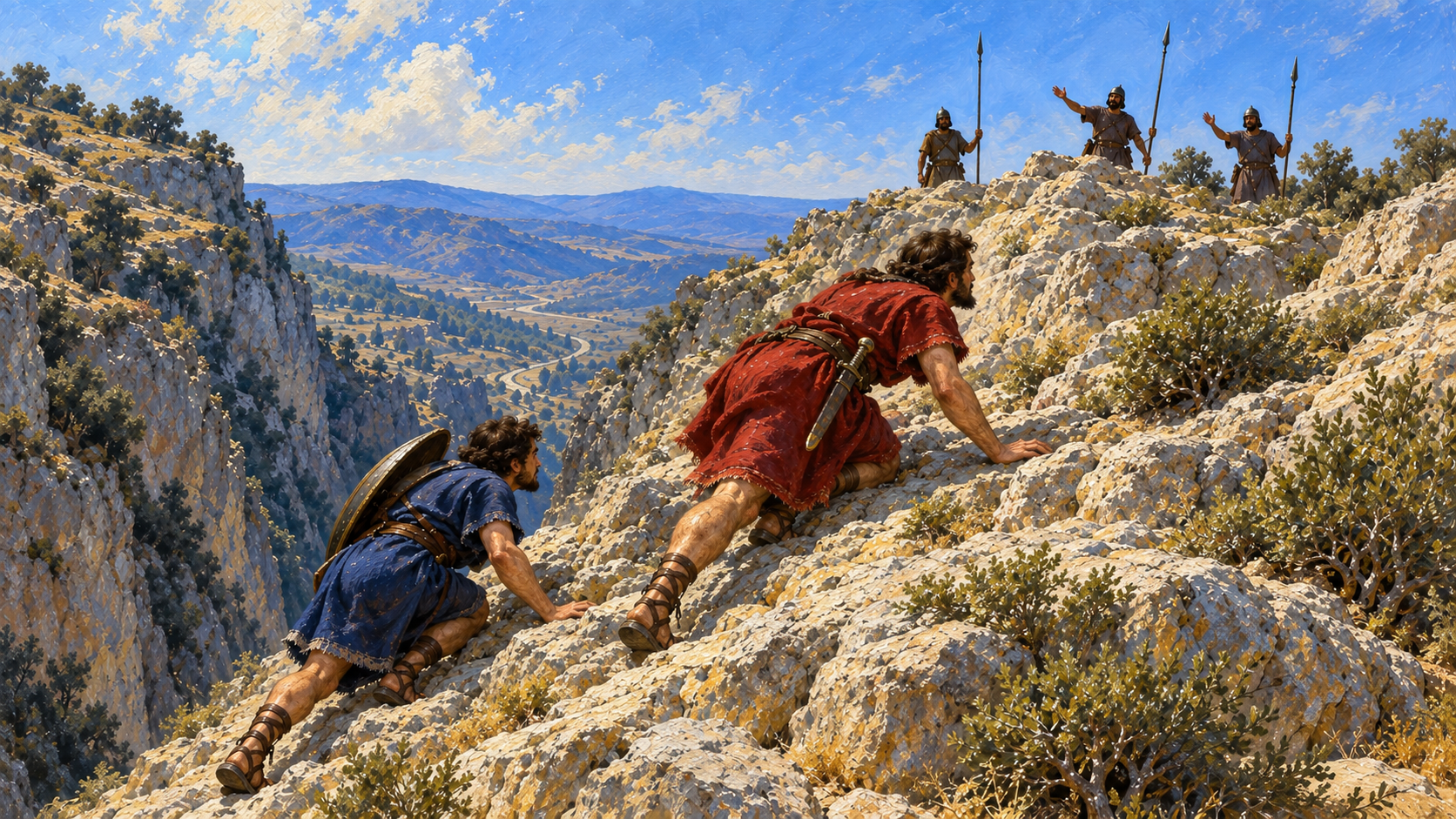
Now it happened one day that Jonathan the son of Saul said to the young man who bore his armor, "Come, let us go over to the Philistines' garrison that is on the other side." But he did not tell his father. And Saul was sitting in the outskirts of Gibeah under a pomegranate tree which is in Migron. The people who were with him were about six hundred men. Ahijah the son of Ahitub, Ichabod's brother, the son of Phinehas, the son of Eli, the LORD's priest in Shiloh, was wearing an ephod. But the people did not know that Jonathan had gone. Between the passes, by which Jonathan sought to go over to the Philistines' garrison, there was a sharp rock on one side and a sharp rock on the other side. And the name of one was Bozez, and the name of the other Seneh. The front of one faced northward opposite Michmash, and the other southward opposite Gibeah. Then Jonathan said to the young man who bore his armor, "Come, let us go over to the garrison of these uncircumcised; it may be that the LORD will work for us. For nothing restrains the LORD from saving by many or by few." So his armorbearer said to him, "Do all that is in your heart. Go then; here I am with you, according to your heart." Then Jonathan said, "Very well, let us cross over to these men, and we will show ourselves to them. If they say thus to us, 'Wait until we come to you,' then we will stand still in our place and not go up to them. But if they say thus, 'Come up to us,' then we will go up. For the LORD has delivered them into our hand, and this will be a sign to us." So both of them showed themselves to the garrison of the Philistines. And the Philistines said, "Look, the Hebrews are coming out of the holes where they have hidden." Then the men of the garrison called to Jonathan and his armorbearer, and said, "Come up to us, and we will show you something." Jonathan said to his armorbearer, "Come up after me, for the LORD has delivered them into the hand of Israel." And Jonathan climbed up on his hands and knees with his armorbearer after him; and they fell before Jonathan. And as he came after him, his armorbearer killed them. That first slaughter which Jonathan and his armorbearer made was about twenty men within about half an acre of land. And there was trembling in the camp, in the field, and among all the people. The garrison and the raiders also trembled; and the earth quaked, so that it was a very great trembling.
Jonathan did not tell Saul his plan. He went with his armor-bearer toward the Philistine outpost between two sharp rocks. Saul remained under a pomegranate tree with about six hundred men, with the priestly household and the ephod present.
Jonathan’s confidence rested on the LORD’s power to save regardless of the size of the human force. God can work through an army or two servants, or use means no commander could arrange. What Israel lacked did not diminish Him.
Jonathan also says, It may be that the LORD will work for us.
That phrase is not unbelief. It distinguishes confidence in what God can do from presumption about what He must do in this moment. Jonathan has no recorded promise that he will survive the climb.
Jonathan proposed an indication of how they should proceed. If the Philistines told them to wait, they would stay where they were. If the men called them up, he would take that response as the LORD’s delivery of the outpost. The Philistines mocked the Hebrews emerging from holes and invited them up.
With his armor-bearer behind him, Jonathan climbed on his hands and knees. They struck roughly twenty men in a small area, and terror spread through the host. The ground shook too, in what the text calls a very great trembling.
I see confidence and restraint together in Jonathan’s faith. He confessed God’s unrestricted power without assuming he could dictate the outcome. After testing the immediate course, he advanced at personal risk. His faith was neither a feeling nor a formula for forcing victory, and the result gave glory to God rather than to favorable numbers.
Jonathan’s armor-bearer answered, Do all that is in your heart. Go then; here I am with you, according to your heart.
He receives less attention in the account, but his presence means Jonathan did not make that climb alone.
An armor-bearer carried equipment and supported a warrior in danger. This young man followed Jonathan up the rocks and killed behind him. Although Scripture records no name for him, his faithful service belonged to the victory too.
His loyalty was admirable because he followed Jonathan toward Israel’s deliverance in confidence in the LORD. Giving the same wholehearted support to a foolish or wicked plan would not have made it virtuous. Loyalty must be governed by God’s truth, not merely by the intensity of our commitment.
Jonathan took the lead and expressed the faith behind their action, but another servant shared the danger. I don’t want to lose him by treating the victory as the achievement of one heroic man. God then sent panic through the enemy and drew Israelites who had hidden or defected back into the battle.
A leader should remember the unnamed companions who carry part of the burden and help complete the work, often sharing its risks. Those companions also need to examine whom they follow and why. A friend’s faithful presence can strengthen courage without becoming a substitute for dependence on God.
Jonathan later became that kind of companion to David. In the woods, he strengthened David’s hand in God rather than making himself the object of David’s confidence.
Saul’s Rash Oath and Jonathan’s Truthful Courage
And the men of Israel were distressed that day, for Saul had placed the people under oath, saying, "Cursed is the man who eats any food until evening, before I have taken vengeance on my enemies." So none of the people tasted food. Now all the people of the land came to a forest; and there was honey on the ground. And when the people had come into the woods, there was the honey, dripping; but no one put his hand to his mouth, for the people feared the oath. But Jonathan had not heard his father charge the people with the oath; therefore he stretched out the end of the rod that was in his hand and dipped it in a honeycomb, and put his hand to his mouth; and his countenance brightened. Then one of the people said, "Your father strictly charged the people with an oath, saying, 'Cursed is the man who eats food this day.'" And the people were faint. But Jonathan said, "My father has troubled the land. Look now, how my countenance has brightened because I tasted a little of this honey. How much better if the people had eaten freely today of the spoil of their enemies which they found! For now would there not have been a much greater slaughter among the Philistines?" Then Saul said to Jonathan, "Tell me what you have done." And Jonathan told him, and said, "I only tasted a little honey with the end of the rod that was in my hand. So now I must die!" Saul answered, "God do so and more also; for you shall surely die, Jonathan." But the people said to Saul, "Shall Jonathan die, who has accomplished this great deliverance in Israel? Certainly not! As the LORD lives, not one hair of his head shall fall to the ground, for he has worked with God this day." So the people rescued Jonathan, and he did not die. Then Saul returned from pursuing the Philistines, and the Philistines went to their own place.
Saul placed the army under an oath forbidding food until evening, before he had taken vengeance on his enemies. The distressed men found honey openly available in the forest, but fear of the oath kept them from eating.
Jonathan had not heard his father’s command. He tasted honey from the end of his rod, and his countenance brightened. Once a soldier told him about the curse, Jonathan plainly judged its effect: his father had troubled the land.
Jonathan’s concern went beyond his own appetite. He saw how faint the people were and reasoned that eating from the enemy’s spoil would have enabled a greater victory. Saul had put his own vengeance first and deprived the men of food without a command from God to do so.
Jonathan spoke truth about the harm his father had caused Israel, and what followed made that harm clearer. After driving the Philistines back, the exhausted soldiers rushed on the spoil and ate meat with the blood. Saul then had to arrange proper slaughter.
Saul’s attempt at strict devotion had contributed to disobedience against an actual command of God. That makes me consider the effect of demands a leader adds. A rule can look severe while weakening obedience, and a wrong command needs to be admitted rather than enforced just to protect the leader’s authority.
A vow does not become righteous because God’s name is attached to it. Scripture warns against rash speech. When a promise requires sin or unjust harm, the answer is repentance, not further sin in the name of consistency.
When God did not answer Saul’s inquiry, Saul assumed there was sin in the camp. He declared that even Jonathan would die if he were responsible. The lot fell on Jonathan, who truthfully reported tasting a little honey and recognized the sentence Saul intended.
Jonathan had not heard the oath, so he had not knowingly defied an announced command. I need to keep that fact in view, along with the difference between God’s moral law and Saul’s destructive royal demand. The lot exposed the event being investigated. It did not relieve Saul of moral responsibility for deciding what penalty should follow.
The people refused to let Saul execute Jonathan. They declared that he had accomplished great deliverance and worked with God that day. By intervening, they restrained the king and saved his son.
This is not mob rule presented as ideal government. It is a moment when the people recognize that royal determination conflicts with evident truth. Saul’s office and fatherhood do not turn an unjust death into obedience.
Children should honor parents, and subjects should respect lawful authority. Neither duty requires participation in sin or silence when authority threatens innocent life. Jonathan can speak truth about his father without becoming contemptuous, and the people can resist a fatal command without claiming authority is meaningless.
Saul turned back from pursuing the Philistines, leaving a reduced military opportunity. His exhausted people had violated the command about blood, and his son had been threatened with death before the king was restrained. Jonathan’s first great victory revealed God’s saving power alongside the damage Saul’s rule had caused.
The Masoretic Text uses forms commonly represented as Yehonatan and Yonatan. English Bibles ordinarily render both as Jonathan. Both Hebrew forms join the divine name with the idea of giving, so Jonathan carries the confession that the LORD has given. The meaning does not guarantee his character or predict each event, but it supplies a fitting frame for his life.
Names in Scripture can preserve confession, memory, family hope, or circumstance. We should not turn them into secret predictions of every event. Jonathan’s name does, however, fit a life in which gift and surrender are closely joined.
Jonathan did not create his own courage, and Israel’s deliverance was the LORD’s work. He received David’s friendship without owning it, just as he held royal standing under God’s choice. His son outlived him and became the recipient of covenant kindness. These parts of his life keep bringing us back to what was given rather than what he could secure for himself.
Jonathan also gave freely. After giving David his robe and weapons, he went on to warn and defend him at personal risk, and later reassured him. Such generosity revealed his nobility rather than diminishing him, because it served God’s will and another person’s good.
I would not turn Jonathan’s life into a technique for making God reward us. Courage and loyal friendship are gifts to cultivate through obedience, while the LORD remains their giver and our Savior. Jonathan’s name helps keep that in view: human virtue never places God in our debt.
Covenant Friendship and the Defense of Innocent Blood
Now when he had finished speaking to Saul, the soul of Jonathan was knit to the soul of David, and Jonathan loved him as his own soul. Saul took him that day, and would not let him go home to his father's house anymore. Then Jonathan and David made a covenant, because he loved him as his own soul. And Jonathan took off the robe that was on him and gave it to David, with his armor, even to his sword and his bow and his belt. So David went out wherever Saul sent him, and behaved wisely. And Saul set him over the men of war, and he was accepted in the sight of all the people and also in the sight of Saul's servants.
David had faced Goliath in the name of the LORD of hosts and returned with the Philistine’s head. After he finished speaking with Saul, Jonathan’s soul was knit to David’s, and Jonathan loved him as his own soul.
Scripture does not reduce that bond to one psychological cause. Jonathan had already trusted the LORD against a Philistine outpost. Now he saw a younger man trust the same God against the Philistine champion. Their shared faith and courage, directed toward Israel’s deliverance, were the setting in which this friendship began.
Jonathan and David made a covenant, a solemn relational commitment before God. It bound them to truthful warning and protection, with kindness toward one another’s households. Their promises would reach beyond either man’s lifetime.
Loving David as his own soul meant David’s good had become personally precious to Jonathan. Leviticus commands love for one’s neighbor as oneself. Jonathan made that love especially visible when his own father began treating David as a threat.
Saul took David into royal service, and David acted wisely wherever he was sent. Jonathan’s friendship did not remove him from public duty or draw him into an exclusive relationship. Their love continued within service under difficult authority.
David is essential to this account, but I don’t want Jonathan to disappear inside David’s biography. Making this covenant revealed Jonathan’s own judgment and character. He chose to bind himself to a faithful man before knowing the full cost of that commitment.
Jonathan gave David the robe he was wearing along with his armor. His sword, bow, and belt were included too. These were substantial gifts from a prince and warrior to the man who had just delivered Israel.
The gifts can reasonably carry royal significance, especially within the unfolding conflict over succession, but Scripture does not call the act a formal abdication or legal transfer of the throne.
Jonathan is not yet recorded as saying that David would be king. That explicit confession comes later in 1 Samuel 23. I would be careful about reading everything he knew then back into chapter 18, as though Scripture had already stated it here.
What we can plainly see is costly, visible honor. Jonathan did not hold this successful young warrior at a suspicious distance. He equipped David from his own possessions and joined himself to him in covenant.
The weapons also belonged to the work both men did. Jonathan’s gift was useful for protection and service in battle, not simply an expression of feeling. Friendship should care about the other person’s faithful work as well as the closeness we enjoy.
We should neither give the gifts a symbolic meaning Jonathan never stated nor reduce them to a casual exchange because their generosity makes a modern reader uncomfortable. They were valuable personal possessions, given publicly in connection with love and covenant.
Now Saul spoke to Jonathan his son and to all his servants, that they should kill David; but Jonathan, Saul's son, delighted greatly in David. So Jonathan told David, saying, "My father Saul seeks to kill you. Therefore please be on your guard until morning, and stay in a secret place and hide. And I will go out and stand beside my father in the field where you are, and I will speak with my father about you. Then what I observe, I will tell you." Thus Jonathan spoke well of David to Saul his father, and said to him, "Let not the king sin against his servant, against David, because he has not sinned against you, and because his works have been very good toward you. For he took his life in his hands and killed the Philistine, and the LORD brought about a great deliverance for all Israel. You saw it and rejoiced. Why then will you sin against innocent blood, to kill David without a cause?" So Saul heeded the voice of Jonathan, and Saul swore, "As the LORD lives, he shall not be killed." Then Jonathan called David, and Jonathan told him all these things. So Jonathan brought David to Saul, and he was in his presence as in times past.
Saul ordered Jonathan and all his servants to kill David. Jonathan, who delighted greatly in David, warned him to hide and promised to speak to Saul. Being a faithful friend now meant acting against a direct command from his father and king.
Jonathan asked Saul not to sin against a servant who had done him no wrong and whose work had been very good. He reminded Saul that David had risked his life and that the LORD had brought great deliverance through him. Saul himself had seen it and rejoiced.
Jonathan then called the intended killing sin against innocent blood, without cause. He did not defend David simply by saying, He is my friend.
He brought Saul back to the evidence and his own earlier judgment, setting those alongside God’s work and moral law.
Saul listened and swore that David would not be killed. Jonathan then brought David back into Saul’s presence. For a time, his appeal appeared to have restored the relationship.
Saul’s later return to violence does not make Jonathan’s effort foolish. Telling the truth and seeking change are faithful peacemaking, but neither can make another person keep an oath. Jonathan was responsible for his obedience; he could not control Saul’s future choices.
Jonathan did not hide the danger when he spoke to Saul. He named the wrong being threatened and used facts Saul already knew to appeal for David’s safety. If I have private access to someone with power, his example makes me consider whether I use it to protect the vulnerable or only to preserve my own comfort.
David later told Jonathan that Saul sought his life. At first, Jonathan struggled to believe his father would hide such a plan from him. David explained that Saul knew Jonathan favored him and might conceal the intention for that very reason.
The friends agreed to test Saul’s response to David’s absence from the New Moon meal. A peaceful response would mean David could return, while fury would confirm Saul’s murderous intent. They sought evidence rather than asking Jonathan to decide between unsupported accusations.
David’s empty place would be noticed at this regular royal feast. Jonathan explained his absence by referring to a requested family sacrifice in Bethlehem. Saul responded with more than ordinary disappointment: his rage fell on both David and Jonathan.
Jonathan had already seen Saul threaten his life in chapter 14 and heard him order David’s death in chapter 19. Even so, the New Moon feast forced him to face how deeply his father’s royal ambitions had become joined to violence. Evidence can be painful when it destroys what we still hope to believe about a parent or leader.
Jonathan’s willingness to test the claim should not be condemned as disloyalty to David. Serious allegations should be established carefully. Once the danger is clear, however, neutrality is no longer available.
Their plan to communicate through arrows kept David from having to enter the court. Jonathan’s care for his friend included his safety. Wise friendship does not insist on a face-to-face confrontation with someone who has already shown lethal intent.
Then Jonathan said to David: "The LORD God of Israel is witness! When I have sounded out my father sometime tomorrow, or the third day, and indeed there is good toward David, and I do not send to you and tell you, may the LORD do so and much more to Jonathan. But if it pleases my father to do you evil, then I will report it to you and send you away, that you may go in safety. And the LORD be with you as He has been with my father. And you shall not only show me the kindness of the LORD while I still live, that I may not die; but you shall not cut off your kindness from my house forever, no, not when the LORD has cut off every one of the enemies of David from the face of the earth." So Jonathan made a covenant with the house of David, saying, "Let the LORD require it at the hand of David's enemies." Now Jonathan again caused David to vow, because he loved him; for he loved him as he loved his own soul. As soon as the lad had gone, David arose from a place toward the south, fell on his face to the ground, and bowed down three times. And they kissed one another; and they wept together, but David more so. Then Jonathan said to David, "Go in peace, since we have both sworn in the name of the LORD, saying, 'May the LORD be between you and me, and between your descendants and my descendants, forever.'" So he arose and departed, and Jonathan went into the city.
Jonathan called on the LORD God of Israel as witness to his promise to learn Saul’s intention and warn David. If Saul meant evil, Jonathan asked for the LORD’s judgment on himself should he fail to send David away safely.
He then spoke of a future in which the LORD would be with David as He had been with Saul. He asked David to show him the kindness of the LORD while he lived. That kindness was also to continue toward Jonathan’s household after the LORD removed David’s enemies.
Jonathan was asking for more than help with an immediate escape. A change of kings in the ancient world could mean the elimination of a rival royal house. He wanted David’s future power governed by covenant kindness rather than vengeance.
Jonathan renewed the covenant with David’s house because he loved David as his own soul. Yet his care for his friend did not make him careless about his child or future household. The promise brought love for David and responsibility for his own family together under God.
After the warning with the arrows, David and Jonathan met again. David bowed before Jonathan, and the two kissed and wept together, with David grieving most deeply. Their courage did not prevent them from expressing affection or sorrow. Scripture lets us see both without treating their tears as weakness.
Jonathan sent David away in peace because of the oath they had sworn before the LORD. It bound them and their descendants, with the LORD as everlasting witness. Though circumstances separated the friends, the truth of their covenant remained.
At the feast, Saul insulted Jonathan as the son of a perverse, rebellious woman. His abusive words shamed Jonathan and his mother together. He treated the friendship with David as disgraceful because it stood in the way of his plans for the dynasty.
Saul said Jonathan and his kingdom would never be established while David lived, then ordered him to bring David to be killed. Preserving the future Saul wanted meant eliminating the man God had chosen.
Jonathan answered by asking what David had done. Instead of accepting his father’s ambitions as justification, he brought the question back to justice. Saul threw a spear at him, showing that his violence could turn on his own son when challenged.
Jonathan rose in fierce anger and refused food, grieving especially for David because Saul had treated him shamefully. Anger is not automatically righteous. Here, though, it answered attempted murder and abuse, with their contempt for innocent blood.
Honoring Saul did not require Jonathan to agree that his ambition was holy. Jonathan neither cursed his father nor sought the throne through violence. He and David did not join together to kill Saul, but Jonathan also refused to hand David over just to preserve peace in the family.
In destructive families, people are often told that loyalty means joining in harm and that refusal makes them rebellious. Jonathan’s conduct shows another way. He told the truth and protected the threatened man despite the cost to himself, leaving the final decision about kingship to God.
Strengthening David in God
And David stayed in strongholds in the wilderness, and remained in the mountains in the Wilderness of Ziph. Saul sought him every day, but God did not deliver him into his hand. So David saw that Saul had come out to seek his life. And David was in the Wilderness of Ziph in a forest. Then Jonathan, Saul's son, arose and went to David in the woods and strengthened his hand in God. And he said to him, "Do not fear, for the hand of Saul my father shall not find you. You shall be king over Israel, and I shall be next to you. Even my father Saul knows that." So the two of them made a covenant before the LORD. And David stayed in the woods, and Jonathan went to his own house.
David lived in wilderness strongholds while Saul hunted him every day. God did not deliver him into Saul’s hand. Yet His protection does not mean a person will be free from fear or fatigue, or that prolonged danger will immediately end.
Jonathan went to David in the woods and strengthened his hand in God. That helps me understand what a faithful friend can do. He did not make David depend on his presence, but helped him rest again in the LORD.
Jonathan told David not to fear because Saul would not find him and he would become king over Israel. He hoped to stand next to David and said that even Saul knew David’s future.
Here Jonathan explicitly recognized that David would have the throne. Instead of joining Saul’s attempt to defeat God’s choice, he pictured himself serving beside David.
Jonathan never received that hoped-for place beside David. Scripture does not record it as a divine promise, and he would die before David reigned over all Israel. I need to distinguish an unfulfilled hope from a broken promise. Even a faithful person’s hopes can remain unrealized without making God unfaithful.
The friends renewed their covenant before the LORD and parted again. Jonathan went home while David remained in danger. A friend can give profound encouragement without being able to end the trial or stay physically present.
Modern readers sometimes treat the language of love, souls knit together, kissing, weeping, and love surpassing that of women as evidence of a sexual relationship. The narrative does not state or imply a sexual act.
Their relationship is repeatedly described as a covenant. Its recorded content concerned David’s protection from Saul through truthful warning, along with his future kingship. The covenant also provided for Jonathan’s household and descendants, with peace between them and the LORD as witness. These were solemn commitments of loyal brotherhood.
David marries women, and Jonathan fathers Mephibosheth. Those facts do not prove every aspect of desire, but they belong to the narrative context and prevent claims that the text presents the men as a same-sex marital pair.
Hebrew narrative uses plain vocabulary for sexual relations elsewhere, but none of it appears in the account of these men. Their love was extraordinary without being erotic. Scripture can praise deep affection between men without making that affection a sexual identity.
David’s later statement that Jonathan’s love surpassed the love of women belongs to his lament. He was grieving a friend whose covenant loyalty had defended him when royal and household power sought his death. I would not make that expression of grief say more than it does.
Defending marriage as the covenant union of one man and one woman should not leave male friendship emotionally barren. Brothers can express love through an embrace or tears and speak tenderly to each other. They can make promises and sacrifices without becoming anything other than brothers. Treating every kind of closeness as sexual impoverishes friendship.
Nor should Jonathan’s friendship be used to demean women or marriage. Different relationships carry different goods and responsibilities. The text honors one remarkable friendship; it does not issue a universal ranking of friendship over marriage.
After meeting David in the woods, Jonathan returned to his own house rather than joining David’s fugitive band. He later fought beside Saul against the Philistines and died with the royal army.
Was Jonathan compromising by staying? Scripture does not stop to condemn him for failing to defect, but neither does it give enough detail to call every decision ideal. I don’t want to pass judgment beyond what we are actually told.
Jonathan had several real responsibilities to consider. He was Saul’s son and an Israelite prince, with duties as a proven commander defending the nation against Philistine oppression. He also had responsibilities as a husband or father. Serving in Israel’s army was not the same as joining Saul’s private attempts to murder David.
His position was tragic nonetheless. He knew David would be king and saw Saul’s violence clearly, but he could not change his father or secure David’s safety. Nor could he guarantee his own hoped-for place beside David or his household’s future.
Within that difficult position, Jonathan repeatedly refused to cross moral lines. He warned and defended David instead of accepting the shedding of innocent blood, bearing Saul’s abuse in the process. He renewed the covenant and strengthened David in God. Scripture records those actions without giving us a theory of political separation.
Not every faithful decision produces a clean life arrangement. Believers may face overlapping obligations at home, at work, in government or military service, and within the church. In those tensions, they must refuse sin and protect people while telling the truth and seeking wise counsel. Even then, some outcomes will remain beyond their control.
Death, Lament, and Covenant Kindness
Now the Philistines fought against Israel; and the men of Israel fled from before the Philistines, and fell slain on Mount Gilboa. Then the Philistines followed hard after Saul and his sons. And the Philistines killed Jonathan, Abinadab, and Malchishua, Saul's sons. The battle became fierce against Saul. The archers hit him, and he was severely wounded by the archers. Then Saul said to his armorbearer, "Draw your sword, and thrust me through with it, lest these uncircumcised men come and thrust me through and abuse me." But his armorbearer would not, for he was greatly afraid. Therefore Saul took a sword and fell on it. And when his armorbearer saw that Saul was dead, he also fell on his sword, and died with him. So Saul, his three sons, his armorbearer, and all his men died together that same day.
On Mount Gilboa, the Philistines fought Israel and killed Jonathan with his brothers Abinadab and Malchishua as Israel’s men fell. Saul was badly wounded. He asked his armor-bearer to kill him, then fell on his own sword and died.
Scripture gives Jonathan no final speech. He did not see David crowned or serve beside him, and he did not live to see the covenant protect his son. The brief report of his death lets us feel that loss.
Dying beside Saul did not erase the differences Scripture had shown between them. A family can share a tragedy without everyone sharing the same character. Jonathan had defended Israel and David, while Saul had pursued David and consulted the medium at En Dor before the final battle.
The contrast between Michmash and Gilboa keeps me from treating courage as a guarantee of deliverance from death. At Michmash, the LORD saved through Jonathan and his armor-bearer. At Gilboa, Jonathan fell. Faith trusts God without a promise that every faithful servant will receive the earthly ending he wants.
The Philistines dishonored Saul’s body and displayed his body and those of his sons on the wall of Beth Shan. Remembering how Saul had once delivered their city, the valiant men of Jabesh Gilead recovered them.
Jonathan’s hoped-for political future ended at Gilboa, but his covenant still had consequences beyond his death. David would grieve for him and remember the promise, seeking someone who remained from Saul’s house to receive kindness for Jonathan’s sake.
Then David lamented with this lamentation over Saul and over Jonathan his son, and he told them to teach the children of Judah the Song of the Bow; indeed it is written in the Book of Jasher: "The beauty of Israel is slain on your high places! How the mighty have fallen! Tell it not in Gath, Proclaim it not in the streets of Ashkelon– Lest the daughters of the Philistines rejoice, Lest the daughters of the uncircumcised triumph. "O mountains of Gilboa, Let there be no dew nor rain upon you, Nor fields of offerings. For the shield of the mighty is cast away there! The shield of Saul, not anointed with oil. From the blood of the slain, From the fat of the mighty, The bow of Jonathan did not turn back, And the sword of Saul did not return empty. "Saul and Jonathan were beloved and pleasant in their lives, And in their death they were not divided; They were swifter than eagles, They were stronger than lions. "O daughters of Israel, weep over Saul, Who clothed you in scarlet, with luxury; Who put ornaments of gold on your apparel. "How the mighty have fallen in the midst of the battle! Jonathan was slain in your high places. I am distressed for you, my brother Jonathan; You have been very pleasant to me; Your love to me was wonderful, Surpassing the love of women. "How the mighty have fallen, And the weapons of war perished!"
David composed the Song of the Bow and ordered it taught to the children of Judah. The grief became something the people would remember together. His lament honored the fallen leaders while mourning the national disaster at Gilboa.
David remembered Saul and Jonathan together as beloved and pleasant in life and undivided in death. I don’t read a lament as though it were a complete moral biography. David had already spoken truth about Saul’s pursuit and repeatedly refused to kill him. Here he mourned Israel’s king rather than listing all his sins.
David addressed Jonathan directly as his brother. He remembered his pleasantness and called his love wonderful, surpassing the love of women. He was mourning covenant loyalty that danger had tested and death had ended.
The comparison does not say women are incapable of faithful love or that David’s marriages are the standard for every marriage. David’s household relationships included serious disorder, and a poem of grief should not be forced into a general ranking.
The repeated cry, How the mighty have fallen,
gives no room for triumphalism. This defeat left David the clearest path to the throne, yet he did not celebrate Saul’s death as a step forward for himself. He mourned Israel and its lost beauty, Saul and Jonathan, and the weapons that had perished.
Mature grief can tell the truth warmly without pretending every relationship was uncomplicated. It can honor what was good, lament what has ended, and leave judgment with God.
Now David said, "Is there still anyone who is left of the house of Saul, that I may show him kindness for Jonathan's sake?" And there was a servant of the house of Saul whose name was Ziba. So when they had called him to David, the king said to him, "Are you Ziba?" He said, "At your service!" Then the king said, "Is there not still someone of the house of Saul, to whom I may show the kindness of God?" And Ziba said to the king, "There is still a son of Jonathan who is lame in his feet." So the king said to him, "Where is he?" And Ziba said to the king, "Indeed he is in the house of Machir the son of Ammiel, in Lo Debar." Then King David sent and brought him out of the house of Machir the son of Ammiel, from Lo Debar. Now when Mephibosheth the son of Jonathan, the son of Saul, had come to David, he fell on his face and prostrated himself. Then David said, "Mephibosheth?" And he answered, "Here is your servant!" So David said to him, "Do not fear, for I will surely show you kindness for Jonathan your father's sake, and will restore to you all the land of Saul your grandfather; and you shall eat bread at my table continually." Then he bowed himself, and said, "What is your servant, that you should look upon such a dead dog as I?" And the king called to Ziba, Saul's servant, and said to him, "I have given to your master's son all that belonged to Saul and to all his house. You therefore, and your sons and your servants, shall work the land for him, and you shall bring in the harvest, that your master's son may have food to eat. But Mephibosheth your master's son shall eat bread at my table always." Now Ziba had fifteen sons and twenty servants. Then Ziba said to the king, "According to all that my lord the king has commanded his servant, so will your servant do." "As for Mephibosheth," said the king, "he shall eat at my table like one of the king's sons." Mephibosheth had a young son whose name was Micha. And all who dwelt in the house of Ziba were servants of Mephibosheth. So Mephibosheth dwelt in Jerusalem, for he ate continually at the king's table. And he was lame in both his feet.
Jonathan’s son was five when news of Saul and Jonathan’s deaths arrived. His nurse fled and dropped him, leaving him lame in both feet. He is named Mephibosheth in 2 Samuel and Merib-Baal in 1 Chronicles. We can note both forms without claiming to know every reason behind the naming choices.
Once David’s kingdom was established, he asked whether anyone remained from Saul’s house to whom he could show kindness for Jonathan’s sake. Ziba told him about Mephibosheth in Lo Debar.
Mephibosheth came fearfully and fell before David. The king told him not to fear and promised kindness for Jonathan’s sake. He restored Saul’s land to him and gave him a continuing place at his own table.
David kept the covenant when Jonathan could give him nothing back. He did more than spare a descendant of the rival house. Mephibosheth received land and provision, with a recognized place at the king’s table.
Mephibosheth’s disability belonged to his circumstances without defining his worth. He spoke for himself and received property, had a son and managed relationships. Later, he gave his own account in a political dispute. I don’t want to reduce him to a prop whose only purpose is to display David’s generosity.
The later events were complicated. During Absalom’s rebellion, Ziba accused Mephibosheth of hoping to recover Saul’s kingdom, and David gave Ziba the estate. After David returned, Mephibosheth said Ziba had deceived and slandered him while he remained in mourning.
David divided the land between them, but Mephibosheth said Ziba could take it all now that the king had returned safely. Scripture leaves some questions unresolved. The covenant kindness was real, even though those administering it faced disputed testimony and political crisis with human limitations.
Friendship Under God and the Greater Covenant Friend
Jonathan’s courage and covenant faithfulness remained accountable to truth. He trusted that the LORD could save by many or few without claiming an outcome God had not promised. His warnings to David rested on evidence, and he named the sin of shedding innocent blood. He also sought lasting good for both households beyond his own life.
Jonathan and David spent long periods apart, so their friendship cannot be measured simply by how often they were together. Timely warnings and courageous advocacy showed its faithfulness. Jonathan remembered their covenant and helped David trust God.
Jonathan did not flatter David or try to make himself indispensable. He told him what Saul intended while confirming his future throne and directing his courage toward God’s protection. That is the help a good friend gives when fear distorts judgment and obedience becomes difficult.
I would be careful about imitating their covenant with dramatic vows of our own. We should understand the responsibility we accept and promise only what is righteous and possible. Then we need to keep our word even when affection no longer brings an immediate reward.
Jonathan’s loyalty to his family remained under God. He did not despise Saul or seek his death, but he refused to take part in murder. He challenged destructive leadership and protected the person his father targeted.
Their friendship also had material consequences. Jonathan gave valuable equipment, and David later restored land and table fellowship to Jonathan’s son. Love can affect the time and resources we give, put our safety or reputation at stake, and ask us to accept responsibility. If none of that is ever involved, the love remains untested.
A friend must not become our savior or the final authority in place of Christ. Jonathan served David best by strengthening his hand in God. Friendship can flourish when both people remain under the LORD instead of asking their relationship to carry a weight that belongs to Him alone.
At Michmash, Jonathan knew God could save by many or few, while it may be left the outcome in God’s hands. Later, he recognized David’s future kingship and hoped to serve beside him. That hope was neither promised nor fulfilled. His life keeps faith and surrender together without making God’s faithfulness depend on a servant receiving the ending he wants.
Jonathan honored Saul as father and king, but God’s truth remained above Saul’s commands. He tested Saul’s intention and warned David, naming innocent blood and bearing abuse rather than joining murder. Those actions are clear. His reasons for remaining with Israel’s army are not fully explained, so we should leave that silence as it stands.
The covenant outlived Jonathan. David remembered his promise by restoring land to Mephibosheth and giving him recognized belonging at the king’s table. The dispute with Ziba later exposed the difficulty of testimony and imperfect administration without making the kindness unreal. I see love in keeping a promise when the person who received it can no longer repay us.
"As the Father loved Me, I also have loved you; abide in My love. If you keep My commandments, you will abide in My love, just as I have kept My Father's commandments and abide in His love. "These things I have spoken to you, that My joy may remain in you, and that your joy may be full. This is My commandment, that you love one another as I have loved you. Greater love has no one than this, than to lay down one's life for his friends. You are My friends if you do whatever I command you. No longer do I call you servants, for a servant does not know what his master is doing; but I have called you friends, for all things that I heard from My Father I have made known to you. You did not choose Me, but I chose you and appointed you that you should go and bear fruit, and that your fruit should remain, that whatever you ask the Father in My name He may give you. These things I command you, that you love one another.
Jonathan’s loyalty is beautiful, but it cannot save a sinner or establish the final kingdom. Jesus is the eternal Son, fully God and fully man, virgin-born and completely sinless. He is David’s Lord and promised Son, the rightful King whose reign never ends.
When Jesus calls His disciples friends, He speaks of His commands and revealed truth, along with the mission He chose for them. Prayer and obedience belong in that setting of sacrificial love. He lays down His life with full authority and takes it again, accomplishing a saving work no human friendship can reproduce.
Wicked men physically tortured and punished Jesus, then killed Him. He willingly bore that real punishment for our sins in His innocent body and shed His blood. He died and was buried, then rose bodily. The Father did not punish or curse Jesus, abandon Him, strike or bruise Him, or pour wrath on Him.
Christ died for the whole world, and God’s offer is genuine even though people can resist and reject Him. Everyone who truly repents and believes is forgiven and justified. That person is born again and made a new creation, indwelt and sealed by the Holy Spirit, and eternally secure.
The Holy Spirit is fully God and a divine Person who produces love and faithfulness. Gentleness, courage, and self-control also come from Him. He never leads us to justify selfish ambition or enable abuse. Nor would He have us break a righteous promise or give a friend the place of an idol.
Eternal security does not excuse lawlessness or prove every superficial profession genuine. The born-again believer obeys from secure belonging, confesses failure honestly, and learns to love without fear of purchasing God’s acceptance.
Jonathan died before he could see the future he desired. Jesus rose bodily and guarantees His people’s resurrection. Though death may interrupt earthly loyalty for a time, everyone in Christ has a living hope stronger than the grave.
Jonathan’s life leads us beyond admiration for a faithful friend to trust in the King who shed His blood and conquered the grave. He keeps covenant perfectly and, through faith, makes God’s enemies members of His household.
For further study, see The Life of King David, The Life of King Saul, The Tribe of Benjamin, and What True Love Is.
My Final Thoughts
Following Jonathan from Geba to Gilboa, I see courage and friendship governed by the LORD rather than ambition. He trusted God’s power without insisting on an outcome and defended David against an unjust death. He accepted that God’s chosen king would receive the future Saul wanted for him. His covenant love was deep brotherhood, and it bore lasting fruit when David welcomed Mephibosheth for Jonathan’s sake. Jonathan’s unfulfilled hopes still call me to strengthen friends in God and refuse any loyalty that requires sin, keeping righteous promises even when there is nothing left to gain. My final hope rests in Jesus, the greater covenant Friend who shed His blood, died, and rose bodily. He is the King whose promises cannot fail and whose friendship will never end.