
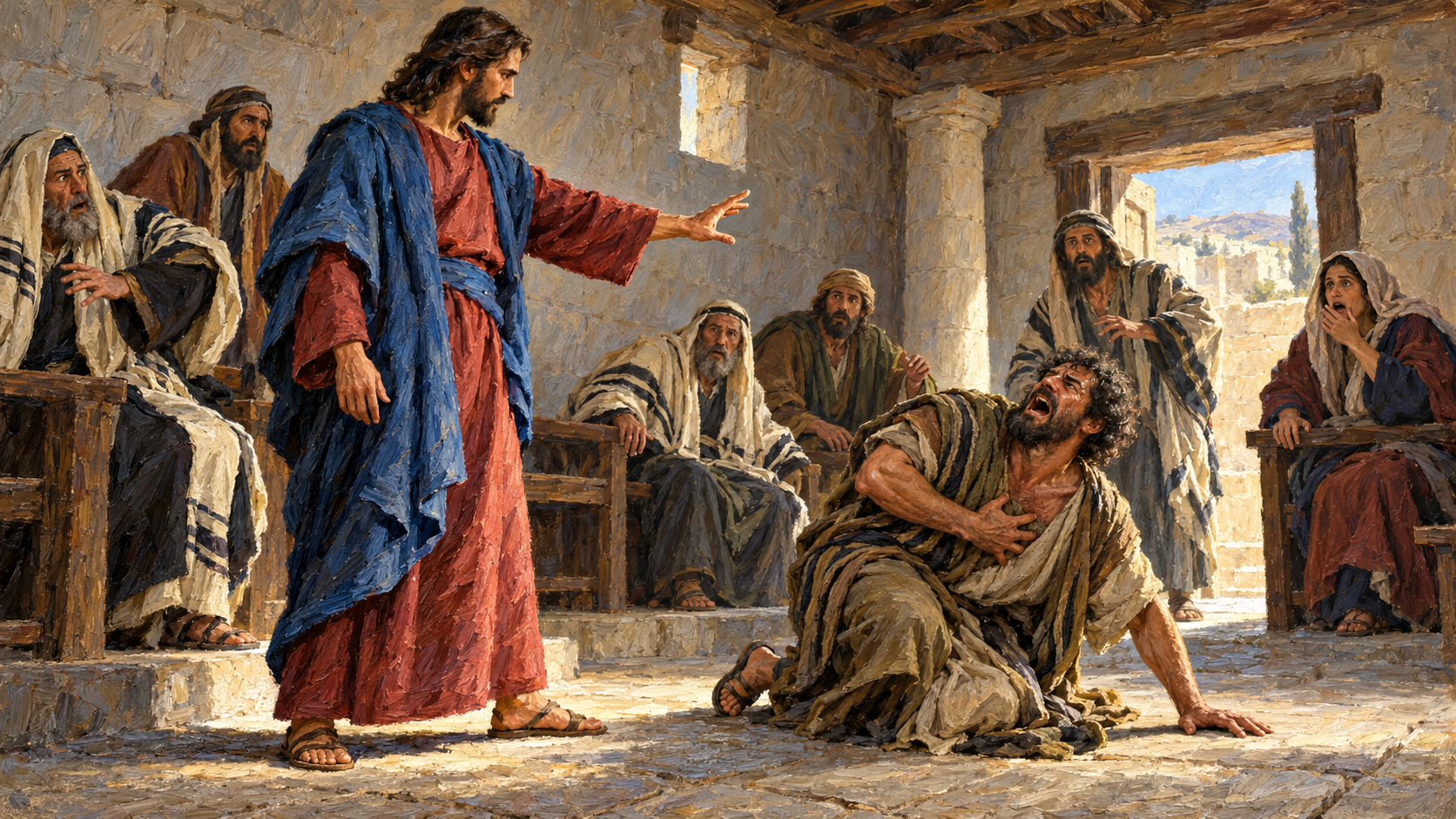
What does the Bible actually teach about casting out demons, and how should Christians respond if a possible case arises today? The Gospels show that demons are real and that Jesus has complete authority over them, but they also keep us from turning illness, distress, or unusual behavior into a careless diagnosis. I want to keep Christ at the center as we follow those passages, without letting concern about spiritual danger eclipse truthful and compassionate care for the person.
Jesus Has Complete Authority Over Real Demons
Then they went into Capernaum, and immediately on the Sabbath He entered the synagogue and taught. And they were astonished at His teaching, for He taught them as one having authority, and not as the scribes. Now there was a man in their synagogue with an unclean spirit. And he cried out, saying, "Let us alone! What have we to do with You, Jesus of Nazareth? Did You come to destroy us? I know who You are–the Holy One of God!" But Jesus rebuked him, saying, "Be quiet, and come out of him!" And when the unclean spirit had convulsed him and cried out with a loud voice, he came out of him. Then they were all amazed, so that they questioned among themselves, saying, "What is this? What new doctrine is this? For with authority He commands even the unclean spirits, and they obey Him." And immediately His fame spread throughout all the region around Galilee.
Mark places this deliverance near the beginning of Jesus’ public ministry. The unclean spirit was present in a synagogue, a setting of Scripture reading and religious instruction. Its presence warns us that religious surroundings do not automatically prevent spiritual darkness.
The spirit spoke as a personal being rather than as part of the afflicted man’s own personality. It recognized Jesus of Nazareth and called Him the Holy One of God. Yet correct information did not amount to saving faith. The demon knew who Jesus was and remained His enemy.
Jesus did not ask for a hidden history or reach for a sacred object. He used no repeated formula and did not bargain or turn the encounter into a performance. He simply rebuked the spirit, silenced it, and ordered it to come out. The people recognized that His teaching was different because even unclean spirits obeyed His authority.
Christ’s authority is inherent. He does not borrow the right to command from another minister, and He cannot be placed beside demons as one spiritual force competing against another. Every demon is a created rebel. Jesus is the Creator and Lord. Christian ministry can act only under His authority and must never turn service in His name into personal celebrity.
And Jesus went about all Galilee, teaching in their synagogues, preaching the gospel of the kingdom, and healing all kinds of sickness and all kinds of disease among the people. Then His fame went throughout all Syria; and they brought to Him all sick people who were afflicted with various diseases and torments, and those who were demon-possessed, epileptics, and paralytics; and He healed them. Great multitudes followed Him–from Galilee, and from Decapolis, Jerusalem, Judea, and beyond the Jordan.
Matthew lists diseases, torments, demon possession, epilepsy, and paralysis as distinct categories. The Gospel writers were capable of saying that a person was sick without calling the sickness a demon. They were also capable of identifying an unclean spirit as more than a poetic label for illness.
This distinction corrects both denial and overdiagnosis. We must not explain away the personal spirits Jesus addressed, but we also must not assume that seizures, paralysis, hallucinations, distress, disability, or unusual behavior prove demonic possession. Similar outward signs can arise from very different causes, and Scripture gives no checklist by which a modern observer can diagnose the unseen from appearance alone.
Some demonic cases in the Gospels produced physical effects, including muteness, blindness, convulsions, or destructive behavior. I think that overlap should make us more humble, not more eager to label someone. It does not turn every person with the same symptom into a possession case. Medical evaluation and prayer can proceed together because all truth belongs to God.
The English phrase demon-possessed summarizes direct demonic affliction and control in the narratives. The passages do not define a clinical scale, a percentage of control, or a procedure for labeling someone. They show real persons suffering under hostile spirits and being restored by Christ.
Then they came to the other side of the sea, to the country of the Gadarenes. And when He had come out of the boat, immediately there met Him out of the tombs a man with an unclean spirit, who had his dwelling among the tombs; and no one could bind him, not even with chains, because he had often been bound with shackles and chains. And the chains had been pulled apart by him, and the shackles broken in pieces; neither could anyone tame him. And always, night and day, he was in the mountains and in the tombs, crying out and cutting himself with stones. When he saw Jesus from afar, he ran and worshiped Him. And he cried out with a loud voice and said, "What have I to do with You, Jesus, Son of the Most High God? I implore You by God that You do not torment me." For He said to him, "Come out of the man, unclean spirit!" Then He asked him, "What is your name?" And he answered, saying, "My name is Legion; for we are many." Also he begged Him earnestly that He would not send them out of the country. Now a large herd of swine was feeding there near the mountains. So all the demons begged Him, saying, "Send us to the swine, that we may enter them." And at once Jesus gave them permission. Then the unclean spirits went out and entered the swine (there were about two thousand); and the herd ran violently down the steep place into the sea, and drowned in the sea. So those who fed the swine fled, and they told it in the city and in the country. And they went out to see what it was that had happened. Then they came to Jesus, and saw the one who had been demon-possessed and had the legion, sitting and clothed and in his right mind. And they were afraid. And those who saw it told them how it happened to him who had been demon-possessed, and about the swine. Then they began to plead with Him to depart from their region. And when He got into the boat, he who had been demon-possessed begged Him that he might be with Him. However, Jesus did not permit him, but said to him, "Go home to your friends, and tell them what great things the Lord has done for you, and how He has had compassion on you." And he departed and began to proclaim in Decapolis all that Jesus had done for him; and all marveled.
The man lived among tombs, isolated from ordinary community. He possessed extraordinary strength, broke restraints, cried out, and cut himself. The account presents terrible suffering, but it never turns the man into the enemy. Jesus directs His authority against the unclean spirits and restores the person they had tormented.
The demons called themselves Legion because they were many. They recognized Jesus, begged permission, and could not act as independent rulers of the scene. Even before they left, their requests displayed their limits. Christ determined what happened.
Afterward the man was sitting, clothed, and in his right mind. The people saw recognizable restoration rather than a minister congratulating himself. Jesus then refused the man’s request to travel with Him and gave him a local assignment: tell his friends what the Lord had done and how He had compassion on him.
Mark 5 should not become a diagnostic template for every case. Scripture records other demonic afflictions with different outward effects. Nor should self-harm be treated as proof of possession. Anyone in danger of harming himself needs immediate protection and qualified crisis help. The lasting lesson is Christ’s compassion and authority over even severe demonic bondage.
Then one was brought to Him who was demon-possessed, blind and mute; and He healed him, so that the blind and mute man both spoke and saw. And all the multitudes were amazed and said, "Could this be the Son of David?" Now when the Pharisees heard it they said, "This fellow does not cast out demons except by Beelzebub, the ruler of the demons." But Jesus knew their thoughts, and said to them: "Every kingdom divided against itself is brought to desolation, and every city or house divided against itself will not stand. If Satan casts out Satan, he is divided against himself. How then will his kingdom stand? And if I cast out demons by Beelzebub, by whom do your sons cast them out? Therefore they shall be your judges. But if I cast out demons by the Spirit of God, surely the kingdom of God has come upon you. Or how can one enter a strong man’s house and plunder his goods, unless he first binds the strong man? And then he will plunder his house. He who is not with Me is against Me, and he who does not gather with Me scatters abroad.
Jesus delivered a demon-possessed man who had been blind and mute. The crowds wondered whether Jesus was the Son of David, the promised King. The Pharisees answered the evidence by accusing Him of casting out demons through Beelzebub.
Jesus exposed the contradiction. Satan does not advance his kingdom by destroying his own rule. Christ cast out demons by the Spirit of God, and that work showed that God’s kingdom had come upon them. The rightful King was binding the strong man and plundering his house.
This passage keeps deliverance tied to what we believe about Jesus Christ. Casting out demons was not a free-floating display of spiritual energy. It bore witness to who Jesus is and to the kingdom entering enemy-held ground. Any modern ministry that makes a deliverer, method, brand, or secret knowledge the center has departed from the meaning of the sign.
The accusation also warns against careless spiritual judgments. The Pharisees saw the Spirit’s work and called it satanic because they had already hardened themselves against Jesus. Christians must test claims, but testing requires biblical evidence. Suspicion, tribal loyalty, and dislike are not discernment.
Christ Delegated Authority as the Gospel Advanced
And when He had called His twelve disciples to Him, He gave them power over unclean spirits, to cast them out, and to heal all kinds of sickness and all kinds of disease. Now the names of the twelve apostles are these: first, Simon, who is called Peter, and Andrew his brother; James the son of Zebedee, and John his brother; Philip and Bartholomew; Thomas and Matthew the tax collector; James the son of Alphaeus, and Lebbaeus, whose surname was Thaddaeus; Simon the Cananite, and Judas Iscariot, who also betrayed Him. These twelve Jesus sent out and commanded them, saying: "Do not go into the way of the Gentiles, and do not enter a city of the Samaritans. But go rather to the lost sheep of the house of Israel. And as you go, preach, saying, 'The kingdom of heaven is at hand.’ Heal the sick, cleanse the lepers, raise the dead, cast out demons. Freely you have received, freely give.
Then the seventy returned with joy, saying, "Lord, even the demons are subject to us in Your name." And He said to them, "I saw Satan fall like lightning from heaven. Behold, I give you the authority to trample on serpents and scorpions, and over all the power of the enemy, and nothing shall by any means hurt you. Nevertheless do not rejoice in this, that the spirits are subject to you, but rather rejoice because your names are written in heaven."
Jesus gave the Twelve authority over unclean spirits as part of a defined mission to the lost sheep of Israel. He also sent the seventy, who returned rejoicing that demons were subject to them in His name. These passages prove that Christ delegated real authority, but the surrounding mission instructions also show why every detail cannot be lifted from its setting and assigned identically to every Christian.
The Twelve were told where to go, what to preach, and what confirming works accompanied that mission. Christians today do not reproduce the Twelve’s foundational office, and no modern minister may claim immunity from examination by borrowing apostolic language.
The seventy broaden the evidence beyond the Twelve. An unnamed man in Luke 9 also cast out demons in Jesus’ name, and Jesus corrected the disciples for forbidding him merely because he did not follow with their immediate group. Christ’s authority was never the private property of one ministry circle.
When the seventy celebrated power over demons, Jesus redirected their joy. He acknowledged the authority He had given and then told them to rejoice that their names were written in heaven. Salvation is a greater cause for joy than dramatic spiritual success. A ministry fascinated with manifestations while neglecting the gospel has reversed Christ’s emphasis.
Later He appeared to the eleven as they sat at the table; and He rebuked their unbelief and hardness of heart, because they did not believe those who had seen Him after He had risen. And He said to them, "Go into all the world and preach the gospel to every creature. He who believes and is baptized will be saved; but he who does not believe will be condemned. And these signs will follow those who believe: In My name they will cast out demons; they will speak with new tongues; they will take up serpents; and if they drink anything deadly, it will by no means hurt them; they will lay hands on the sick, and they will recover." So then, after the Lord had spoken to them, He was received up into heaven, and sat down at the right hand of God. And they went out and preached everywhere, the Lord working with them and confirming the word through the accompanying signs. Amen.
Mark 16:9-20 belongs in the received text used by Unforsaken. The passage includes the risen Lord’s commission, the promise of accompanying signs, His ascension, and the disciples preaching everywhere as the Lord confirmed the Word.
I believe we should receive these signs as real rather than dismissing the casting out of demons simply because modern readers have seen counterfeit or abusive practices. The same passage, however, does not say every believer will personally perform every listed sign. It describes signs accompanying the believing mission as the gospel advanced and closes by emphasizing the Lord’s confirmation of the preached Word.
Reading this passage with the rest of Scripture prevents reckless use. Mark 16 does not command Christians to handle snakes, drink poison, or create danger to prove faith. Acts records extraordinary protection when danger came in the course of obedience. Jesus had already refused to manufacture a sign by jumping from the temple. Receiving the whole passage means refusing both unbelief and presumption.
Matthew 28:20 promises Christ’s presence as disciples teach everything He commanded. That promise is precious, but it does not turn every command given in every temporary mission into an identical personal assignment. We must follow the New Testament’s own account of how the Spirit distributed signs and gifts.
Therefore those who were scattered went everywhere preaching the word. Then Philip went down to the city of Samaria and preached Christ to them. And the multitudes with one accord heeded the things spoken by Philip, hearing and seeing the miracles which he did. For unclean spirits, crying with a loud voice, came out of many who were possessed; and many who were paralyzed and lame were healed. And there was great joy in that city.
Philip preached Christ in Samaria, and unclean spirits came out of many who were possessed. The result was great joy in the city. I do not want us to overlook this evidence, because it shows that the ministry was not limited to Jesus’ pre-crucifixion work or to the Twelve alone.
Luke keeps the order clear. Philip preached Christ. The signs drew attention to the gospel entering Samaria, where longstanding hostility could have become a barrier to hearing. Deliverance served the message rather than replacing it.
The passage does not supply a script, training ladder, or business model. It gives no support to charging frightened people, advertising guaranteed results, or building an audience around frightening stories. The gospel moved outward, Christ was proclaimed, afflicted people were freed, and the city rejoiced.
Now it happened, as we went to prayer, that a certain slave girl possessed with a spirit of divination met us, who brought her masters much profit by fortune-telling. This girl followed Paul and us, and cried out, saying, "These men are the servants of the Most High God, who proclaim to us the way of salvation." And this she did for many days. But Paul, greatly annoyed, turned and said to the spirit, "I command you in the name of Jesus Christ to come out of her." And he came out that very hour.
The enslaved girl possessed a spirit of divination, and her owners profited from her exploitation. Her words about Paul and his companions sounded supportive, yet Paul did not accept demonic testimony as useful promotion. After many days he commanded the spirit in Jesus Christ’s name to come out, and it left that very hour.
The scene is brief and direct. Paul did not interview the spirit, repeat its claims, or stage a prolonged confrontation. He acted under the authority of Jesus Christ. The girl’s deliverance also threatened the income of men who had made money from her bondage, which led to persecution against Paul and Silas.
Spiritual exploitation still deserves scrutiny. A ministry can claim to oppose demons while profiting from fear, keeping vulnerable people dependent, or using their private pain as promotional material. Paul freed an exploited person and accepted the cost. He did not turn her suffering into a revenue stream.
Now God worked unusual miracles by the hands of Paul, so that even handkerchiefs or aprons were brought from his body to the sick, and the diseases left them and the evil spirits went out of them. Then some of the itinerant Jewish exorcists took it upon themselves to call the name of the Lord Jesus over those who had evil spirits, saying, "We exorcise you by the Jesus whom Paul preaches." Also there were seven sons of Sceva, a Jewish chief priest, who did so. And the evil spirit answered and said, "Jesus I know, and Paul I know; but who are you?" Then the man in whom the evil spirit was leaped on them, overpowered them, and prevailed against them, so that they fled out of that house naked and wounded. This became known both to all Jews and Greeks dwelling in Ephesus; and fear fell on them all, and the name of the Lord Jesus was magnified. And many who had believed came confessing and telling their deeds. Also, many of those who had practiced magic brought their books together and burned them in the sight of all. And they counted up the value of them, and it totaled fifty thousand pieces of silver. So the word of the Lord grew mightily and prevailed.
Acts calls the works through Paul unusual miracles, language that should make readers cautious about turning them into an ordinary technique. God was bearing witness in Ephesus, a city deeply involved in magic and occult practice.
The sons of Sceva attempted to invoke the Jesus whom Paul preached. Their words treated the name as borrowed power rather than an expression of submission to the real Lord. The evil spirit distinguished Jesus, Paul, and the unauthorized men before the possessed man overpowered them.
The passage does not explicitly say the entire explanation was that these men were not born again. It identifies them as itinerant Jewish exorcists and exposes their formula-driven presumption. The warning reaches anyone who tries to use Christian vocabulary while remaining outside Christ’s authority or refusing accountable obedience.
The fruit in Ephesus was repentance rather than fascination. Believers confessed former practices and destroyed costly occult books. They did not keep magical material as souvenirs, use it to train a Christianized technique, or sell it to recover their investment. The Word of the Lord prevailed.
Depend on God Instead of Formulas or Spectacle
And when He came to the disciples, He saw a great multitude around them, and scribes disputing with them. Immediately, when they saw Him, all the people were greatly amazed, and running to Him, greeted Him. And He asked the scribes, "What are you discussing with them?" Then one of the crowd answered and said, "Teacher, I brought You my son, who has a mute spirit. And wherever it seizes him, it throws him down; he foams at the mouth, gnashes his teeth, and becomes rigid. So I spoke to Your disciples, that they should cast it out, but they could not." He answered him and said, "O faithless generation, how long shall I be with you? How long shall I bear with you? Bring him to Me." Then they brought him to Him. And when he saw Him, immediately the spirit convulsed him, and he fell on the ground and wallowed, foaming at the mouth. So He asked his father, "How long has this been happening to him?" And he said, "From childhood. And often he has thrown him both into the fire and into the water to destroy him. But if You can do anything, have compassion on us and help us." Jesus said to him, "If you can believe, all things are possible to him who believes." Immediately the father of the child cried out and said with tears, "Lord, I believe; help my unbelief!" When Jesus saw that the people came running together, He rebuked the unclean spirit, saying to it, "Deaf and dumb spirit, I command you, come out of him and enter him no more!" Then the spirit cried out, convulsed him greatly, and came out of him. And he became as one dead, so that many said, "He is dead." But Jesus took him by the hand and lifted him up, and he arose. And when He had come into the house, His disciples asked Him privately, "Why could we not cast it out?" So He said to them, "This kind can come out by nothing but prayer and fasting."
The disciples had received real authority, yet they failed in this case. Their earlier successes did not turn spiritual ministry into a power they owned or could deploy automatically. Jesus delivered the boy and then answered their private question about why they could not do it.
The received text says this kind comes out by nothing but prayer and fasting. Prayer confesses dependence on God. Fasting can give focused expression to that dependence by setting aside food for a season to seek Him. Neither practice works as a mechanism that forces God or demons to respond to human effort.
The boy’s symptoms included convulsions and dangerous falls. This biblical account identifies a spirit because Jesus and the inspired narrator identify it, not because convulsions themselves prove possession. Modern seizures require appropriate first aid and medical evaluation. A Christian must not imitate the crowd’s assumptions while claiming the certainty of Christ.
Fasting must never be imposed on a vulnerable or ill person as a condition of care. It can be unsafe for some medical conditions and medications. Mature believers who choose to fast should do so voluntarily and wisely. Spiritual dependence is not measured by how much physical harm someone will endure.
Yes, God remains free and able to deliver. Scripture does not teach that the Holy Spirit retired after the apostles or that Christ’s authority over demons has expired. The church should pray confidently and refuse the unbelief that treats every biblical deliverance as a closed category God can no longer repeat.
At the same time, we need the rest of the New Testament to understand that answer properly. Christians do not inherit the apostles’ foundational office, and no individual receives a guaranteed package of every sign. A claimed deliverance ministry must remain accountable to Scripture, qualified church leadership, truthful evidence, and the Spirit’s concern for order and love.
When there is sound reason to believe a genuine spirit is present, mature believers may pray and, under Christ’s authority, command it to leave in the name of Jesus Christ. The words should be simple. Screaming and repeated formulas add nothing to Christ’s authority. Neither bargaining nor secret objects belong in the encounter, and there is no place for theatrical music, forced vomiting, or hours of interrogation.
God may answer immediately, as He did in Acts 16, or a situation may remain unclear. No human method guarantees an outcome. Uncertainty should produce prayer, patience, further evaluation, and continued care rather than escalating pressure until the person performs the expected response.
There are diversities of gifts, but the same Spirit. There are differences of ministries, but the same Lord. And there are diversities of activities, but it is the same God who works all in all. But the manifestation of the Spirit is given to each one for the profit of all: for to one is given the word of wisdom through the Spirit, to another the word of knowledge through the same Spirit, to another faith by the same Spirit, to another gifts of healings by the same Spirit, to another the working of miracles, to another prophecy, to another discerning of spirits, to another different kinds of tongues, to another the interpretation of tongues. But one and the same Spirit works all these things, distributing to each one individually as He wills.
1 Corinthians describes varieties of gifts, ministries, and activities under one Spirit and one Lord. The Spirit distributes to each one individually as He wills. A gift is grace for service, not a possession that places God under the speaker’s control.
Later in the chapter Paul asks whether all are apostles, all are prophets, all are teachers, all work miracles, all have gifts of healings, or all speak with tongues. The expected answer is no. The body needs different members, and no manifestation becomes a universal test of salvation or spiritual maturity.
Mark 16 and 1 Corinthians 12 therefore belong together. Signs truly accompanied believing gospel ministry, while the Spirit governed their distribution. Christians should neither erase the signs nor promise that every believer will cast out a demon whenever confronted with a possible case.
This distinction protects vulnerable people from ministers who claim unquestionable power, because every claimed gift can be tested. A minister’s character, doctrine, methods, finances, and fruit remain open to examination. The Holy Spirit does not need secrecy, manipulation, or fear to protect His work.
The name of Jesus is not a sound pattern with magical force. It identifies the crucified and risen Lord and expresses action under His authority. Paul’s command at Philippi was more than a pronunciation of syllables. He belonged to Christ, served His gospel, and commanded the spirit as Christ’s servant.
The sons of Sceva exposed the opposite approach. They tried to borrow the Jesus whom Paul preached while standing outside the obedience their words claimed. Repeating the right phrase cannot turn presumption into authority.
A person acting in Jesus’ name must submit to Jesus’ Word. That rules out violence, sexual contact disguised as ministry, financial exploitation, humiliation, lies, and unaccountable control. It also rules out claiming that failure proves the sufferer secretly wanted bondage. Christ’s authority is holy and compassionate.
Christians do not need to collect demon names or discover a hidden hierarchy before praying. Jesus sometimes silenced spirits and refused their testimony. Scripture gives no general command to hold conversations with demons, seek information from them, or construct doctrine from what hostile spirits say.
Discern Carefully and Protect the Person
Human beings cannot see the unseen realm directly or speak with Christ’s infallible knowledge. A claim of possession therefore requires humility, corroboration, and patience. One dramatic behavior, frightening dream, intrusive thought, voice, addiction, seizure, unusual belief, or reaction to prayer is not enough to establish the cause.
Scripture distinguishes the flesh, the world, the devil, sickness, weakness, suffering, trauma, temptation, deception, oppression, and direct possession. Flattening every category into a demon can keep a person from confessing ordinary sin or receiving ordinary care. It can also intensify fear until normal bodily responses are interpreted as supernatural proof.
I think doctrinal discernment deserves just as much attention, because demons work through false worship and deceiving teaching, not only through dramatic possession. A church can obsess over manifestations while tolerating greed, sexual sin, false doctrine, bitterness, slander, or controlling leadership. The quieter deception may cause broader damage than the event everyone came to watch.
Begin by separating what is known from what is only inferred, and say plainly what remains uncertain. Listen without feeding the person frightening suggestions. Medical history and recent medication changes may matter, as may substance use, lost sleep, or trauma. Immediate safety comes first. Pray, involve qualified church leadership, and never claim more certainty than the evidence allows.
Safety becomes urgent when someone may harm himself or another person, has a life-threatening condition, or is experiencing a medical emergency. Contact local emergency services. In the United States, call 911 for immediate danger and call or text 988 for crisis support.
Psychosis can involve hallucinations, delusions, confused speech, and difficulty recognizing what is real. Those symptoms can arise from treatable mental illness or medical conditions. The National Institute of Mental Health advises early evaluation by qualified professionals because timely treatment supports better recovery.
Seizures also take different forms. Some involve falling and rhythmic movements, while others may involve confusion, staring, wandering, or unusual movements. The CDC’s seizure first-aid guidance says to protect the person from injury, stay with him, avoid restraint, avoid placing anything in the mouth, and seek emergency help under the listed conditions.
Prayer is not a reason to stop prescribed medicine, cancel an evaluation, ignore withdrawal, or delay emergency care. Medication changes should be handled with the prescribing clinician. Christians can pray while an ambulance is coming, sit with someone in an emergency room, support treatment, and continue pastoral care afterward.
No deliverance attempt may involve hitting or shaking a person. Do not hold someone down, shout into their face, deprive them of food or sleep, or force a confession. Sexual contact, isolation, and pressure to produce a voice or bodily reaction are also forbidden. A minor or vulnerable adult must never be placed alone with an unaccountable minister. Alleged spiritual purpose does not turn abuse into care.
The SAMHSA crisis page directs people in danger or a medical emergency to 911 or the nearest emergency room and provides 988 for immediate crisis support. Using those services does not deny spiritual reality. It recognizes that Christians are commanded to love their neighbor in truth.
First protect life and address immediate danger. Remove hazards, seek emergency help when needed, and do not restrain a person having a seizure. Calm presence is more useful than a crowd. One responsible person should coordinate practical decisions while others reduce noise and confusion.
Second, listen before declaring a diagnosis. Ask what happened, when it began, what the person remembers, and whether medical conditions, medication changes, sleep deprivation, trauma, intoxicants, or occult practices may be involved. Do not plant memories or suggest symptoms the person has not described.
Third, involve qualified leaders and appropriate professionals. A possible possession case should not become a private adventure for one self-appointed deliverer. Mature believers can pray, evaluate doctrine and conduct, and protect the person from exploitation. Clinicians can examine conditions church leaders are not trained to diagnose.
Fourth, present the gospel and call for honest repentance. If occult involvement is present, renounce it and remove the practices and materials tied to it. Confess known sin without forcing the person to invent hidden transgressions. Salvation and holiness rest in Christ, not in achieving a particular emotional release.
Fifth, if evidence warrants a direct command, keep it simple and centered on Jesus Christ. Do not bargain, ask for demonstrations, or use sacred objects as charms. Afterward continue discipleship, fellowship, medical care, sleep, nutrition, and appropriate counseling. A dramatic moment is not a substitute for a truthful Christian life.
Belonging to Christ, Repentance, and the Empty House
In Him you also trusted, after you heard the word of truth, the gospel of your salvation; in whom also, having believed, you were sealed with the Holy Spirit of promise, who is the guarantee of our inheritance until the redemption of the purchased possession, to the praise of His glory.
Or do you not know that your body is the temple of the Holy Spirit who is in you, whom you have from God, and you are not your own? For you were bought at a price; therefore glorify God in your body and in your spirit, which are God’s.
I do not believe a truly born-again Christian can be inhabited as a demon’s dwelling or owned as demonic property. The believer belongs to Christ. The Holy Spirit indwells that believer and seals him for the day of redemption. Jesus does not purchase a person with His blood and leave ownership undecided.
This does not make Christians immune to spiritual attack. A believer can face temptation and accusation or be harassed, deceived, frightened, and oppressed. Sin can give the devil opportunity, and false doctrine can capture attention. The answer is to repent and return to truth, then resist through prayer and faithful fellowship with confidence in Christ. We must not treat a believer as though a demon shares ownership with the Lord.
A superficial profession is not proof of new birth. The issue is not whether someone once repeated words, received baptism, joined a church, or attended a deliverance meeting. A person must repent and believe in Jesus Christ. Everyone truly born again is a new creation, and the Spirit’s seal is real.
Eternal security never gives permission to play with occult practices or remain in willful sin. Security establishes whose we are and gives courage to confess, abandon darkness, and walk in the light. Christ’s ownership produces holiness rather than carelessness.
Acts 19 connects confession with action. People who had practiced magic brought their books together and burned them publicly. The costly destruction showed that repentance was not an attempt to add Jesus to an existing collection of spiritual powers.
A person leaving occult practice should remove whatever keeps that willing participation alive. This may include objects or media, online accounts, relationships, and repeated habits. The point is not to imagine that every object independently contains a spirit. It is the ordinary wisdom of refusing to preserve a bridge back to what God commands us to leave.
Christians should not experiment with divination, spirit guides, seances, channeling, curses, magical rituals, attempts to contact the dead, or spiritual practices that invite an unknown power. Calling an activity entertainment, wellness, or personal intuition does not make its worship and claims harmless.
Repentance should also reject fear-driven obsession. A believer does not need to inspect every ordinary possession for a hidden demon or live under continual panic that accidental contact transferred ownership. Confess actual involvement, remove what belongs to it, submit to God, and fill the life with Scripture, prayer, worship, honest work, and church fellowship.
"When an unclean spirit goes out of a man, he goes through dry places, seeking rest, and finds none. Then he says, 'I will return to my house from which I came.’ And when he comes, he finds it empty, swept, and put in order. Then he goes and takes with him seven other spirits more wicked than himself, and they enter and dwell there; and the last state of that man is worse than the first. So shall it also be with this wicked generation."
Jesus warned about an unclean spirit leaving and later returning to a house found empty, swept, and put in order. The ending becomes worse than the beginning. In context, He applies the warning to an evil generation that witnessed His works without receiving Him.
The passage shows why moral cleanup and relief cannot replace salvation. Removing destructive habits may improve outward order, and deliverance from a spirit would be real mercy. Yet an empty life without Christ remains vulnerable. The absence of a demon is insufficient. A person needs reconciliation to God, new birth, the Spirit’s indwelling, and a life filled with truth.
Follow-up care is therefore essential because a person needs more than one dramatic moment. The church should continue providing the gospel, Scripture, prayer, fellowship, baptism after salvation, sound teaching, and help with daily obedience. Mature care points the believer toward Christ and stable participation in His body instead of keeping the person dependent on repeated sessions.
Ordinary Spiritual Warfare and Lasting Deliverance
Finally, my brethren, be strong in the Lord and in the power of His might. Put on the whole armor of God, that you may be able to stand against the wiles of the devil. For we do not wrestle against flesh and blood, but against principalities, against powers, against the rulers of the darkness of this age, against spiritual hosts of wickedness in the heavenly places. Therefore take up the whole armor of God, that you may be able to withstand in the evil day, and having done all, to stand. Stand therefore, having girded your waist with truth, having put on the breastplate of righteousness, and having shod your feet with the preparation of the gospel of peace; above all, taking the shield of faith with which you will be able to quench all the fiery darts of the wicked one. And take the helmet of salvation, and the sword of the Spirit, which is the word of God; praying always with all prayer and supplication in the Spirit, being watchful to this end with all perseverance and supplication for all the saints–
Therefore submit to God. Resist the devil and he will flee from you. Draw near to God and He will draw near to you. Cleanse your hands, you sinners; and purify your hearts, you double-minded. Lament and mourn and weep! Let your laughter be turned to mourning and your joy to gloom. Humble yourselves in the sight of the Lord, and He will lift you up.
Ephesians plainly says believers wrestle against spiritual hosts of wickedness. Paul then gives armor made of truth, righteousness, gospel readiness, faith, salvation, God’s Word, and persevering prayer. He does not teach the church to chase demons or name a spirit behind every problem.
The letter has already addressed unity, honest work, truthful speech, sexual purity, forgiveness, marriage, family, and the filling of the Spirit. Those ordinary commands belong to spiritual warfare. A person cannot stand against deception while choosing lies or resist accusation while refusing the righteousness Christ commands.
James places submission before resistance. Humility, repentance, clean hands, and a purified heart belong to the command to resist the devil. Spiritual warfare is not a shortcut around obedience or an excuse to blame a demon for the sin a person refuses to confess.
Prayer against actual demonic attack is appropriate, but so are sleep, wise boundaries, restitution, forgiveness, truthful teaching, medical care, and leaving a tempting environment. God made human beings as embodied persons. Faithfulness cares for the whole person while keeping confidence in Christ.
For to this you were called, because Christ also suffered for us, leaving us an example, that you should follow His steps: "Who committed no sin, Nor was deceit found in His mouth"; who, when He was reviled, did not revile in return; when He suffered, He did not threaten, but committed Himself to Him who judges righteously; who Himself bore our sins in His own body on the tree, that we, having died to sins, might live for righteousness–by whose stripes you were healed.
Moreover, brethren, I declare to you the gospel which I preached to you, which also you received and in which you stand, by which also you are saved, if you hold fast that word which I preached to you–unless you believed in vain. For I delivered to you first of all that which I also received: that Christ died for our sins according to the Scriptures, and that He was buried, and that He rose again the third day according to the Scriptures,
No ritual, minister, command, fast, or emotional experience can save a sinner. The deepest bondage is sin and separation from God. A person may be free from a particular spirit and still remain unsaved, while a suffering believer may belong securely to Christ even before every attack has ended.
Jesus is the eternal Son, fully God and fully man. He was born of a virgin and lived completely without sin. Wicked men physically tortured, punished, and killed Jesus. He willingly bore that real punishment for our sins in His innocent body, shed His blood, died, was buried, and rose bodily. The Father did not punish, curse, abandon, strike, bruise, or pour wrath on Jesus.
Christ died for the whole world. People can resist and reject God’s genuine offer, but everyone who repents and believes in Jesus receives forgiveness, justification, and everlasting life by grace apart from works. The believer is born again, made a new creation, indwelt by the Holy Spirit, and sealed.
Everyone truly born again is eternally secure because Christ keeps those He saves. Security is not permission for lawlessness, and a superficial profession does not prove new birth. Grace frees a believer to bring occult history, fear, sin, and suffering into the light without trying to purchase acceptance through a successful deliverance experience.
The believer’s final confidence is not the memory of having said the right command. It is the crucified and risen Jesus Christ. Demons obey His authority, sin is forgiven through His blood, death could not hold Him, and no hostile power can overturn His ownership of those who truly belong to Him.
For related studies, see Demons, The Armor of God, and The Person of the Holy Spirit.
My Final Thoughts
After working through these passages, I believe Christians should face possible demonic activity with confidence in Jesus and deep care for the suffering person. Christ can still deliver, but His authority gives no permission for reckless diagnosis or spectacle. It certainly does not excuse abuse or the withholding of medical help. We should begin by protecting the person, seeking the truth, praying, and bringing the situation under accountable church care. A direct command in Jesus Christ’s name belongs only where sound evidence warrants it, and even then the goal is not a dramatic story but reconciliation to God and a stable life of discipleship. Our deepest confidence rests in the crucified and risen Lord whose ownership no hostile power can overturn.