
Saul began as a king God had chosen and equipped, and he died after repeatedly refusing God’s Word. I don’t think we should explain that decline by pretending his early promise was a fraud. He delivered Israel, showed restraint toward his critics, and received real help from the Lord. Those beginnings make his later choices more sobering.
A Promising King Still Had to Obey
Israel’s elders came to Samuel with a legitimate concern: he was growing old, and his sons were not following his example. Their proposed remedy, however, went beyond replacing unfaithful judges. They wanted a king like the surrounding nations, a visible ruler to lead them into battle. God explained what their demand revealed about their trust in Him:
And the LORD said to Samuel, "Heed the voice of the people in all that they say to you; for they have not rejected you, but they have rejected Me, that I should not reign over them. According to all the works which they have done since the day that I brought them up out of Egypt, even to this day–with which they have forsaken Me and served other gods–so they are doing to you also. Now therefore, heed their voice. However, you shall solemnly forewarn them, and show them the behavior of the king who will reign over them."
Samuel described what their desired security would cost. Their sons would serve in the king’s army and work his land, while their daughters supplied his household. He would take fields, produce, servants, and flocks to maintain his government (1 Samuel 8:10-18). Even after hearing those demands, the people insisted on a king (1 Samuel 8:19-22). Becoming like the nations meant more to them than heeding God’s warning.
Kingship itself was not forbidden. Deuteronomy had anticipated a king, and Jacob’s blessing had connected rule with Judah. Here, Israel sinned by rejecting the Lord as King while demanding the arrangement they thought would make them secure. God granted the request without releasing either the king or his subjects from His commands. Israel’s Kings and the Word examines the responsibility that came with the office.
Saul was Kish’s son from Benjamin, the tribe that had suffered terribly in the civil war at the end of Judges. He was handsome and stood taller than the people from his shoulders upward. His appearance was impressive, but it could not establish whether he would obey God. The Lord would later correct Samuel himself for judging a prospective king by his stature.
We first meet Saul searching for his father’s lost donkeys. As the search continued, he worried that Kish would become more concerned about his son than about the animals. His servant suggested consulting Samuel. God had already told Samuel that the man He had chosen was coming, so Saul arrived at a meeting whose purpose he did not yet know. Samuel told him:
"You shall go down before me to Gilgal; and surely I will come down to you to offer burnt offerings and make sacrifices of peace offerings. Seven days you shall wait, till I come to you and show you what you should do." So it was, when he had turned his back to go from Samuel, that God gave him another heart; and all those signs came to pass that day. When they came there to the hill, there was a group of prophets to meet him; then the Spirit of God came upon him, and he prophesied among them.
Samuel privately anointed Saul as commander over the Lord’s inheritance (1 Samuel 10:1). The signs confirmed Samuel’s message: the donkeys had been found and the predicted encounters took place (1 Samuel 10:2-7). God gave Saul another heart for the work ahead, and when he met the prophets the Spirit came upon him and he prophesied. His later rebellion cannot make those acts of God unreal or mean that he had never been called to serve.
At his public selection, Saul was found hiding among the equipment. Humility, reluctance, or fear may have contributed; Scripture does not explain his motive. I would not turn that unexplained moment into a diagnosis that makes all his later wickedness inevitable. His actions as king must be judged by what he actually did.
The first major rescue of his reign gave Israel reason to recognize the help God had provided through him:
So it was, on the next day, that Saul put the people in three companies; and they came into the midst of the camp in the morning watch, and killed Ammonites until the heat of the day. And it happened that those who survived were scattered, so that no two of them were left together. Then the people said to Samuel, "Who is he who said, 'Shall Saul reign over us?' Bring the men, that we may put them to death." But Saul said, "Not a man shall be put to death this day, for today the LORD has accomplished salvation in Israel."
Nahash gave Jabesh-gilead a cruel condition for surrender: every man must lose his right eye (1 Samuel 11:1-2). Saul heard the news as he returned from the field. The Spirit of God came upon him, his anger was aroused, and he gathered Israel to relieve the city (1 Samuel 11:4-10). He divided the army into three companies, attacked the Ammonites, and scattered them.
After the victory, some people wanted to execute the men who had opposed Saul’s appointment. He refused and credited the Lord with Israel’s deliverance. Instead of using the victory to settle a personal score, he showed mercy to his critics. His courage and restraint deserve a place in an honest account of his reign alongside the failures that followed.
Pressure Exposed Saul’s Self-Rule
When the kingdom was renewed at Gilgal, Samuel made clear that receiving a king had not changed Israel’s obligation to the Lord:
"For the LORD will not forsake His people, for His great name's sake, because it has pleased the LORD to make you His people. Moreover, as for me, far be it from me that I should sin against the LORD in ceasing to pray for you; but I will teach you the good and the right way. Only fear the LORD, and serve Him in truth with all your heart; for consider what great things He has done for you. But if you still do wickedly, you shall be swept away, both you and your king."
The thunder and rain during wheat harvest exposed the wickedness of Israel’s demand, and the people asked Samuel to pray for them (1 Samuel 12:16-19). He urged them to serve the Lord with all their hearts and promised to continue praying and teaching them (1 Samuel 12:20-23). Their past sin did not make further obedience pointless. God’s faithfulness to His great name gave them reason to return, while Samuel warned that continuing rebellion would bring judgment on king and people alike.
Saul would soon have to decide whether he would obey the Lord when the army was frightened and Samuel had not yet arrived:
And Samuel said, "What have you done?" Saul said, "When I saw that the people were scattered from me, and that you did not come within the days appointed, and that the Philistines gathered together at Michmash, then I said, 'The Philistines will now come down on me at Gilgal, and I have not made supplication to the LORD.' Therefore I felt compelled, and offered a burnt offering." And Samuel said to Saul, "You have done foolishly. You have not kept the commandment of the LORD your God, which He commanded you. For now the LORD would have established your kingdom over Israel forever. But now your kingdom shall not continue. The LORD has sought for Himself a man after His own heart, and the LORD has commanded him to be commander over His people, because you have not kept what the LORD commanded you."
The enormous Philistine force left Israelites hiding in caves and other shelters. Some crossed the Jordan, and the troops who remained with Saul trembled. He waited seven days, but presented the burnt offering himself before Samuel arrived. Samuel came just as he finished (1 Samuel 13:5-10).
Saul pointed to the scattering troops, Samuel’s delay, and the threat of an imminent attack. He wanted to seek the Lord’s help before battle and said he had felt compelled to act. I do not dismiss those pressures, but they gave him no authority to replace the instruction he had received. Samuel had told him to wait until he came and showed him what to do.
Some explanations reduce Saul’s failure to offering a sacrifice without being a priest. Samuel’s stated charge was that he had not kept the Lord’s command. Saul decided the emergency justified proceeding without Samuel, using a religious act to disregard the very instruction God had given him.
The judgment concerned the future of Saul’s dynasty: his kingdom would not continue, and the Lord had sought a man after His own heart. Saul did not immediately cease to be king. He would remain in office for years, but he could no longer expect the throne to remain in his family.
As the fighting continued, Saul’s determination to impose his own judgment created danger for the very army he was leading:
Then Saul said to Jonathan, "Tell me what you have done." And Jonathan told him, and said, "I only tasted a little honey with the end of the rod that was in my hand. So now I must die!" Saul answered, "God do so and more also; for you shall surely die, Jonathan." But the people said to Saul, "Shall Jonathan die, who has accomplished this great deliverance in Israel? Certainly not! As the LORD lives, not one hair of his head shall fall to the ground, for he has worked with God this day." So the people rescued Jonathan, and he did not die.
Jonathan had acted in faith against the Philistines, but Saul bound the soldiers to an oath forbidding food until evening. The fighting and pursuit left them faint. Jonathan had not heard the prohibition, and eating the honey restored his strength. He recognized how much his father’s demand had hindered the men (1 Samuel 14:24-30).
Famished, the soldiers rushed to the spoil, slaughtered animals, and ate the meat with its blood. Hunger did not make that lawful. Saul arranged for proper slaughter when he heard what they were doing, but his rash oath had helped create the desperate conditions (1 Samuel 14:31-35). He needed to face the harm caused by his own command as well as correct their conduct.
When God gave no answer about further pursuit, Saul insisted that the offender must die even if it was Jonathan (1 Samuel 14:36-42). He was ready to execute his son for tasting honey without knowing the oath, although Jonathan had worked with God to deliver Israel. The people intervened and rescued him. Insisting on obedience to his words could not make Saul’s reckless demand righteous.
Rebellion Hid Behind Religious Words
The command concerning Amalek brought Saul’s selective obedience into full view:
Samuel also said to Saul, "The LORD sent me to anoint you king over His people, over Israel. Now therefore, heed the voice of the words of the LORD. Thus says the LORD of hosts: 'I will punish Amalek for what he did to Israel, how he ambushed him on the way when he came up from Egypt. Now go and attack Amalek, and utterly destroy all that they have, and do not spare them. But kill both man and woman, infant and nursing child, ox and sheep, camel and donkey.'"
I find this one of the hardest commands in Saul’s life to read. Amalek had attacked Israel on the journey out of Egypt, targeting the vulnerable rear of the people. The Lord had announced judgment, and through Samuel He now commissioned Saul to carry it out. The Hebrew term herem describes what is devoted to God for destruction under that judgment.
The passage presents the Lord judging a nation and commissioning Israel’s king to execute this particular sentence. It gives no permission for private hatred, an ordinary war to gain territory, or a modern campaign of ethnic violence. Saul’s commission was specific, and he had no authority to select the portions he thought worth obeying.
Saul rightly warned the Kenites to leave because they had shown kindness to Israel. He then spared Agag and the valuable livestock while destroying what he and the people considered worthless (1 Samuel 15:4-9). That was a distinction they chose, not the one God had commanded. Saul kept what seemed useful and later claimed to have fulfilled the mission.
So Samuel said: "Has the LORD as great delight in burnt offerings and sacrifices, As in obeying the voice of the LORD? Behold, to obey is better than sacrifice, And to heed than the fat of rams. For rebellion is as the sin of witchcraft, And stubbornness is as iniquity and idolatry. Because you have rejected the word of the LORD, He also has rejected you from being king."
Before meeting Saul at Gilgal, Samuel learned that the king had erected a monument for himself at Carmel. At Gilgal, the king greeted him with a blessing and a claim of obedience. The surviving sheep and oxen could be heard as he spoke (1 Samuel 15:12-14). Those animals were evidence that Saul and the people had refused the command to destroy them.
Saul blamed the people (1 Samuel 15:15-21) and said they had kept the best livestock for sacrifice to “the Lord your God.” Samuel would not accept disobedience disguised as an offering. The sacrifices God commanded were good, but an intention to worship could not excuse preserving what He had ordered destroyed. Obedience was better than a sacrifice offered to explain away rebellion.
Samuel rebuked that rebellion by comparing it with witchcraft and idolatry. Divination seeks guidance outside the means God has authorized, while stubborn self-rule puts our judgment above His Word. Saul acted as though he could devise a better course and still require God to accept it. His religious language could not change the fact that he had followed his own judgment.
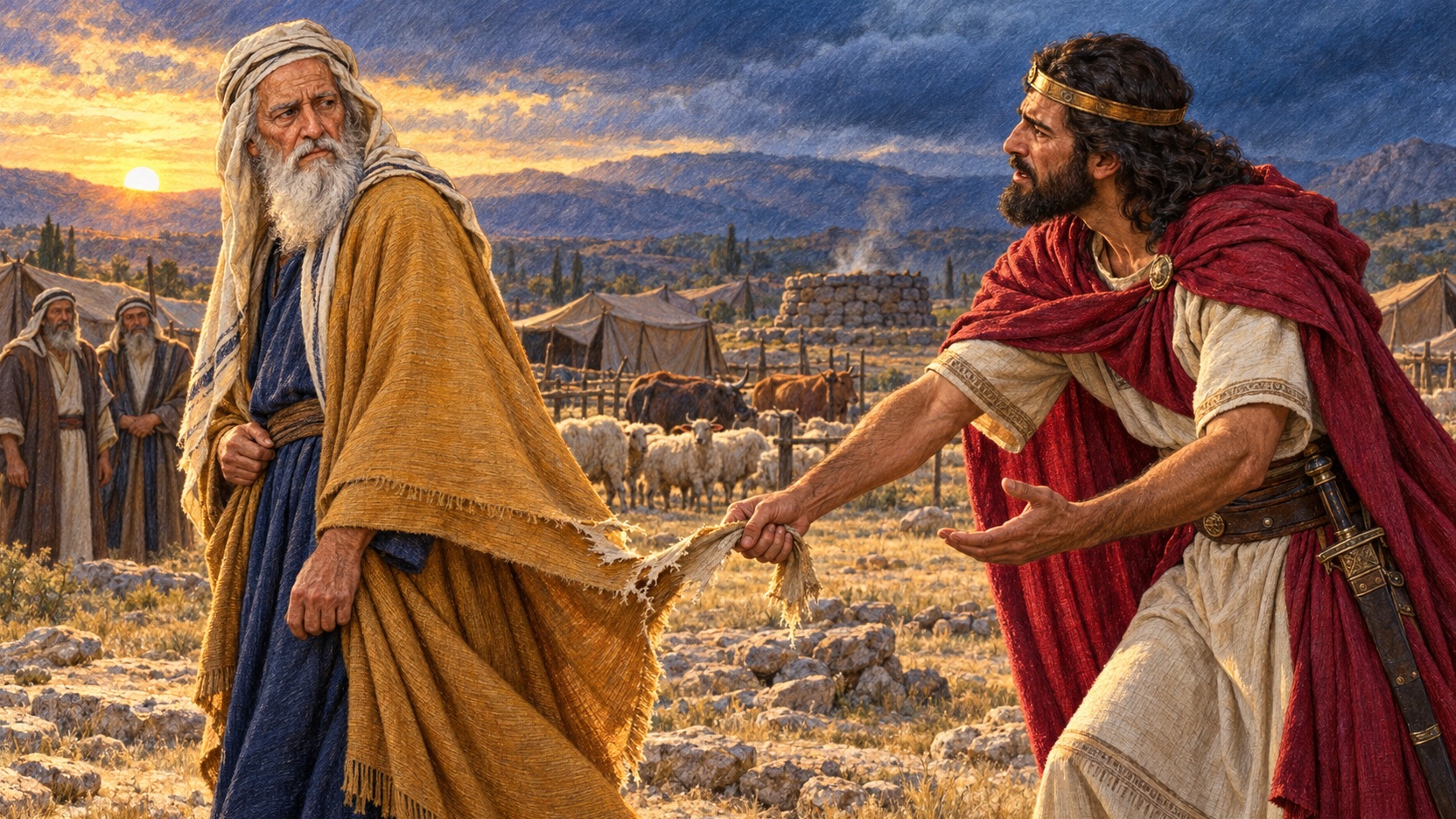
Saul finally admitted that he had feared the people and obeyed their voice. As Samuel turned to leave, Saul seized the prophet’s robe, and it tore. Samuel explained that God had likewise torn the kingdom from Saul and given it to a better neighbor (1 Samuel 15:24-28). The torn robe made the announced judgment visible; Saul could not bargain it away.
Even then, Saul asked Samuel to honor him before the elders. His public standing still concerned him, and his later conduct would show that admitting sin had not produced a lasting willingness to turn from it.
This chapter records both God’s regret at appointing Saul and Samuel’s declaration that He would not relent (1 Samuel 15:11,29). God genuinely grieved over Saul’s rebellion. He had not discovered an unforeseen fact or made a mistake. Nor would He reverse His settled judgment about the kingship as though His Word were unreliable.
David Received the Anointing Saul Lost
Samuel mourned Saul’s rejection, but the Lord sent him to anoint the king He had chosen from Jesse’s family:
So he sent and brought him in. Now he was ruddy, with bright eyes, and good-looking. And the LORD said, "Arise, anoint him; for this is the one!" Then Samuel took the horn of oil and anointed him in the midst of his brothers; and the Spirit of the LORD came upon David from that day forward. So Samuel arose and went to Ramah. But the Spirit of the LORD departed from Saul, and a distressing spirit from the LORD troubled him.
When Samuel saw Eliab, he initially expected him to be the chosen man because of his appearance. God corrected that judgment: a man’s stature could not reveal his heart (1 Samuel 16:6-7). David, Jesse’s youngest son, was still caring for the sheep when Samuel asked that he be brought in (1 Samuel 16:11). The Lord identified him, Samuel anointed him, and the Spirit came upon David from that day forward.
The Spirit’s departure from Saul belongs to this transfer of royal empowerment. God had equipped Saul to serve as king and now rejected him from that office. Losing that office does not establish a pattern of the Holy Spirit abandoning a born-again believer whom He has sealed. Saul’s earlier experience does not settle his eternal state either. Scripture tells us what happened to his kingship without answering that separate question.
A distressing spirit from the Lord troubled Saul, and David’s music brought relief. I understand the spirit as subject to God’s judgment and rule. God could govern a created spirit and give Saul over to distress without Himself becoming evil or tempting him to sin. Scripture tells us that a spirit troubled this particular man; it gives us no grounds to assume the same cause in every person who experiences distress.
David’s anointing did not immediately remove Saul from office or give David permission to seize the throne. He entered Saul’s service and, after defeating Goliath, became the object of the king’s jealousy. When women celebrated David’s victories, Saul began watching him as a rival. The faithful service that benefited Israel now looked to the king like a threat to his own position.
Saul threw spears at David and placed him in military danger. By requiring Philistine foreskins as the marriage price for his daughter Michal, he hoped to have David killed by the enemy. Later he ordered his servants to kill David and led repeated pursuits to capture him. At times he admitted that David was more righteous, but those admissions did not stop his violence.
Jonathan’s response exposes the injustice of Saul’s hostility. As Saul’s son, he had an obvious interest in the succession to the throne, yet he recognized God’s work in David and kept his covenant with him. A place in the royal family did not require him to treat David as an enemy. Our study on Jonathan follows that friendship and faithfulness more fully.
Saul’s pursuit eventually reached people who had helped David without knowing that the king was hunting him:
Then the king said to the guards who stood about him, "Turn and kill the priests of the LORD, because their hand also is with David, and because they knew when he fled and did not tell it to me." But the servants of the king would not lift their hands to strike the priests of the LORD. And the king said to Doeg, "You turn and kill the priests!" So Doeg the Edomite turned and struck the priests, and killed on that day eighty-five men who wore a linen ephod. Also Nob, the city of the priests, he struck with the edge of the sword, both men and women, children and nursing infants, oxen and donkeys and sheep–with the edge of the sword.
David had presented his visit to Ahimelech as the king’s business. The priest knew him as Saul’s faithful servant and son-in-law, unaware of the conflict behind the visit. Saul accused him of conspiracy anyway and ordered the Lord’s priests killed (1 Samuel 22:11-16). When his guards refused, Doeg obeyed, killing eighty-five priests. The inhabitants and animals of Nob were then put to the sword as well.
The comparison with Amalek is dreadful. Saul had protected a king and valuable animals God had placed under judgment; now he ordered innocent priests killed for his own cause. His will had become the standard for deciding whom to spare and whom to destroy. Accusing these people of treason did not make them guilty.
Abiathar escaped and reported the massacre to David. David acknowledged his part in what had happened: he had misled Ahimelech and knew that Doeg, whom he saw at Nob, would tell Saul. He received the surviving priest and offered him protection, accepting responsibility for his earlier actions instead of leaving Abiathar to bear their consequences alone (1 Samuel 22:20-23).
Twice David later had an opportunity to kill Saul and refused to strike the Lord’s anointed. He still confronted Saul, presented evidence of his innocence, and kept a safe distance. Respect for the royal office did not require him to pretend Saul was acting rightly or remain within reach of his spear. The phrase “Touch not My anointed” gives no dangerous leader immunity from scrutiny, correction, or removal. King David examines David’s conduct during those years more fully.
Saul Seeks a Medium and Dies on Gilboa
By the final Philistine campaign, Samuel had died. Saul could no longer summon the prophet, and the Lord was not answering him through the means by which he sought direction. He consulted a medium, and Samuel told him:
Then Samuel said: "So why do you ask me, seeing the LORD has departed from you and has become your enemy? And the LORD has done for Himself as He spoke by me. For the LORD has torn the kingdom out of your hand and given it to your neighbor, David. Because you did not obey the voice of the LORD nor execute His fierce wrath upon Amalek, therefore the LORD has done this thing to you this day. Moreover the LORD will also deliver Israel with you into the hand of the Philistines. And tomorrow you and your sons will be with me. The LORD will also deliver the army of Israel into the hand of the Philistines."
The Philistine army terrified Saul. He had expelled mediums and spiritists from the land, yet now told his servants to find one (1 Samuel 28:3-7). In disguise and accompanied by two men, he went to En Dor at night and asked the woman to bring up Samuel. He even swore by the Lord that she would suffer no punishment for the forbidden practice (1 Samuel 28:8-11). Once again, he used God’s name to support a course contrary to His command.
The narrator repeatedly calls the appearing person Samuel, and the woman cried out when she saw him (1 Samuel 28:12-15). I therefore understand Samuel himself to have appeared through an exceptional act God permitted. That does not establish that the medium could command the dead or that her practice was an authorized way to seek God’s guidance.
Samuel gave Saul no new means of escaping the verdict he had already heard. The kingdom was being given to David because Saul had disobeyed the Lord, and Israel faced defeat. Saul and his sons would be with Samuel the next day in the realm of the dead. That statement announced their approaching death without, by itself, settling the eternal state of everyone mentioned.
The battle became fierce against Saul. The archers hit him, and he was severely wounded by the archers. Then Saul said to his armorbearer, "Draw your sword, and thrust me through with it, lest these uncircumcised men come and thrust me through and abuse me." But his armorbearer would not, for he was greatly afraid. Therefore Saul took a sword and fell on it. And when his armorbearer saw that Saul was dead, he also fell on his sword, and died with him. So Saul, his three sons, his armorbearer, and all his men died together that same day.
The Philistines killed Jonathan, Abinadab, and Malchishua, and their archers severely wounded Saul (1 Samuel 31:1-3). He feared abuse at the enemy’s hands and asked his armorbearer to kill him. When the man refused, Saul fell on his own sword. His armorbearer then took his own life too. Scripture records those decisions without commending suicide as an escape from humiliation.
The defeat drove Israelites from their towns, and the Philistines displayed Saul’s body at Beth-shan. Men from Jabesh-gilead traveled through the night to recover his body and those of his sons (1 Samuel 31:7-13). The city Saul had saved at the beginning of his reign now supplied the men who honored him in death. His earlier deliverance of them still belonged to the account, despite the failures of his later years.
In 2 Samuel 1, an Amalekite claimed that he had killed the wounded king. His report conflicts with the direct account of Saul’s death in 1 Samuel and was probably an attempt to gain David’s favor. Instead of rewarding him, David ordered judgment. In 1 Chronicles 10, Saul’s death is explained as the Lord’s judgment for his unfaithfulness, including his refusal to keep God’s Word and his consultation of a medium. The Lord’s judgment came through the same death Saul inflicted on himself by falling on his sword.
David mourned Saul and Jonathan, honored them as mighty men, and instructed Judah’s children to learn his lament. He could grieve Israel’s loss without denying Saul’s rebellion. I think we need that honesty when speaking about the dead. A funeral should not become an occasion for vengeance, but grief does not require us to rewrite a life.
Saul’s Rejection Points Us to the Faithful King
Samuel’s conscious speech after death does not support soul sleep. It does not establish that the human soul is immortal in itself or prove endless conscious torment either. God alone has immortality in Himself. Scripture teaches a future resurrection and the final, irreversible destruction of the unbeliever’s body and soul in the Lake of Fire. En Dor must be read alongside that wider teaching, rather than made to answer every question about the dead.
Saul’s visit to En Dor warns us against the practice he sought, even though I understand the appearing person to be Samuel. An exceptional act God permitted did not authorize necromancy, or seeking contact with the dead. Mediums, divination, and attempts to obtain occult guidance remain forbidden. Someone involved needs to stop, confess the sin, and seek the Lord through Scripture and prayer. Christ is our mediator; contact with a departed person gives us no other way to God.
Throughout his reign, Saul kept religious words and practices while repeatedly allowing fear, appetite, and reputation to determine how far he would obey. His choices injured soldiers, faithful servants, priests, and families. Past victories and spiritual experiences could not excuse his present disobedience. The rejection of his dynasty and royal office warns us against rebellion without proving that a regenerated Christian can lose eternal life.
Our hope rests in the promised Son of David, the faithful King. Jesus is the eternal Son, fully God and fully man, born of a virgin and completely without sin. He willingly gave Himself to be slain as the perfect sacrifice for our sins. His atonement rests on His perfection and voluntary sacrifice, through which sinners are reconciled to God. Wicked men tortured Him and put Him to death. His saving sacrifice through His shed blood and death was complete before He was buried. He then rose bodily from the grave. The Father did not punish, curse, abandon, strike, bruise, or pour wrath on Jesus. Father and Son acted in perfect unity.
Christ died for the whole world, and God genuinely offers salvation to every person, though people can resist His grace and reject Him. Whoever repents and believes in Jesus is forgiven and born again. The Holy Spirit indwells and seals the believer, who remains eternally secure in Christ. That security gives no permission to imitate Saul’s rebellion. An empty profession of faith without evidence of new life does not prove that someone has been born again. Obedience is evidence of salvation, never the means of earning it or keeping ourselves saved.
Saul’s excuses make me examine my response to pressure. A deadline does not change God’s command, and an act of worship cannot buy permission to disregard it. If I have sinned, I need to name it and turn from it, without blaming the people whose approval I wanted. Insisting first that my reputation be protected would repeat the concern that compromised Saul’s confession.
Leaders need to welcome accountability while they still have the opportunity to respond. Gifts and past service cannot establish present faithfulness, and an office gives no one the right to silence Scripture’s correction. People under their care may honor lawful authority while refusing a sinful demand, confronting wrongdoing, and protecting others from harm.
My Final Thoughts
Saul’s early promise makes his end painful to read. God truly chose and equipped him, yet he kept adjusting his obedience to protect his own interests. I need to hear that warning without confusing his lost royal calling with the Spirit abandoning a believer He has sealed. My hope rests in Jesus, the faithful King who has completed His saving work. Following Him calls for an honest response to His Word, especially when obedience threatens the comfort or approval I want to keep.