
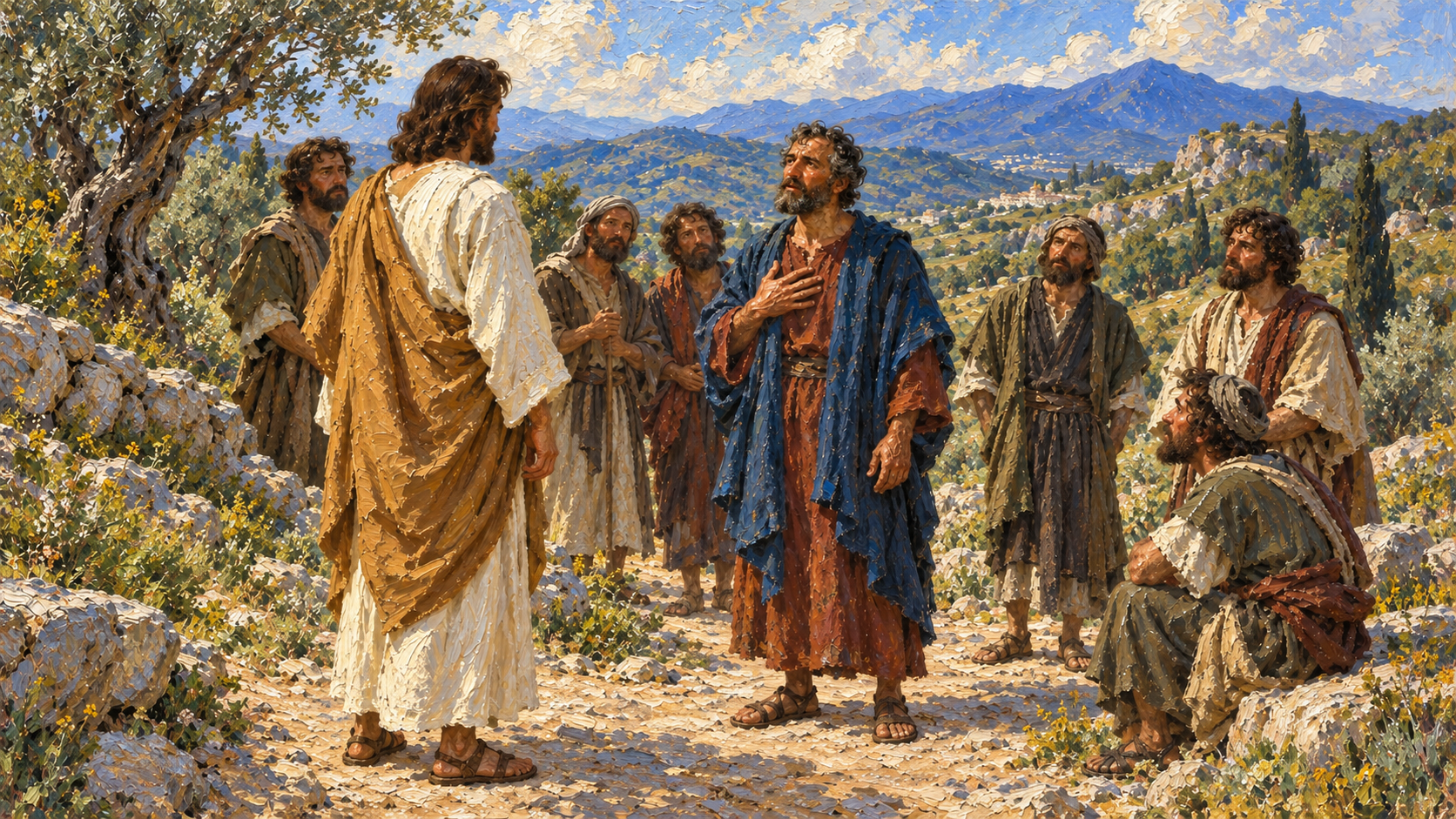
Jesus asked His disciples what other people were saying about Him, and then He turned the question toward them: “But who do you say that I am?” Peter answered correctly, yet he soon resisted what Jesus said about His suffering. I want to understand how he could recognize the Christ and still struggle to accept what the Christ had come to do. As Jesus explained His identity, He spoke of the cross and resurrection along with the church He would build.
The Question and Peter’s Confession
Three Gospel writers preserve this conversation from Jesus’ ministry as an event that actually happened. His question also confronts us as readers. Scripture tells us who Jesus is, so we cannot simply make Him into the person we would prefer Him to be.
People can respect Jesus and still refuse the identity He revealed. Calling Him a wise teacher or moral reformer may acknowledge something admirable without reaching Peter’s answer. The same is true of describing Him as a prophet or revolutionary, or praising Him as a spiritual example or symbol of love. Jesus is the Christ and the Son of the living God.
The verses around Peter’s confession explain what those titles mean. Jesus would build His church, but He would also suffer and be killed before rising on the third day. He called His disciples to follow Him and promised to return in glory. I cannot receive the title Christ while rejecting His cross or bodily resurrection. The answer Scripture gives also requires me to acknowledge His deity and authority.
When Jesus came into the region of Caesarea Philippi, He asked His disciples, saying, “Who do men say that I, the Son of Man, am?” So they said, “Some say John the Baptist, some Elijah, and others Jeremiah or one of the prophets.” He said to them, “But who do you say that I am?” Simon Peter answered and said, “You are the Christ, the Son of the living God.” Jesus answered and said to him, “Blessed are you, Simon Bar-Jonah, for flesh and blood has not revealed this to you, but My Father who is in heaven.
Matthew places this conversation in the region of Caesarea Philippi, at a time when conflict with the religious leaders had been growing. The disciples had seen Jesus exercise authority over sickness and demons. They had also watched nature and even death yield to Him. After warning them about corrupt teaching, He asked them to say directly who they understood Him to be.
Teachers often draw attention to the pagan temples around Caesarea Philippi, its imperial associations, or the prominent rock face. Those details may help us picture the cultural setting, but Matthew never says Jesus pointed to a shrine or makes the location determine His meaning. I want to keep my attention on what Matthew does emphasize: Jesus’ words and Peter’s answer, followed by Jesus identifying the Father as the source of that revelation.
Jesus called Himself the Son of Man when He asked the question. The title speaks of His genuine humanity while also recalling the heavenly ruler in Daniel 7. The real man standing before the disciples was the promised ruler who receives dominion.
The disciples reported that some people identified Jesus as John the Baptist and others as Elijah. Some named Jeremiah or simply called Him one of the prophets. Herod had feared that John had risen from the dead, while Malachi’s prophecy gave people reason to expect Elijah. Jeremiah brought to mind a suffering prophetic voice. These were serious opinions about Jesus, not dismissals of Him as someone unimportant.
Even so, every answer was wrong. Jesus was not a returned prophet or another human messenger in a continuing line. That helps me see why admiration alone is inadequate. Someone can speak very highly of Jesus while denying who He is, and the consequences of that error are eternal.
We cannot settle Jesus’ identity by finding out which opinion is most popular. An error remains false however often it is repeated or however warmly the culture welcomes it. Religious heritage and sincerity cannot make an answer right when it contradicts what God has revealed. We need to receive His testimony in Scripture.
Now Jesus and His disciples went out to the towns of Caesarea Philippi; and on the road He asked His disciples, saying to them, “Who do men say that I am?” So they answered, “John the Baptist; but some say, Elijah; and others, one of the prophets.” He said to them, “But who do you say that I am?” Peter answered and said to Him, “You are the Christ.” Then He strictly warned them that they should tell no one about Him. And He began to teach them that the Son of Man must suffer many things, and be rejected by the elders and chief priests and scribes, and be killed, and after three days rise again. He spoke this word openly. Then Peter took Him aside and began to rebuke Him. But when He had turned around and looked at His disciples, He rebuked Peter, saying, “Get behind Me, Satan! For you are not mindful of the things of God, but the things of men.”
Peter spoke for the disciples when he answered, “You are the Christ, the Son of the living God.” Mark records the shorter confession, “You are the Christ.” Luke gives it as “The Christ of God.” These accounts agree, with each contributing wording that helps us understand the confession.
Peter recognized who Jesus really is, rather than discovering some hidden potential in Him. He is the One God had promised, and God had sent and anointed Him. Matthew records Jesus blessing Peter because the Father had made this known to him, rather than leaving him to arrive at the answer through ordinary human judgment.
Peter’s confession is true even before he understands every implication. Within moments he resists Jesus’ announcement of suffering and death. I find that encouraging because Scripture presents growing disciples whose real faith still requires correction, not flawless men who grasp the entire plan at once.
The Christ and the Son of the Living God
Why do the nations rage, And the people plot a vain thing? The kings of the earth set themselves, And the rulers take counsel together, Against the LORD and against His Anointed, saying, “Let us break Their bonds in pieces And cast away Their cords from us.” He who sits in the heavens shall laugh; The LORD shall hold them in derision. Then He shall speak to them in His wrath, And distress them in His deep displeasure: “Yet I have set My King On My holy hill of Zion.” “I will declare the decree: The LORD has said to Me, ‘You are My Son, Today I have begotten You. Ask of Me, and I will give You The nations for Your inheritance, And the ends of the earth for Your possession. You shall break them with a rod of iron; You shall dash them to pieces like a potter’s vessel.'” Now therefore, be wise, O kings; Be instructed, you judges of the earth. Serve the LORD with fear, And rejoice with trembling. Kiss the Son, lest He be angry, And you perish in the way, When His wrath is kindled but a little. Blessed are all those who put their trust in Him.
The Greek title Christos corresponds to the Hebrew Messiah, meaning Anointed One. The title “Christ” identifies Jesus as the promised King rather than giving us His family name. He is also the Priest and Deliverer in whom God brings His purposes together.
Psalm 2 describes nations raging against the LORD and His Anointed. God sets His King in Zion and addresses Him as Son, then commands earthly rulers to submit. This connection between kingship and sonship helps us understand Peter’s confession. Its declaration, “Today I have begotten You,” announces the Son in His royal office, not the creation or beginning of His existence. The psalm warns of judgment and also offers refuge to everyone who trusts Him.
Jesus would not accept a messiahship confined to political expectations. He will reign bodily and fulfill God’s promises. But His way to that glory required rejection and death, followed by resurrection. Neither the crowd’s expectations about His crown nor Peter’s resistance to His cross could determine His mission.
“When your days are fulfilled and you rest with your fathers, I will set up your seed after you, who will come from your body, and I will establish his kingdom. He shall build a house for My name, and I will establish the throne of his kingdom forever. I will be his Father, and he shall be My son. If he commits iniquity, I will chasten him with the rod of men and with the blows of the sons of men. But My mercy shall not depart from him, as I took it from Saul, whom I removed from before you. And your house and your kingdom shall be established forever before you. Your throne shall be established forever.”‘”
God’s promise included Solomon and the kings who would follow him in David’s line. Solomon built the temple, and those fallible kings could sin and receive chastening. I would not apply that clause about iniquity to Jesus, who never sinned. The promise reaches beyond the temporary reigns of David’s descendants to the final Son of David, whose throne lasts forever.
Royal sonship helps us understand the Messianic promise, but the New Testament reveals more than a king’s place in David’s family. Jesus is the eternal Son who took on true human nature and entered David’s line. He was never a created man who was later adopted into deity.
Describing God as “living” distinguishes Him from powerless idols and acknowledges Him as the source of life. Jesus uniquely shares His Father’s divine nature, yet He remains personally distinct from the Father and the Holy Spirit. We are speaking of one God in three co-equal, co-eternal Persons.
The Son already existed with the Father before creation, and He made all things. Becoming flesh did not begin His existence or bring His deity to an end. He lived among us as a fully human man and remained completely sinless.
Jesus called Peter blessed and addressed him as Simon Bar-Jonah, meaning Simon son of Jonah. “Flesh and blood” refers to human origin or ability. Peter had heard testimony and seen the signs, but God Himself had made Jesus’ identity known to him.
We should not take that revelation to mean the evidence was unnecessary. The Father reveals the Son through the words and works Scripture records, and the Holy Spirit bears truthful witness to Him. Faith receives that testimony rather than celebrating belief in something irrational.
Peter had no reason to congratulate himself on being more intelligent than the crowds. His answer depended on what God had revealed. That leaves no room for my pride either, since every believer depends on God’s grace and the truth He has made known.
The Rock, Christ’s Church, and the Keys
And I also say to you that you are Peter, and on this rock I will build My church, and the gates of Hades shall not prevail against it. And I will give you the keys of the kingdom of heaven, and whatever you bind on earth will be bound in heaven, and whatever you loose on earth will be loosed in heaven.” Then He commanded His disciples that they should tell no one that He was Jesus the Christ.
Jesus connected Peter’s name (Petros) with the Greek word for rock (petra) in a wordplay that has prompted real debate. Some interpreters take the rock to be Peter himself. Others understand it as his confession or as Christ, while still others emphasize the divinely revealed truth Peter confessed. I want to acknowledge those readings and then consider what the context supports.
Peter did have a foundational role as an apostle. He preached at Pentecost and helped open the gospel witness to Jews, with his ministry later reaching Samaritans and Gentiles. Yet the New Testament identifies Christ as the chief cornerstone and includes the apostles and prophets together as foundational witnesses. Peter never portrayed himself as an infallible monarch ruling the church.
I believe Christ and the truth God revealed about Him form the foundation on which He builds. Peter served within that foundation as an apostle who confessed Him. I find no transferable papal office in this passage, nor authority for a later bishop to govern the whole church or be personally free from doctrinal error. The correction Peter received in the very next scene gives us further reason not to make those claims for him.
The Greek word ekklesia describes an assembly or congregation. Jesus called it “My church,” so its ownership is settled before we discuss any human leader. He builds the church and preserves His redeemed people, and every leader serves under Him.
Keys represent authority to open and close. In the same way, “binding” and “loosing” could refer to forbidding or permitting something, or to applying an authoritative judgment. Jesus entrusted Peter with a genuine stewardship, which we later see exercised through apostolic proclamation and church discipline.
The grammar gives priority to heaven’s authority. It does not put heaven under an obligation to follow Peter’s private decisions. The apostles proclaimed the terms of the gospel Christ had established, without authority to invent salvation or revise Scripture. They could not offer forgiveness apart from His blood.
Jesus later used the language of binding and loosing with the gathered disciples in Matthew 18. This ministry remains accountable to His Word. A leader therefore misuses this authority if he demands allegiance to himself or puts tradition above Scripture. Concealing sin also contradicts the responsibility to exercise church discipline.
Hades is the realm of the dead, and gates are defensive structures. Jesus promised that the gates of Hades would not prevail against His church. Death cannot hold the risen Christ, so it cannot finally conquer those who belong to Him. That promise concerns Christ and His people; it does not declare every congregation or institution with a Christian name permanently faithful.
The Suffering Messiah and the Call to Follow Him
From that time Jesus began to show to His disciples that He must go to Jerusalem, and suffer many things from the elders and chief priests and scribes, and be killed, and be raised the third day. Then Peter took Him aside and began to rebuke Him, saying, “Far be it from You, Lord; this shall not happen to You!” But He turned and said to Peter, “Get behind Me, Satan! You are an offense to Me, for you are not mindful of the things of God, but the things of men.” Then Jesus said to His disciples, “If anyone desires to come after Me, let him deny himself, and take up his cross, and follow Me. For whoever desires to save his life will lose it, but whoever loses his life for My sake will find it. For what profit is it to a man if he gains the whole world, and loses his own soul? Or what will a man give in exchange for his soul? For the Son of Man will come in the glory of His Father with His angels, and then He will reward each according to his works. Assuredly, I say to you, there are some standing here who shall not taste death till they see the Son of Man coming in His kingdom.”
From then on, Jesus began explaining what lay ahead in Jerusalem. He would suffer many things and be killed, then rise on the third day. When He said these things “must” happen, He was describing God’s settled plan of redemption, not surrendering helplessly to events.
His announcement helps us understand why He had temporarily told the disciples not to publicize His identity. The crowds understood Messiah in terms of national and political hopes. His cross and resurrection had to show them what kind of Messiah He is.
We have not received the whole confession if we welcome Jesus’ power but reject His saving death. He willingly suffered and shed His blood, then died and was buried before rising bodily. His victory will be publicly completed when He comes in future glory.
Peter took Jesus aside and rebuked Him, insisting that the suffering He had predicted would never happen. Only a short time earlier, Peter had spoken what the Father revealed. Now he was voicing an outlook Jesus identified with Satan’s opposition.
Jesus’ words, “Get behind Me, Satan,” addressed the temptation Peter was expressing. They did not mean Peter was literally the devil or had ceased to be a disciple. By setting his mind on human priorities, he had become a stumbling block to Jesus.
Peter’s reversal makes me stop and consider whether I am letting Jesus explain the very titles I use for Him. It is possible to say the right words and still resist their God-given meaning. Jesus must define Messiahship for us. We need the same submission to the whole testimony of Scripture when we speak of salvation or leadership, and when we think about glory.
Jesus called His disciples to deny themselves and take up their cross as they followed Him. To someone in the first century, a cross meant shameful execution, not an everyday inconvenience. Following Christ may cost us the approval of others or our personal safety. We may lose possessions, and loyalty to Him may even cost our lives.
Taking up our cross does not pay for sin or add anything to Christ’s sacrifice. His blood alone secures forgiveness. We follow Him because we belong to Him, not because Christians must perform another atonement.
Jesus asked what a person really gains by acquiring the whole world while losing his soul. By that measure, what looks like complete success can be a catastrophic loss. The Son of Man will come in His Father’s glory and repay each person according to works. The One we trust for salvation is also the coming Judge, so His identity and authority cannot be separated from saving faith.
Now after six days Jesus took Peter, James, and John his brother, led them up on a high mountain by themselves; and He was transfigured before them. His face shone like the sun, and His clothes became as white as the light. And behold, Moses and Elijah appeared to them, talking with Him. Then Peter answered and said to Jesus, “Lord, it is good for us to be here; if You wish, let us make here three tabernacles: one for You, one for Moses, and one for Elijah.” While he was still speaking, behold, a bright cloud overshadowed them; and suddenly a voice came out of the cloud, saying, “This is My beloved Son, in whom I am well pleased. Hear Him!” And when the disciples heard it, they fell on their faces and were greatly afraid. But Jesus came and touched them and said, “Arise, and do not be afraid.” When they had lifted up their eyes, they saw no one but Jesus only.
Six days after Peter’s confession and Jesus’ announcement of the cross, He took Peter, James, and John up a mountain. His face shone and His clothes became white as light. Moses and Elijah appeared with Him, but the Father’s voice singled out His beloved Son.
Peter wanted to make three tabernacles. The bright cloud and the command from heaven corrected any attempt to put Jesus on the same level as even God’s greatest servants. The Father said, “Hear Him,” establishing His Son’s supreme authority. I cannot limit that authority to the words I welcome. It includes what Jesus taught about suffering and death as well as resurrection and discipleship.
The Transfiguration let the disciples see a preview of kingdom glory in the very Messiah who would be rejected. His humility in becoming man had never diminished His deity. He was the glorious Son even as He prepared to suffer.
The Wider Witness to the Eternal Son
Jesus said to her, “I am the resurrection and the life. He who believes in Me, though he may die, he shall live. And whoever lives and believes in Me shall never die. Do you believe this?” She said to Him, “Yes, Lord, I believe that You are the Christ, the Son of God, who is to come into the world.”
Jesus did more than promise Martha that He could raise someone. He told her, “I am the resurrection and the life.” He was directing her to Himself as the One in whom life is found.
Martha confessed Him as the Christ and the Son of God who was to come into the world, closely echoing Peter’s answer. I notice that she said this before Jesus called Lazarus out of the tomb. Her confession helps me understand faith while grief remains: we trust who Jesus is before we have seen what He will do.
Jesus was not promising that believers would never die bodily. Lazarus had died, and believers still die unless they are alive when Christ returns. His promise guarantees resurrection and everlasting life beyond death’s temporary reach.
Then the Jews answered and said to Him, “Do we not say rightly that You are a Samaritan and have a demon?” Jesus answered, “I do not have a demon; but I honor My Father, and you dishonor Me. And I do not seek My own glory; there is One who seeks and judges. Most assuredly, I say to you, if anyone keeps My word he shall never see death.” Then the Jews said to Him, “Now we know that You have a demon! Abraham is dead, and the prophets; and You say, ‘If anyone keeps My word he shall never taste death.’ Are You greater than our father Abraham, who is dead? And the prophets are dead. Who do You make Yourself out to be?” Jesus answered, “If I honor Myself, My honor is nothing. It is My Father who honors Me, of whom you say that He is your God. Yet you have not known Him, but I know Him. And if I say, ‘I do not know Him,’ I shall be a liar like you; but I do know Him and keep His word. Your father Abraham rejoiced to see My day, and he saw it and was glad.” Then the Jews said to Him, “You are not yet fifty years old, and have You seen Abraham?” Jesus said to them, “Most assuredly, I say to you, before Abraham was, I AM.” Then they took up stones to throw at Him; but Jesus hid Himself and went out of the temple, going through the midst of them, and so passed by.
After saying that Abraham rejoiced to see His day, Jesus declared, “before Abraham was, I AM.” Abraham had come into existence, but Jesus spoke of His own existence in absolute terms. He was making a different claim from simply having lived a long time.
The Greek ego eimi can be an ordinary way of identifying oneself, but here Jesus was claiming existence before Abraham. The solemn wording fits John’s wider testimony about Christ, and the attempt to stone Him shows that His hearers recognized an extraordinary claim. In language that recalls God’s self-revelation, Jesus declared His eternal preexistence.
I would not isolate those two Greek words and ask them to carry the whole doctrine of Christ’s deity. John began his Gospel by identifying the Word as God and Creator. He then recorded Jesus’ signs and claims, and near the close of his main testimony he showed Thomas addressing the risen Jesus as God. The surrounding testimony helps us understand the words honestly and accurately.
But Jesus kept silent. And the high priest answered and said to Him, “I put You under oath by the living God: Tell us if You are the Christ, the Son of God!” Jesus said to him, “It is as you said. Nevertheless, I say to you, hereafter you will see the Son of Man sitting at the right hand of the Power, and coming on the clouds of heaven.” Then the high priest tore his clothes, saying, “He has spoken blasphemy! What further need do we have of witnesses? Look, now you have heard His blasphemy! What do you think?” They answered and said, “He is deserving of death.” Then they spat in His face and beat Him; and others struck Him with the palms of their hands, saying, “Prophesy to us, Christ! Who is the one who struck You?”
Under oath, Jesus answered whether He was the Christ, the Son of God, by connecting His answer with Psalm 110 and Daniel 7. The Son of Man would sit at the right hand of Power and come on the clouds of heaven.
The high priest tore his clothes and called Jesus’ statement blasphemy. That verdict shows the extraordinary claim the court understood Him to be making; it does not establish that He was guilty. The prisoner they condemned had told His accusers that they would see Him exercising divine royal authority.
His captors spat on Him and beat Him while mocking Him. The true Messiah endured the suffering He had foretold. Their cruelty fulfilled the course Scripture had predicted, but fulfilling that prediction did not make the perpetrators innocent.
Now Thomas, called the Twin, one of the twelve, was not with them when Jesus came. The other disciples therefore said to him, “We have seen the Lord.” So he said to them, “Unless I see in His hands the print of the nails, and put my finger into the print of the nails, and put my hand into His side, I will not believe.” And after eight days His disciples were again inside, and Thomas with them. Jesus came, the doors being shut, and stood in the midst, and said, “Peace to you!” Then He said to Thomas, “Reach your finger here, and look at My hands; and reach your hand here, and put it into My side. Do not be unbelieving, but believing.” And Thomas answered and said to Him, “My Lord and my God!” Jesus said to him, “Thomas, because you have seen Me, you have believed. Blessed are those who have not seen and yet have believed.” And truly Jesus did many other signs in the presence of His disciples, which are not written in this book; but these are written that you may believe that Jesus is the Christ, the Son of God, and that believing you may have life in His name.
Thomas had demanded physical evidence. When Jesus appeared among the gathered disciples, He invited Thomas to inspect His wounds and commanded him to stop being unbelieving and believe.
Thomas addressed Jesus directly when he said, “My Lord and my God!” Jesus accepted this confession as belief instead of redirecting it. He then blessed those who would believe without seeing what Thomas had seen.
John explains that he recorded these signs so readers would believe Jesus is the Christ and the Son of God, and through believing have life in His name. Peter’s confession and Thomas’s confession both lead us toward that same saving faith.
The rest of the New Testament continues the Gospels’ testimony. Paul says everything was created through Christ and for Him. The Son existed before all things, and all fullness dwells in Him. In Hebrews, Paul also identifies Him as the One who made the worlds and upholds everything, the express image of God’s person.
Peter called Jesus the Holy One and the Just, and he identified Him as the Prince of life. He also described Him as the cornerstone the builders rejected. The apostle who confessed Jesus kept directing people to Him, never presenting himself as the person they should trust for salvation.
The apostles agree that Jesus shares the divine identity and truly became man. He died for sins and rose bodily from the grave. He reigns now and will return. Any later teaching that calls Him a created being contradicts this testimony entrusted to the church.
Saving Faith Trusts the Son Who Died and Rose
Jesus claimed authority beyond that of an ordinary teacher, and we cannot fit Him into the category of prophet either. Prophets directed people away from themselves, while Jesus called people to believe in Him for life. Scripture also identifies Him as Creator and commands angels to worship Him. He cannot therefore be an angel or a created god.
The Son existed before creation, so He could not have become divine at some later point. Nor does “Son of God” describe biological offspring. The title speaks of His unique personal relationship with the Father and their shared divine nature, never a physical union between God and a woman.
Jesus did not receive the crowd’s respectful opinions as equally valid answers to His question. His correction rules out treating them as alternate paths. We need to know who He actually is, rather than suppose every religious answer reaches the same truth.
Knowing facts about Jesus does not by itself save someone. Demons recognized facts about Him, and people who falsely profess faith can still call Him “Lord.” Peter himself needed Jesus to correct his thinking. Saving faith trusts the Jesus revealed in Scripture, rather than attaching His name to something else we have chosen to trust.
Yet Peter also helps me see why incomplete knowledge does not make salvation impossible. He confessed Jesus before understanding every consequence of that answer. We are called to trust the true Son presented in the gospel, not pass an advanced theology examination before we can be saved.
In repentance we turn from sin and unbelief toward God, and in faith we rely on Christ. Confession gives open expression to that faith without earning God’s grace. A settled refusal to acknowledge Jesus, however, reveals rejection of His identity and authority.
For to this you were called, because Christ also suffered for us, leaving us an example, that you should follow His steps: “Who committed no sin, Nor was deceit found in His mouth”; who, when He was reviled, did not revile in return; when He suffered, He did not threaten, but committed Himself to Him who judges righteously; who Himself bore our sins in His own body on the tree, that we, having died to sins, might live for righteousness–by whose stripes you were healed. For you were like sheep going astray, but have now returned to the Shepherd and Overseer of your souls.
Jesus is fully God and fully man, born of a virgin and completely without sin throughout His life. Wicked men physically tortured Him and shed His blood before killing Him. He willingly bore that real punishment for our sins in His innocent body. After He died and was buried, He rose bodily from the grave. Scripture never says the Father punished or cursed Jesus. Neither does it say He abandoned His Son, struck or bruised Him, or poured wrath on Him.
Christ died for the sins of the whole world, and God’s offer is genuine for every person. People can resist and reject that offer, but whoever repents and believes in the Son receives forgiveness and eternal life.
Someone who is truly born again becomes a new creation. The Holy Spirit lives within that believer and seals him, and he is eternally secure. That security gives no permission for lawlessness, just as a shallow profession without new life gives no proof of genuine faith. Our security shows the greatness of the saving work of the Christ Peter confessed.
For related studies, see The Deity of Jesus, The Apostle Peter, and Jesus Is the Truth.
My Final Thoughts
Jesus’ question asks more of me than admiration. I need to receive the Christ Scripture reveals, the eternal Son who became truly human and went to the cross before rising bodily. Peter answered correctly and still needed Jesus to correct his expectations. That makes me consider whether I am allowing His words to govern what I expect of Him. He owns and builds His church, with every apostle and leader serving under His Word. I answer His question personally by trusting Him for eternal life and receiving His own testimony about who He is.