
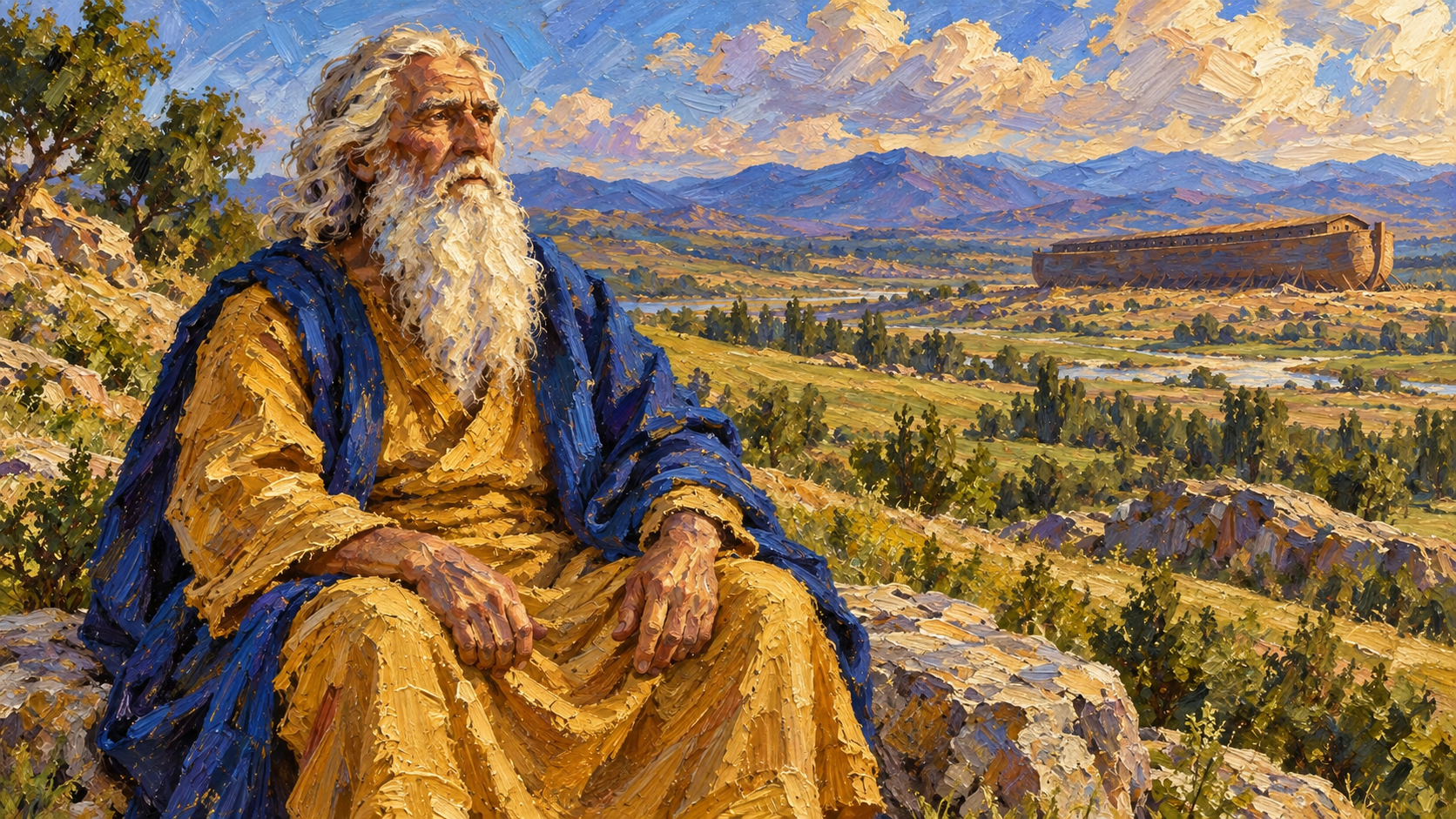
Genesis records that Methuselah lived 969 years, and his name is often connected with the coming of the flood. Did the name really predict that judgment, and do we know whether he died before the rain began? I want to work through the ages Scripture gives us without filling in the details it leaves unknown.
Methuselah in the Biblical Record
Scripture records no human life longer than Methuselah’s, but there is more to learn about him than his age. His father Enoch walked with God and was taken without seeing death. His grandson Noah led the household God preserved through the flood. Between those two men, Methuselah had a place in the carefully dated family line that leads from Adam toward the Messiah.
You may have heard that Methuselah’s name means “when he dies, it shall come.” If that were its meaning, his life would have been a countdown to the flood. There is a chronological reason the claim attracts attention: the ages in Genesis 5 and Genesis 7 place his final year in the year the flood began. But the proposed meaning of his name is uncertain, and Genesis never calls it a prophecy. We need to examine the arithmetic and the name separately.
I want to be as confident about the details Scripture gives as I am honest about what it does not tell us. Methuselah’s long life and his death in the flood year follow from the text. So do the accounts of human corruption and God’s patience while the ark was prepared, along with the family line that leads to Christ. But we are not given his exact death date or its cause, a judgment about his heart, or a prophetic explanation of his name.
Since only a few verses name Methuselah, we need to read them alongside the genealogy and the flood account. Those passages show how his life fits into the family line and its chronology. Jesus and the apostles then help us understand what we should learn from the days of Noah.
Enoch lived sixty-five years, and begot Methuselah. After he begot Methuselah, Enoch walked with God three hundred years, and had sons and daughters. So all the days of Enoch were three hundred and sixty-five years. And Enoch walked with God; and he was not, for God took him. Methuselah lived one hundred and eighty-seven years, and begot Lamech. After he begot Lamech, Methuselah lived seven hundred and eighty-two years, and had sons and daughters. So all the days of Methuselah were nine hundred and sixty-nine years; and he died. Lamech lived one hundred and eighty-two years, and had a son. And he called his name Noah, saying, “This one will comfort us concerning our work and the toil of our hands, because of the ground which the LORD has cursed.” After he begot Noah, Lamech lived five hundred and ninety-five years, and had sons and daughters. So all the days of Lamech were seven hundred and seventy-seven years; and he died. And Noah was five hundred years old, and Noah begot Shem, Ham, and Japheth.
Now it came to pass, when men began to multiply on the face of the earth, and daughters were born to them, that the sons of God saw the daughters of men, that they were beautiful; and they took wives for themselves of all whom they chose. And the LORD said, “My Spirit shall not strive with man forever, for he is indeed flesh; yet his days shall be one hundred and twenty years.” There were giants on the earth in those days, and also afterward, when the sons of God came in to the daughters of men and they bore children to them. Those were the mighty men who were of old, men of renown. Then the LORD saw that the wickedness of man was great in the earth, and that every intent of the thoughts of his heart was only evil continually. And the LORD was sorry that He had made man on the earth, and He was grieved in His heart. So the LORD said, “I will destroy man whom I have created from the face of the earth, both man and beast, creeping thing and birds of the air, for I am sorry that I have made them.” But Noah found grace in the eyes of the LORD.
This is the genealogy of Noah. Noah was a just man, perfect in his generations. Noah walked with God. And Noah begot three sons: Shem, Ham, and Japheth. The earth also was corrupt before God, and the earth was filled with violence. So God looked upon the earth, and indeed it was corrupt; for all flesh had corrupted their way on the earth. And God said to Noah, “The end of all flesh has come before Me, for the earth is filled with violence through them; and behold, I will destroy them with the earth. Make yourself an ark of gopherwood; make rooms in the ark, and cover it inside and outside with pitch. And this is how you shall make it: The length of the ark shall be three hundred cubits, its width fifty cubits, and its height thirty cubits. You shall make a window for the ark, and you shall finish it to a cubit from above; and set the door of the ark in its side. You shall make it with lower, second, and third decks. And behold, I Myself am bringing floodwaters on the earth, to destroy from under heaven all flesh in which is the breath of life; everything that is on the earth shall die. But I will establish My covenant with you; and you shall go into the ark–you, your sons, your wife, and your sons’ wives with you. And of every living thing of all flesh you shall bring two of every sort into the ark, to keep them alive with you; they shall be male and female. Of the birds after their kind, of animals after their kind, and of every creeping thing of the earth after its kind, two of every kind will come to you to keep them alive. And you shall take for yourself of all food that is eaten, and you shall gather it to yourself; and it shall be food for you and for them.” Thus Noah did; according to all that God commanded him, so he did.
Noah was six hundred years old when the floodwaters were on the earth. So Noah, with his sons, his wife, and his sons’ wives, went into the ark because of the waters of the flood. Of clean animals, of animals that are unclean, of birds, and of everything that creeps on the earth, two by two they went into the ark to Noah, male and female, as God had commanded Noah. And it came to pass after seven days that the waters of the flood were on the earth. In the six hundredth year of Noah’s life, in the second month, the seventeenth day of the month, on that day all the fountains of the great deep were broken up, and the windows of heaven were opened. And the rain was on the earth forty days and forty nights. On the very same day Noah and Noah’s sons, Shem, Ham, and Japheth, and Noah’s wife and the three wives of his sons with them, entered the ark– they and every beast after its kind, all cattle after their kind, every creeping thing that creeps on the earth after its kind, and every bird after its kind, every bird of every sort. And they went into the ark to Noah, two by two, of all flesh in which is the breath of life. So those that entered, male and female of all flesh, went in as God had commanded him; and the LORD shut him in. Now the flood was on the earth forty days. The waters increased and lifted up the ark, and it rose high above the earth. The waters prevailed and greatly increased on the earth, and the ark moved about on the surface of the waters. And the waters prevailed exceedingly on the earth, and all the high hills under the whole heaven were covered. The waters prevailed fifteen cubits upward, and the mountains were covered. And all flesh died that moved on the earth: birds and cattle and beasts and every creeping thing that creeps on the earth, and every man. All in whose nostrils was the breath of the spirit of life, all that was on the dry land, died. So He destroyed all living things which were on the face of the ground: both man and cattle, creeping thing and bird of the air. They were destroyed from the earth. Only Noah and those who were with him in the ark remained alive. And the waters prevailed on the earth one hundred and fifty days.
And it came to pass in the six hundred and first year, in the first month, the first day of the month, that the waters were dried up from the earth; and Noah removed the covering of the ark and looked, and indeed the surface of the ground was dry. And in the second month, on the twenty-seventh day of the month, the earth was dried. Then God spoke to Noah, saying, “Go out of the ark, you and your wife, and your sons and your sons’ wives with you. Bring out with you every living thing of all flesh that is with you: birds and cattle and every creeping thing that creeps on the earth, so that they may abound on the earth, and be fruitful and multiply on the earth.” So Noah went out, and his sons and his wife and his sons’ wives with him. Every animal, every creeping thing, every bird, and whatever creeps on the earth, according to their families, went out of the ark. Then Noah built an altar to the LORD, and took of every clean animal and of every clean bird, and offered burnt offerings on the altar. And the LORD smelled a soothing aroma. Then the LORD said in His heart, “I will never again curse the ground for man’s sake, although the imagination of man’s heart is evil from his youth; nor will I again destroy every living thing as I have done. “While the earth remains, Seedtime and harvest, Cold and heat, Winter and summer, And day and night Shall not cease.”
Then God spoke to Noah and to his sons with him, saying: “And as for Me, behold, I establish My covenant with you and with your descendants after you, and with every living creature that is with you: the birds, the cattle, and every beast of the earth with you, of all that go out of the ark, every beast of the earth. Thus I establish My covenant with you: Never again shall all flesh be cut off by the waters of the flood; never again shall there be a flood to destroy the earth.” And God said: “This is the sign of the covenant which I make between Me and you, and every living creature that is with you, for perpetual generations: I set My rainbow in the cloud, and it shall be for the sign of the covenant between Me and the earth. It shall be, when I bring a cloud over the earth, that the rainbow shall be seen in the cloud; and I will remember My covenant which is between Me and you and every living creature of all flesh; the waters shall never again become a flood to destroy all flesh. The rainbow shall be in the cloud, and I will look on it to remember the everlasting covenant between God and every living creature of all flesh that is on the earth.” And God said to Noah, “This is the sign of the covenant which I have established between Me and all flesh that is on the earth.”
Adam, Seth, Enosh, Cainan, Mahalalel, Jared, Enoch, Methuselah, Lamech, Noah, Shem, Ham, and Japheth.
Now Jesus Himself began His ministry at about thirty years of age, being (as was supposed) the son of Joseph, the son of Heli, the son of Matthat, the son of Levi, the son of Melchi, the son of Janna, the son of Joseph, the son of Mattathiah, the son of Amos, the son of Nahum, the son of Esli, the son of Naggai, the son of Maath, the son of Mattathiah, the son of Semei, the son of Joseph, the son of Judah, the son of Joannas, the son of Rhesa, the son of Zerubbabel, the son of Shealtiel, the son of Neri, the son of Melchi, the son of Addi, the son of Cosam, the son of Elmodam, the son of Er, the son of Jose, the son of Eliezer, the son of Jorim, the son of Matthat, the son of Levi, the son of Simeon, the son of Judah, the son of Joseph, the son of Jonan, the son of Eliakim, the son of Melea, the son of Menan, the son of Mattathah, the son of Nathan, the son of David, the son of Jesse, the son of Obed, the son of Boaz, the son of Salmon, the son of Nahshon, the son of Amminadab, the son of Ram, the son of Hezron, the son of Perez, the son of Judah, the son of Jacob, the son of Isaac, the son of Abraham, the son of Terah, the son of Nahor, the son of Serug, the son of Reu, the son of Peleg, the son of Eber, the son of Shelah, the son of Cainan, the son of Arphaxad, the son of Shem, the son of Noah, the son of Lamech, the son of Methuselah, the son of Enoch, the son of Jared, the son of Mahalalel, the son of Cainan, the son of Enosh, the son of Seth, the son of Adam, the son of God.
By faith Enoch was taken away so that he did not see death, “and was not found, because God had taken him”; for before he was taken he had this testimony, that he pleased God. But without faith it is impossible to please Him, for he who comes to God must believe that He is, and that He is a rewarder of those who diligently seek Him. By faith Noah, being divinely warned of things not yet seen, moved with godly fear, prepared an ark for the saving of his household, by which he condemned the world and became heir of the righteousness which is according to faith.
Now Enoch, the seventh from Adam, prophesied about these men also, saying, “Behold, the Lord comes with ten thousands of His saints, to execute judgment on all, to convict all who are ungodly among them of all their ungodly deeds which they have committed in an ungodly way, and of all the harsh things which ungodly sinners have spoken against Him.”
“But of that day and hour no one knows, not even the angels of heaven, but My Father only. But as the days of Noah were, so also will the coming of the Son of Man be. For as in the days before the flood, they were eating and drinking, marrying and giving in marriage, until the day that Noah entered the ark, and did not know until the flood came and took them all away, so also will the coming of the Son of Man be. Then two men will be in the field: one will be taken and the other left. Two women will be grinding at the mill: one will be taken and the other left. Watch therefore, for you do not know what hour your Lord is coming. But know this, that if the master of the house had known what hour the thief would come, he would have watched and not allowed his house to be broken into. Therefore you also be ready, for the Son of Man is coming at an hour you do not expect.
For Christ also suffered once for sins, the just for the unjust, that He might bring us to God, being put to death in the flesh but made alive by the Spirit, by whom also He went and preached to the spirits in prison, who formerly were disobedient, when once the Divine longsuffering waited in the days of Noah, while the ark was being prepared, in which a few, that is, eight souls, were saved through water. There is also an antitype which now saves us–baptism (not the removal of the filth of the flesh, but the answer of a good conscience toward God), through the resurrection of Jesus Christ, who has gone into heaven and is at the right hand of God, angels and authorities and powers having been made subject to Him.
Genesis 5 gives the family relationships and ages we need for the calculation. Genesis 6 through 9 follows the world’s corruption and God’s warning through the ark’s preservation in the worldwide flood. After deliverance came worship and God’s covenant. The names in 1 Chronicles 1 and Luke 3 connect Methuselah to the historical line that reaches Jesus Christ. Hebrews 11 explains Enoch’s and Noah’s faith, and Jude 14-15 records Enoch’s prophecy. In Matthew 24 and 1 Peter 3, we find warnings about readiness for judgment alongside teaching about God’s patience and salvation.
Enoch was sixty-five when Methuselah was born into the family line that Genesis traces from Adam. At 187, Methuselah fathered Lamech, who later became Noah’s father. That makes Methuselah Enoch’s son and Noah’s grandfather. The same sequence appears in 1 Chronicles, while Luke places him in the ancestry of Jesus.
I would like to know more about Methuselah’s life, but Scripture does not tell us his occupation or record a speech or journey. It describes no act of worship from him and gives no direct judgment about his character. We can learn from his place in the genealogy without inventing a biography. Neither his long life nor his relationship to faithful men tells us whether he had saving faith himself.
We know his family relationships and lifespan. We do not know what he preached or how he died, and Scripture never says he helped Noah build the ark.
Genesis 5 follows Adam’s descendants through Seth, the line of promise after Cain’s rebellion and Abel’s murder. The father’s age at the named son’s birth connects each generation to the next, but those lives repeatedly close with “and he died.” Those words remind us that Adam’s sin brought death. Enoch’s entry interrupts the pattern because God took him. Methuselah then lived longer than anyone else whose age Scripture records, but even his entry ends with “and he died.”
The ages also show how many generations shared Methuselah’s lifetime. He was 243 when Adam died. Seth and Enosh lived during part of his life, as did Cainan and Mahalalel, while Jared was still alive during Methuselah’s early centuries. Methuselah was 300 when Enoch was taken. Much later, he was 964 when Lamech died, and his own life ended at 969 when Noah was 600. These overlaps in the Masoretic figures of Genesis 5 let us follow a connected chronology rather than a loose list of ancestors.
Methuselah had fathered Lamech at 187. By the time Enoch was taken, Methuselah was 300 and already had a son of his own. Lamech later became Noah’s father at 182. These relationships let us trace the years from one generation to the next.
The Chronology of His Life and the Flood
I use the Hebrew Masoretic Text as the basis for Old Testament language work and chronology. Here its figures let us make a straightforward calculation. Methuselah was 187 when Lamech was born, and Lamech was 182 when Noah was born. Add Noah’s 600 years at the coming of the flood, and we arrive at 969 years from Methuselah’s birth.
We do not have to guess a calendar date for creation to work this out. Genesis supplies years relative to the generations: Noah was born 1,056 years after creation, and Genesis 7 places the flood 600 years later, in year 1,656. Methuselah’s birth falls in year 687. Adding his 969 years brings us to that same year 1,656.
Some patriarchal ages differ in other ancient textual traditions, but I do not use those figures to overrule the Hebrew base text. The conclusion here follows the Masoretic ages. They establish the year without giving us the month or day of Methuselah’s death.
So the calculation is 187 plus 182 plus 600, which equals Methuselah’s full lifespan of 969 years. His final year and the flood year coincide.
That gives us firm grounds for saying Methuselah died in the year the flood began according to the Masoretic chronology. It does not tell us that he died seven days before the rain or on the day the ark door closed. Nor does it say he died in the floodwaters. We know the year because his 969 years reach Noah’s six hundredth year, but Genesis does not give the order of those events within it.
Noah entered the ark with his wife and their three sons, each of whom brought his wife. Genesis says that only Noah and those with him remained alive, and Peter identifies them as eight souls. Methuselah was not one of them, so his life had ended by the time the flood judgment was complete. That agrees with the chronology without telling us whether he died naturally beforehand or died in the judgment itself.
I would lose a real connection in Scripture if I ignored the matching years. But I would go beyond Scripture if I made Methuselah’s death immediately before the flood a final prophetic signal. The ages establish that he died in the flood year, not that his death announced the rain.
We can be exact about the year and still admit that we do not know what happened within it. That is the degree of confidence the record gives us.
His Name, Enoch, Lamech, and Noah
The Hebrew name מְתוּשֶׁלַח is transliterated Methuselah. Its etymology, or origin, is disputed. One common proposal connects the first part with “man.” The second may refer to a weapon, giving suggested meanings such as “man of the dart” or “man of the javelin,” while some sources use the broader “man of the weapon.” Even that explanation is a proposal, since the origins of forms preserved in ancient names can be difficult to recover with certainty.
The explanation “his death shall bring it” usually comes from dividing the name into proposed verbal parts and expanding them into a sentence. That is not a straightforward translation of the written Hebrew. I need to distinguish a memorable sermon explanation from a meaning established by the language. Readers deserve to know when an explanation rests on tradition or conjecture.
Genesis does explain the significance of some names. At Noah’s birth, Lamech said, “This one will comfort us concerning our work and the toil of our hands.” There is no comparable explanation of Methuselah’s name and no statement that it predicted the flood. The Holy Spirit could have given that explanation, but the text does not.
The matching years help explain why the tradition sounds persuasive, but chronology cannot establish a name’s origin. Methuselah’s death year coincided with the flood year. That does not prove Enoch gave his son a name containing a revealed sentence about what would happen at his death.
We do know that Enoch was a prophet. Jude records his warning that the Lord would come to execute judgment and convict the ungodly. Yet Jude does not connect that prophecy to Methuselah’s name, and Genesis does not connect the name to the flood. I can affirm Enoch’s prophecy without joining those details in a way the inspired writers did not.
The tradition joins two things that need different kinds of evidence. The ages establish the year; they cannot supply a Hebrew translation or an unrecorded prophecy.
Enoch was sixty-five when Methuselah was born, and Genesis says he walked with God for the next 300 years while having other sons and daughters. He was 365 when God took him, so Methuselah was 300. The passage draws our attention to Enoch’s walk with God, which Hebrews explains as a life that pleased God by faith.
Jude calls Enoch “the seventh from Adam.” Counting Adam as the first gives us Seth and Enosh, then Cainan, Mahalalel, and Jared before Enoch. His prophecy about the Lord coming with His saints to execute judgment shows that judgment was proclaimed in the earliest generations. It does not identify Methuselah as a living prophecy or make his lifespan the stated interval until the flood.
God took Enoch without his seeing death, an exception to the deaths recorded throughout the genealogy. Methuselah lived 604 years longer than his father, yet he still died. That comparison brings home the limit of longevity to me: more years cannot overcome the sentence of death. Life beyond it depends on God’s power.
Methuselah lived another 782 years after fathering Lamech at 187. Lamech’s whole life lasted 777 years, which means he died five years before his father. Even in these exceptionally long lives, greater age did not determine who would die first.
When Lamech spoke of comfort from painful labor, he connected Noah’s birth with the ground the LORD had cursed after Adam’s sin. Noah’s life would bring some relief within the work of a fallen world, but it would not remove sin from the human heart. After the flood, God still described the imagination of that heart as evil from youth.
With Noah, we have Lamech’s own words explaining the connection he saw in the name. We have no recorded saying from Methuselah. I can teach the explanation God preserved without supplying one where He gave none.
Methuselah was 369 when Noah was born and lived through Noah’s first six centuries. His final year came when Noah reached 600. During that time the earth became corrupt and filled with violence, and God warned Noah of the coming judgment. He instructed Noah to build the Ark and established His covenant with him. Noah obeyed everything the Lord commanded.
2 Peter calls Noah a preacher of righteousness, and Hebrews describes his faith in responding to a divine warning about things not yet seen. Those descriptions belong to Noah. It is reasonable to recognize that Methuselah lived while the ark was being prepared, but that does not tell us he preached alongside Noah or helped build it.
The related study A Complete Bible Study on Noah and the Ark follows the flood account in detail. Here we can see where Methuselah’s life meets those events: his years ended in the year of Noah’s flood.
His 969 Years and the Judgment of Noah’s Day
Genesis records Methuselah’s age as history. Its repeated pattern gives a father’s age when the named son was born, mentions later children, and then records his total years and death. Nothing in that pattern tells us to read 969 as a symbol or a total for a dynasty. Nor are we invited to substitute a shorter unit of time. If we turn the years into months, several patriarchs would have fathered children while still young children themselves.
The pre-flood world includes many long lives. Adam reached 930 years, while Seth lived to 912. Enosh died at 905 and Cainan at 910. Mahalalel reached 895 years, and Jared lived to 962. Lamech’s life ended at 777. Methuselah’s 969 years form the highest stated age, but they belong to this consistent pattern. Lifespans decline over the generations after the flood, although Scripture does not explain the biological mechanism.
Genesis does not explain these lifespans by a vapor canopy or unusually high oxygen levels. It does not name genetic purity or a particular diet as the cause either. Those proposals can be discussed as possibilities in another setting, but we cannot present them as the Bible’s explanation. What we can affirm is that God sustained human life for extraordinary spans and recorded those years accurately.
For the wider chronological framework, see A Complete Bible Study on the Age of the Earth. Genesis 5 provides an actual clock because each named generation is tied to the next by a father’s age.
I am curious about how those long lives were possible, but an atmospheric or genetic theory cannot become part of the biblical record simply because it offers an explanation. Genesis gives us the ages without identifying a scientific mechanism.
In Genesis 6:3, God says, “My Spirit shall not strive with man forever.” He then identifies man as flesh and gives his days as 120 years. Some understand that as the time remaining before the flood, while others see a description of shortened human life. Faithful interpreters have defended both readings, so we should consider what each can explain.
An immediate 120-year limit on every life cannot account for the ages that follow. Noah lived 950 years and Shem 600. Later, Abraham reached 175, Isaac 180, and Jacob 147. Moses did live to 120, but some people after him lived longer. The decline after the flood happened gradually.
The countdown reading fits the approaching judgment and God’s warning that His striving would not continue forever. It still leaves questions about when He said this in relation to Noah’s age and the ark’s construction. God set a limit on that world’s rebellion, but the verse does not give us a precise starting date or explain Methuselah’s 969 years.
The flood came because wickedness had become great on the earth. Every intent of the thoughts of the human heart was continually evil, and that rebellion produced a corrupt world filled with violence. God saw the cruelty perfectly. He was not condemning an innocent population, and His grief and judgment were holy and righteous.
Genesis records a worldwide judgment and dates its beginning to the seventeenth day of the second month in Noah’s six hundredth year. The fountains of the great deep broke open as the windows of heaven released their water. The flood covered the high hills and even the mountains, and every dry-land creature outside the Ark died. Only Noah’s company survived. The covenant afterward concerned the whole earth and all flesh, the same scope as the judgment.
Methuselah’s years connect that judgment to the family we have been following. Enoch’s son, who became Lamech’s father and Noah’s grandfather, died in the year the ancient world reached its appointed end. We are still not told whether he died under that judgment. The warning about judgment remains clear without an answer to that question.
1 Peter 3 tells us plainly where to see God’s patience: “the Divine longsuffering waited in the days of Noah, while the ark was being prepared.” God allowed time for the work He had commanded while Noah preached righteousness to a generation approaching judgment. That delay expressed patience toward people, not indifference to their sin.
I do not need an uncertain meaning of Methuselah’s name to show that God was patient. Peter locates that patience in Noah’s days while the ark was being prepared. Scripture never says God extended Methuselah’s life to 969 years in order to delay judgment as long as possible.
That patience did have an appointed end. The Ark’s door closed, the waters came, and the world of that time perished. God’s patience now gives people room to repent without canceling the judgment to come. I should receive His mercy while it is offered, rather than treat another day of life as evidence that I will never have to answer to Him.
The Genealogy Leads to Christ
1 Chronicles opens with the same early family line in a more compact form. From Adam it follows Seth and Enosh, then Cainan, Mahalalel, and Jared before Enoch. Methuselah comes between Enoch and Lamech, followed by Noah and his sons. By preserving that sequence, Chronicles confirms his place as a real person in Israel’s ancestry. Its purpose differs from Genesis, so it does not repeat the ages, but the names remain in agreement.
Luke works backward from Jesus through David and Abraham. The line passes through Shem and Noah to Lamech and Methuselah, then through Enoch toward Adam. Methuselah therefore has a place in the human ancestry of the incarnate Son of God. He does not save anyone or predict salvation himself. Through him, God preserved part of the family line through which the Savior entered the world.
A genealogy can seem distant when it gives us names with few details about people’s lives. But those names represent real births in actual families across real centuries. People lived and died as kingdoms rose and fell, and God remained faithful to His promise. He preserved this family line through Noah’s household in the flood and continued it until Jesus was born in the fullness of time.
Luke begins with Jesus at the start of His public ministry and traces His ancestry back to Adam. That places Him within the human race without taking away His unique identity. Conceived by the Holy Spirit and born of the virgin Mary, Jesus is the eternal Son, fully God and fully man. Because He remained completely sinless, He alone can be our Savior and Mediator.
Adam brought sin and death into human history, and Methuselah’s 969 years could keep away neither his own death nor the judgment of Noah’s generation. Jesus entered that same human history to do what no patriarch could. He obeyed God without sin and willingly gave Himself for sinners. His bodily resurrection conquered the death Methuselah’s long life could not escape.
That is where the genealogy takes my attention beyond Methuselah’s age to Christ, who gives eternal life. He does not simply extend our fallen condition forever. Through Him we are reconciled to God, and that life rests securely in His finished work and resurrection power.
Luke’s genealogy is the only New Testament passage that names Methuselah. Elsewhere, the writers give more attention to Enoch and Noah. Hebrews explains how Enoch pleased God by faith and how Noah believed God’s warning and prepared the Ark. Jude records Enoch’s prophecy, while Peter calls Noah a preacher of righteousness and describes God’s patience during the ark’s preparation. Jesus compares the days before His return with the days of Noah.
The emphasis stays on what those men believed and did. Methuselah belonged to that significant family, but the inspired writers do not call him a preacher or prophet. They do not give him the role of Ark builder or make him an end-times type. I want to learn from the roles Scripture assigns rather than transfer them to him.
In the family sequence, Enoch came before Methuselah and Noah after him. Hebrews tells us that Enoch was taken without seeing death and Noah prepared the refuge in which his household survived the flood. Methuselah lived more years than either man, yet he died. We cannot measure a person’s faith by the number of earthly years God gives him.
Jesus compared His coming to the days before the flood, when people kept eating and drinking and carried on with marriage and family life. Those ordinary activities were not the crimes that brought judgment. People went on with normal life without understanding or heeding the warning, until Noah entered the Ark and the flood came and took them away.
Christ told His hearers to watch because they did not know the hour. Methuselah’s chronology gives us no way to calculate the date of Christ’s return. Genesis supplies the flood’s date as God reveals it within the account, but Jesus expressly withholds the day and hour of His coming from human knowledge.
I need to be ready by belonging to Christ and living faithfully, not by trying to decode Methuselah’s name. God has already revealed enough to warn us against delay. Ordinary life continued for years before judgment came in Noah’s day, and the Son of Man will come at an hour people do not expect.
What We Can Say and Where We Must Stop
What, then, is established? Genesis identifies Methuselah as Enoch’s son and Lamech’s father, which makes him Noah’s grandfather. Luke places him in the ancestry of Jesus. Scripture gives him 969 years, and the Masoretic ages place his final year in the flood year. He was not among the eight people who entered the Ark. Each conclusion rests on a stated relationship or age.
We cannot use those facts to settle the condition of Methuselah’s heart. Scripture never describes him preaching, building the Ark, or receiving revelation. It does not call his name a flood prophecy or place his death immediately before the rain. His family relationships cannot establish his faith any more than the matching years establish how he died.
Admitting those limits is part of submitting to Scripture. God’s Word gives us what we need for faith and obedience without satisfying every historical curiosity. When I distinguish its statements from tradition, the reader can see why I am confident about one conclusion and unwilling to insist on another.
Calling the popular sentence a secure Hebrew translation would give readers more certainty than the language warrants. Giving an exact death date would do the same with the chronology.
The same care applies to claims about his work and longevity. Scripture assigns the preaching and ark building to Noah. It records the long lives without attributing them to an atmospheric change, a special diet, genetics, or another environmental cause.
Nine hundred sixty-nine years seems astonishing beside a modern lifespan, but Methuselah still came to the end of his life. That makes me consider what I expect more time to accomplish. Years are a gift, yet they cannot save us or guarantee that we will eventually repent. Whether our lives are long or short, wisdom lies in walking with God by faith.
The ages also give us reason to trust Genesis as a historical record. They connect creation to the patriarchs and the flood rather than leaving us with legends detached from time. God acted within that history. He saw human violence and warned before bringing judgment, yet He preserved the promised line and kept His covenant.
There is already enough here to hold my attention without embellishment. The longest human life recorded in Scripture ended in the year a corrupt world came under judgment. We can teach that confidently without claiming God gave Methuselah’s name a meaning He never revealed.
In the flood, we see God judge real evil and provide the refuge He appointed. Noah found grace and entered the Ark by faith. Jesus Christ is the greater refuge for sinners. The eternal Son took true human nature within the line Luke records, and He alone lived completely without sin.
Wicked men physically tortured and punished Jesus before killing Him. He willingly bore that real punishment for our sins in His innocent body. Christ shed His blood and died, then was buried and rose bodily from the grave. The Father did not punish or curse Jesus. He never abandoned His Son or poured wrath upon Him. The Father did not strike or bruise Jesus. Christ offered Himself willingly and finished the saving work that no other descendant of Adam could accomplish.
Christ died for the whole world, so God’s offer of salvation is genuine even though people can resist and reject it. Everyone who repents and believes in Jesus is born again and made a new creation. The Holy Spirit indwells and seals that believer, whose salvation is eternally secure. Water baptism follows salvation as identification with Christ; it does not produce the new birth.
When 1 Peter connects the flood with baptism, he points us to Christ’s resurrection and expressly denies that outward washing saves. Salvation rests in the risen Christ. Family heritage and knowledge of biblical chronology cannot take His place, nor can a religious ceremony or the hope of living many years. God’s patience gives us an opportunity to come to the Savior now.
Related studies give fuller treatments of Enoch, Noah and the ark, and the age of the earth.
My Final Thoughts
The ages give me confidence that Methuselah died in the year the flood began. They do not tell me whether he died before the rain or in the judgment, and his Hebrew name cannot securely be translated, “when he dies, it shall come.” I can accept those limits without losing what Scripture teaches. Even the longest recorded human life ended, and God’s patience reached its appointed end in Noah’s generation. Yet the family line that includes Methuselah leads us to Jesus Christ, the risen Son of God who gives eternal life to everyone who believes. That is where our hope belongs, beyond any number of earthly years.