
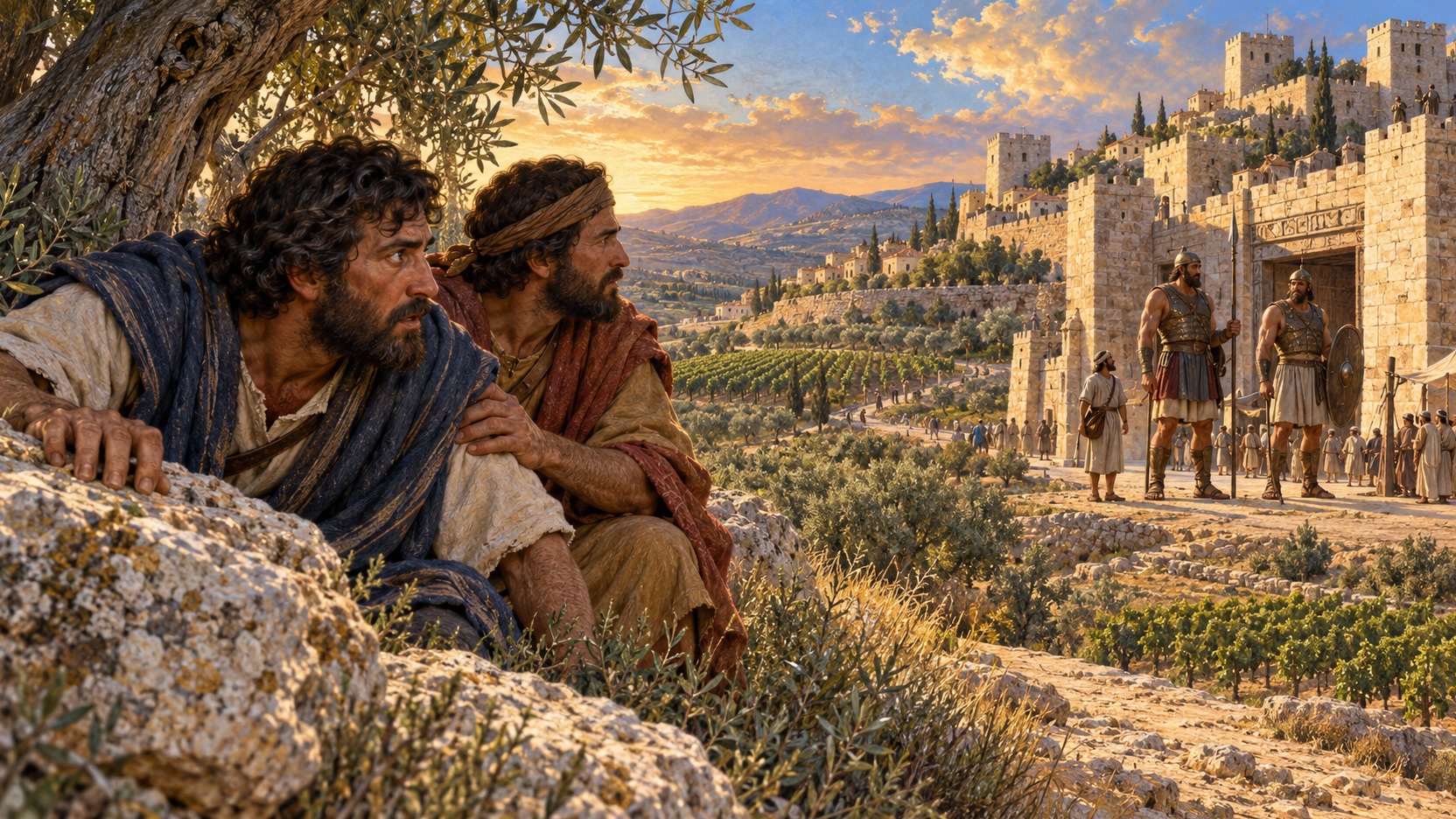
When Moses, Israel’s leader, sent men to examine the land God had promised the nation, they returned with news of fortified cities and people so large that the spies compared themselves to grasshoppers. Among those inhabitants were the descendants of Anak, whom Numbers 13 connects with the Nephilim named earlier in Genesis. I want to understand that connection without adding generations to a family tree that Scripture does not give us.
The Names and Limits Scripture Gives
The name Nephilim first appears in the account of the corruption that preceded God’s judgment of the world through the Flood. Genesis 6 describes a world in which people were multiplying, the sons of God were taking wives from the daughters of men, and children were being born from those unions. The NKJV translates the Hebrew name Nephilim as “giants.”
There were giants on the earth in those days, and also afterward, when the sons of God came in to the daughters of men and they bore children to them.
Those were the mighty men who were of old, men of renown.
I understand these sons of God to be fallen angels who had relations with women and produced the giants called Nephilim. I came to that conclusion by comparing this account with the way the Old Testament uses the expression “sons of God” and with what the New Testament says about angels who rebelled. To show you what I mean, let’s look at those connections before we move to the later peoples.
In Job 1:6 and 2:1, the sons of God present themselves before the LORD, and Satan appears among them. The setting is a heavenly gathering, where Satan makes his accusations concerning Job, a man on earth who fears God. Later, when the LORD questions Job about the creation of the earth, He describes the sons of God rejoicing when its foundations were laid (Job 38:4-7). I understand those passages to refer to angelic beings, and that use of the expression helps explain how I read Genesis 6.
In his New Testament letter, Jude adds that certain angels left their proper dwelling and are being held in darkness for judgment (Jude 6). The apostle Peter also describes angels who sinned and were confined for judgment. He then speaks about God’s judgment on the ancient world through the Flood, when He preserved Noah, a preacher of righteousness, along with seven others (2 Peter 2:4-5). I believe those passages help us understand the rebellion behind the unions in Genesis. The angels involved did not remain in the place God had assigned them.
Genesis records the unions and the children born from them, but it does not explain how these beings participated in human reproduction. I can affirm what I believe happened without inventing a biological explanation for it. The giants were real, and their strength and reputation belong to the history Genesis records.
Their name also deserves care. Nephilim, נְפִלִים, is sometimes explained as meaning fallen ones, but the derivation is disputed. The Brown-Driver-Briggs entry acknowledges that uncertainty. I do not base the whole interpretation on a proposed meaning of the name and then treat the proposal as proof. The passages about the sons of God and angelic rebellion are the evidence for the conclusion I have stated.
The world in which these events occurred was also full of human wickedness and violence. God told Noah to build the ark, a large vessel in which Noah, his wife, their three sons, and their sons’ wives would be preserved through the Flood. Genesis 7:21-23 describes the death of the people outside it, and Genesis 8:15-19 records Noah’s household coming out afterward. The text does not identify a group of Nephilim who survived somewhere beyond that judgment.
That leaves a question when the name appears again much later in Numbers. The words “and also afterward” in Genesis 6:4 do not tell us who married whom in the generations after the Flood. Scripture does not identify anyone aboard the ark as carrying a Nephilim lineage, and it does not narrate another angelic union after the Flood. I do not want to turn a proposed explanation into an event the Bible supposedly records. Numbers gives us a connection with the descendants of Anak, but it does not fill in the intervening history.
Later writings supply far more elaborate accounts. The work known as the Book of Enoch, or 1 Enoch, describes rebellious angels often called Watchers, the giants connected with them, and claims about their spirits and forbidden knowledge. Those details must be examined by Scripture rather than accepted because they are vivid or widely repeated. The study on the Book of Enoch explains why I distinguish those writings from inspired Scripture. They cannot supply missing biblical details with the same authority as Genesis.
Another name we will encounter is Rephaim. It identifies an ancient people and is also used more broadly in passages that associate several peoples of great stature with them. We first meet the Rephaim in Genesis 14:5, during the lifetime of Abram, the ancestor of Israel later known as Abraham. A coalition led by Chedorlaomer, king of Elam, attacked them at Ashteroth Karnaim. These were people living in a named place who were defeated in an actual military campaign.
That setting helps prevent confusion with another use of the same Hebrew consonants, רְפָאִים. In poetic passages, the term can refer to the departed dead, sometimes described as shades. Isaiah 14:9, for example, depicts dead rulers stirred at the arrival of Babylon’s fallen king. That use does not turn the Rephaim who inhabited territories and fought battles into spirits wandering among the living. We have to let the passage tell us which use is intended.
The broader study on giants in the Bible follows the wider subject of Genesis 6 and the response of faith. Here, I want to keep the later names attached to the people and places Scripture identifies, so that we can see which relationships are actually given.
The Spies, the Anakim, and the Peoples East of Israel
By the time we reach Numbers 13, God has brought Israel out of slavery in Egypt under Moses’ leadership. He has promised them the land of Canaan, and Moses sends twelve men, one from each tribe, to examine it. They are to report on the land, its people, and whether the cities are open settlements or fortified strongholds.
The men spend forty days in the land. At Hebron, a city in the hill country, they see descendants of Anak. They also bring back grapes, pomegranates, and figs as evidence of the land’s fruitfulness. When they return to the camp at Kadesh, they acknowledge that the land is good, but they emphasize the strength of its inhabitants and the size of its fortified cities. Caleb, one of the twelve, urges Israel to go up and take possession. The others who oppose him insist that the inhabitants are too strong for them.
And they gave the children of Israel a bad report of the land which they had spied out, saying, “The land through which we have gone as spies is a land that devours its inhabitants,
and all the people whom we saw in it are men of great stature.
There we saw the giants (the descendants of Anak came from the giants);
and we were like grasshoppers in our own sight, and so we were in their sight.”
The Hebrew word translated “giants” here is Nephilim, and the passage connects Anak’s descendants with them. I do not dismiss that connection simply because the report is called bad. At the same time, we should pay attention to what made the report harmful. These men were using what they had seen to persuade Israel that it could not obey the God who had promised to bring the nation into the land.
The Anakim really were a great and tall people. Moses himself describes them that way in Deuteronomy 9:1-2, so their size cannot simply be explained away as a frightened invention. The spies had also seen real walls and defenses. But comparing themselves with grasshoppers expressed how small they felt; it did not give the height of either group. They then claimed that the inhabitants saw them in the same way.
I think the decisive mistake comes in the conclusion they drew from those observations. They had been asked to examine the strength of the inhabitants, so acknowledging strength was not disobedience. Their failure was to treat that strength as proof that God’s command could not be followed. The God who had delivered them from Egypt had not lost His ability to bring them into Canaan.
Their report does not explain the generations between these Anakim and Genesis 6. It does not say how the later people came to bear the Nephilim name or provide the sequence of births that would answer every question about their ancestry. I accept the connection Numbers gives while leaving that missing history unfilled. A claim about someone on Noah’s ark or a repeated angelic event needs evidence beyond our desire to finish the explanation.
The nearer ancestry of the Anakim is more specific. Anak was the son of Arba, and Joshua 14:15 describes Arba as the greatest man among the Anakim. The name Kirjath Arba was associated with the city later called Hebron (Joshua 15:13). These details identify a particular people; Anakim is not simply a label for every tall person who happened to live in Canaan.
Their reputation was so intimidating that Moses recalls the question about who could stand before Anak’s descendants (Deuteronomy 9:2). Yet Joshua and Caleb, the two spies who urged Israel to trust the LORD, had seen the same land. When the people began talking about returning to Egypt, those two men tore their clothes and urged them not to rebel. They said that the LORD could bring Israel into the land and give it to them (Numbers 14:6-9).
Israel refused, and God declared that the unbelieving generation would die in the wilderness. Joshua and Caleb would be preserved to enter the land, along with the children whose parents had feared would become victims there. That judgment explains the long interval between the spies’ report and Israel’s later entry into Canaan. It also explains why Caleb’s confidence becomes so notable when we encounter him again decades afterward.
As that wilderness period drew toward its end, Israel approached lands east of the Jordan River. The Jordan formed the eastern boundary of much of the land they were preparing to enter, but God had also assigned neighboring territories to other peoples. Moses reminded Israel that it was not free to seize every place along the route. The history of those territories introduces two more names associated with the Rephaim.
Moab lay east of the Dead Sea, south of the lower Jordan. God told Israel not to harass the Moabites or take their land, because He had given it to the descendants of Lot, Abraham’s nephew. Before the Moabites possessed that territory, the Emim had lived there. Moses describes them by comparing them with the Anakim Israel already knew about.
(The Emim had dwelt there in times past, a people as great and numerous and tall as the Anakim.
They were also regarded as giants, like the Anakim, but the Moabites call them Emim.
The Horites formerly dwelt in Seir, but the descendants of Esau dispossessed them and destroyed them from before them, and dwelt in their place, just as Israel did to the land of their possession which the LORD gave them.)
The Emim were great in number and tall like the Anakim, and they too were regarded as Rephaim. The NKJV uses “giants” here, while the underlying Hebrew identifies the Rephaim. Emim was the name the Moabites used for them. Moses associates these peoples without saying that the Emim and Anakim were one identical tribe, and the earlier displacement in Moab was not an Israelite campaign.
Further north, the Ammonites had a similar history. They called the former inhabitants of their territory Zamzummim and regarded them as Rephaim. Deuteronomy 2:20-21 describes those people as numerous and tall like the Anakim, but it also says that the LORD destroyed them before the Ammonites, who settled in their place. Israel was told to respect Ammon’s possession as well, because the Ammonites, like the Moabites, were descendants of Lot.
Moses also mentions the Horites who had occupied Seir before the descendants of Esau displaced them. Esau was the brother of Jacob, the ancestor of Israel, and his descendants were the people of Edom. God had given them Seir, and Israel had been told not to seize it (Deuteronomy 2:4-5, 12, 22). That comparison concerns God’s authority to give land and remove its former occupants. The passage does not have to call every people in the comparison giants for the comparison to work.
Explanations of the name Zamzummim sometimes appeal to sounds such as murmuring or buzzing. Even if a proposed word origin were established, it would not tell us that these people practiced a particular sinister ritual. Deuteronomy does not describe one. It gives us their territory, their stature, their relationship to the Rephaim, and their displacement. Those details are enough to understand why Moses includes them here.
I find it interesting that Israel was hearing about peoples of intimidating strength who had already been removed before it arrived. God had not promised that every enemy would be weak. He had shown that strength did not place a people beyond His authority. At the same time, His commands protected lands Israel was forbidden to take. Trusting Him meant obeying both the instruction to advance and the instruction to leave a neighbor’s possession alone.
Og, Goliath, and the Warriors from Gath
Israel then encountered a king who belonged to the Rephaim remnant. Og ruled Bashan, a region east of the Jordan and north of the territories just discussed. In Deuteronomy 3, Moses recalls how Og came out with his people to fight Israel at Edrei. The LORD told Moses not to fear him and promised to deliver the king, his people, and his land into Israel’s hand.
Og’s kingdom included sixty fortified cities in the region of Argob, as well as many unwalled settlements. Moses describes high walls, gates, and bars, so this was a substantial military obstacle. Israel defeated Og and took his territory. The account then gives a physical detail that helps us appreciate why this king remained memorable.
Deuteronomy 3:11 identifies Og’s iron bedstead and says it was in Rabbah of the Ammonites. It measured nine cubits long and four cubits wide. A cubit was a measure based on the distance from the elbow to the fingertips, although ancient standards varied. If we use an eighteen-inch cubit, the bed was approximately thirteen and a half feet long and six feet wide.
Pay attention to what has been measured: it is the bed, not the king’s body. A bed is ordinarily longer than the person using it. Some commentators have also discussed whether the object should be understood as a royal couch or as something preserved to commemorate the king’s greatness. Those are proposals about the object and its use; they do not supply Og’s height. I accept the extraordinary dimensions Moses gives without converting them into a bodily measurement he never states.
The same passage describes Og as remaining from the remnant of the Rephaim. That statement belongs to the account of Bashan and its former inhabitants. It should not be made to mean that Scripture will never mention another giant anywhere, because the later accounts plainly do. Og’s defeat showed Israel that neither an imposing king nor strongly defended cities could prevent God from fulfilling the promise He had given Moses.
Moses also describes Og and Sihon, the king Israel had defeated just before him, as kings of the Amorites (Deuteronomy 3:8). That does not mean that every Amorite was a Rephaite or that every subject in Og’s kingdom had his stature. Amorite can identify a broad Canaanite people, and in some passages it describes the inhabitants of the land more generally. The labels tell us different things about a ruler, a people, or a territory.
Amos uses the Amorites to remind Israel of what God had done for them. As the prophet confronts Israel’s own sins, he recalls the LORD removing an enemy whose height was compared with cedars and whose strength was compared with oaks (Amos 2:6-10). Trees provide the comparison for formidable strength. The words do not measure every Amorite at the height of a cedar, any more than the spies’ grasshopper comparison measures their own bodies.
The account of Goliath gives us a more direct measurement. He lived much later, when Saul was king of Israel and the Philistines were fighting Israel in the Valley of Elah. Goliath came from Gath, a Philistine city. Joshua 11:22 had earlier identified Gath as one of the places where Anakim remained after the conquest, along with Gaza and Ashdod.
Goliath stepped out as the Philistine champion and challenged Israel to send a man to fight him. The proposed contest would decide which people would serve the other. His size and equipment help explain why Saul and Israel’s soldiers were afraid to answer him.
And a champion went out from the camp of the Philistines, named Goliath, from Gath, whose height was six cubits and a span.
He had a bronze helmet on his head, and he was armed with a coat of mail, and the weight of the coat was five thousand shekels of bronze.
And he had bronze armor on his legs and a bronze javelin between his shoulders. Now the staff of his spear was like a weaver’s beam, and his iron spearhead weighed six hundred shekels; and a shield-bearer went before him.
The Masoretic Text, the traditional Hebrew text followed by the NKJV in this passage, gives his height as six cubits and a span. A span was a measure across an outstretched hand, from the thumb to the little finger. Using the common approximations of eighteen inches for a cubit and nine inches for a span gives a height of about nine feet nine inches. Those are approximate modern conversions, but the account plainly describes an exceptionally large man.
His equipment also carried extraordinary weight. The shekels used to measure the coat of mail and the spearhead are units of weight, not a price in coins. The comparison of the spear’s shaft to a weaver’s beam, a substantial part of a loom used to make cloth, helps describe its size. He had armor covering his head, body, and legs, and another man carried his shield ahead of him. Israel was looking at a formidable opponent who was openly challenging its army.
David, the young man who killed Goliath, had come to the camp after his father sent him with food for his older brothers. He heard the challenge, spoke to Saul, and went out against the champion with a sling and stones. We will return to the reason David gave for his confidence, but his victory was not the last encounter with unusually large warriors from Gath.
In the later battles recorded in 2 Samuel 21, David was king and his servants fought alongside him. The chapter names several opponents connected with the giant family at Gath, and its final encounter gives a detail about a man whose own name is not supplied.
Yet again there was war at Gath, where there was a man of great stature, who had six fingers on each hand and six toes on each foot, twenty-four in number; and he also was born to the giant.
So when he defied Israel, Jonathan the son of Shimea, David’s brother, killed him.
These four were born to the giant in Gath, and fell by the hand of David and by the hand of his servants.
This man had six fingers on each hand and six toes on each foot. The term for extra fingers or toes is polydactyly. The passage records that physical characteristic and identifies his family connection, but it does not explain what caused the condition or say that every person in that family had it. I have no basis for treating an extra finger or toe in someone today as evidence of a hidden Nephilim ancestry.
The four warriors are described as born to the giant in Gath, with the Hebrew designation sometimes rendered Rapha. That relationship should not be changed into a claim that all four were sons of Goliath. The parallel account in 1 Chronicles 20:5 specifically names Lahmi, the man Elhanan killed, as Goliath’s brother. The NKJV also identifies Elhanan’s opponent as the brother of Goliath in 2 Samuel 21:19. A brother is not a son, and those details should remain distinct when we describe the family.
The men who defeated these opponents should remain distinct too. Jonathan, who killed the man with twenty-four fingers and toes, was the son of Shimea, David’s brother. He was David’s nephew, not Jonathan the son of King Saul. In another of these battles, David became faint and Abishai came to his aid and killed the Philistine who threatened him (2 Samuel 21:15-17). The later victories involved the men serving under David, rather than David personally killing every champion.
Gath connects these accounts geographically with a city where Anakim had remained, but the books of Samuel do not trace each warrior’s ancestry through every earlier generation. I can recognize that connection without pretending the account supplies a complete genealogy. Scripture has given enough detail to identify real people, their extraordinary strength, and the men who defeated them.
The Conquest Was Judgment, Not Genetic Cleansing
To understand why the Anakim were removed from their cities, we need to return from David’s time to Israel’s entry into Canaan. After Moses’ death, Joshua led the nation into the land. The account of his campaigns describes the removal of the Anakim and also names the places where they remained.
And at that time Joshua came and cut off the Anakim from the mountains: from Hebron, from Debir, from Anab, from all the mountains of Judah, and from all the mountains of Israel; Joshua utterly destroyed them with their cities.
None of the Anakim were left in the land of the children of Israel; they remained only in Gaza, in Gath, and in Ashdod.
That was a severe judgment, and I do not think we explain it faithfully by saying only that the inhabitants were unusually large. God stated His reasons for giving Israel the land. In Deuteronomy 9:4-6, Moses tells Israel that the LORD is driving out those nations because of their wickedness and because He is fulfilling the promise He made to Abraham, Isaac, and Jacob. Those men were Israel’s forefathers, through whom God had given the covenant promise of the land.
God had spoken about that judgment long before Moses or Joshua led the nation. In Genesis 15, He told Abram that his descendants would live as strangers in another land, suffer oppression, and afterward return. He also explained why the occupation of Canaan lay ahead rather than happening immediately: the iniquity of the Amorites was not yet complete. That statement shows God’s patience before judgment. He was dealing with actual wickedness, not waiting for Israel to devise a test of someone’s ancestry.
The commands concerning the conquest came to Israel by God’s direct revelation for that particular purpose. They were not a standing permission to attack any neighboring people Israel disliked. We have already seen Him protect the lands of Moab, Ammon, and Esau’s descendants from Israelite seizure. Neither unusual height nor an asserted family connection gave Israel the right to disregard what He had commanded.
Joshua 11 gives the broad summary of the conquest, while chapters 14-15 explain Caleb’s inheritance and the removal of the Anakim from Hebron in particular. Caleb was forty when Moses sent him to examine the land, and forty-five years later he asked Joshua for the hill country God had promised him. He spoke about the Anakim and their fortified cities as obstacles he would face in taking possession. Yet he also trusted the LORD to be with him so that he could drive them out (Joshua 14:6-15).
Joshua gave him Hebron, and Joshua 15:13-14 names Sheshai, Ahiman, and Talmai as the three sons of Anak whom Caleb drove out. These are the same names encountered when the spies first came to Hebron in Numbers 13:22. Caleb’s request acknowledged the difficulty of facing those people, just as the earlier report had described it. His confidence came from continuing to trust the God whose promise the others had refused to believe.
The people who survived the conquest also help us understand why ancestry cannot be made its governing explanation. Rahab was a woman living in Jericho when Joshua sent two men to examine the city. She hid them from the king’s agents and told them she knew the LORD had given Israel the land. She had heard about the deliverance from Egypt and the defeat of Sihon and Og, and she acknowledged the LORD as God in Heaven and on earth (Joshua 2:8-13).
Rahab asked for her household to be spared. The men agreed, and when Jericho fell, Joshua sent them to bring her and her family out. She was then incorporated into Israel (Joshua 6:22-25). The account gives her response to the LORD and the preservation of her household; it does not describe a genetic examination to determine whether they could live.
The Gibeonites survived under different circumstances. They were inhabitants of nearby Canaanite towns, but they came to Joshua pretending to be travelers from a distant country. Their worn clothing and moldy provisions supported the deception. Israel’s leaders accepted their account and made a treaty without asking counsel from the LORD. When the truth became known, the leaders honored the oath they had sworn, and the Gibeonites became woodcutters and water carriers (Joshua 9).
I would not equate their deception with Rahab’s response of faith. The accounts explain different actions and different reasons for preserving those households and towns. Yet both show that the conquest cannot be reduced to an order to remove a supposedly identifiable genetic contamination from the land. That explanation replaces the reasons Scripture actually gives with a theory about ancestry.
God also warned Israel that it would face removal if it practiced the same abominations as the nations before it (Leviticus 18:24-30). Centuries later, after Israel had divided into a northern kingdom and the southern kingdom of Judah, that warning came upon the northern kingdom. Its people worshiped other gods and refused to listen to the prophets the LORD sent, and 2 Kings 17 records their removal from the land into captivity in Assyria. Their descent from Israel had not made their rebellion acceptable. The judgment concerned their conduct before God, just as Moses had warned.
Faith Refuses to Make the Enemy Larger Than God
When I compare the spies’ refusal with Caleb’s later request, I see the same formidable people being assessed in two very different ways. The ten spies treated the inhabitants’ strength as the reason Israel could not go forward. Caleb acknowledged that strength and still believed the LORD could do what He had promised. He did not need to solve every question about the Anakim’s ancestry before he could obey.
David’s response to Goliath follows that same dependence on God. When Saul questioned whether he could fight the champion, David told him how he had protected his father’s sheep from a lion and a bear. He credited the LORD with delivering him from those animals, and he trusted the LORD to deliver him from the Philistine who had defied the armies of the living God (1 Samuel 17:34-37).
David did not overlook Goliath’s weapons. When he approached him, he named the sword, spear, and javelin the champion carried. Then he explained that he came in the name of the LORD and that the battle belonged to Him. David’s stone struck Goliath in the forehead, and he used the fallen champion’s own sword to finish the victory. The account directs our confidence toward the God David trusted, rather than toward the idea that David had discovered a secret about giant bloodlines.
I cannot take that victory as a promise that every difficulty in my life will end in the outcome I want. Israel had received particular commands and promises, and David’s encounter happened within that history. Faith means trusting what God has actually said, including what He says about enduring suffering. An obstacle does not make disobedience wise, but calling something my giant does not give me a promise God never made.
When the New Testament addresses spiritual warfare, it tells believers how to stand against the devil’s schemes. Paul explains in Ephesians 6:10-18 that the struggle involves spiritual powers, and he directs us to the armor God supplies. The point of the armor is that we depend on the Lord’s strength and use what He has given, rather than imagine we can protect ourselves by learning hidden names or genealogies.
Paul describes truth as a belt and righteousness as a breastplate. The gospel of peace prepares our feet, faith is a shield against the enemy’s attacks, and salvation is pictured as a helmet. He identifies the Word of God as the sword of the Spirit and calls believers to remain watchful in prayer. These are things we can actually attend to: receive God’s truth, obey Him, trust His promise, and continue coming to Him in prayer when we are under pressure.
Scripture does not tell Christians to diagnose every hardship as a Nephilim spirit or to identify some hidden giant ancestry before they can stand firm. I want to follow the instructions God has given me instead of becoming absorbed in instructions He has never given. The study on angels examines their service, rebellion, and judgment within the wider biblical teaching.
Our confidence finally rests in Jesus Christ, who is Lord over every visible and invisible power. He is the eternal, uncreated Son, and He became fully man without ceasing to be God. He lived without sin and willingly gave Himself to be slain as the perfect sacrifice for our sins. Wicked men inflicted the bodily suffering and death, but they could not turn His obedience into a defeat of God’s purpose. His sacrifice through His shed blood and death was complete before His burial, and He then rose bodily from the dead (John 1:1-14; 10:17-18; 1 Corinthians 15:3-4).
I do not understand the cross to mean that the Father punished, cursed, abandoned, struck, or bruised Jesus, or poured wrath upon Him. The Father, Son, and Holy Spirit acted in unity in our salvation. Jesus told His disciples that even when they scattered, He would not be alone because the Father was with Him (John 16:32). No ancient warrior and no unseen power can overturn what the risen Lord has accomplished.
Christ died for the whole world, and His invitation to salvation is genuine for everyone, although people can resist it. We respond to Him in repentance and faith. Everyone who truly believes is forgiven and justified, which means declared righteous before God, and receives new spiritual life through being born again. The Holy Spirit dwells in the believer and seals him as God’s own, so his eternal security rests in God rather than his ability to defeat an enemy by himself (Ephesians 1:13-14).
Obedience grows from that new life; it does not earn salvation or keep us saved. At the same time, a superficial claim to faith is no proof that someone has been born again. Genuine faith does not make a believer sinless, but it gives him a reason to confess his sins and return to the Savior instead of defending lawlessness (1 John 1:7-2:2). That is the response this subject should encourage in me: trusting the Lord who has made Himself known and obeying what He has said.
My Final Thoughts
I believe the Nephilim of Genesis 6 were giants produced through the unions of fallen angels and women, and Numbers connects the descendants of Anak with the Nephilim. The later passages also identify the Emim and Zamzummim with the Rephaim and describe Og and the formidable warriors from Gath. Those are real connections, but they do not give us every generation between the Flood and Israel’s encounters in Canaan.
I can accept the extraordinary details Scripture records while leaving the missing details unfilled. The giants’ strength did not cancel God’s promise, and their ancestry was not the reason Caleb or David trusted Him. I want my study of these passages to lead me to that same dependence on the Lord, with enough confidence in His Word to obey it and enough care with His Word not to add what He has not said.