
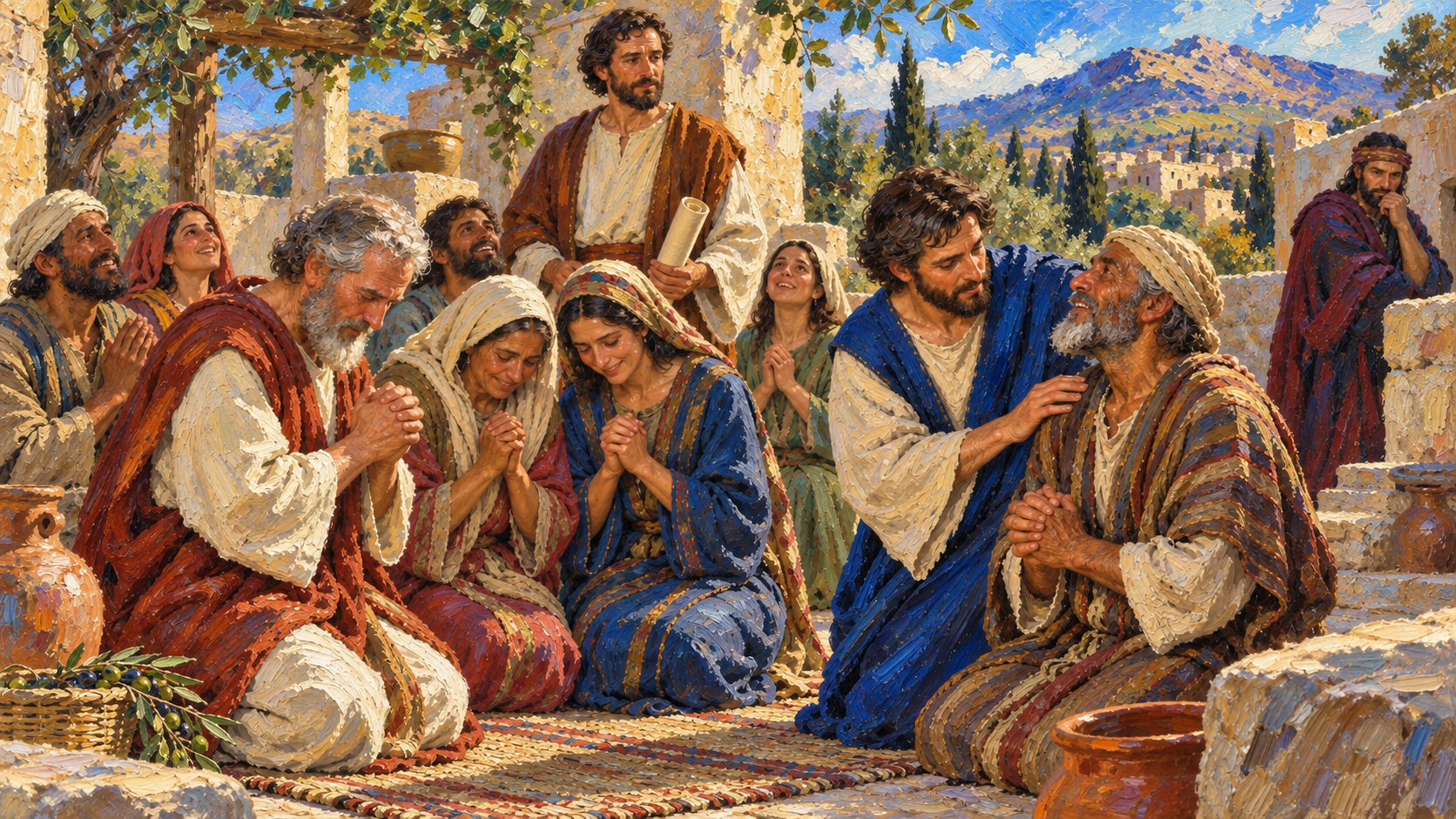
When Jesus spoke with Samaritans, He crossed a division shaped by centuries of rival worship, political conflict, and disputed ancestry. He did not treat their religious claims as equally true, but neither did He accept contempt as a proper response to their error. I want to follow that history into the Gospels and Acts, where the Lord offered salvation and brought believers from estranged communities into one church.
Samaria’s History and Religious Divide
Samaria can mean a city, a region, or a people, depending on the passage. Omri bought a hill from Shemer, built the northern kingdom’s capital there, and named it Samaria. The surrounding territory came to bear the name too. The Hebrew is commonly transliterated Shomron; the New Testament uses Samareia for the place and related forms such as Samareites for a Samaritan. A geographical reference does not always identify the later religious community.
The population also changed across the centuries. Israelites lived around the northern capital before Assyria brought foreign settlers into the region. The opponents described in Ezra and Nehemiah belonged to a later period, and the community Jesus encountered developed through further generations. Each period contributes to our understanding, but no single event explains the ancestry and religious life of every person called a Samaritan.
False worship was already established before the Assyrian settlers arrived. After the kingdom divided, Jeroboam feared that worship in Jerusalem would draw the northern tribes back toward David’s house. He set up calves at Bethel and Dan, appointed an unauthorized priesthood, and instituted a rival festival. Later kings repeatedly followed “the sins of Jeroboam.” Omri built Samaria as his capital, and Ahab, his son, promoted Baal worship.
The LORD sent prophets to confront that rebellion. Elijah and Elisha ministered in the region, and Amos and Hosea warned the northern kingdom before its fall. Israelites had rejected the worship God appointed and resisted His correction. 2 Kings 17 therefore presents Assyria’s conquest as covenant judgment. False worship had taken hold long before the foreign settlers arrived, so we cannot place all responsibility for the region’s religious corruption on them.
When Assyria conquered Samaria, it deported many Israelites to places including Halah, the banks of the Habor River, and cities of the Medes. It also brought other populations into the conquered territory. Such displacement helped the empire weaken local resistance and hold the land it had taken.
Then the king of Assyria brought people from Babylon, Cuthah, Ava, Hamath, and from Sepharvaim, and placed them in the cities of Samaria instead of the children of Israel; and they took possession of Samaria and dwelt in its cities. And it was so, at the beginning of their dwelling there, that they did not fear the LORD; therefore the LORD sent lions among them, which killed some of them. So they spoke to the king of Assyria, saying, "The nations whom you have removed and placed in the cities of Samaria do not know the rituals of the God of the land; therefore He has sent lions among them, and indeed, they are killing them because they do not know the rituals of the God of the land."
The new residents spoke as though they needed to appease a deity who governed that territory. They wanted to learn the customs of “the God of the land.” The Assyrian king sent back an Israelite priest, who settled at Bethel and taught them how they should fear the LORD. They adopted practices associated with Him while continuing to serve their own gods.
They feared the LORD, yet served their own gods–according to the rituals of the nations from among whom they were carried away.
The description exposes divided allegiance. They could observe rituals associated with the LORD while continuing to serve other gods, but that was not the exclusive loyalty He required. This religious mixture is called syncretism. It combines beliefs and worship in ways God has not authorized, rather than merely adopting a neutral cultural custom. Adding God’s name to idolatry cannot turn it into faithful worship.
Assyria’s deportations were severe, but they did not remove every Israelite. Scripture elsewhere mentions people from Asher and Zebulun, and 2 Chronicles 34:9 refers to a remnant of Israel that included Ephraim and Manasseh. We need to allow for people who remained, imported settlers, and subsequent movements of people. The account in 2 Kings explains a crucial stage in the region’s history without tracing the ancestry of every first-century Samaritan. I would not reduce that whole community to five foreign groups who became one unchanging population.
When Judean exiles returned from Babylon, people of the land offered to help rebuild the temple and opposed the work when their offer was refused. Nehemiah also records Sanballat’s opposition and mentions the army of Samaria. Those conflicts intensified regional hostility, but Ezra and Nehemiah do not identify every opponent with the fully developed Samaritan community of the New Testament. Their accounts give us part of the history without settling every stage of its development.
By Jesus’ day, Samaritans worshiped on Mount Gerizim near Shechem rather than at Jerusalem. They accepted the Torah, or Pentateuch, in a distinct textual tradition. These are the five books from Genesis through Deuteronomy. Their canon, the collection of books recognized as authoritative Scripture, stopped there. They also claimed continuity with Israel through Joseph’s descendants, claims that Jewish communities rejected along with their worship.
Both communities could look back to the patriarchs associated with this region. Blessings had been proclaimed at Gerizim after Israel entered the land, and Shechem was connected with Abraham, Jacob, and Joseph. Those connections help explain the importance of the place. Appealing to shared ancestors and sacred places, however, could not settle the dispute over God’s appointed sanctuary or justify restricting the Scripture He had given.
John 4:9 describes Jews as having no dealings with Samaritans, explaining the woman’s surprise when Jesus asked for a drink. This does not mean every Jew avoided every transaction or took the same route around the region. The disciples were buying food in a Samaritan town during that very encounter. We can nevertheless hear the hostility in John 8:48, where Jesus’ opponents tried to disgrace Him by calling Him a Samaritan and saying He had a demon. He denied the demonic accusation and confronted their unbelief.
I would not force those divisions into a single modern racial category. Related peoples disputed ancestry, worship, territory, and political claims. Their hostility was real even though its categories differed from ours. Inherited contempt can train a person to see a label before recognizing the neighbor who needs truth or mercy.
Jesus Brings the Gospel Across the Divide
In Matthew 10, Jesus sent the Twelve to the lost sheep of Israel and told them not to enter Samaritan cities. During that stage of His earthly ministry, the Messiah directed their witness to the people to whom God had given the covenant promises. The restriction did not permanently exclude Samaritans. Jesus ministered to them, and His commission after the resurrection named Samaria explicitly. Paul’s later statement that the gospel is for the Jew first and also the Greek likewise identifies a priority in proclamation. His words do not give us two gospels or two ways of salvation.
The disciples also had to learn how to respond when Samaritans rejected Jesus. Luke 9 records a village refusing to receive Him on His journey toward Jerusalem.
and sent messengers before His face. And as they went, they entered a village of the Samaritans, to prepare for Him. But they did not receive Him, because His face was set for the journey to Jerusalem. And when His disciples James and John saw this, they said, "Lord, do You want us to command fire to come down from heaven and consume them, just as Elijah did?" But He turned and rebuked them, and said, "You do not know what manner of spirit you are of. For the Son of Man did not come to destroy men’s lives but to save them." And they went to another village.
The villagers’ refusal was connected with His destination, bringing the dispute over worship into the encounter. James and John appealed to Elijah’s judgment as a precedent for destroying them. Jesus instead rebuked His own disciples and continued to another village. The Samaritans were wrong to reject Him, but the disciples’ proposed response was also wrong.
Jesus was not denying future judgment. He was correcting disciples who wanted to answer rejection by calling down destruction during His mission to save. I need to let that rebuke examine my zeal. Knowing someone has rejected truth does not authorize me to indulge resentment and call it faithfulness to God.
In Luke 10, a lawyer correctly identified the commands to love God and one’s neighbor, then tried to justify himself by asking who qualified as his neighbor. Jesus answered with a parable about a traveler who was robbed, wounded, and left half dead. A priest and a Levite each saw him and passed by. Jesus does not explain their motives, so I would not supply fear, ceremonial concerns, or inconvenience as though the text gave those reasons. He tells us what they did, then describes the response of a Samaritan.
But a certain Samaritan, as he journeyed, came where he was. And when he saw him, he had compassion. So he went to him and bandaged his wounds, pouring on oil and wine; and he set him on his own animal, brought him to an inn, and took care of him.
The Samaritan approached, treated the wounds, used his own animal, and took the injured man to an inn. He paid for the care and promised further help. Jesus asked who had become a neighbor to the wounded man, and the lawyer answered, “He who showed mercy.” The question had begun with the limits of obligation; Jesus directed him to recognize and imitate costly compassion.
Jesus was confronting the lawyer’s attempt to excuse himself from love. He was not endorsing Samaritan worship by making a Samaritan the example of mercy. I also would not turn every detail into an allegory, identifying the Samaritan as Jesus and the objects he used as hidden parts of the gospel. Christ embodies perfect mercy, but His stated instruction here is direct: “Go and do likewise.”
Luke 17 gives another encounter in which an outsider responded differently from those around him. Jesus cleansed ten men of leprosy as they went to show themselves to the priests.
And one of them, when he saw that he was healed, returned, and with a loud voice glorified God, and fell down on his face at His feet, giving Him thanks. And he was a Samaritan. So Jesus answered and said, "Were there not ten cleansed? But where are the nine? Were there not any found who returned to give glory to God except this foreigner?" And He said to him, "Arise, go your way. Your faith has made you well."
Although all ten received bodily healing, only one returned to glorify God and thank Jesus. Luke identifies him as a Samaritan, and Jesus calls him a foreigner. His position outside the Jewish community had not prevented him from responding in faith. He gave glory to God at Jesus’ feet, recognizing the One who had made him well. Seeing him return when the other nine did not makes me examine how readily I enjoy the Lord’s gifts without thanking Him.
Jesus and the Samaritan Woman
John 4 records a fuller conversation about Samaritan worship during Jesus’ journey from Judea toward Galilee. He sat down at Jacob’s well near Sychar, weary from His journey, and asked a Samaritan woman for water. The eternal Son had become fully man and knew real bodily fatigue without sin. His request surprised her because He was a Jewish man asking a Samaritan woman for a drink. Jesus used that exchange to begin explaining the gift of God to her.
The journey through Samaria also served a purpose: John says Jesus “needed” to pass that way. It lay on a direct route from Judea to Galilee, though other routes were possible. I understand the necessity to include God’s saving purpose in this encounter, rather than simply the demands of the road. John places the meeting at about the sixth hour, often understood as noon, although readers differ over his timekeeping. The hour does not establish the woman’s reasons for coming then. John never says she was avoiding other women, was shunned by the town, or was a prostitute.
The gift Jesus offered her was living water, an expression that could refer to fresh, running water. He promised water that would become a fountain springing up into everlasting life. John 7 later connects this language with the Holy Spirit given to believers. Initially she understood Him in terms of water that would relieve her repeated trips to the well. Jesus then told her to call her husband.
She replied that she had no husband. Jesus acknowledged that she had answered truthfully, then told her she had had five husbands and that the man she now had was not her husband. His knowledge of her life was unmistakable, but we are not told how the marriages ended or who bore responsibility in each case. Her present union was not marriage. Jesus spoke truthfully about her life without humiliating her before a crowd.
Some read the five husbands as symbols of imported populations or their gods. I read this as an encounter with a real woman whose marital history Jesus knew. The offer of everlasting life came from the One who already knew her circumstances. She recognized Him as a prophet and brought up the dispute over worship that divided their communities.
Our fathers worshiped on this mountain, and you Jews say that in Jerusalem is the place where one ought to worship." Jesus said to her, "Woman, believe Me, the hour is coming when you will neither on this mountain, nor in Jerusalem, worship the Father. You worship what you do not know; we know what we worship, for salvation is of the Jews.
She may have wanted a prophet to resolve that question, or she may have been redirecting the conversation from her own life. John does not tell us her motive. Jesus answered her question directly and corrected Samaritan worship. He did not treat the claims of Gerizim and Jerusalem as equally valid. God had appointed Jerusalem for the temple under the old covenant and entrusted the fuller body of Scripture to the Jews. Samaritan tradition could not authorize a rival sanctuary or justify limiting God’s revealed word to the Torah.
His words “Salvation is of the Jews” identify the people through whom God gave the revelation and promises fulfilled in the Messiah. Jesus came through Israel as the promised son of David and son of Abraham. He was not declaring Jewish moral superiority or saying that ancestry could save anyone. God had brought the Savior through that nation, and the salvation He offered would reach far beyond it.
But the hour is coming, and now is, when the true worshipers will worship the Father in spirit and truth; for the Father is seeking such to worship Him. God is Spirit, and those who worship Him must worship in spirit and truth."
Proskyneo, the Greek verb for worship here, can describe bowing in homage. In this passage the worship is directed to the Father. Pneuma and aletheia mean spirit and truth. Jesus calls for inward worship governed by God’s revelation. Sincerity alone cannot make worship of a false god true, and emotional intensity cannot establish that worship is spiritual.
The coming hour belongs to Christ’s saving work and the new covenant. Through the Son, believers come to the Father and are indwelt by the Holy Spirit. A building may provide a place to gather, but neither a location nor a ceremony can bring us into that relationship with God. Worship in spirit and truth can include order and thoughtful preparation. The outward acts need to express inward allegiance to the God who has revealed Himself.
As the conversation continued, the woman spoke of the coming Messiah, who would explain these things. Jesus plainly identified Himself as that Messiah. She left her waterpot, returned to the city, and invited others to meet the Man who had told her what she had done.
And many of the Samaritans of that city believed in Him because of the word of the woman who testified, "He told me all that I ever did." So when the Samaritans had come to Him, they urged Him to stay with them; and He stayed there two days. And many more believed because of His own word. Then they said to the woman, "Now we believe, not because of what you said, for we ourselves have heard Him and we know that this is indeed the Christ, the Savior of the world."
John says many believed in Jesus because of the woman’s testimony. When He stayed with them for two days, many more believed through hearing Him for themselves. Her witness had directed them to Christ, and their own hearing strengthened their recognition of who He was. I want testimony to serve that purpose: helping people come to know the Savior and hear His word. Their confession of Him as the Savior of the world reaches beyond Judea and Samaria. It agrees with God’s love for the world and His genuine offer to whoever believes. It does not mean everyone is automatically saved, since John distinguishes believers who receive life from unbelievers who remain condemned.
Samaria and the One Church in Acts
After His bodily resurrection, Jesus told the apostles that the Holy Spirit would empower their witness in Jerusalem, Judea, Samaria, and to the end of the earth. Naming Samaria identified a boundary they were to cross, not a community they could continue avoiding. The gospel would bring people estranged by rival worship into fellowship through the same Savior.
Samaritans occupied a distinctive place in that progress. They claimed Israelite ancestry, received the Torah, and lived in land connected with the patriarchs, yet were estranged from the Jews. I therefore do not describe Acts 8 simply as the first Gentile conversion. Acts 10 later records the public opening to Cornelius and other Gentiles.
The Samaritan mission in Acts 8 began as persecution following Stephen’s death scattered believers from Jerusalem into Judea and Samaria. Forced from their homes, they continued to preach the word wherever they went. Philip’s ministry in Samaria grew out of that scattering.
Therefore those who were scattered went everywhere preaching the word. Then Philip went down to the city of Samaria and preached Christ to them. And the multitudes with one accord heeded the things spoken by Philip, hearing and seeing the miracles which he did. For unclean spirits, crying with a loud voice, came out of many who were possessed; and many who were paralyzed and lame were healed. And there was great joy in that city.
Philip preached Christ in Samaria, explaining the kingdom of God and the name of Jesus. People listened as he spoke and as they saw deliverance from demonic bondage and the healing of bodily afflictions. The city rejoiced, and men and women who believed were baptized. Their baptism publicly identified them with Christ; the water did not purchase forgiveness or produce new birth.
That response also displaced Simon’s influence. His sorcery had amazed people, who praised him as “the great power of God.” The gospel called them away from deception to the true Messiah. They could trust Christ without becoming Jews, but believing Him meant leaving the deception and false worship that had governed them.
Now when the apostles who were at Jerusalem heard that Samaria had received the word of God, they sent Peter and John to them, who, when they had come down, prayed for them that they might receive the Holy Spirit. For as yet He had fallen upon none of them. They had only been baptized in the name of the Lord Jesus. Then they laid hands on them, and they received the Holy Spirit.
The order of events here differs from what the New Testament teaches us to expect when someone is saved. Every true believer belongs to Christ and is indwelt and sealed by the Holy Spirit. Yet these Samaritans had believed and been baptized before Peter and John came to pray for them. Later in Acts, Gentiles receive the Spirit before water baptism. I understand these differences in light of the foundational events Luke records as the gospel crossed the boundaries between long-divided communities.
Peter and John came from Jerusalem, prayed for the Samaritans, and witnessed their reception of the Spirit. Their presence connected these believers openly with the apostles and the church in Jerusalem. I understand that public connection as a safeguard against establishing rival churches around Gerizim, Philip, or a separate spiritual experience. The Samaritans received the same divine Person who indwelt Jewish believers. Through Christ, people divided for centuries now belonged to one body.
I therefore would not turn Acts 8 into a rule that Christians normally wait for the Spirit after conversion. It does not establish a universal second blessing or make salvation dependent on modern apostles completing it. In this particular event, the reception of the Spirit openly joined Samaritan believers to the same church. John, who had wanted fire to fall on a Samaritan village, was now praying for Samaritans to receive the Holy Spirit.
Simon brings a warning into this account. Luke says he believed and was baptized, and that he continued with Philip, amazed at the signs. When he saw the Spirit given through the apostles’ laying on of hands, he offered money to obtain that authority. Peter told him his money should perish with him, declared that his heart was not right before God, and called him to repent and pray for forgiveness. Simon asked the apostles to pray for him, but Luke does not tell us what followed or describe his later spiritual condition. I would not treat a baptized profession, amazement at miracles, or closeness to a minister as sufficient proof of genuine new birth.
The Holy Spirit is God, not a power Simon could purchase and control. Churches should take that warning seriously when spiritual status or authority to impart gifts is offered for sale. A donation, conference fee, credential, or relationship with a famous leader cannot buy what only God gives. The Spirit distributes gifts according to His will.
On the return to Jerusalem, Peter and John preached in many Samaritan villages. Acts 9:31 then includes Samaria alongside Judea and Galilee among churches enjoying peace and being built up. John was proclaiming salvation in the region where he had once proposed destruction.
The fellowship described in Acts rested on the truth of Christ. Jesus had corrected Samaritan worship, and Philip had preached the gospel. Believers from both communities now belonged to the same Savior and received the same Spirit. Jewish Christians needed to welcome Samaritans as brothers and sisters, while Samaritan Christians needed to leave their former religious rivalry behind. Accepting these believers did not require accepting their previous worship. Once Christ had received them, inherited hostility could no longer justify refusing them fellowship.
The Gospel and Our Response
Ancestry, a sacred mountain, sincere rituals, and an impressive religious experience cannot save us. Neither baptism nor association with a minister can substitute for Christ. The people in these passages needed a Savior who could give them life, and so do we.
Jesus is the eternal Son, fully God, who became fully man through the virgin birth and lived without sin. He willingly gave Himself to be slain as the perfect sacrifice for our sins. Wicked people inflicted real bodily torture and crucified Him; He shed His blood and died. His saving sacrifice was complete through that death, before His burial and bodily resurrection. The Father did not punish, curse, abandon, strike, bruise, or pour wrath on Jesus. Father and Son remained united in the work of our redemption.
Christ died for the whole world, and salvation is genuinely offered to everyone. People can resist His grace and reject Him, but everyone who repents and believes is forgiven and justified, receiving righteous standing before God. That person is born again, indwelt and sealed by the Holy Spirit, and eternally secure in Christ. A superficial profession does not establish new birth, and assurance gives no permission for lawlessness. Obedience grows from the new life God gives; it neither earns salvation nor keeps us saved.
We come to the Father through the Son and worship according to His truth. That excludes mixing Christianity with idolatry. Religious language cannot make occult practices faithful or turn self-worship into obedience to Christ. Wealth and national power must never receive the devotion that belongs to God. I need to ask whether I am obeying the Lord or merely adding His name to loyalties I refuse to surrender.
The same truth calls us to receive believers whom Christ has received, even where our communities have learned distrust. The Samaritan in Jesus’ parable showed costly mercy, the healed man returned in gratitude, and the woman directed her neighbors to hear Christ. Philip preached the word, and John learned to pray and preach among people he had wanted destroyed. I want those passages to correct any zeal in me that would rather punish an opponent than see that person saved.
My Final Thoughts
Jesus corrected Samaritan error while offering the living water they needed. He brought believers into one church through the same gospel proclaimed to Jews and Gentiles, without treating truth as an obstacle to peace. I want to follow that teaching closely enough to reject false worship and inherited contempt together. The Lord who has shown us mercy also calls us to worship the Father in spirit and truth and show mercy to the neighbor before us.