
We say Amen so often that it can become little more than the sound that ends a prayer. What are we affirming when we use it, and does saying it accomplish anything by itself? I want to follow the word through Scripture, from solemn covenant responses to public worship and the teaching of Jesus, who calls Himself “the Amen.” Its meaning asks more of us than a familiar response.
Amen Begins with the God of Truth
Amen can confirm something spoken, express agreement, join a prayer, or affirm praise. The familiar “so be it” fits many prayers, while “truly,” “it is established,” “I agree,” or “let this stand” may better explain another setting. No one English expression captures every occurrence. When Revelation uses it as Christ’s title, the word identifies His reliability rather than expressing a request.
The Hebrew amen belongs to a family of words concerning firmness, dependability, and faithfulness. Related forms include the verb commonly written aman and emunah, often translated faithfulness, steadiness, or fidelity. Forms translated “believed” can belong to the same family. These connections help explain the relationship between trust and reliability, but they do not make every related word interchangeable. Each sentence determines its meaning.
Isaiah 65 connects Amen with God’s own character. The prophet contrasts those who forsake the LORD with His servants, announcing judgment and blessing while looking ahead to the removal of former troubles. Twice in verse 16, the Hebrew calls Him Elohei amen, rendered “the God of truth” in the NKJV:
So that he who blesses himself in the earth
Shall bless himself in the God of truth;
And he who swears in the earth
Shall swear by the God of truth;
Because the former troubles are forgotten,
And because they are hidden from My eyes.
God’s promises are reliable because He is reliable. He does not lie, lose track of what He has said, or change His holiness with His mood. His warnings are as truthful as His assurances. I do not make either more certain by approving them. When I answer Amen, I acknowledge truth that stands independently of my response.
This also keeps faith from becoming confidence in our own confidence. A believer may feel weak and speak quietly, yet the God he trusts remains faithful. A thousand loud responses cannot make a false claim true, and an entire generation’s rejection cannot make God’s Word false. We need to judge what is being affirmed rather than rely on sincerity, emotion, volume, or the number of people who agree.
Covenant Agreement Must Become Obedience
Some early uses carry the seriousness of a public signature. In the jealousy procedure described in Numbers 5, the priest stated the oath and its consequences. The woman answered, “Amen, so be it” (Numbers 5:22), accepting those terms before God. She was doing more than approving an impressive speaker.
Deuteronomy 27 gives a sustained example. As Israel prepared to enter the land, Moses commanded the law to be written plainly and directed the covenant ceremony at Mount Ebal and Mount Gerizim. The Levites were to announce curses against idolatry and dishonor, injustice and sexual sin. Violence and bribery also came under judgment, along with failure to uphold the law. The people were to answer each declaration:
‘Cursed is the one who does not confirm all the words of this law by observing them.’
“And all the people shall say, ‘Amen!'”
By answering Amen, the people would acknowledge God’s right to give the standard and judge disobedience. Their response could neither negotiate His commands nor grant Him authority He lacked. It would commit them publicly to the truth they heard.
That passage does not teach that sinners can make themselves righteous through flawless law keeping. Paul quotes it in Galatians 3:10 to show the curse resting on those who fail to continue in everything the law requires. He then announces redemption through Christ becoming a curse for us, pointing to the shameful death He suffered on a tree. I understand this in terms of the sinless Son willingly giving Himself to be slain as the perfect sacrifice for our sins. Wicked men inflicted His bodily suffering, but the Father did not curse, punish, or abandon Him. A sinner who agrees that God’s law is holy should recognize his need for redemption rather than boast in his ability to satisfy it.
When David ordered Solomon’s public installation as king, Benaiah answered Amen and asked the LORD to confirm it (1 Kings 1:36). Benaiah could affirm David’s direction, but only God could establish the outcome. Human agreement responded to authority; it did not give him control over what God would do.
Nehemiah 5 makes the obligation to act especially concrete. During famine and imperial taxation, wealthy Jews exploited poorer families who had mortgaged property, borrowed money, and even placed children into servitude. Nehemiah rebuked the nobles and rulers and required restitution. He called priests to witness their oath, then shook out his garment as a sign of judgment on anyone who broke it.
The congregation answered Amen and praised the LORD, and the people did what they had promised (Nehemiah 5:13). Their promise addressed specific wrongdoing and required specific repair. Religious agreement could not take the place of returning what had been taken.
I need to consider that when I affirm biblical correction. Agreement with generosity is hypocrisy if I continue exploiting someone. The same is true if I affirm purity while hiding pornography or forgiveness while cultivating bitterness. Before praising truthfulness, I need to consider whether I am repeating an accusation I have not checked. James 1:22 warns against hearing without doing. Works do not buy salvation, but obedience should grow from faith in the Savior whose authority we receive.
A believer’s failure does not automatically prove he was never saved. Born-again people still need confession, correction, growth, and fatherly discipline. Eternal security cannot excuse protecting a double life. If my conduct contradicts the truth I have affirmed, I need to repent and obey it, rather than stop saying it is true.
Worship Requires Understanding and Discernment
Amen also belongs to the shared praise of God’s people. Psalm 41:13 closes the first book of Psalms with doxology, or words of praise, and Amen. Psalms 72:18-19 and 89:52 end the second and third books in the same way, while Psalm 106 ends the fourth by calling the people to respond. These endings follow prayers that speak honestly about sin and enemies, suffering, covenant, and judgment. Even when a worshiper is troubled, he can praise God for the character He has revealed.
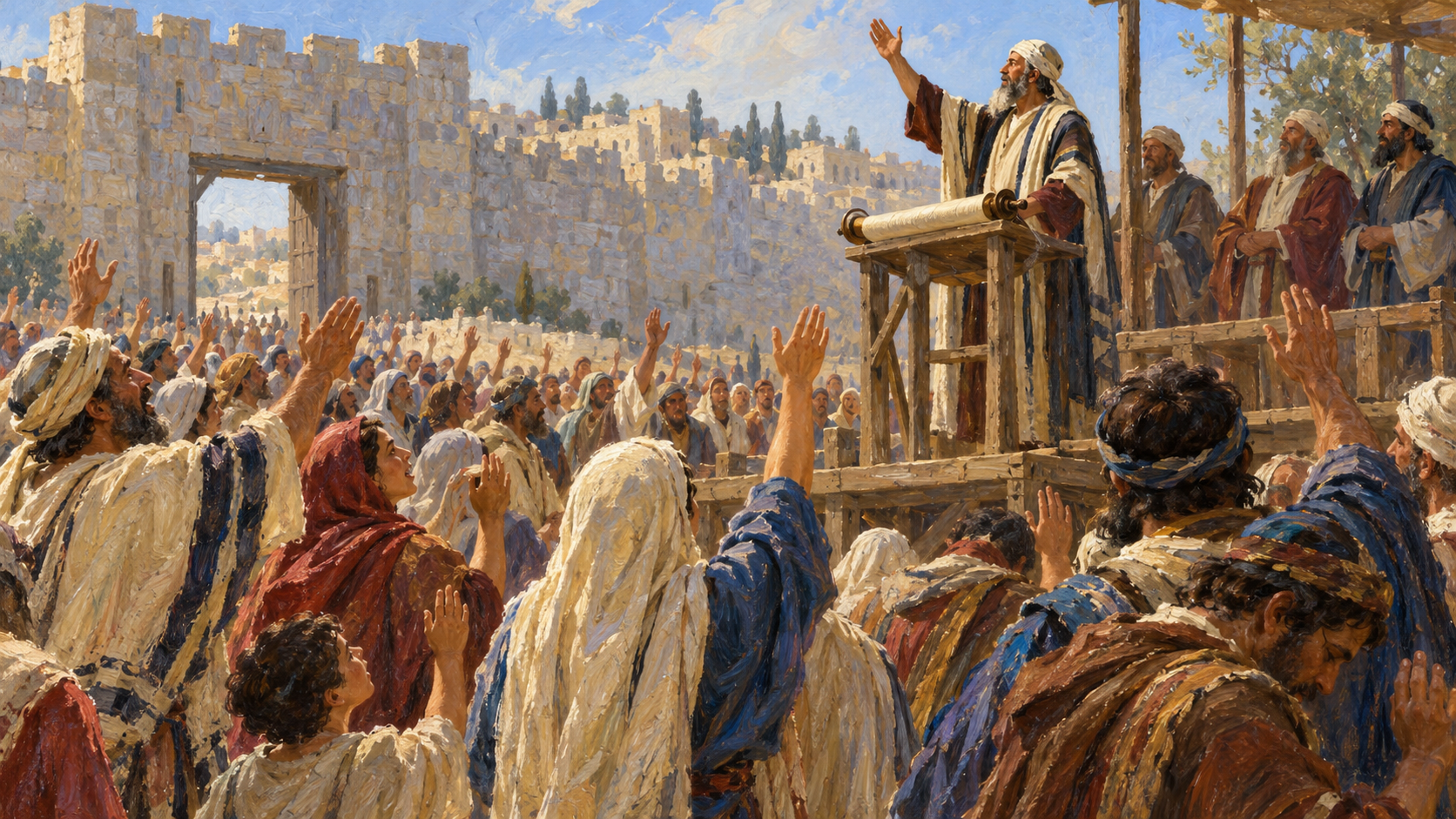
Nehemiah 8 describes people gathering in the open square and asking Ezra to bring the Law. At the beginning of a reading that lasted from morning until midday, he opened the Book and the people stood. He then blessed God, and they responded:
And Ezra blessed the LORD, the great God.
Then all the people answered, “Amen, Amen!” while lifting up their hands.
And they bowed their heads and worshiped the LORD with their faces to the ground.
Their audible response, raised hands, and bowed faces were directed toward the LORD whose Word they had gathered to hear. The following verses describe the Levites explaining the law so the people could understand it. Wholehearted worship and careful explanation belonged together.
Scripture gives us good reason to answer Amen aloud. Revelation also describes heavenly worship in which living creatures and elders, angels and redeemed people affirm praise to God and the Lamb. Yet no leader has authority to measure spiritual health by volume or shame quiet hearers into a performance. A verbal response may encourage the congregation, while solemn attention may also express genuine faith. Neither sound nor silence establishes holiness by itself.
Paul’s correction in 1 Corinthians 14 makes understanding essential to participation. Gifts must serve edification, which means building up the church. Impressive speech cannot do that if the hearers do not know what is being said:
Otherwise, if you bless with the spirit, how will he who occupies the place of the uninformed say “Amen” at your giving of thanks, since he does not understand what you say?
Paul expected the listener to be able to join the thanksgiving honestly. An emotional atmosphere cannot supply the meaning of words left unexplained. People need to understand preaching and public prayer well enough to test them by Scripture. The same applies to testimony and song, and to every claimed spiritual message. Insider vocabulary or untranslated language can leave people unable to follow. Hurried speech and repeated prompts may stir a response without explaining what they are being asked to affirm.
As a listener, I am responsible for my agreement too. I need to hear the actual claim, examine quotations in context, and consider whether a prayer asks for something righteous. A speaker’s rhythm cannot decide that for me. Withholding agreement from error does not dishonor God. We may need to remain quiet while we examine the passage, ask a careful question, or reject a false statement plainly.
Jeremiah 28 shows why an appealing message still needed testing. Hananiah promised that Babylon’s yoke would soon break and that the temple vessels and captives would return. Jeremiah wanted that restoration and answered, “Amen! The LORD do so” (Jeremiah 28:6). He then explained that a prophet of peace would be recognized when the announced word came to pass. Jeremiah’s desire for restoration did not authenticate Hananiah. Later in the chapter, God exposed the prophecy as false and judged the man who delivered it.
I can want a message to be true without having grounds to believe it. The New Testament therefore tells believers to test spirits and judge prophecy, holding to what is good. The Holy Spirit is a divine Person who continues to give gifts, but a claim to spiritual origin does not put a message beyond Scripture’s scrutiny. Teaching must agree with the Trinity and with Christ’s full deity and humanity. It must also preserve salvation by grace through faith. Any teaching that excuses sin or places a leader above accountability contradicts that standard.
Discernment need not turn into suspicion of everything. We can receive faithful teaching joyfully because we understand why we agree. I can agree with an accurate sentence from a flawed teacher without approving his whole ministry. Disliking someone does not make his correct quotation false, though character and qualifications still require attention. If I agreed too quickly with an unbiblical claim, I should correct my words rather than defend a mistake for pride’s sake.
Jesus Speaks as the Amen
Jesus used Amen in an unusual position. Instead of responding to another person’s words, He placed it before His own declarations. The Synoptic Gospels (Matthew, Mark, and Luke) often record a single Amen, translated “assuredly” in the NKJV. John characteristically records the doubled form, “most assuredly.” Jesus was solemnly affirming the reliability of what He Himself would say.
John 3:3 begins amen amen lego soi, literally, “Amen, amen, I say to you.” The Hebrew word was carried into Greek by transliteration, retaining its sound. Jesus used it when teaching about new birth and the kingdom, and also about judgment and resurrection. It introduces teaching about discipleship, His relationship with the Father, and future events as well. He spoke with the authority of the eternal Son who knows the Father and reveals Him truthfully.
Nicodemus, a Pharisee and Jewish ruler, recognized from Jesus’ signs that He was a teacher sent by God. Jesus addressed the need that education and religious standing could not meet:
Jesus answered and said to him, “Most assuredly, I say to you, unless one is born again, he cannot see the kingdom of God.”
Ancestry and morality cannot give a sinner entrance to the kingdom. Nor can ministry, ritual, or familiarity with religious vocabulary. The Holy Spirit must give new life. Jesus went on to explain His coming death by comparing His being lifted up with Moses lifting the bronze serpent in the wilderness. Whoever believes in the Son receives eternal life. Saying Amen to facts about Him cannot take the place of trusting the crucified and risen Savior.
New birth gives our response a deeper basis than familiarity with Christian language. The Spirit indwells believers and renews their thinking through Scripture, teaching them to love what God calls true and good. That growth follows new life. It is not a way to earn it by conforming to the congregation.
Paul likewise grounds God’s promises in Christ rather than in a technique of affirmation. In 2 Corinthians 1, a change in his travel plans had given critics a reason to accuse him of being both Yes and No. He answered by pointing to the faithful Son whom he, Silvanus, and Timothy had preached. Their gospel had not announced a wavering Christ:
For all the promises of God in Him are Yes, and in Him Amen, to the glory of God through us.
God’s own promises find confirmation and fulfillment in His Son. His saving purpose and covenant faithfulness rest in Christ, as do the kingdom and blessings He has promised. Paul adds “to the glory of God through us,” keeping the apostolic witness and the believers’ response in view. That confession glorifies God. It neither creates the promise nor supplies the power to fulfill it.
The following verses say that God establishes believers in Christ, anoints and seals them, and gives the Spirit as a guarantee. Their security rests in what He has done, rather than the force of a verbal response. This is reason for assurance without pretending every personal hope is a divine promise.
A command, a recorded event, and a promise are not interchangeable. We need to identify who was addressed and in what covenant and historical setting. A promise to Israel, an apostle, or a particular king does not automatically predict the same event in my life. We can learn and apply the truth without erasing those distinctions.
Christ’s faithfulness also includes correcting people who misunderstand their own condition. In Revelation, He introduces Himself as the Amen when addressing the Laodiceans. They considered themselves wealthy and without need, while He declared them wretched, miserable, poor, blind, and naked. Before delivering that verdict, He identified Himself:
“And to the angel of the church of the Laodiceans write,
‘These things says the Amen, the Faithful and True Witness, the Beginning of the creation of God:
The Amen is completely reliable. As the Faithful and True Witness, Jesus cannot give mistaken testimony through ignorance or distort it through fear, self-interest, or pressure. The Laodiceans needed His judgment to correct their own; their resources could not make His verdict mistaken. Jesus also said, “As many as I love, I rebuke and chasten” (Revelation 3:19). His truthful rebuke called for zealous repentance while offering fellowship.
Some who deny His deity claim that “the Beginning of the creation of God” makes Him the first created being. The Greek arche can refer to beginning, source, origin, or rule, but a list of possible meanings cannot settle the passage. John 1:1-3 says the Word already existed in the beginning, was with God, and was God. Everything made came into existence through Him. He cannot be one of the things He made.
Colossians 1:16-17 likewise identifies Him as Creator of everything in heaven and earth, visible and invisible, including every power and dominion. All was made through Him and for Him, so creation belongs to Him and exists for His purposes. He precedes it and holds it together. Revelation calls Him the First and the Last and describes Him as the One who died and lives forevermore. He searches minds and hearts, and the Lamb rightly receives worship with the One on the throne, while a created angel refuses it.
I therefore understand arche here as identifying the origin and source of creation, with His rule or place as first cause also in view. The exact English nuance can be discussed, but “first creature” cannot fit the wider testimony of Scripture. The Son’s incarnation was His taking human nature, not the beginning of His existence. He remains fully God and became fully man. Because He is the divine Savior, He can reveal the Father perfectly, bear the sins of the whole world, and give eternal life. Those are not the works of a created helper. The study on the Deity of Jesus examines that testimony more fully.
At Revelation’s close, John answers Jesus’ promise to come quickly with “Amen. Even so, come, Lord Jesus!” (Revelation 22:20). The hope is secure because of the One who promised. He needs no congregation’s agreement to make His words true, but we have reason to receive them with confidence.
Prayer Trusts God Without Trying to Control Him
Amen naturally fits the close of prayer. The received text of Matthew 6:13 concludes the Lord’s Prayer with “For Yours is the kingdom and the power and the glory forever. Amen.” Many other biblical prayers and doxologies also close this way. We mean the prayer we have offered and entrust it to the Father through the Son, helped by the Spirit.
The Lord’s Prayer teaches us what that agreement includes. We honor the Father’s name and seek His kingdom and will, depending on Him for daily bread. Asking for forgiveness belongs with a willingness to forgive others. We also depend on Him against temptation and evil. The closing doxology recognizes His kingdom, power, and glory; it does not transfer control of those things to the person praying.
In 1 John 5:14, confidence rests in asking according to God’s will. Jesus voiced His desire in Gethsemane while submitting to the Father. We may ask specifically for healing or marriage, for a child or needed employment. Reconciliation, protection, and relief can also be proper requests without being promised outcomes. Wanting an answer deeply does not authorize us to announce that God guaranteed it.
Paul asked three times for his thorn to depart and received Christ’s promise of sufficient grace while the weakness remained. God may grant, withhold, delay, or answer in an unexpected form. The unmet request does not establish His unfaithfulness or a failure to say Amen confidently enough. Believers can grieve, ask questions, and continue trusting without pretending pain is pleasant.
Praying in Jesus’ name means approaching through His mediation and under His authority, in keeping with His character and will. Adding His name to a selfish or sinful request cannot make it righteous. A sincere Amen may express, “Father, this is truly my prayer. I ask through Your Son, trust Your character, submit the answer to Your wisdom, and desire Your name to receive glory.” A Complete Bible Study on Prayer develops that dependence.
Prosperity teaching often treats our desires as promises God has made. A speaker may guarantee health or wealth, promotion or immediate deliverance, then ask people to “claim it” with Amen. That pressures listeners to mistake hesitation for unbelief. God can provide all those gifts, but His servants have also endured imprisonment and sickness. They have faced material need and persecution, and some have suffered martyrdom. Their suffering was not proof of deficient faith.
Our words communicate truth or falsehood. We use them to bless or accuse, make promises, and express prayer. They are not an impersonal energy that rearranges reality independently of God. Amen cannot cleanse false doctrine or make it right to place another mediator beside Christ. It cannot excuse manipulation either. Nor can it confer salvation any more than walking an aisle, signing a card, or answering a speaker on cue. Words may express personal faith, but they cannot replace it.
The Gospel Gives Our Amen Its Foundation
Christ’s title, the Amen, directs our trust to Him personally. Agreement with facts about Him cannot take the place of reconciliation to the God of truth. Better language and moral reform cannot remove a sinner’s guilt. Neither can ritual or knowledge, church activity or emotional responses.
The eternal Son through whom creation exists was born of a virgin and lived without sin. He willingly gave Himself to be slain as the perfect sacrifice for our sins, enduring the bodily violence wicked people inflicted on Him. His saving work through His shed blood and death was complete before His burial and bodily resurrection. The Father did not punish, curse, or abandon His Son. Father, Son, and Holy Spirit remained united in their saving purpose. His atonement was real, not an appearance or a vague symbol.
Christ died for the whole world, and God’s offer of salvation is genuine even though people may resist it. Everyone who turns to Christ in repentance and faith receives forgiveness and eternal life as a gift, never as wages earned by works. God justifies the believer, declaring him righteous, and gives new birth. The Spirit indwells and seals that person, making salvation eternally secure.
A person can know correct facts and still refuse to entrust himself to Christ. Even demons possess facts about God without saving faith. Saying Amen may accompany trust, but it cannot save apart from the Savior. A Bible Study on How Jesus Is Truth considers the One on whom our confidence rests.
For someone genuinely born again, obedience and repentance belong to the new life. They neither earn nor keep his place in God’s family. The Spirit produces fruit, and God disciplines His children; eternal security gives no permission for lawlessness. Assurance rests in Christ’s blood, promise, and priesthood, together with the Spirit’s seal. It does not depend on a remembered level of emotion.
I can therefore say Amen freely when I understand that the content agrees with Scripture. An audible response can encourage worship and faithful teaching, while quietness gives no superior standing. If something is unclear or wrong, I should examine it and raise a respectful question where needed. Truth is better served by correcting an error than protecting my reputation for having agreed.
Agreement also calls for action. If I affirm God’s holiness while preserving access to secret sin, that access needs to be removed. If I affirm restitution, I should repay what I owe. In prayer, I can distinguish Scripture’s actual promise from my personal request and speak honestly about both. God remains true when I am mistaken, and His faithfulness gives me reason to receive correction.
My Final Thoughts
I want to say Amen with understanding because I am affirming something before the God of truth. The word cannot make my desire a promise, excuse disobedience, or give me power over Him. Christ is the Amen: His words are reliable, His saving work is sufficient, and His return is certain. We can join in worship and pray boldly because we trust Him, leaving the answer to His wisdom and bringing our conduct under the truth we affirm.