
God’s names are often gathered into charts, but a chart can make very different biblical expressions look identical. Some passages give His covenant name, while others name a place, altar, or city after He acts. I want to read each expression in its own setting so that our worship rests on what God actually revealed.
The Covenant Name at the Burning Bush
God does not ask us to trust an unknown power. He speaks and acts in history so people can know Him. He keeps His promises, judges evil, and saves sinners. His names are not labels invented to make religion easier. They belong to His own self-revelation.
This is why we must begin with Scripture rather than a popular list. Some expressions are direct statements from God. Others name an altar, place, or city after the LORD acted there. “LORD of hosts” appears again and again as a title. A later devotional label may combine genuine Hebrew words in a convenient form that the verse itself never uses. Accuracy does not make these truths less precious. It lets us hear each passage on its own terms instead of pretending every familiar English hyphen marks the same grammatical form.
I think this is an important distinction because it also protects our worship. A list can turn into slogans detached from their context. People may speak as if saying Jehovah-Jireh produces money or Jehovah-Rapha guarantees health. Jehovah-Nissi can then be used to promise success for a human project. Scripture gives us no such method. These names reveal the sovereign Lord and call us to reverent faith, repentance, and obedience.
A name in Scripture is more than a sound, but that does not make the words unimportant. Names identify persons and can reveal character, authority, or remembered action. When God explains His name, the explanation belongs to the passage He inspired. We should therefore resist two opposite mistakes. One treats the Hebrew syllables like a spiritual password; the other treats every detail as interchangeable because all the expressions refer to God. Careful reading honors both the one LORD and the particular truth He chose to reveal in each place.
The English word Jehovah is not a translation of a sentence such as “the LORD will provide.” It is a received representation of the covenant name YHWH. Forms such as Jehovah-Jireh join that representation to another Hebrew word or phrase for convenient study. They can help memory when we understand what they are doing. They become misleading when the convenient label is treated as though it appears in precisely that form throughout the Hebrew Bible.
The one God revealed by these names is the triune God. The Father is God. The Son and Holy Spirit are God, yet there is only one God rather than three. The names do not divide His character into separate powers. The God who provides is holy, and the One who heals is also Judge. The God of peace remains the LORD of hosts. Every attribute belongs perfectly and eternally to the one living God.
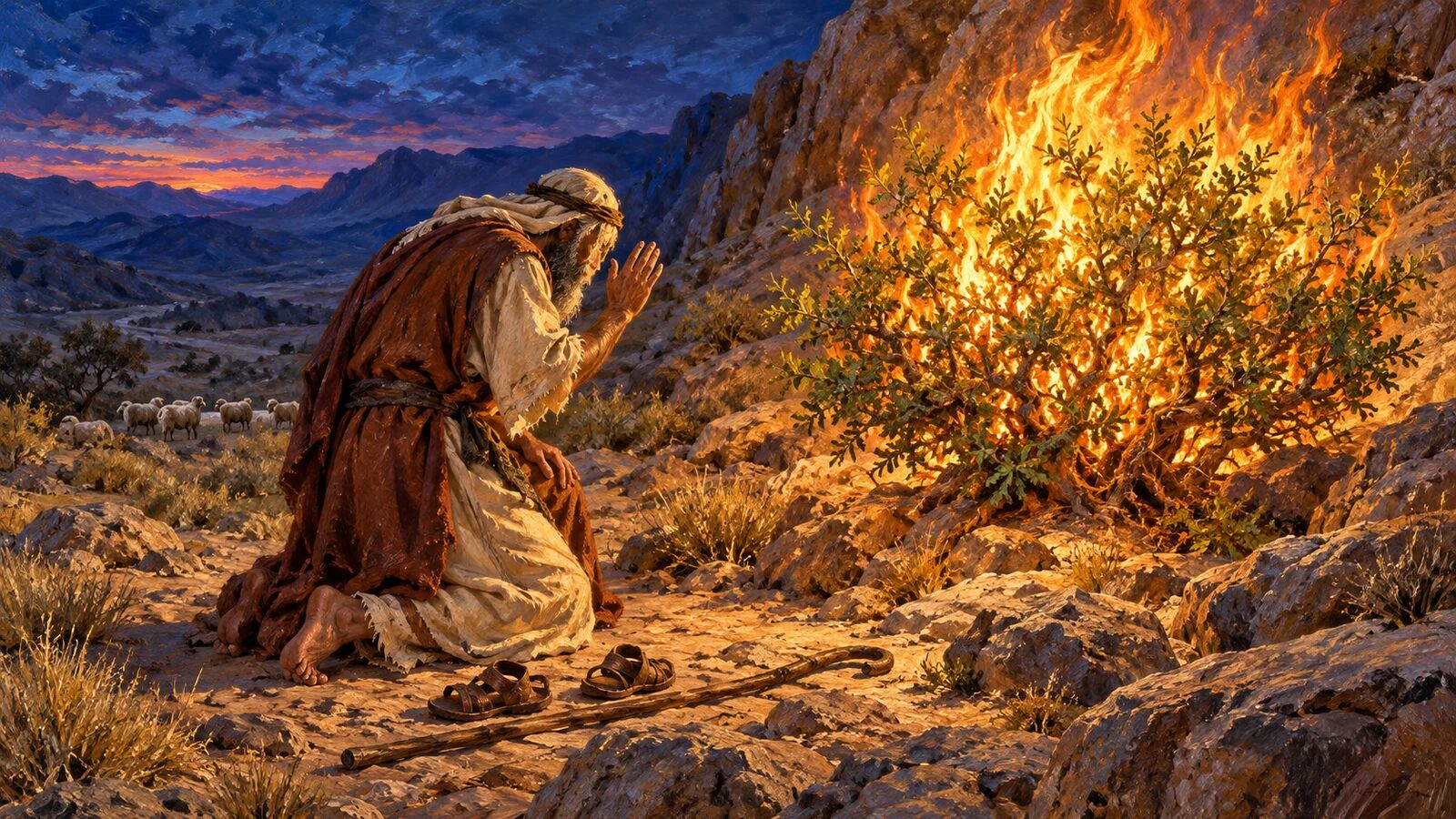
Exodus 3 gives us the foundation. Israel is enslaved in Egypt, and Moses has spent years in Midian after trying to deliver an Israelite in his own strength. At Horeb, the Angel of the LORD appears in the flame of a bush. The account then says God speaks from within it and identifies the speaker as the LORD. This distinctive Angel is not an ordinary created messenger. He speaks as God because He bears the divine identity. He is the preincarnate Christ.
Moses expects the Israelites to ask which God sent him. That question makes sense in Egypt, where many named deities were worshiped. It also asks whether the God of their fathers is now acting to keep His covenant. God first answers with the first-person declaration “I AM WHO I AM.” He then gives the covenant name represented by the four Hebrew consonants YHWH. The NKJV follows the long English practice of printing that name as “LORD” in capitals, helping readers distinguish it from the ordinary title Lord.
And God said to Moses, “I AM WHO I AM.” And He said, “Thus you shall say to the children of Israel, ‘I AM has sent me to you.'” Moreover God said to Moses, “Thus you shall say to the children of Israel: ‘The LORD God of your fathers, the God of Abraham, the God of Isaac, and the God of Jacob, has sent me to you. This is My name forever, and this is My memorial to all generations.’
The two expressions are connected, but they are not the same grammatical form. Ehyeh is the first-person expression “I am” or “I will be.” YHWH is the covenant name given in the next verse. Together, they connect God’s name with His self-existence and faithful presence. Moses depends on something outside himself, as do Pharaoh, Egypt, and Israel. The LORD depends upon no one. He simply is, and the promised rescue stands because He will be with Moses.
Unforsaken uses “Jehovah,” the established English form carried in received Christian usage. The consonants YHWH are certain in the Masoretic text, but the exact ancient vowels cannot be proved from those four consonants alone. “Yahweh” is a scholarly reconstruction. That reconstruction is not a reason to discard the received English form or speak as if every question has been settled. We can use Jehovah confidently without claiming more than the textual evidence proves.
Exodus 6 may initially sound as if Abraham, Isaac, and Jacob had never heard the covenant name. Genesis repeatedly uses the name and says that the patriarchs called upon it, so the statement must be read in its covenant setting. The patriarchs knew the LORD who promised, but they did not live to see the national deliverance through which this generation would know His name in public fulfillment.
The LORD was about to answer Egyptian power with judgment. He would bring Israel out with an outstretched arm, claim the people as His own, and lead them toward the land promised to their fathers. They would know more than a pronunciation. They would experience the covenant faithfulness identified by the name.
Readers who want to examine Exodus 3 and its connection with Jesus more closely can continue with The Name of God Jehovah: I Am Who I Am. For this study, the burning bush gives us the starting point for every later expression: one self-existent, covenant-keeping LORD reveals His character through what He says and does.
Before moving through the familiar forms, the simple rule I want to follow is to read the grammar and the story together. We should ask what the passage actually names. Genesis 22 names a place, while Exodus 17 and Judges 6 name altars. Exodus 15 and 31 contain clauses in which the LORD describes what He does. Psalm 23 is David’s personal confession. Ezekiel 48 names a future city, and “LORD of hosts” is a recurring title. Each expression reveals God, but the inspired sentences do not all serve the same purpose.
The historical setting must stay in place too. God reveals Himself as provider while preserving the promised son through a substitute. He identifies Himself as healer while testing redeemed Israel at bitter water. He is Israel’s banner in a real battle with Amalek and sanctifies Israel in the setting of the Sabbath covenant sign. He speaks peace to Gideon before sending him against Midian. Once the setting is removed, the words can be made to promise almost anything.
Later Scripture must also be allowed to explain what came earlier. The ram provided for Isaac prepares us to recognize substitution, but Jesus is not merely one more animal sacrifice. He is God’s sinless Son and the Lamb of God. Psalm 23 grows clearer when Jesus calls Himself the Good Shepherd who lays down His life and takes it again. Jeremiah’s LORD our righteousness is the righteous Davidic King. These lines converge on Christ without erasing what each Old Testament passage meant in its own time.
Provider and Healer
Genesis 22 records one of Scripture’s most difficult tests. God commands Abraham to offer Isaac, the son through whom He explicitly promised the covenant line would continue. God is testing Abraham, not tempting him to evil, and the account prevents Isaac’s death. Other passages condemn human sacrifice as an abomination. Here the command brings Abraham to the point where obedience appears to make fulfillment impossible. The test reveals whether he trusts the Giver to remain faithful to His own promise.
Abraham tells Isaac that God will provide the lamb for Himself. At the decisive moment, the Angel of the LORD calls from heaven and stops Abraham. His obedience has shown that he fears God. Abraham then sees a ram caught by its horns. The wording is openly substitutionary because the animal is offered “instead of his son.”
Then Abraham lifted his eyes and looked, and there behind him was a ram caught in a thicket by its horns. So Abraham went and took the ram, and offered it up for a burnt offering instead of his son. And Abraham called the name of the place, The-LORD-Will-Provide; as it is said to this day, “In the Mount of the LORD it shall be provided.”
The Masoretic phrase is YHWH yireh. Its verb comes from raah, which means to see. In the story, the LORD sees to the need and supplies what His promise requires. Abraham names the place. He is not announcing a separate divine power called provision.
Jehovah-Jireh is often stretched into a promise of wealth, but Genesis 22 cannot carry that meaning. Abraham does not name the mountain after receiving luxury. God’s provision does not let him avoid obedience or fulfill a private dream. The LORD provides the substitute required by His covenant purpose.
The wider Bible assures us that the Father knows the needs of His children. It also prepares believers to endure hardship with contentment. Following Christ may require costly sacrifice and may bring persecution. God’s provision can be daily bread, wisdom for the next decision, grace in weakness, or help through other believers. It should never be reduced to financial increase on our terms.
The greatest provision is Jesus Christ, whom God willingly gave for us. Jesus came and physically bore the punishment for our sins in His innocent body. Wicked men subjected Him to real torture before He shed His blood and died. Unlike Isaac, Jesus was not released while another creature completed the offering. He was buried and rose bodily from the grave. Christ died for the whole world, and anyone who believes in Him receives eternal life.
The next familiar expression comes from Exodus 15. Israel begins the chapter singing after the LORD destroys Pharaoh’s pursuing army at the Red Sea. Three days later, the people reach Marah and find bitter water. Their praise quickly becomes complaint. Moses cries to the LORD, who shows him a tree. When it is cast into the water, the bitterness is removed. God then uses the crisis to instruct the nation He has redeemed.
and said, “If you diligently heed the voice of the LORD your God and do what is right in His sight, give ear to His commandments and keep all His statutes, I will put none of the diseases on you which I have brought on the Egyptians. For I am the LORD who heals you.”
The familiar label Jehovah-Rapha summarizes the final clause, but the Hebrew sentence describes the LORD as the One healing Israel. Its immediate audience is the nation recently redeemed from Egypt. The promised protection contrasts covenant obedience with diseases the LORD had brought upon Egypt in judgment. It is not a medical guarantee addressed without qualification to every person in every covenant.
God had already redeemed Israel before giving this test. Obedience was not the price of their Passover rescue, but the redeemed people were responsible to heed their Redeemer. Israel obeyed because the LORD had saved them, not in order to earn the rescue. Grace established the relationship before obedience became the fitting response.
This verse does not teach that every sickness comes from an identifiable personal sin. Job suffered even though Scripture calls him blameless and upright. Paul continued with an affliction after repeatedly praying for relief. Timothy had recurring stomach trouble, and Epaphroditus nearly died while serving Christ. The Bible tells believers to pray for healing because God truly heals. It never permits us to accuse every sick person of defective faith.
God may heal immediately or work through medicine and ordinary care. At other times He gives strength through a long recovery. Complete healing may not come until the resurrection. A truly born-again believer is secure in Christ, but eternal security does not promise a body free from suffering in this age. It promises that Christ will raise His people and finish their redemption. The final answer to sickness is not denial. It is resurrection life.
Provision and healing are therefore real, but God defines both gifts. We bring our needs to Him without using His name as a tool. Faith may receive an immediate answer, or it may be sustained through hardship. In either case, confidence rests in the LORD’s revealed character rather than in our ability to repeat a label.
Banner, Sanctifier, and Peace
Exodus 17 follows another crisis at Rephidim. Israel questions whether the LORD is really among them, and God provides water from the rock. Amalek then attacks. Deuteronomy later explains that Amalek struck the rear ranks and preyed on the tired and weary without fearing God.
Joshua chooses men and fights in the valley. Moses stands on the hill with the rod of God. Israel prevails while his hand is raised and loses ground when it drops. The rod and posture are signs directed by God, not magic. Aaron and Hur support Moses’ heavy hands until sunset while Joshua fights a real battle. God makes the source of victory clear without canceling human responsibility.
And Moses built an altar and called its name, The-LORD-Is-My-Banner;
YHWH nissi names the altar. Nes can mean a banner, standard, or raised signal, and the ending gives the sense “my banner.” The LORD Himself is the rallying point and commander. He supplies the help and receives the glory. The banner is not Moses, Joshua, the rod, or Israel’s courage.
This confession cannot be transferred to every modern campaign. A political party or nation cannot claim guaranteed success by using God’s name. The same is true of a business or ministry. The church does not fight against flesh and blood and has no authority to call unwanted people Amalek. Believers stand in the Lord’s strength by holding to truth and living in the righteousness He requires. The gospel prepares them to stand, faith rests in God’s salvation, and His Word supplies the sword. Prayer runs through the whole battle.
The detailed study Jehovah-Nissi: The LORD Is My Banner follows that battle and its later biblical connections more fully. Here we should keep the main distinction clear: God’s banner is a call to allegiance and dependence, not a guarantee that He will endorse our cause.
Exodus 31 places the next expression near the end of the tabernacle instructions and within Israel’s Sabbath command. The Sabbath was a covenant sign between the LORD and the children of Israel. It marked their national relationship with Him. God had already redeemed them from Egypt before commanding the sign, but Israel still had to order its work and weekly time under His authority.
“Speak also to the children of Israel, saying: ‘Surely My Sabbaths you shall keep, for it is a sign between Me and you throughout your generations, that you may know that I am the LORD who sanctifies you.
The expression sometimes written Jehovah-Mekoddishkem is a clause: the LORD who sanctifies you. The verb means to set apart as holy. The LORD claims a people for Himself, and their lives should reflect that they belong to Him. Leviticus 20:8 repeats the truth in a setting that joins God’s sanctifying work with Israel’s duty to keep His statutes.
The Sabbath sign cannot be imposed on the church as a requirement for salvation. Water baptism does not cause the new birth. Church attendance and moral reform cannot save either. Salvation is by grace through faith in Jesus Christ. Once a person truly believes, the Holy Spirit comes to dwell within and seal that believer. The Christian has been set apart in Christ and begins a lifelong growth in practical holiness.
Grace does not make sin harmless. The God who sanctifies uses Scripture and prayer to conform believers to Christ. He works through fellowship and loving discipline too. Suffering can deepen this growth when a Christian responds with active obedience. Eternal security never permits peace with rebellion. When a believer sins, he confesses it and returns to the light while trusting Christ as his Advocate.
The related study on Sanctification examines the difference between being set apart in Christ and growing in daily holiness. The name in Exodus 31 protects both truths: the LORD claims His people, and the people He claims must live as those who belong to Him.
Judges 6 brings us to Jehovah-Shalom. Israel is under Midianite oppression because the nation has again done evil. The raids are so destructive that Israelites hide in dens and lose their produce. Gideon threshes wheat in a winepress, an awkward place chosen to hide the grain, when the Angel of the LORD appears and calls him a mighty man of valor. Gideon looks at his fearful circumstances and asks why this suffering has come if the LORD is with Israel.
The account moves freely between the Angel of the LORD speaking and the LORD speaking. The Angel receives Gideon’s offering with supernatural fire and disappears. An ordinary created messenger could not rightly receive that response. This is another Christophany, an appearance of the eternal Son before Bethlehem.
Gideon realizes he has seen the Angel of the LORD face to face and fears he will die. The LORD answers that fear before the Midianite threat has been removed. Peace begins with Gideon’s safe standing before the holy God.
Then the LORD said to him, “Peace be with you; do not fear, you shall not die.” So Gideon built an altar there to the LORD, and called it The-LORD-Is-Peace. To this day it is still in Ophrah of the Abiezrites.
YHWH shalom names Gideon’s altar. Shalom can refer to peace, welfare, wholeness, or things being set right. In this scene, the LORD assures Gideon that he will live in His presence. Midian has not vanished, and Gideon still faces a costly command. Peace is not the absence of conflict.
The gospel establishes this peace at its deepest level. Sinners need more than a calm mood because we need peace with God. Jesus made that peace through the blood of His cross. Everyone justified by faith now has a settled standing before God. From that reconciliation, believers learn to bring anxiety to the Father. God’s peace guards heart and mind while Christians pursue peace without compromising truth.
A sentimental use of Jehovah-Shalom misses the scene. Peace does not give permission to avoid truth or ignore sin, and it does not guarantee calm circumstances. Gideon received peace before entering a dangerous assignment. Christian peace rests first on reconciliation through Christ, then steadies obedience within a troubled world.
Righteousness, Shepherd, and LORD of Hosts
Jeremiah speaks the name Jehovah-Tsidkenu while Judah is collapsing under unfaithful rulers. The shepherds of the nation have scattered the flock, but the LORD promises to gather His people and raise up a righteous King from David’s line. The answer is not a better slogan or a temporary reform. God Himself will provide the King and the righteousness His people need.
“Behold, the days are coming,” says the LORD, “That I will raise to David a Branch of righteousness; A King shall reign and prosper, And execute judgment and righteousness in the earth. In His days Judah will be saved, And Israel will dwell safely; Now this is His name by which He will be called: THE LORD OUR RIGHTEOUSNESS.
YHWH tsidqenu means the LORD our righteousness. Here it is the name given to the promised Branch, the King descended from David. Jeremiah therefore does more than say that God acts righteously. The coming King bears a divine name and rules with the justice that Judah’s failed kings lacked. Jesus Christ fulfills this promise. He is David’s Son according to the flesh and David’s Lord according to His divine nature.
We cannot build the righteousness God requires by collecting religious works. All have sinned. Even our best deeds cannot erase guilt already committed or make an unclean heart pure. Jesus lived without sin, then willingly shed His blood and died under the judgment sinners deserved. He rose bodily from the grave. The person who believes in Him is justified, which means God declares that believer righteous on the basis of Christ rather than personal merit.
This truth is sometimes described as Christ’s righteousness being counted to us. It is not a claim that faith becomes a meritorious work. Faith receives the Savior God offers. Nor does justification pretend that sin never happened. The cross shows how seriously God judges sin, while the resurrection shows that Christ’s payment was accepted. Because our standing rests on Him, a believer can have assurance without boasting.
Jeremiah’s prophecy must not be reduced to the church alone. It names Judah and Israel and describes safety under the Davidic King on the earth. Jesus will return bodily, restore Israel, judge in righteousness, and reign. The same Messiah who justifies every believer will keep the national promises God made. Grace to the church does not cancel His faithfulness to Israel.
Psalm 23 gives another beloved expression: the LORD is my shepherd. This is a confession about the LORD rather than a formal compound name assigned to a place. David knew both sides of the picture. He had cared for sheep, and he knew that he himself depended on God’s direction, provision, correction, and protection.
The LORD is my shepherd; I shall not want. He makes me to lie down in green pastures; He leads me beside the still waters. He restores my soul; He leads me in the paths of righteousness For His name’s sake.
The promise that David will not want does not mean he will possess everything desire can imagine. A shepherd supplies what the sheep truly need and leads them where they could not safely lead themselves. Rest, water, restoration, and right paths all come from the Shepherd’s care. Even the valley later in the psalm is not removed from the route. The Shepherd stays with His sheep through it.
Jesus identifies Himself as the Good Shepherd in John 10. He is not merely imitating the LORD’s care from a distance. He lays down His life for the sheep, takes it up again, knows His own personally, and gives them eternal life. His words join the Shepherd of Psalm 23 with the Son who came in the flesh.
My sheep hear My voice, and I know them, and they follow Me. And I give them eternal life, and they shall never perish; neither shall anyone snatch them out of My hand.
The life Jesus gives is eternal, not temporary life kept only by human strength. No enemy can remove a true believer from His hand. The next verse adds the Father’s hand, and Jesus concludes, “I and My Father are one.” This security does not turn following into an empty detail. Christ’s sheep hear Him and follow Him because they belong to Him, yet their final safety rests on the Shepherd who keeps them.
Another biblical title is the LORD of hosts, often represented by YHWH Sabaoth. The word hosts speaks of organized multitudes or armies. Depending on the setting, it may bring heavenly beings, the stars, or earthly forces into view. The title presents the LORD as Commander over powers no creature can finally resist.
Hannah uses this title in 1 Samuel 1 while praying in deep grief for a son. Her circumstances show that the LORD of hosts is not only a battlefield expression. She appeals to the sovereign God who sees one afflicted woman. Later, David confronts Goliath in the name of the LORD of hosts, the God of the armies of Israel. David’s confidence is not in his size or equipment but in the living God whom the giant has defied.
Isaiah’s vision makes the title still larger. The seraphim cry that the LORD of hosts is holy and that the whole earth is full of His glory. He commands heaven and rules the nations, yet His power is never detached from holiness. No human ruler can recruit this title to bless aggression, and no Christian may use it to make personal anger sound sacred. God alone defines His cause and exercises perfect judgment.
When I place these expressions beside one another, I see the LORD meeting needs we cannot meet for ourselves. He supplies righteousness to the guilty, shepherds the helpless, and commands every host. These expressions do not divide Him into separate powers. The righteous King is also the caring Shepherd, and the tender Shepherd is still the holy Sovereign before whom every power must answer.
The LORD Is There, Jealous, Redeemer, and Savior
Ezekiel closes his prophecy with the land restored to Israel and divided among the tribes. He carefully measures a city and describes a temple where the LORD dwells among His people. After earlier visions of God’s glory departing because of Israel’s sin, this ending carries enormous weight. The expression often called Jehovah-Shammah belongs to the city in that future order.
All the way around shall be eighteen thousand cubits; and the name of the city from that day shall be: THE LORD IS THERE.”
YHWH shammah means the LORD is there. The text calls it the name of the city, not a new personal name that replaces YHWH. Its glory lies in what the name announces. The God whose presence had departed returns to dwell with the restored nation.
The details around this promise should not dissolve into a vague feeling that God is nearby. Ezekiel describes Israel’s land, tribes, priesthood, city, and sanctuary. Jesus will return bodily and establish His kingdom on the earth. Revelation 20 places His reign within a literal thousand years. Israel will know the promised restoration under her Messiah, and the nations will see His righteous government.
Ezekiel also speaks of sacrifices in that kingdom. They cannot repeat or add to Christ’s finished sacrifice, because Hebrews is clear that He offered one sacrifice for sins forever. These future offerings function as memorials within the restored order, looking back to the blood He shed just as the Lord’s Supper now proclaims His death. Their presence does not compete with the cross; it displays the faithfulness of the One who fulfilled every shadow.
The millennial kingdom is not the final state. After the last rebellion and judgment, God creates a new heaven and new earth. The New Jerusalem comes down, and the dwelling place of God is with redeemed humanity forever. Ezekiel’s city promise therefore has a real future setting and also points our hope toward the day when separation from God’s presence is gone for good.
Exodus 34 reveals a different expression that modern readers can easily misunderstand. Israel has just broken covenant by worshiping the golden calf. As the LORD renews covenant terms, He commands the nation not to make agreements that draw it into idolatry. His jealousy appears in the demand for exclusive worship.
(for you shall worship no other god, for the LORD, whose name is Jealous, is a jealous God),
The Hebrew word qanna describes the LORD’s holy jealousy. Human jealousy often grows from insecurity, envy, or a desire to possess what belongs to someone else. None of those weaknesses exists in God. Everything belongs to Him, and He alone is worthy of worship. His jealousy is the righteous protection of a covenant relationship and the refusal to share His glory with an idol.
This warning still reaches the heart even when no carved image is present. Money becomes an idol when it rules our trust and decisions. Approval becomes one when we trade obedience for acceptance. Even good gifts such as family or ministry can occupy the place that belongs to God, while pleasure and personal control can quietly demand the same devotion. The jealous LORD is not petty when He exposes these rivals. He is calling His people away from lies that enslave and back to the only One who gives life.
Scripture also repeatedly calls the LORD Redeemer. The Hebrew idea of a goel is a kinsman-redeemer, someone with the right and responsibility to recover what has been lost, defend a family member, or restore an inheritance. God applies that family language to His rescue of Israel. Isaiah especially joins the title with the Holy One of Israel and the LORD of hosts.
Jesus fulfills redemption at the deepest level by taking on true humanity. He became our near kinsman without ceasing to be God. No sinner could pay for another sinner, but the sinless Son gave His own blood as the price of release. Redemption includes forgiveness now, freedom from sin’s dominion, and the future redemption of the body at the resurrection.
The LORD is also called the Most High, translating El Elyon. The title declares that no ruler, spirit, or supposed god stands above Him. Genesis 14 uses it when Melchizedek blesses Abram in the name of God Most High, Possessor of heaven and earth. Abram identifies that Most High God with the LORD. The titles do not introduce rival deities; they describe the one true God.
Savior is another true and recurring title. The Hebrew verb yasha means to save or deliver, and biblical names sometimes grow from that root. Yet we should be careful when a devotional list turns every true statement into a fixed Hebrew compound. The Bible plainly teaches that the LORD saves even where it does not present a formal name such as “Jehovah-Savior.” The truth needs no invented label to make it precious.
God’s saving work has both historical and eternal dimensions. He rescued Israel from Egypt and repeatedly delivered the nation from enemies. Those acts reveal His power and faithfulness, but the greatest need is rescue from sin and judgment. The Father sent the Son as the Savior of the world, and the Holy Spirit gives life to those who believe. There is one Savior and one divine work of salvation, carried out by the distinct persons of the Trinity.
The Divine Name and Jesus Christ
All these passages finally press us toward the identity of Jesus. The Bible does not teach that the Father, Son, and Holy Spirit are three gods or three forms worn by one person. There is one God who eternally exists as three distinct persons. The Father is not the Son, the Son is not the Spirit, and the Spirit is not the Father. Yet each is fully divine and shares the one undivided being of God.
The Old Testament prepares for this truth without spelling out the later doctrinal vocabulary. The Angel of the LORD speaks as God, bears God’s authority, and receives the response due to God, while He is also sent and distinguished from the LORD. We saw this at the burning bush and in Gideon’s encounter. These appearances make sense when understood as Christophanies, visible appearances of the eternal Son before He took human nature in Mary’s womb.
The incarnation is different from a temporary appearance. Jesus was conceived by the Holy Spirit and born of the virgin Mary. The eternal Son truly became man while remaining fully God. He did not merely look human, and He did not surrender His deity. His two natures are united in one person without mixture or change.
Jesus draws directly on the language of Exodus 3 during His dispute with religious leaders in John 8. Abraham had lived centuries earlier, yet Jesus does not merely say that He was planned before Abraham. He speaks with the absolute expression that recalls the divine self-identification.
Jesus said to them, “Most assuredly, I say to you, before Abraham was, I AM.”
The response shows that His hearers understood the claim. They picked up stones to throw at Him. Jesus is not the Father, but He shares the divine identity. John makes the same truth plain by calling the Word God, saying that all things were made through Him, and then declaring that the Word became flesh.
Other names in this study converge on Him. The LORD who shepherds His people is revealed in Jesus the Good Shepherd. The LORD our righteousness is the Davidic Branch who reigns as King. The promised presence of God reaches us in Emmanuel, God with us, and will be displayed when Christ returns. The Redeemer became our kinsman. The Savior bears a personal name that announces the LORD saves.
This does not mean every Old Testament name can be assigned carelessly to Jesus while ignoring the Father and Spirit. The persons remain distinct, and the context of each passage still governs its meaning. It does mean that the Son is not a lesser created helper standing outside the identity of the LORD. He shares the one divine nature and reveals the Father perfectly.
That identity gives the gospel its saving weight. Wicked men tortured Jesus and nailed Him to a cross, but His death was not an accident or merely an example of courage. He willingly bore in His body the punishment sin deserves. He shed real blood and physically died. On the third day He rose bodily, leaving an actual tomb empty. The living Christ now offers salvation to every person.
The invitation is genuine, but it can be resisted. God does not pretend to offer life while secretly barring a willing sinner from Christ. Whoever believes in the Son has eternal life; whoever refuses remains under condemnation. Repentance is not a work that purchases salvation. It is the change of mind that turns from unbelief and receives Jesus for who He truly is.
At the moment of faith, the sinner is born again, justified, indwelt by the Holy Spirit, and sealed for the day of redemption. Those gifts are not earned in stages. They come through Christ’s finished work, and eternal life begins at once. Christian growth follows salvation. It never becomes the price that keeps the believer adopted.
The names of the LORD therefore cannot be used like verbal tools. Correct Hebrew pronunciation does not force God to act, and uncertainty about ancient vowel sounds does not prevent prayer. We approach the Father through the Son, depending on the Spirit, because God has opened the way. Faith rests on the God who revealed Himself, not on mastering a sound.
We also cannot select one favored attribute and push the rest aside. The Provider is still jealous for holy worship. The Healer is also the righteous Judge. The LORD of peace commands obedience, and the Shepherd is the sovereign LORD of hosts. God’s character is perfectly united. Every name must be read within the whole witness of Scripture.
That care protects us from familiar errors. We cannot turn Jehovah-Jireh into wealth on demand or make Jehovah-Rapha guarantee immediate physical healing. God’s banner does not place divine approval on our politics or private ambition. The LORD who sanctifies never teaches salvation by law keeping. We must also let Jehovah-Shammah retain Ezekiel’s real promises to Israel instead of reducing it to a general feeling.
A careful response is both thoughtful and personal. I can ask what the passage actually calls a name, what it calls an altar or city, and what it states as a title or covenant clause. Then I can trust the truth the passage reveals. When provision is uncertain, I remember the Father who already gave His Son. When illness remains, I pray for healing while resting in the promised resurrection. When guilt accuses, I look to the LORD our righteousness rather than my record.
The same care shapes worship. I do not need to flatten every expression into a matching list, but I should not lose the wonder behind the distinctions. The LORD meets His people as Provider and Healer, then calls them to holiness under His command. He gives peace, cares for His flock, and completes the redemption no human being could achieve. His names invite us to know His character through His Word rather than offering a shortcut around reading it.
My Final Thoughts
When I read these names in their own settings, I see one faithful God meeting real people in sin, fear, weakness, and need. I also see that every line leads me away from trusting a formula and toward trusting the LORD Himself, most clearly revealed in Jesus Christ. He is righteous enough to save me, strong enough to keep me, and near enough to shepherd me through what I cannot control. I want to honor His name by believing what He has actually said and walking with Him in grateful obedience.