
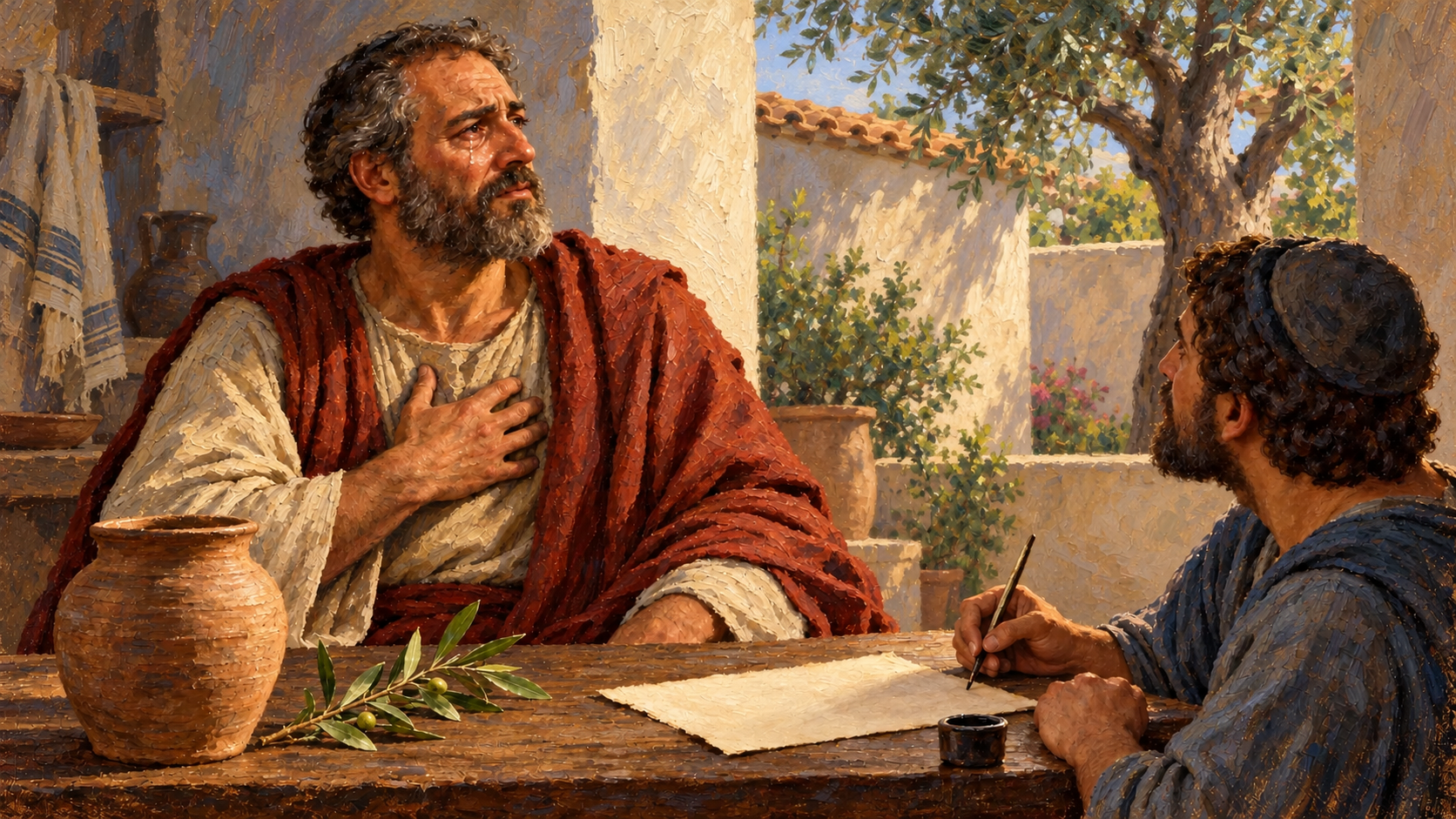
Romans 9 is often read as though Paul stopped his letter to explain an unconditional choice of certain individuals for salvation while passing over others. But what question is Paul actually answering, and why does he begin with such deep grief over Israel? I believe we have to follow his argument through Romans 10 and 11, along with the Old Testament passages he quotes, before deciding what election, mercy, and hardening mean here.
Paul’s Grief Frames the Question
Romans 8 has just celebrated the security of everyone who is in Christ. Nothing can separate believers from God’s love, and His saving purpose will reach glory. Paul then turns to a painful question. If God’s promises are secure, what should believers conclude when many Israelites who received the covenants are rejecting their Messiah?
Romans 9 through 11 answers that apparent contradiction without undoing Christian assurance or God’s promises to Israel. Paul is not writing as a detached philosopher. He writes as an apostle whose heart is breaking over his countrymen according to the flesh.
I find it helpful to keep three questions in view as we read the chapter. In each Old Testament example, what did God actually choose, and what conduct came before or accompanied the mercy and hardening Paul describes? We also need to follow the argument into Romans 10 and 11 to see how Paul speaks about faith and unbelief. Those chapters show us what he teaches about Jewish responsibility, Gentile inclusion, and Israel’s future. This approach allows Paul’s sources to define his words instead of letting a theological system supply the answer in advance.
Romans 9 cannot be interpreted responsibly by isolating one sentence from the rest. Paul reaches into Genesis for Isaac, Ishmael, Jacob, and Esau. Malachi supplies the later contrast between Israel and Edom. Exodus gives the settings for mercy after the golden calf and for Pharaoh’s hardening. Hosea and Isaiah explain Gentile inclusion, the remnant, and the stumbling stone. The discussion then continues without a break into the gospel call of Romans 10 and the olive-tree argument of Romans 11.
I tell the truth in Christ, I am not lying, my conscience also bearing me witness in the Holy Spirit, that I have great sorrow and continual grief in my heart. For I could wish that I myself were accursed from Christ for my brethren, my countrymen according to the flesh, who are Israelites, to whom pertain the adoption, the glory, the covenants, the giving of the law, the service of God, and the promises; of whom are the fathers and from whom, according to the flesh, Christ came, who is over all, the eternally blessed God. Amen.
Paul knows the Scriptures entrusted to Israel and understands the nation’s history. Its privileges carry real weight. Adoption describes Israel’s special national place in God’s plan, while the glory points to His presence among the people. God gave Israel the covenants and the law. He established the temple service and entrusted His promises to the nation descended from the patriarchs.
Above all, the Messiah came through Israel according to the flesh. Paul calls Christ the One who is over all, the eternally blessed God. Jesus truly shares Israel’s human ancestry, yet He is also fully divine. God’s promises reach their center in Him.
Israel’s national adoption did not mean that every Israelite was personally born again. God called the nation His son, delivered the people from Egypt, and dwelt among them. He also gave them a covenant calling before the nations. Those privileges made unbelief more tragic, not less serious. Paul can honor Israel’s real place in God’s plan while insisting that every person needs faith in Messiah.
Paul’s wish that he could be accursed for his brethren shows the depth of his sorrow. It does not mean he could actually become their substitute or that separation from Christ would purchase their salvation. Moses used similarly anguished words after the golden calf when he pleaded for Israel. Only the sinless Son could give Himself for the sins of the world. Paul’s impossible wish shows how earnestly he longs for his people to receive Christ.
Any reading that makes Paul sound smug has already missed the opening. His doctrine is not separated from tears. He is defending God’s faithfulness while grieving over people who possess great spiritual privilege and remain in grave danger.
The question appears plainly in verse 6. Israel received God’s promises, yet many Israelites were refusing Christ while Gentiles came to faith. Has God’s word failed?
But it is not that the word of God has taken no effect. For they are not all Israel who are of Israel,
This sentence is a key to the chapter. Paul does not say Israel has become meaningless. He says there has always been a distinction within Israel. Physical descent from Abraham brought real privilege, but it never guaranteed saving faith. A person could belong to Israel by ancestry and still refuse the God of Israel.
That distinction does not mean the church has replaced ethnic Israel. Paul continues to call his countrymen Israelites. In Romans 11 he asks whether God has cast away His people and then speaks about their future. Membership in the physical nation and participation in saving mercy are connected, but they are not the same thing. God’s promises to Israel stand, while unbelieving Israelites still need the gospel.
Paul had already made a similar distinction earlier in Romans. Outward circumcision alone did not define a faithful Jew, and Abraham was counted righteous through faith before he was circumcised. A rich religious heritage cannot take the place of personal faith. Neither ancestry nor covenant privilege can do that.
At the same time, this inward distinction does not empty the outward privileges of meaning. Israel truly received what Paul names, and Gentile believers should not rewrite that history as if the covenants had always belonged to the church. The nation can retain its place in God’s purpose while individual Israelites remain accountable to believe. Paul will hold both truths together all the way through Romans 11.
God’s word has therefore not failed when Israelites reject Christ. He never promised that every physical descendant would be saved because of bloodline. He promised to carry His covenant purpose forward, and He has done that through Christ.
The Promise Runs Through Isaac and Jacob
Paul first reaches back to Abraham’s sons. Ishmael was truly Abraham’s son, and Genesis shows that God cared for him. Even so, the covenant line through which Messiah would come did not run through Ishmael. It ran through Isaac, the son God had promised to Sarah.
nor are they all children because they are the seed of Abraham; but, “In Isaac your seed shall be called.” That is, those who are the children of the flesh, these are not the children of God; but the children of the promise are counted as the seed.
This does not mean God hated Ishmael or showed no concern for him. Abraham had tried to secure an heir through Hagar according to a human arrangement, but God said Sarah herself would bear the promised son. At the same time, He heard Ishmael and preserved his life. God promised to make a nation from him and remained attentive to Hagar’s distress.
Choosing Isaac for the covenant line does not tell us Ishmael’s eternal destiny. It certainly does not prove that God withheld every form of mercy from him. Paul’s point is narrower: God was free to appoint the promise line rather than allow human planning or natural birth order to control it.
This fits the wider biblical pattern in which a younger son receives the inheritance people expected to belong to the older. The related study on the younger receiving the inheritance traces that pattern from the early families of Scripture through the patriarchs and into David’s royal line. God repeatedly overturns inherited rank so that His promise cannot be treated as a human entitlement. The reversal removes boasting without removing personal responsibility.
The pattern is not limited to Isaac and Jacob. Abel is received before Cain despite being the younger brother. Joseph’s younger son Ephraim receives the greater blessing over Manasseh, and David is chosen from behind his older brothers. These men are not interchangeable examples of individual salvation. Their stories show God directing inheritance, covenant history, and royal calling without submitting His purpose to the rank that people expected birth order to provide.
Romans 9:11 uses the Greek word ekloge, which means choice or election. Knowing the word’s meaning does not yet tell us what God chose. The surrounding argument must answer that question. Here Paul explains God’s purpose in the promise line before anyone’s works could become the basis for that choice.
That brings Paul from Abraham’s sons to Rebekah’s twins. Before Jacob and Esau were born, God announced which line would carry the covenant purpose. Neither man’s works established that line.
(for the children not yet being born, nor having done any good or evil, that the purpose of God according to election might stand, not of works but of Him who calls), it was said to her, “The older shall serve the younger.”
Genesis gives us essential background for the sentence. God did not speak to Rebekah only about two isolated infants and their eternal destinies. He explicitly spoke about nations and peoples.
And the LORD said to her: “Two nations are in your womb, Two peoples shall be separated from your body; One people shall be stronger than the other, And the older shall serve the younger.”
Jacob and Esau were real men, so the prophecy was not irrelevant to their lives. What they chose still carried real moral weight. Esau truly sinned when he despised his birthright, and Jacob truly sinned through deception. Yet the prophecy Paul quotes is framed around two peoples and their historical roles as God directs covenant history.
The older serving the younger reversed normal expectation. Esau was the firstborn, but Jacob’s line carried the covenant promise. This was not because Jacob was morally superior. Genesis never presents him as a sinless hero. God kept His word through a flawed man so that the promise rested upon God’s call rather than human worthiness.
The later history confirms the national force of the prophecy. Genesis does not show Esau becoming Jacob’s lifelong servant. When the brothers meet again, Jacob actually bows before Esau. Centuries later, Edom came under Israel’s rule during David’s reign and eventually revolted from Judah. The older people serving the younger people unfolded through covenant history, just as God had announced to Rebekah.
Paul then quotes one of the chapter’s most disputed lines.
As it is written, “Jacob I have loved, but Esau I have hated.”
The words come from Malachi, who wrote centuries after Jacob and Esau had lived. I think that timing helps us understand whom the prophecy addresses. Malachi addressed Israel and contrasted that nation with Edom, the nation associated with Esau. Paul is not quoting words spoken over two newborn infants.
“Was not Esau Jacob’s brother?” Says the LORD. “Yet Jacob I have loved; But Esau I have hated, And laid waste his mountains and his heritage For the jackals of the wilderness.”
Malachi points to Edom’s desolation and its proud determination to rebuild while under judgment. The prophet calls its territory “the land of wickedness.” Obadiah gives more of that moral history. Edom acted violently against Jacob and gloated when disaster came. Its people even cooperated with invaders. God’s later judgment was not morally empty. It answered real historical rebellion.
We should not weaken the strong language of love and hate, but we should let Scripture show how such language can work. Jesus uses hate language in Luke 14:26 when He demands loyalty above every family relationship; He is not commanding sinful hostility toward parents. Genesis describes Leah as hated or unloved in comparison with Rachel while also showing God’s care for Leah. Context explains the contrast.
The Greek verbs in Romans 9:13 are egapesa and emisesa, from agapao and miseo. They can carry strong personal force. In this sentence, however, Paul quotes Malachi’s covenant-history contrast between Israel and Edom. The words describe covenant favor and rejection in that setting, not Esau’s unconditional personal condemnation before he had been born.
God freely chose Jacob’s line before the brothers had performed any works. Later, He judged Edom for actual wickedness. Those two truths must not be collapsed into one unexplained decree. Paul is showing that God remains free and faithful as He carries out His promise, not that He arbitrarily assigns eternal destinies without regard to faith or unbelief.
This distinction also explains why Malachi is such an important part of Paul’s reasoning. If Romans 9:13 were meant to describe God’s private eternal decision about two infants, the prophet’s later account of national history would be an odd place to prove it. Malachi instead looks back over God’s preservation of Jacob’s people and His judgment upon Edom. Paul uses that history because the question before him concerns Israel, covenant promise, and God’s faithfulness across generations.
Mercy and Hardening Do Not Erase Responsibility
Paul knows that his argument raises an objection. If God chose the promise line and showed covenant favor in this way, is He unrighteous? His answer is immediate: certainly not. God is the standard of righteousness and never violates His holy character.
What shall we say then? Is there unrighteousness with God? Certainly not! For He says to Moses, “I will have mercy on whomever I will have mercy, and I will have compassion on whomever I will have compassion.” So then it is not of him who wills, nor of him who runs, but of God who shows mercy.
The quotation comes from the aftermath of the golden calf. Israel had violated the covenant through idolatry while Moses was on the mountain. The people deserved judgment, but Moses pleaded for God’s presence to remain with them and asked to see His glory. God showed mercy and continued His covenant purpose without pretending their sin was harmless.
This background clarifies why mercy can never be demanded. If a person could claim it as payment, it would no longer be mercy. Romans 9 draws on compassion shown after covenant rebellion; it is not describing God refusing mercy to morally innocent people.
Faith does not become a meritorious work merely because a person must believe. It offers God no payment and places Him under no obligation. Faith receives what He gives. Paul has already taught that Abraham was counted righteous through faith, and Romans 10 will call sinners to believe in the risen Christ. Romans 9 contrasts mercy with human entitlement, not mercy with faith.
Likewise, the one who wills or runs cannot redirect God’s covenant purpose or make Him owe a gift. The words picture desire and strenuous effort when people use them as grounds for a claim. They do not erase every meaningful human response. The same apostle who denies boasting here soon commands hearers to believe and holds Israel responsible for refusing.
The contrast with entitlement is vital. Human will could not make Ishmael the promised son once God had named Isaac, and determined effort could not earn covenant mercy after the golden calf. Yet neither example turns faith into a forbidden response. Abraham believed God’s promise, Moses interceded, and Romans 10 will call Israel to believe the word already brought near. Mercy begins with God, but receiving mercy by faith does not become a wage paid by Him.
Pharaoh provides Paul’s next example, and we have to read the whole Exodus account to understand what Paul is saying. Pharaoh is never presented as a humble seeker whom God prevents from believing. He is a proud idolater and oppressor who refuses the LORD’s authority, increases Israel’s burdens, and repeatedly resists the command to let God’s people go.
God announced beforehand that Pharaoh would be hardened, so the judgment was not an improvised reaction or a limit on divine foreknowledge. At the same time, Exodus makes Pharaoh’s guilt plain. When a plague presses him, he bargains and may admit sin for a moment. Once relief comes, he reverses himself. At some points Pharaoh hardens his own heart. Other verses simply say that his heart was hard, and later God confirms him in that condition. Divine purpose and accountable rebellion remain together.
I think we should pay close attention to the sequence because a single hardening verse cannot carry the whole account. Before many statements about God’s action, Pharaoh has already rejected the LORD and increased Israel’s labor. He treats divine signs as something to resist or imitate. Each temporary concession proves hollow when pressure lifts. God knows the end from the beginning, but His foreknowledge does not turn Pharaoh’s contempt into innocence.
For the Scripture says to the Pharaoh, “For this very purpose I have raised you up, that I may show My power in you, and that My name may be declared in all the earth.” Therefore He has mercy on whom He wills, and whom He wills He hardens.
Hardening is serious, but the context presents it as judicial. God is not creating unbelief in a morally neutral man. Pharaoh has already refused God’s word, and when relief comes, he again chooses resistance.
But when Pharaoh saw that there was relief, he hardened his heart and did not heed them, as the LORD had said.
God then confirms Pharaoh in the rebellious path he has chosen and uses that stubbornness to display divine power. Pharaoh’s sin cannot derail the Exodus. The Lord rules over the tyrant’s defiance without becoming the moral author of it.
When God says He raised Pharaoh up, He means the king was brought to this historical position and allowed to remain through the plagues for a purpose Pharaoh never intended. God’s power and name would be declared through judgment upon Egypt. Pharaoh was never stronger than God, and his resistance did not place history beyond the Lord’s control.
This distinction protects both sides of the passage. God is sovereign over Pharaoh’s rebellion, and Pharaoh remains responsible for it. The chapter does not teach that God turns away sincere seekers who desire mercy. It warns that God has every right to show mercy freely and to judge hardened rebellion decisively. No sinner can command compassion, and no rebel can overpower God’s purpose.
The Potter Leads to Gentiles, the Remnant, and Christ
Paul next answers the protest that people cannot be blamed if God rules over history. His response is severe because the objection places a creature over the Creator as judge. Clay does not possess authority over the Potter.
But indeed, O man, who are you to reply against God? Will the thing formed say to him who formed it, “Why have you made me like this?” Does not the potter have power over the clay, from the same lump to make one vessel for honor and another for dishonor?
Paul’s words should not be softened into a polite suggestion. As Creator and Judge, God has rights that no creature possesses. He is not answerable to human pride. The questioner is not humbly asking for help understanding grace. He replies against God and treats creaturely entitlement as the standard by which the Potter must be judged.
The same image does not give interpreters permission to teach fatalism. Jeremiah 18 presents the Lord as Potter over nations and includes real warnings. If a nation repents of evil, God responds; if it turns from good, He warns of judgment. God’s authority stands alongside real human accountability.
Jeremiah’s clay is marred in the potter’s hand, and the potter works it into another vessel as he sees fit. The Lord then explains the image through His right to announce judgment or blessing over a nation. The announced outcome is not presented as a reason for the hearers to do nothing. It becomes the very reason they must turn from evil. That Old Testament setting keeps Paul’s Potter language forceful without making repentance an illusion.
Paul had already faced similar protests earlier in Romans when an objector tried to make God’s faithfulness an excuse for human falsehood. He refuses the claim that God’s sovereign use of rebellion removes the rebel’s guilt. The Potter response humbles the protest rather than erasing the moral choices that fill Paul’s argument.
Paul then speaks about vessels of wrath and vessels of mercy. His exact wording deserves attention. He says God endured the vessels of wrath with much longsuffering. He says the vessels of mercy were prepared beforehand for glory. I would not build an entire theological system from grammar alone, but I do not want to flatten Paul’s emphasis either.
What if God, wanting to show His wrath and to make His power known, endured with much longsuffering the vessels of wrath prepared for destruction, and that He might make known the riches of His glory on the vessels of mercy, which He had prepared beforehand for glory,
God’s wrath is real, and so are His patience and mercy. Paul is not embarrassed by God’s right to judge, but neither does he portray God as eager to destroy. The Lord endures vessels headed toward destruction and displays the riches of His glory upon vessels of mercy.
The text does not say God creates innocent people evil so that He can destroy them. Vessels of wrath appear within an argument filled with unbelief, hardened resistance, and divine longsuffering. Vessels of mercy have no ground for boasting because God prepared their promised glory. The contrast magnifies just judgment and unearned mercy without turning moral choices into unreal parts of a predetermined performance.
Paul now applies the argument to Jews and Gentiles. God calls people from Israel and from the nations, and the prophets had already prepared the way for both Gentile inclusion and an Israelite remnant.
Hosea supplies the first pattern. In the prophet’s original setting, the names Lo-Ruhamah and Lo-Ammi announced judgment on the unfaithful northern kingdom before God promised restoration. Under apostolic inspiration, Paul applies that pattern to God’s call reaching Gentiles as well as Jews. The God who restores those outside covenant standing is free to name a people for Himself from the nations.
Paul’s use of Hosea does not require us to pretend the prophet originally addressed Gentiles. It recognizes a pattern in God’s own words. People under the sentence “not My people” can receive a new name through mercy. If God could restore covenant standing after Israel’s unfaithfulness, no Jewish objector could claim that He lacked the freedom to bring believing Gentiles near. The application grows out of Hosea’s restoration theme rather than replacing its first historical audience.
Isaiah supplies the other side. During the Assyrian crisis, the prophet warned that only a remnant of Israel would return. He compared the threatened devastation with Sodom and Gomorrah. Physical numbers and ancestry could not prevent judgment. The remnant did not prove God’s word had failed; it revealed His preserving mercy in the midst of judgment.
Isaiah also cries out concerning Israel: “Though the number of the children of Israel be as the sand of the sea, The remnant will be saved.
This truth devastates ethnic pride while comforting Gentile believers. Gentiles are not second-rate guests who entered God’s purpose by accident. Israel’s remnant is not evidence of failure. God had already said this pattern would occur.
Gentile inclusion must never become Gentile arrogance. Romans 11 warns believers from the nations not to boast against Israel’s branches. The mercy that brings Gentiles in should make them grateful to God and humble toward Israel.
The end of Romans 9 finally brings the issue down to faith and unbelief. Gentiles who were not pursuing righteousness in Israel’s works-based way attained righteousness by faith. Israel pursued the law as though righteousness could be secured through works and stumbled over Christ.
What shall we say then? That Gentiles, who did not pursue righteousness, have attained to righteousness, even the righteousness of faith; but Israel, pursuing the law of righteousness, has not attained to the law of righteousness. Why? Because they did not seek it by faith, but as it were, by the works of the law. For they stumbled at that stumbling stone.
This ending is difficult to fit into a Calvinistic reading that makes the chapter mainly about a hidden decree of individual salvation and damnation. Paul tells us why Israel stumbled: they did not seek righteousness by faith. The problem was not a lack of privilege or a Messiah made unavailable to them. It was unbelief toward Christ.
Paul joins two passages from Isaiah. Isaiah 8 describes the LORD as a stone of stumbling to both houses of Israel. Isaiah 28 promises that the one who believes in God’s tested cornerstone will not be put to shame. By applying these passages to Jesus, Paul identifies Christ with the LORD. The same Savior becomes either the rejected stone or the secure foundation.
Jesus was not an obstacle God secretly made impossible for Israel to receive. He is the promised Messiah and only Savior. Many Israelites pursued righteousness with confidence in works while missing the One in whom righteousness is found. Gentile believers have no reason to boast because they received righteousness through faith in God’s mercy.
Romans 10 Keeps the Gospel Offer Real
Romans 10 continues Paul’s burden for Israel. He prays for the nation’s salvation and says Christ is the end of the law for righteousness to everyone who believes. A sinner must believe that God raised Jesus from the dead and confess Him as Lord.
that if you confess with your mouth the Lord Jesus and believe in your heart that God has raised Him from the dead, you will be saved.
This is a genuine invitation. Paul does not preach as though God’s offer were restricted to a hidden group. He assures every person who calls upon the Lord that he will be saved.
For “whoever calls on the name of the LORD shall be saved.”
Romans 10 also says Israel heard and resisted. God describes Himself stretching out His hands all day to a disobedient and contrary people. That picture does not fit irresistible grace. It shows a real divine appeal met by real human resistance.
Paul explains the ordinary path by which faith responds. A messenger first preaches the gospel so that people can hear Christ’s word. Faith comes through that hearing. Israel’s unbelief cannot be blamed on silence from God because the message went out. The prophets had already anticipated both Gentile reception and Israelite resistance.
God’s outstretched hands show patient invitation rather than a hollow command directed at people excluded from every possibility of response. The broad offer remains honest. Everyone may come to Christ, and everyone who believes receives Him.
The gospel center must remain clear. Wicked men physically tortured, punished, and killed Jesus Christ. He willingly bore that real punishment for our sins in His innocent body and shed His blood. The Father did not punish, curse, or abandon His beloved Son. Jesus died and was buried, then He rose bodily from the dead.
Christ does not ask sinners to establish their own righteousness. He calls them to believe in Him. Faith earns no wage. It receives Christ and His finished work. The chapter’s defense of free mercy therefore leads naturally into an invitation that every hearer can genuinely answer.
Romans 11 Preserves Israel’s Future
Romans 11 closes the larger argument by protecting Israel’s future. Paul asks whether God has cast away His people, and his answer could hardly be clearer.
I say then, has God cast away His people? Certainly not! For I also am an Israelite, of the seed of Abraham, of the tribe of Benjamin.
Paul points to himself as evidence that God still saves Israelites, then speaks of a remnant according to the election of grace. Israel’s stumbling has brought salvation to Gentiles in a way intended to provoke Israel to jealousy. That mercy gives Gentiles no right to boast.
The olive tree keeps grace and response together. Some natural branches were broken off because of unbelief, while Gentile believers stand by faith. Arrogance would be irrational because the root supports the branches, not the other way around. Paul also says God can graft natural branches in again if they do not continue in unbelief. Israel’s hardening is neither total nor an irreversible decree against every Jewish person.
The breaking and grafting of branches does not mean a genuinely born-again believer can become unborn or lose the Holy Spirit’s seal. Paul describes Jewish and Gentile participation in the covenant olive tree and warns Gentiles as a group not to repeat Israel’s unbelief. Personal salvation is received through faith in Christ, and everyone truly born again is eternally secure. The historical role of a people in God’s witness should not be confused with the reversal of an individual’s new birth.
Paul later says Israel’s blindness is partial and temporary. It lasts until the fullness of the Gentiles has come in. God’s gifts and calling remain irrevocable, so He has not abandoned His promises to Israel as a people.
For I do not desire, brethren, that you should be ignorant of this mystery, lest you should be wise in your own opinion, that blindness in part has happened to Israel until the fullness of the Gentiles has come in.
Paul goes on to say that all Israel will be saved and supports that statement with promises about the Deliverer turning ungodliness away from Jacob. In the flow of Romans 11, this points to Israel’s future national turning to Messiah after the present partial hardening. It does not teach automatic salvation for every Jewish person regardless of faith. The Deliverer saves through the same covenant mercy centered in Christ.
The word “until” in Romans 11:25 gives the partial hardening a horizon. Paul is not describing a permanent rejection that allows Gentiles to take Israel’s identity. He expects God’s work among the nations to reach its appointed fullness and God’s promises concerning Jacob to remain alive. The future salvation of Israel will still be salvation through the Deliverer, so national promise never becomes a second way of salvation apart from Jesus.
Reading Romans 9 through the next two chapters guards against opposite errors. Calvinistic determinism turns the chapter into a decree selecting some individuals for salvation while leaving others without a genuine opportunity to respond. Replacement theology makes Israel disappear into the church. Paul does neither. He maintains the gospel offer and holds Israel responsible for unbelief while preserving both a believing remnant and the nation’s promised future.
A fair reading should still take the Calvinist argument seriously. Calvinists point to God’s choice of Jacob before birth, His freedom to show mercy, Pharaoh’s hardening, and the Potter’s rights over clay. They often argue that the objector’s words in verse 19, “Why does He still find fault?”, make the most sense if Paul is teaching unconditional individual election. This view rightly emphasizes God’s sovereignty. It also understands that mercy can never be demanded and that Paul’s answer to the objector carries real force.
The strongest form of that reading says Paul is not merely assigning historical roles. It understands Jacob and Esau as examples of God’s unconditional choice of some individuals for salvation, with Pharaoh showing His right to harden or pass over others according to a secret decree. The Potter then answers every protest by asserting the Creator’s absolute right over each person’s destiny. I understand why those verses are brought together that way, and a careful response must do more than repeat that God loves everyone.
I remain unconvinced because the objection does not settle the meaning by itself. A Jewish hearer could protest God’s right to judge covenant members, confirm persistent rebels in hardening, and welcome Gentiles without ethnic privilege. Paul had answered similar attempts to excuse sin under divine faithfulness earlier in Romans. The Potter’s reply humbles the protest, but it does not erase the Old Testament settings Paul chose to quote.
Corporate and historical election does have consequences for individuals. Isaac and Jacob were real men. Pharaoh was a real ruler, and Paul speaks about believing Gentiles alongside unbelieving Israelites. The question is not whether individuals appear. We must ask what God chose these people or their nations for, then listen to Paul explain how righteousness is received.
In Romans 9, covenant calling and historical purpose rest on God’s choice. By the end of the chapter, Paul plainly says righteousness is received through faith. Romans 10 addresses every hearer personally, while Romans 11 describes branches standing by faith or being broken off through unbelief. That continuous argument is stronger than an interpretation built from isolated phrases.
God’s sovereignty loses nothing in this reading. He begins the promise and defines its covenant line, and the Messiah comes because God gives Him. Mercy reaches sinners as an undeserved gift. God rules over kings, judges rebellion, and never loses control of history. As He opens the gospel to the nations, He preserves Israel’s remnant and guarantees Israel’s future. Human response remains dependent upon grace, yet Scripture still treats a person’s faith or refusal as real. Its calls to repentance do not describe predetermined appearances.
For these reasons, I reject limited atonement and irresistible grace. I also reject the claim that regeneration must happen before faith or any system that turns God’s broad invitations into hollow words. The related biblical examination of Calvinism develops those issues across the rest of Scripture, while the study of Ephesians 1:4 examines election in Christ.
My Final Thoughts
After following Paul’s quotations back into Genesis, Exodus, Malachi, Hosea, and Isaiah, I do not believe Romans 9 teaches Calvinistic determinism. It teaches that God’s word has not failed and that no one can demand mercy because of ancestry, effort, birth order, or religious privilege. God remains free to carry His promise forward, judge hardened rebellion, welcome Gentiles, and preserve Israel, while Romans 10 still invites whoever will call upon the risen Lord. Gentile believers have no room for pride, because we stand by faith in mercy we did not earn. Romans 9 should leave us humbled before God’s authority, confident in every promise He has made, and clinging to Jesus Christ as the only righteousness sinners can receive.