
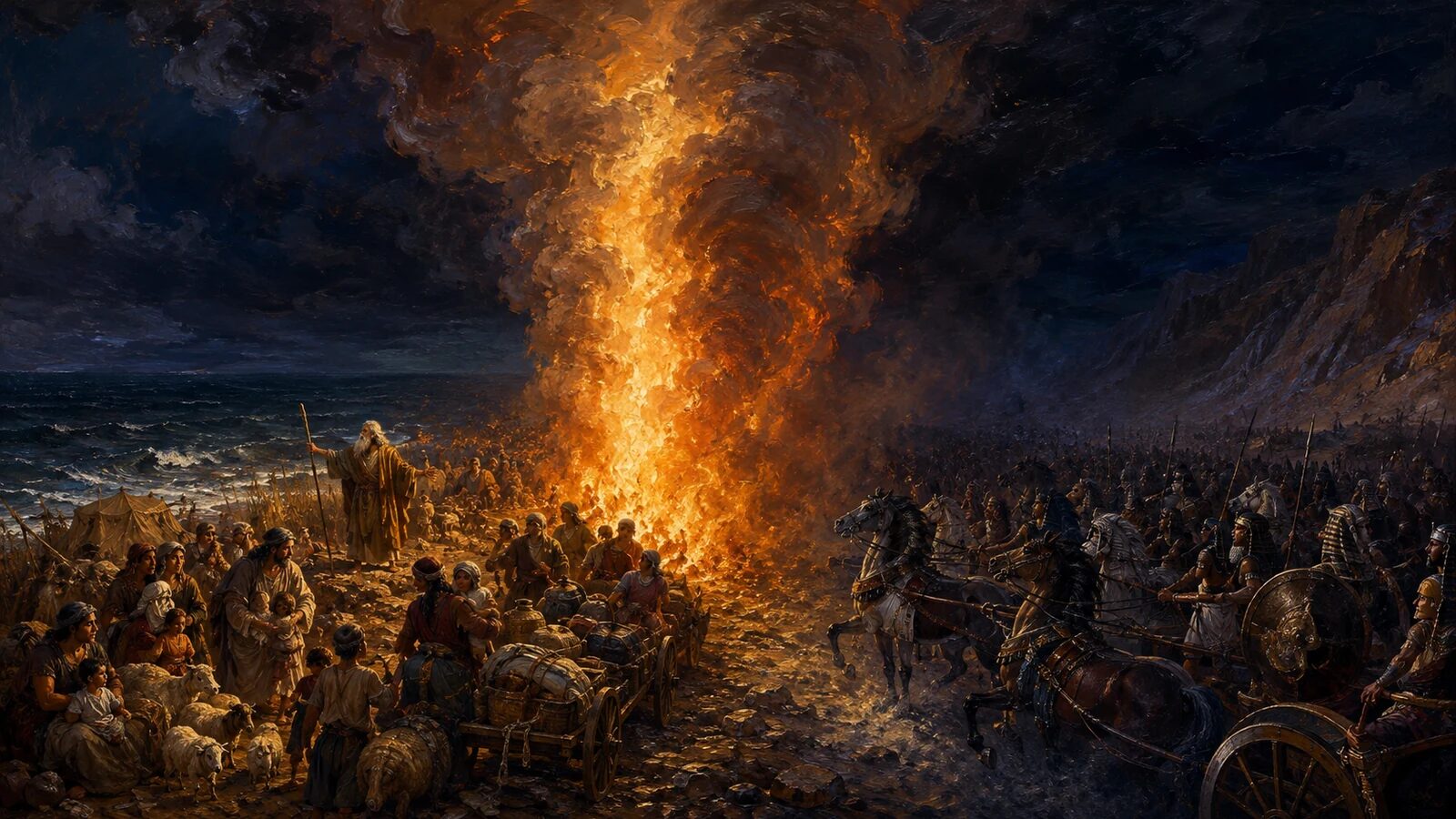
The pillar of cloud and fire is easy to picture, but I find it important to let Exodus tell us what it actually was. The LORD made His presence publicly visible to the nation He had redeemed, leading them through a road they did not understand and protecting them from danger they could not overcome. The pillar teaches us that redemption does not make God’s people independent; it brings them under the faithful leadership of their Lord.
Exodus treats this as real history, not a later legend attached to Israel’s journey. At Passover, Israel sheltered under the blood of the lamb while judgment fell upon Egypt’s firstborn. God then brought the people out of slavery and would soon open the sea before them. Yet the newly freed nation did not know how to live under His rule. They needed Him to show them the road and protect them from dangers they could not foresee. They also had to learn the discipline of waiting for God to move before following Him.
In the middle of that weakness, the LORD made His leadership visible through a cloud by day and fire by night. His presence guided Israel and later shielded the people from their enemy. The same cloud would also fill the tabernacle. Through all of this, God taught Israel that redemption does not produce independence from Him. The people rescued from Pharaoh now lived under the LORD’s leadership. Their worship and daily timing had to honor His holiness.
This account still speaks directly to the way Christians think about God’s guidance. We may assume He will lead us by the shortest road, or we may chase supernatural signs while ignoring what Scripture has already made clear. We can even want the comfort of His presence without submitting to His authority. The pillar corrects those mistakes because the God who faithfully meets His people’s needs also leads them as their holy Lord.
The Lord’s Route and Public Guidance
Before Exodus introduces the pillar, it tells us something about the route. God did not lead Israel by the nearer road through the land of the Philistines because the people were not ready for war. That detail is easy to miss, but it is one of the first lessons in the passage. For Israel, the nearest road was not the merciful one.
Israel may have assumed that freedom from Egypt would bring an immediate arrival in the promised land. God knew that the people were not ready. Although they had left Egypt, its influence still shaped their fears and habits. Their unbelief also needed to be exposed. The Lord chose a road that would teach them to depend upon Him. This was not cruelty but covenant care.
God did not lead them by way of the land of the Philistines, although that was near.
This account guards us from judging God’s guidance by speed. A longer road may be the kinder route because a delay can provide needed protection. Even a wilderness can become a classroom in which the Lord prepares His people. The God who knows the destination also understands what they can bear. He knows what they must learn before they arrive and which dangers they are not yet ready to face.
The main description is simple but weighty. The LORD went before Israel during the day in a pillar of cloud. At night He led them through a pillar of fire. Exodus does not say that Israel noticed a strange natural feature and assigned religious meaning to it. The text says that the LORD Himself went before them. Its focus is personal divine leadership.
And the LORD went before them by day in a pillar of cloud to lead the way, and by night in a pillar of fire to give them light.
The pillar answered Israel’s real needs. During the day, the cloud marked the way and displayed the LORD’s nearness. At night, the fire gave the people light. God’s leadership was not an abstract idea because His presence helped them walk the road before them. The One who commanded their obedience also provided what they needed to obey.
The next verse adds that He did not take the pillar away from before the people, and I think we should not overlook what that continual presence shows. God did not deliver Israel from Egypt and then leave them to find their own way with only memories of what He had done. The excitement of the exodus would fade and hard days would come, yet the LORD remained visibly before them.
The Hebrew word ammud means a pillar or standing column. Exodus uses ordinary visible language to describe public guidance that the whole camp could recognize.
That public nature is important. The pillar was not a private impression that only a few people could claim. Israel’s life as a people was ordered by something God made plain in their midst. His presence brought comfort, but it also brought accountability. The Lord was before them, not behind them waiting for their suggestions.
The Presence That Protects
At the Red Sea, Israel learns that God’s presence does more than point in a direction. Pharaoh’s army approaches from behind while the sea blocks the way forward. The people have no human solution. Then the pillar moves from the front of the camp to the rear. God’s presence becomes a shield between His people and their enemy.
The Angel of God, who went before the camp of Israel, moved and went behind them; and the pillar of cloud went from before them and stood behind them.
Exodus connects this movement with the Angel of God, so we should not reduce the scene to an impersonal force. God is personally active. In this passage, the Angel of God acts with divine presence and authority while bringing deliverance. I understand this distinctive Angel in keeping with the Old Testament pattern of Christophany, an appearance of Christ before He became man. This does not mean that every angel mentioned in Scripture is Christ. It means that the details of this scene describe more than ordinary angelic assistance.
The cloud stood between the camp of Egypt and the camp of Israel. It brought darkness to one side and light to the other. The same divine presence has different effects depending on where people stand in relation to God. To Israel, it was light and protection. To Egypt, it was restraint and darkness.
It was a cloud and darkness to the one, and it gave light by night to the other.
That should sober us, because God’s presence is never neutral. His nearness comforts the redeemed and judges the proud. Pharaoh could not cross the boundary God set, and the Lord governed the crisis until He opened the sea at the moment He chose.
God’s Holy Presence in the Camp
As Exodus moves toward the tabernacle, the cloud becomes tied to worship and dwelling. God is doing more than guiding Israel along the road. He is teaching them that He will dwell in the midst of His redeemed people according to His own holy terms.
When the tabernacle is completed, the cloud covers it and the glory of the LORD fills it. Moses is not able to enter at that moment. That detail is not accidental. Moses is not a stranger to God, yet even Moses cannot treat God’s manifested presence casually.
The cloud covered the tabernacle of meeting, and the glory of the LORD filled the tabernacle.
The Hebrew word often translated glory is kavod. It can carry the idea of weight and can describe the honor due to someone of great worth, as well as splendor. God’s glory is therefore not a religious atmosphere. The cloud visibly reveals His holy presence and shows that He is worthy of honor.
This account holds comfort and holiness together. God is near, but His nearness is never casual. Israel cannot invent its own way of approaching Him. The tabernacle and its priesthood teach that sinners need the way God appoints. The sacrifices and mercy seat reinforce the same truth. This entire pattern prepares us for Christ, whose blood truly brings sinners near.
Exodus closes by explaining how the cloud governed Israel’s journeys. When it was taken up, the nation moved. When the cloud remained over the tabernacle, Israel stayed in camp. Panic or impatience was not supposed to determine their movement. Neither personal ambition nor a majority vote could replace God’s direction. The presence and command of the LORD regulated their life together.
If the cloud was not taken up, then they did not journey till the day that it was taken up.
Numbers 9 expands upon this pattern. Israel camped or journeyed according to the command of the LORD. Sometimes the cloud remained in place for many days. At other times it stayed only from evening until morning. Faithfulness required the people to pay attention and wait for God’s direction before obeying it.
This is where the pillar becomes intensely practical. Some people move too quickly because they are restless, while others refuse to move because obedience feels costly. Israel had to learn both forms of submission: waiting when God waits and moving when God moves.
Later Scripture remembers the pillar as mercy. Nehemiah says God did not forsake Israel in the wilderness. Psalm 78 says He led them with the cloud by day and with fire by night. The pillar therefore becomes part of Israel’s memory of God’s patience, not merely His power.
Guidance Must Remain Under God’s Word
The pillar never replaced the Word of God. Israel received His commandments at Sinai, and the tabernacle was built according to the pattern He revealed. Even the sacrifices and priesthood were ordered by His command. God’s presence and His Word governed Israel together.
This relationship between God’s presence and His Word gives us a necessary guardrail. People still use spiritual language to cover disobedience and claim that God is leading them while they walk against Scripture. That is not divine guidance. God never leads His people into rebellion or false worship, and He will not direct someone toward sexual immorality. Guidance driven by greed cannot come from Him. Neither can guidance that depends on pride or dishonesty, because the Spirit of truth does not oppose the Word He inspired.
Exodus 33 gives us another important picture, but its sequence should be clear. The completed tabernacle will not be raised until Exodus 40. In chapter 33, Moses takes a tent and pitches it outside the camp after Israel’s golden-calf rebellion. People seeking the LORD go out to this tent of meeting, and the pillar descends at its door while the LORD speaks with Moses. The people see what is happening and worship from their own tent doors. Once again, God’s presence and His speech belong together. He draws near in order to speak to His servant.
The pillar of cloud descended and stood at the door of the tabernacle, and the LORD talked with Moses.
Christians should therefore begin their search for guidance in Scripture and prayer. The Lord may use mature counsel to give wisdom, and we can come to see how He is guiding events as we obey. We do not need to chase a visible pillar because we have the written Word and the indwelling Holy Spirit. Christ’s finished work has brought us near to God and placed us within the fellowship of His body. God’s guidance is still deeply personal, but it now comes to us in the clearer light of the new covenant.
The Pillar Points to Christ
The pillar points forward, but we need to let the New Testament show us how. Jesus does not merely give light. He is the light of the world. He calls people to follow Him and promises that the one who follows Him will not walk in darkness but will have the light of life.
I am the light of the world. He who follows Me shall not walk in darkness, but have the light of life.
John says that the Word became flesh and dwelt among us. The apostles beheld His glory. The theme of God’s dwelling presence runs through the tabernacle and cloud before reaching its clearest revelation in the eternal Son made flesh. Jesus is fully God and fully man. He is not one more sign placed beside the cloud but the Lord to whom every sign leads.
The cross stands at the center of that glory and of God’s saving work. Jesus lived completely without sin. Wicked men physically tortured Him, shed His blood, and killed Him, yet He willingly bore that real punishment for our sins in His innocent body. He then rose bodily from the dead. The Father did not punish or abandon His Son. He did not curse, strike, or bruise Jesus, nor did He pour wrath on Him.
Christ died for the sins of the whole world, so God’s saving offer is genuine for every person, though people can resist and reject it. The sinner who repents and trusts in Jesus is forgiven and born again. The Holy Spirit comes to indwell and seal that believer, who is eternally secure in Christ. Eternal security is not permission for lawlessness, and a shallow profession without new life is not proof of genuine faith.
The Holy Spirit now indwells believers and guides them into truth. In John 16, Jesus first speaks to the apostles who will bear His authoritative witness after His departure. The Spirit guides them into the truth Christ gives, which grounds the New Testament testimony the church now receives. This promise does not turn every private impression into revelation or mean that every Christian should expect to see a visible cloud or fire. The Spirit is a divine Person rather than a feeling or impersonal force. He glorifies Christ by applying the written Word to believers. Through that truth, He teaches them and convicts them of sin. His work also sanctifies God’s people, making them holy, and He equips them with gifts for service. His leadership will always remain consistent with truth.
When He, the Spirit of truth, has come, He will guide you into all truth.
The transfiguration also echoes the cloud theme when a bright cloud overshadows the disciples who accompanied Jesus up the mountain. From within it, the Father’s voice declares, “This is My beloved Son… Hear Him” (Matthew 17:5). Although Moses and Elijah are present, the command directs all attention toward Jesus. The proper response is not fascination with the cloud but obedience to the Son.
My Final Thoughts
After working through these passages, I do not think the pillar tells Christians to wait for a private sign before obeying God. Israel received a public covenant sign, while we have the written Word and the indwelling Spirit who always leads in agreement with it. Yet the account still gives real comfort: the Lord is not careless with the road He chooses for His people. He may lead us by a path we would not have selected, but Christ remains the Light who brings us safely near to God. His presence calls us to trust Him enough to obey, whether He tells us to move or to wait.